
Cybersecurity has quietly become one of the few fields where demand outpaces supply by millions of people, and that gap shows up directly in what employers are willing to pay for advanced skills. If you’re weighing a Master’s in Cybersecurity against the cost, the time, and the nagging “will this actually move my career” question, here’s the direct answer: for most professionals aiming at leadership, architecture, or specialized technical roles, yes, it’s worth it.
The numbers back it up without needing to oversell it. The global cybersecurity workforce is short by roughly 4.8 million people, and that gap hasn’t closed (ISC2 2024 Cybersecurity Workforce Study). In the U.S., the jump from an analyst-level role to a management-level one comes with a real pay bump, tens of thousands of dollars a year, and a master’s degree is the credential employers consistently point to when making that call.
That doesn’t make it a universal yes. It’s worth it specifically when you’re aiming at those senior roles, not simply to add another line to a resume you’re not planning to use differently.
Top 10 Reasons to Pursue a Master's in Cybersecurity in 2026
1. The Cybersecurity Talent Shortage Is at an All-Time High
The global workforce gap reached 4.8 million unfilled positions in ISC2’s 2024 workforce study, a 19% jump from the prior year, and remains the most recently published headcount estimate. In the U.S. alone, CyberSeek (a NIST/CompTIA-backed tracker) logged over 514,000 open cybersecurity job listings in its most recent 12-month update. Organizations aren’t just short on headcount, they’re short on people who can design, defend, and lead security strategy in practice, not just recognize threats on paper. A master’s degree positions you above entry-level candidates for that gap.
2. Higher Salaries and Faster Career Growth
Information security analysts earn a median of $124,910 (BLS, 2024), already among the higher-paid IT roles. Move into management and that jumps further: computer and information systems managers earn a median of $171,200 (BLS, May 2024), a role master’s graduates are far more likely to reach. Advanced credentials signal both technical depth and strategic thinking, and employers pay for that combination.
3. Cybersecurity Is No Longer Just an IT Function
Security now touches business continuity, national security, healthcare, finance, and critical infrastructure. Leaders increasingly expect security professionals to understand risk management, compliance, and governance, not just tools. A master’s program builds that business fluency on top of the technical foundation.
4. AI, Cloud, and IoT Have Changed the Threat Landscape
Modern attacks are increasingly automated and AI-assisted, while organizations run on cloud infrastructure, IoT devices, and distributed remote environments. ISC2’s 2025 Cybersecurity Workforce Study found AI and machine learning security is now the top skills gap employers report, cited by 41% of organizations, up from 34% the year before.
Graduate-level programs are built to close exactly that kind of emerging gap, something certifications alone struggle to keep pace with.
5. Employers Prefer Advanced Degrees for Leadership Roles
For roles like Cybersecurity Manager, Security Architect, Cyber Risk Consultant, and CISO, a master’s degree is increasingly the preferred qualification. It prepares you to lead teams and set policy, not just respond to incidents.
6. Practical, Hands-On Learning Matters More Than Ever
Employers are prioritizing real-world skills over theory alone. Strong programs, including EC-Council University’s MSCS, are built around hands-on labs, simulations, and applied research rather than lecture-only formats.
7. Strong Alignment With Industry Certifications
A cybersecurity-focused master’s that embeds recognized certifications gives you both an academic credential and job-ready certifications in one program. EC-Council University’s MSCS, built by the organization behind CEH and other globally recognized credentials, folds those frameworks directly into the coursework.
8. Global Career Mobility
Cybersecurity demand isn’t regional. Whether you’re targeting roles in North America, Europe, the Middle East, or Asia, a recognized master’s degree travels with you across multinational corporations, government and defense, financial institutions, and consulting firms.
9. Room to Specialize and Stand Out
Graduate programs let you go deep into ethical hacking and penetration testing, digital forensics, cyber risk and compliance, or security operations, helping you differentiate in a crowded field rather than staying a generalist.
10. You’re Investing in Long-Term Career Resilience
Technology will keep shifting, but the need for cybersecurity expertise isn’t going anywhere. Unlike roles more exposed to automation, cybersecurity professionals remain central to digital trust and operational resilience.
How Long Does a Master's in Cybersecurity Take?
Most online Master’s in Cybersecurity programs, including ECCU’s MSCS, take about 2 years to complete for a student taking a standard course load. The degree requires 36 semester credit hours.
That timeline can shrink if you’re bringing prior learning to the table. ECCU accepts up to 18 transfer credits toward the MSCS from qualifying prior coursework or industry certifications, which can cut close to a year off your schedule and reduce tuition proportionally. Because the program is fully online and asynchronous, most working professionals complete it alongside a full-time job rather than pausing their career to enroll.
Master's in Cybersecurity Requirements
Requirements vary slightly by school, but most accredited programs, including ECCU’s MSCS, ask for:
- A bachelor’s degree (any field) or foreign equivalent from an accredited institution
- A cumulative undergraduate GPA of 2.5 or higher
- No GRE
- No prior cybersecurity or programming experience required
- English proficiency proof for international applicants (TOEFL or IELTS)
- A current resume and official transcripts from prior institutions
The “no prior experience required” point matters. Career changers coming from IT, engineering, or even non-technical backgrounds are a normal part of the applicant pool, not the exception.
How Much Does a Master's in Cybersecurity Cost?
Total cost varies by school and specialization. At EC-Council University, the MSCS runs $19,440 to $20,440 in total tuition depending on your chosen specialization track, plus miscellaneous fees (Source: ECCU Tuition and Fees). That figure covers all 36 credit hours; textbooks and course materials are included at no extra cost. ECCU offers a 5% discount for students who pay a term’s tuition in full upfront, along with payment plans, scholarships, and GI Bill eligibility for military-affiliated students.
For context, that puts a specialized cybersecurity master’s well below the cost of many general MBA or computer science graduate programs at comparable institutions, while targeting a narrower, higher-demand job market.
Master's in Cybersecurity ROI: By the Numbers
The short version, per ECCU’s own salary analysis: entry-level master’s graduates typically start between $85,000 and $95,000, roughly 15 to 25% above bachelor’s-only peers in comparable roles, and the gap widens at the mid-career and leadership level. Professionals without a graduate degree frequently plateau around $110,000 to $125,000, while senior managers and architects with a master’s earn 20 to 35% more than bachelor’s-educated peers in the same tier. These figures sit within the range BLS data independently supports at the aggregate level (a $46,000 median gap between analyst-tier and manager-tier roles, detailed below), though the granular breakdown is ECCU’s own compiled analysis rather than a single third-party study.
Weigh that against ECCU’s roughly $19,440-$20,440 total tuition and the payback period on this degree is short relative to most graduate programs.
For the full salary breakdown by role, experience level, and specialization: How Much Can a Master’s in Cybersecurity Increase Your Salary? →
Is a Master's in Cybersecurity Worth It Without Experience?
Yes, and this is one of the more common misconceptions about the degree. ECCU’s MSCS, like most accredited cybersecurity master’s programs, requires no prior cybersecurity or programming experience for admission. Career changers make up a substantial share of enrolled students, and the curriculum is structured to build technical foundations alongside strategic and governance skills, rather than assuming you already have them.
For a full walkthrough of how career changers approach this degree: Get a Master’s Degree in Cybersecurity Without a Tech Background →
Master's in Cybersecurity vs. Bachelor's: Which Pays More?
A master’s degree consistently out-earns a bachelor’s-only cybersecurity career at every stage past entry level. BLS data puts information security analysts (a role bachelor’s graduates commonly fill) at a $124,910 median, while computer and information systems managers, a tier master’s graduates are more likely to reach, sit at $171,200. That’s a roughly $46,000 gap between execution-level and leadership-level roles, and the master’s degree is the credential most consistently associated with crossing it.
That doesn’t make a bachelor’s degree a weak starting point. It’s still the standard entry requirement for most cybersecurity roles and opens the door to certifications and work experience that later feed into a master’s application.
For the full comparison: Is a Bachelor’s in Cybersecurity Worth It? →
Master's in Cybersecurity vs. Certifications: Which Path?
Certifications and a master’s degree serve different functions, and the strongest career positioning usually combines both rather than picking one. Certifications validate specific, current technical skills fast, often in months, and are well recognized for individual contributor and technical specialist roles. A master’s degree builds the governance, risk, and leadership fluency that senior and executive roles actually require. The BLS notes that for computer and information systems managers, the role tier most cybersecurity leadership paths run through, employers “may require or prefer” a graduate degree on top of the standard bachelor’s requirement, something no certification track substitutes for.
If you already have two or three relevant certifications and you’re hitting a ceiling on promotion or salary, that’s usually the signal it’s time to add the degree rather than another certification.
For the full breakdown of costs, timelines, and outcomes: Master’s Degree or Cybersecurity Certifications: Which Pays Off Faster? →
What Specializations Can You Master with an MSCS Degree?
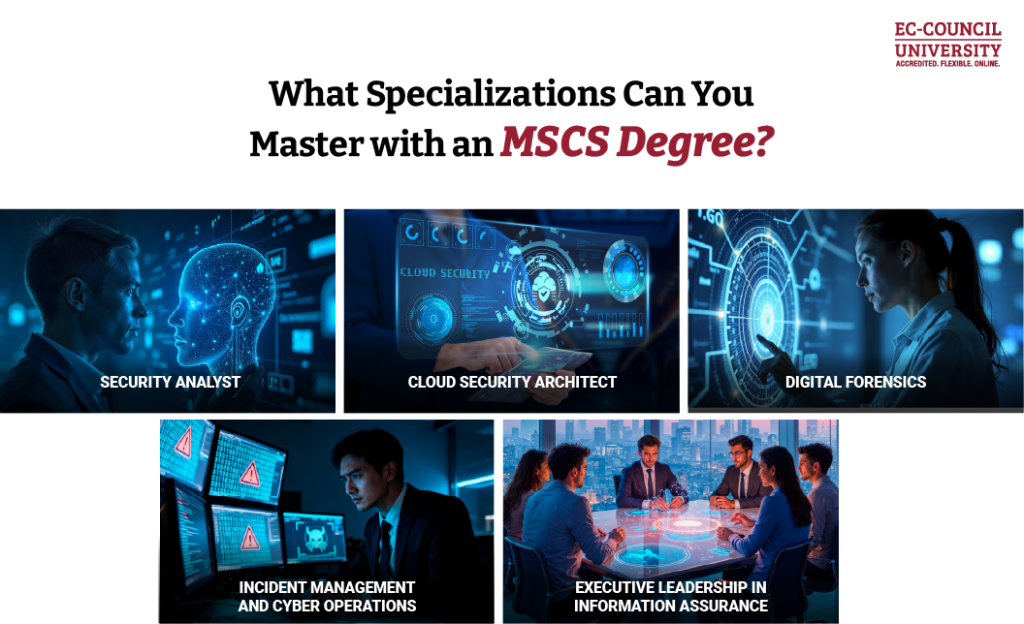
Build expertise in high-demand domains, including:
- Security Analyst — Monitoring systems, analyzing threats, and implementing security controls to protect organizational assets.
- Cloud Security Architect — Designing and securing cloud-based infrastructures for scalability, compliance, and resilience.
- Digital Forensics — Investigating cyber incidents, collecting digital evidence, and supporting legal and regulatory processes.
- Incident Management and Cyber Operations — Detecting, responding to, and recovering from cyberattacks while maintaining business continuity.
- Executive Leadership in Information Assurance — Preparing professionals to lead enterprise-wide security programs and communicate strategy at the executive level.
These specializations map directly to the career paths and hiring demand covered below.
What Are the Benefits of Earning a Master's in Cybersecurity?
Beyond the top 10 reasons above, a few outcomes stand out on their own:
- A shorter path to leadership roles. Many senior and executive postings list a master’s degree as preferred or required, something a bachelor’s alone often can’t clear.
- A built-in specialization credential. Instead of a generalist resume, you graduate with a documented depth in one domain, digital forensics or cloud security architecture, for example, that hiring managers can act on immediately.
- Recession-resilient positioning. Cybersecurity spending tends to hold up even when broader IT budgets contract, since the risk it manages doesn’t go away during a downturn.
Top 5 Cybersecurity Career Paths for a Master's in Cybersecurity Graduate in 2026
Graduates with a Master’s in Cybersecurity are well-positioned for the following roles:
Cybersecurity Analyst —
Monitors threats, analyzes security incidents, and implements controls to protect organizational systems and data.


Security Engineer —
Designs, builds, and maintains secure IT infrastructure, including networks, cloud platforms, and applications.
Penetration Tester (Ethical Hacker) —
Simulates cyberattacks to identify vulnerabilities and recommend remediation strategies.


Cloud Security Specialist —
Secures cloud environments by managing identity, access controls, encryption, and compliance across multi-cloud environments.
Cybersecurity Manager / Consultant —
Leads security programs, develops policies, manages risk, and advises organizations on cybersecurity strategy and compliance.


Security Architect —
Defines enterprise-wide security architecture, ensuring systems and applications are secure by design.
Digital Forensics and Incident Response (DFIR) Expert —
Investigates cyber incidents, analyzes digital evidence, and leads response and recovery efforts.


Chief Information Security Officer (CISO) —
Oversees organizational cybersecurity strategy, governance, risk management, and executive-level security leadership.
Top Companies Hiring Cybersecurity Master's Graduates in 2026
Cybersecurity master’s graduates are in demand across a wide range of industries as digital transformation and regulatory pressure continue to grow. Key hiring sectors include:
- Global technology companies — Securing software products, cloud services, and global digital infrastructure against increasingly sophisticated threats.
- Financial services and fintech organizations — Protecting sensitive financial data, preventing fraud, and complying with strict security regulations.
- Healthcare and pharmaceutical enterprises — Safeguarding patient data and connected medical devices as digital health records and biotech research expand.
- Government and defense agencies — Protecting national infrastructure, classified information, and critical services from cyber warfare and espionage.
- Consulting and Managed Security Service Providers (MSSPs) — Delivering risk assessments, incident response, and managed security services across client industries.
How to Choose the Best Master's in Cybersecurity Program
Not all cybersecurity master’s programs are built the same. A few factors are worth checking before you enroll anywhere:
- Accreditation. Confirm the program holds recognized regional or national accreditation, since this affects credit transfer, employer recognition, and eligibility for federal financial aid or GI Bill benefits.
- Certification alignment. Programs that embed industry certifications into coursework let you graduate with both a degree and job-ready credentials, rather than paying for certification prep separately later.
- Hands-on labs versus lecture-only formats. Employers consistently prioritize applied skills. Ask whether the curriculum includes live labs, simulations, or a capstone project, not just reading and exams.
- Specialization depth. Check whether the school offers a real specialization track in your target domain, cloud security, digital forensics, or executive leadership, rather than one generic “cybersecurity” track.
- Format and flexibility. If you’re working full time, confirm the program is asynchronous and doesn’t require live attendance at fixed hours.
- Total cost versus published outcomes. Compare total tuition against the school’s own published salary or placement data where available, not just the sticker price.
Why Consider EC-Council University's Master of Science in Cybersecurity?
EC-Council University’s MSCS is built around the same criteria above. The program is
fully online, requires no GRE and no prior cybersecurity experience, and lets students
earn up to 5 industry-recognized EC-Council certifications alongside the degree. Backed by the organization behind CEH and other globally recognized cybersecurity
certifications, ECCU’s curriculum embeds industry-aligned frameworks directly into
coursework rather than treating certification prep as a separate track.
The program emphasizes:
- Industry-relevant, practitioner-driven curriculum
- Hands-on labs and applied research
- Alignment with globally respected cybersecurity standards
- Preparation for leadership and advanced technical roles
Your Cybersecurity Leadership Begins at the Master's Level
A Master’s in Cybersecurity in 2026 is more than an academic credential. As threats grow more complex and AI-driven, organizations need professionals who can lead, innovate, and defend at scale. If you’re ready to move beyond foundational skills into advanced, high-impact roles, EC-Council University’s Master of Science in Cybersecurity is built for that step.
Frequently Asked Questions
For most professionals targeting leadership, architecture, or specialized technical roles, yes. The combination of a 4.8 million global talent gap and a documented salary jump between analyst-level and manager-level roles makes the degree pay for itself faster than most graduate programs.
Around 2 years for a standard course load and 36 credit hours. Transfer credit for prior learning or certifications can shorten that timeline.
At EC-Council University, total tuition runs $19,440 to $20,440 depending on specialization, plus miscellaneous fees.
Costs vary by institution.
No. Most accredited programs, including ECCU’s MSCS, require no prior cybersecurity or programming experience, only a bachelor’s degree in any field.
They serve different purposes. Certifications prove specific technical skills quickly. A master’s degree builds the leadership, governance, and risk fluency most senior roles require, and it’s the more common credential among sitting CISOs. Combining both is typically the strongest position.
Yes, particularly at the management and architecture level. BLS data shows a roughly $46,000 median gap between information security analyst roles (commonly bachelor’s-level) and computer and information systems manager roles (more commonly reached with a master’s).