
DNS Spoofing at a Glance
Every time you visit a website, send an email, or access a cloud application, your device relies on the Domain Name System (DNS) to locate the correct destination. It’s a foundational and essential internet function, but it also creates a vector for cybercrime. If a cybercriminal manipulates DNS resolution, you could be redirected to a harmful destination without realizing it. This is a cyberattack known as DNS spoofing.
At its core, DNS spoofing exploits trust to facilitate phishing scams, credential theft, malware delivery, and other cyberattacks. Let’s examine how DNS spoofing works, explore common attack techniques, and how cybersecurity professionals can detect, prevent, and respond to these threats.
What is DNS Spoofing?
DNS spoofing is a cyberattack in which an attacker manipulates DNS records or the DNS resolution process to direct users to an unintended IP address or destination. The malicious destination might host a fraudulent login page, distribute malware, or imitate a legitimate online service.
To understand the threat, consider how DNS normally operates. When you enter a domain name, such as www.example.com, your device queries a DNS resolver to obtain the corresponding IP address. The resolver retrieves the necessary information from its cache or queries authoritative DNS servers. DNS spoofing interferes with this process by causing a device or resolver to accept incorrect DNS information.
The Internet Corporation for Assigned Names and Numbers (ICANN) (1) clarifies how forged DNS responses can redirect users to attacker-controlled websites, potentially exposing their account credentials. The central risk is simple: you may enter the correct website address but reach the wrong destination.
How Does a DNS Spoofing Attack Work?
Understanding the DNS spoofing attack flow
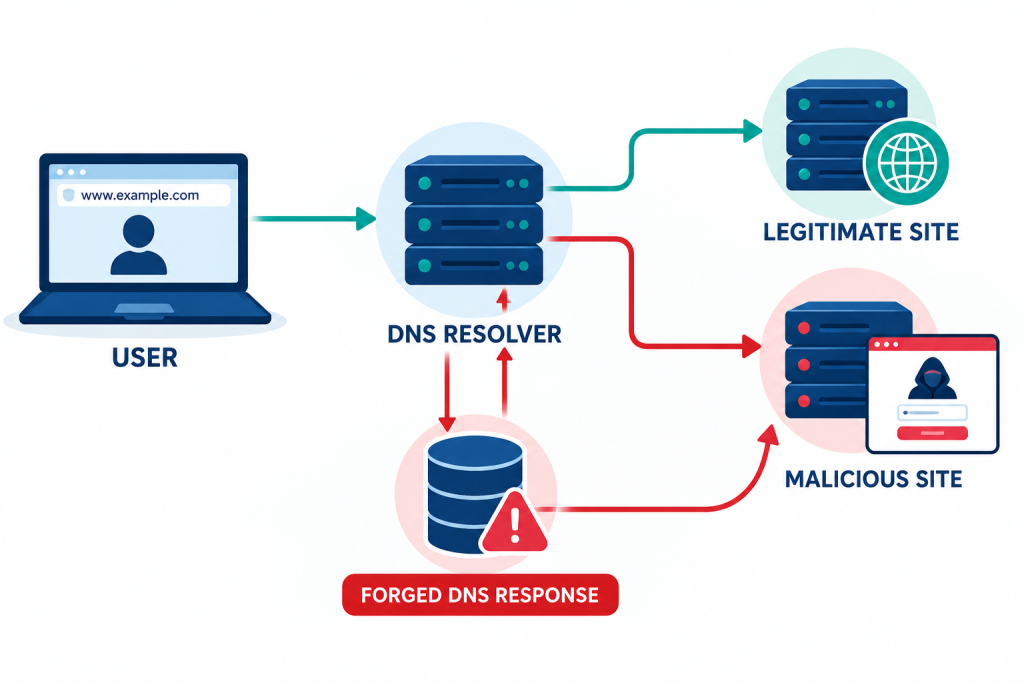
- The user initiates a request: An employee enters a legitimate website address into a browser.
- The device requests DNS resolution: The device queries its configured DNS resolver for the domain’s IP address.
- The attacker manipulates DNS information: Depending on the technique, the attacker may inject a forged response, poison a resolver’s cache, or change DNS configuration.
- The resolver returns an incorrect address: If the malicious information is accepted, the device may receive an IP address controlled by the attacker.
- The browser connects to the unintended destination: The attacker may present a fraudulent login page, attempt to deliver malware, or collect sensitive information.
For example, an employee trying to access a corporate email portal might be redirected to a convincing imitation of the legitimate login page. If the employee enters their credentials, the attacker could capture them and attempt to access corporate systems.
It’s worth noting that DNS spoofing does not automatically defeat HTTPS. A properly configured browser should reject an invalid certificate for the requested domain, although attackers may pursue other techniques to exploit the situation.
Common Types of DNS Spoofing Attacks
1. DNS cache poisoning
DNS cache poisoning occurs when an attacker causes a DNS resolver to store fraudulent DNS records. Resolvers cache DNS responses to reduce lookup time and network traffic. If a resolver accepts a forged response, it may continue returning the incorrect address to subsequent users until the record expires or is removed by administrators. Attackers may attempt to exploit weaknesses in response validation or compromise the resolver itself to introduce malicious records.
Cache poisoning can have a broad impact because multiple devices may rely on the same recursive resolver.
2. Forged DNS responses
In this technique, an attacker attempts to send a fabricated DNS response that a client or resolver accepts as legitimate. Traditional DNS exchanges can be vulnerable to response forgery when attackers can predict or discover relevant query details. Modern resolvers mitigate these risks through transaction-ID validation, randomized source ports, and other protections.
An attacker must generally overcome these safeguards or exploit another weakness for the attack to succeed.
3. DNS configuration hijacking
Attackers may compromise a router, endpoint, DNS management account, or network configuration and replace the legitimate DNS server with one they control. This technique differs from cache poisoning because the attacker changes where DNS queries are sent rather than necessarily corrupting a resolver’s cache.
For example, a compromised office router could direct employees’ devices to a malicious resolver that returns fraudulent addresses for selected websites.
4. DNS redirection for phishing
Attackers may exploit DNS resolution manipulation to direct victims to fraudulent websites that imitate banks, cloud platforms, payment services, or corporate identity providers. The objective is often to steal credentials, capture sensitive information, or persuade victims to download malicious software.
DNS redirection can also accompany broader attacks involving compromised routers, stolen administrator credentials, or unauthorized changes to domain management accounts.
DNS Spoofing vs. DNS Hijacking vs. ARP Spoofing
These terms describe related but distinct attack methods.
| Attack Type | Primary Mechanism | Potential Impact |
|---|---|---|
| DNS spoofing | Manipulates DNS responses or resolution data | Redirects users to unintended destinations |
| DNS cache poisoning | Introduces false records into a DNS cache | Affects users relying on the poisoned cache |
| DNS hijacking | Changes DNS configuration or control of DNS infrastructure | Redirects queries through unauthorized systems |
| ARP spoofing | Sends fraudulent address-resolution messages on a local network | Can enable traffic interception or redirection |
| IP spoofing | Falsifies the source IP address in network packets | Conceals or misrepresents traffic origins |
What Makes DNS Spoofing a Serious Cybersecurity Threat?
DNS supports access to websites, cloud platforms, email systems, and many other network services. Manipulating this foundational service can therefore create risks beyond a single fraudulent website. Key consequences include:
- Credential theft: Attackers may capture login details through fraudulent websites.
- Malware distribution: Victims may encounter malicious downloads or exploit pages.
- Financial fraud: Redirected users may disclose banking information or authorize fraudulent transactions.
- Enterprise compromise: Stolen credentials may provide a foothold for further attacks against corporate applications and infrastructure.
- Service disruption: Incorrect DNS records can prevent users from reaching legitimate services.
- Reputational damage: Successful attacks may undermine customer trust and disrupt business operations.
The National Institute of Standards and Technology (NIST) emphasizes that DNS security is integral to enterprise network security. Its March 2026 Secure Domain Name System (DNS) Deployment Guide(2) provides recommendations for protecting DNS integrity, availability, and confidentiality.
How Can Organizations Prevent DNS Spoofing Attacks?
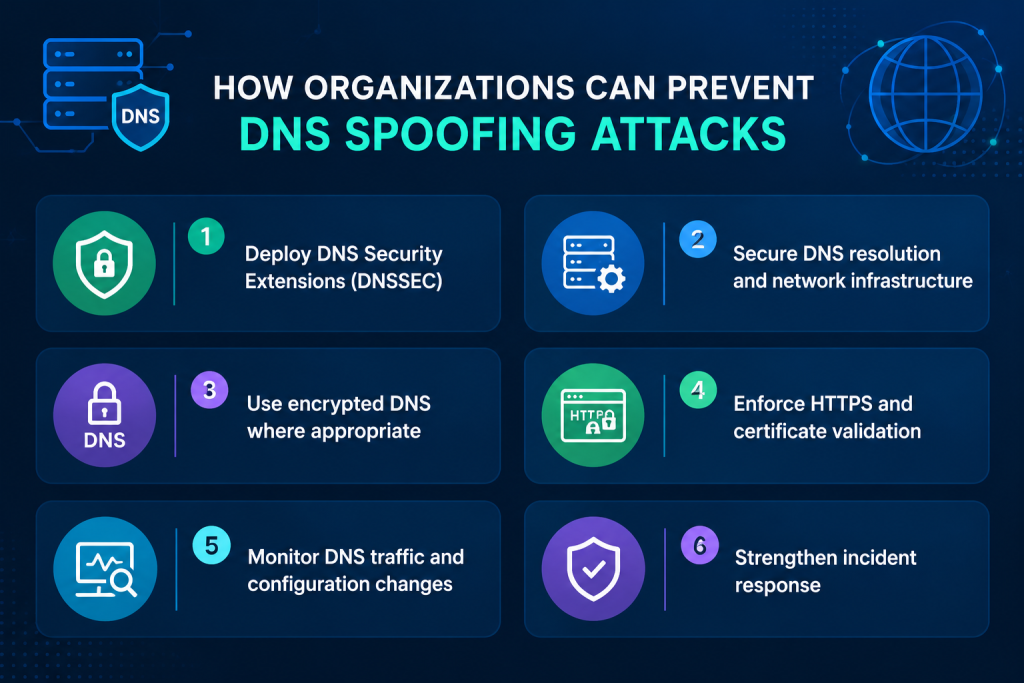
1. Deploy DNS Security Extensions (DNSSEC)
DNSSEC uses cryptographic signatures to help validating resolvers verify the authenticity and integrity of DNS data. When a resolver validates a signed DNS record, it can detect unauthorized modifications and reject records that fail validation.
Organizations should assess whether their DNS zones are correctly signed and whether their resolvers perform DNSSEC validation. DNSSEC does not encrypt DNS queries, prevent every form of DNS hijacking, or protect users from every malicious website. It is one component of a broader DNS security strategy.
2. Secure DNS resolution and network infrastructure
Organizations should use trusted, properly configured DNS resolvers and keep DNS software, routers, firewalls, and endpoints up to date.
Security teams should also restrict administrative access, use multifactor authentication for DNS management accounts, and monitor unauthorized changes to DNS settings.
3. Use encrypted DNS where appropriate
DNS over HTTPS (DoH) and DNS over TLS (DoT) encrypt DNS queries in transit between a client and a supporting resolver.
These protocols help reduce opportunities for interception or modification along that connection. However, encryption alone does not guarantee that a resolver returns trustworthy information. Organizations should combine encrypted DNS with trusted resolvers, appropriate validation, and monitoring.
4. Enforce HTTPS and certificate validation
HTTPS helps authenticate a website’s identity and protects communications in transit.
Organizations should maintain valid TLS certificates, configure web services securely, and train employees not to bypass certificate warnings. Security teams should also investigate unexpected certificate errors rather than dismissing them as routine browser problems.
5. Monitor DNS traffic and configuration changes
Security teams should establish a baseline for normal DNS activity and investigate deviations, including unexpected changes to DNS records or resolver settings, queries to suspicious or newly observed domains, unusual DNS response patterns, connections to IP addresses that differ from approved destinations, and DNS activity associated with potentially compromised endpoints.
Centralized DNS logging, endpoint detection and response (EDR), and security information and event management (SIEM) platforms can help correlate suspicious DNS activity with other indicators of compromise.
6. Strengthen incident response
Organizations should maintain robust cyber incident response practices for investigating suspected DNS manipulation. Depending on the incident, responders may need to verify DNS records against trusted sources, inspect router and endpoint configurations, remove unauthorized records, flush affected caches, secure compromised accounts, and investigate related credential theft.
Teams should also document the incident, preserve relevant logs, and verify that the legitimate resolution has been restored.
How to Detect a Potential DNS Spoofing Incident
Watch for unusual behavior, including:
- A familiar website resolves to an unexpected IP address.
- Several users encounter the same suspicious redirection.
- Router DNS settings change without authorization.
- Browser certificate warnings appear unexpectedly.
- Security monitoring identifies unusual DNS queries or responses.
Note: These symptoms do not independently prove DNS spoofing. Misconfiguration, expired certificates, compromised websites, and ordinary connectivity issues can produce similar signs.
For technical investigation, compare DNS responses using a trusted resolver, inspect the affected device’s configuration, review available DNS logs, and validate the website’s TLS certificate. Avoid entering credentials into a site that displays unexplained security warnings.
Gain the Expertise to Defend Against DNS Threats
DNS spoofing demonstrates how attackers can exploit a fundamental internet service to undermine trust, redirect users, and gain opportunities for further compromise. Preventing these attacks requires more than deploying a single security tool. Cybersecurity professionals must understand DNS architecture, network security protocols, identity security, cryptographic validation, threat detection, and incident response. If you’re keen on developing these capabilities, advanced cybersecurity education can provide a structured pathway to deeper technical knowledge and practical defensive skills.
EC-Council University (ECCU) offers flexible online cybersecurity degrees and certification courses for professionals seeking to enhance their technical expertise and prepare to address complex modern-day security challenges. Consult with an ECCU Advisor for free to learn how we can support your professional development in cybersecurity.