The Demise of VPNs? Not Quite
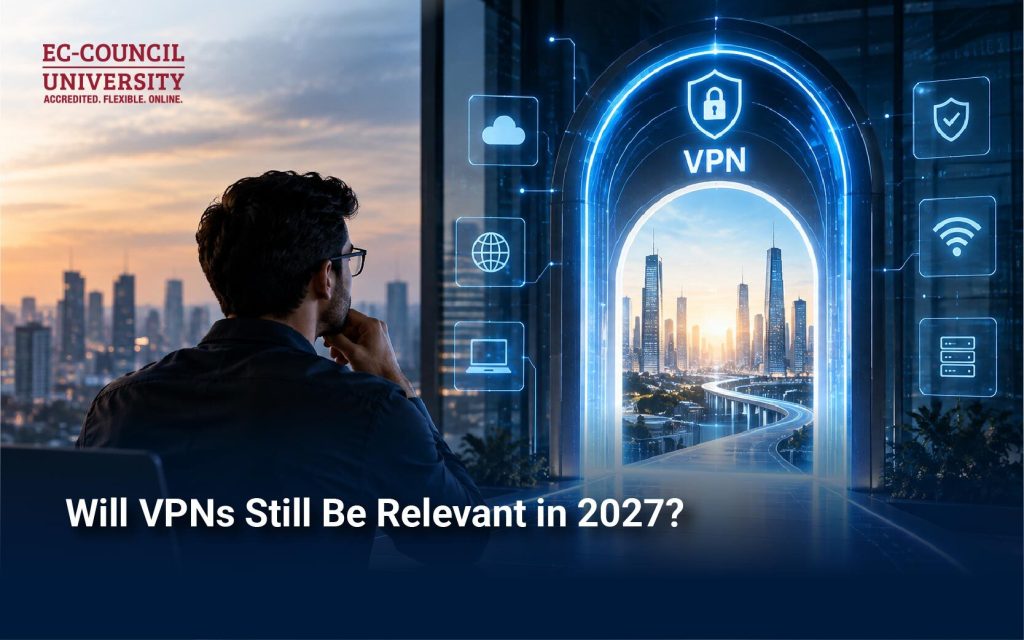
Virtual private networks (VPNs) have long served as a foundational technology for securing remote access and network communications. But as organizations embrace cloud computing, AI, hybrid or remote work, and Zero Trust security, an important question arises: “Will VPNs remain relevant in 2027, or will newer technologies make them obsolete?”
The answer is pretty straightforward. VPNs will continue to play an important role in cybersecurity, but organizations must understand their limitations and adapt their deployment. Encryption alone cannot protect an enterprise from compromised credentials, vulnerable endpoints, or excessive access privileges. And for cybersecurity professionals, the challenge is not simply to preserve or replace VPNs, but rather to determine where they fit within a modern, layered security architecture.
What is a VPN, and How Does It Work?
A virtual private network establishes an encrypted connection between a user’s device and a VPN endpoint, or between two networks. It allows data to travel across an untrusted network, such as the public internet, while protecting its confidentiality and integrity in transit.
Consider an employee working remotely who needs to access a company’s internal systems. Instead of sending traffic over the internet without a secure tunnel, the employee connects via an authenticated VPN gateway. The VPN establishes the encrypted tunnel and applies the organization’s access policies. Depending on its configuration, the VPN may route all device traffic through the tunnel or restrict the connection to selected corporate resources.
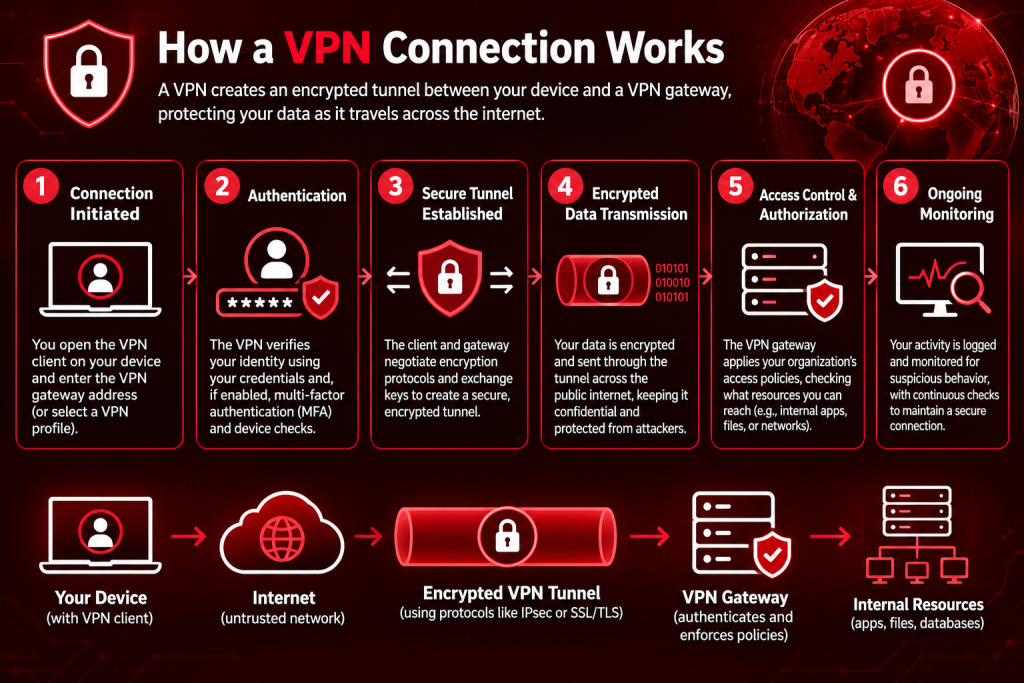
How a VPN connection works:
- Connection: The user’s device contacts the VPN gateway.
- Authentication: The VPN verifies the user’s credentials and, where configured, additional authentication factors and device requirements.
- Secure tunnel establishment: The endpoints negotiate cryptographic parameters and establish session keys.
- Encrypted transmission: The VPN protects traffic inside the tunnel as it travels across the network.
- Access and monitoring: The gateway applies relevant access rules, while security systems monitor activity where visibility is available.
Why VPNs Will Remain Important in 2027
Despite advances in cybersecurity, VPNs continue to address several important security requirements:
- Secure remote work: Employees, contractors, and administrators need reliable access to corporate resources from homes, hotels, airports, and other locations. A properly configured VPN can protect data and traffic across untrusted public Wi-Fi networks.
- Enterprise network connectivity: Site-to-site VPNs can connect branch offices, data centers, cloud environments, and partner networks without requiring organizations to expose every internal service directly to the internet.
- Legacy system protection: Some older applications and operational technology environments depend on network-level connectivity. VPNs can help restrict and protect access to these systems while organizations plan modernization.
- Protecting data in transit: Strong encryption helps prevent network observers from reading protected traffic. However, VPN encryption does not replace application-layer protections such as HTTPS, nor does it guarantee that the endpoint or destination is trustworthy.
For individual users, a reputable VPN can also reduce exposure to local network observers. However, it does not make users anonymous to every online service, prevent malware infections, or eliminate phishing risks.
Traditional VPN Architectures Face New Challenges
VPNs remain useful, but traditional deployments can create security weaknesses when organizations treat network connectivity as proof of trust.
- Vulnerable VPN gateways: Internet-facing VPN appliances can become attractive targets for attackers. Unpatched vulnerabilities, exposed management interfaces, weak configurations, and unsupported software can provide opportunities for unauthorized access.
- Excessive network access: Some traditional VPN configurations grant authenticated users access to broad internal network segments. If an attacker compromises an authorized account or device, that access can facilitate lateral movement toward other systems.
- Stolen credentials and compromised devices: A VPN protects the connection, but it does not automatically establish that a legitimate person controls the account or that the connecting device remains safe. Attackers can exploit stolen credentials, session weaknesses, and compromised endpoints to misuse valid connections.
- Limited visibility: Depending on the architecture, VPN deployments may complicate traffic inspection or create blind spots across cloud applications and remote endpoints. Organizations must combine VPN logs with identity, endpoint, network, and application telemetry to identify suspicious activity.
These limitations do not make VPNs inherently insecure. They demonstrate why VPN connectivity must operate within a broader security framework.
VPNs vs. Zero Trust, ZTNA, SASE, and SSE
Modern security architectures increasingly focus on protecting individual resources rather than relying primarily on network boundaries. Here’s how other prominent architectures differ from VPNs:
- Zero Trust Architecture (ZTA) is a security approach that does not automatically trust users or devices because of their location or network connection. Access decisions depend on authentication, authorization, policy, and relevant contextual signals.
- Zero Trust Network Access (ZTNA) applies these principles to access requests, typically connecting authorized users to specific applications or resources rather than granting broad network access.
- Secure Access Service Edge (SASE) combines networking capabilities, commonly including software-defined wide-area networking (SD-WAN), with cloud-delivered security services. (Here’s a complete guide to SASE)
- Security Service Edge (SSE) focuses on cloud-delivered security capabilities, commonly including secure web gateways, cloud access security broker (CASB) functions, and ZTNA.
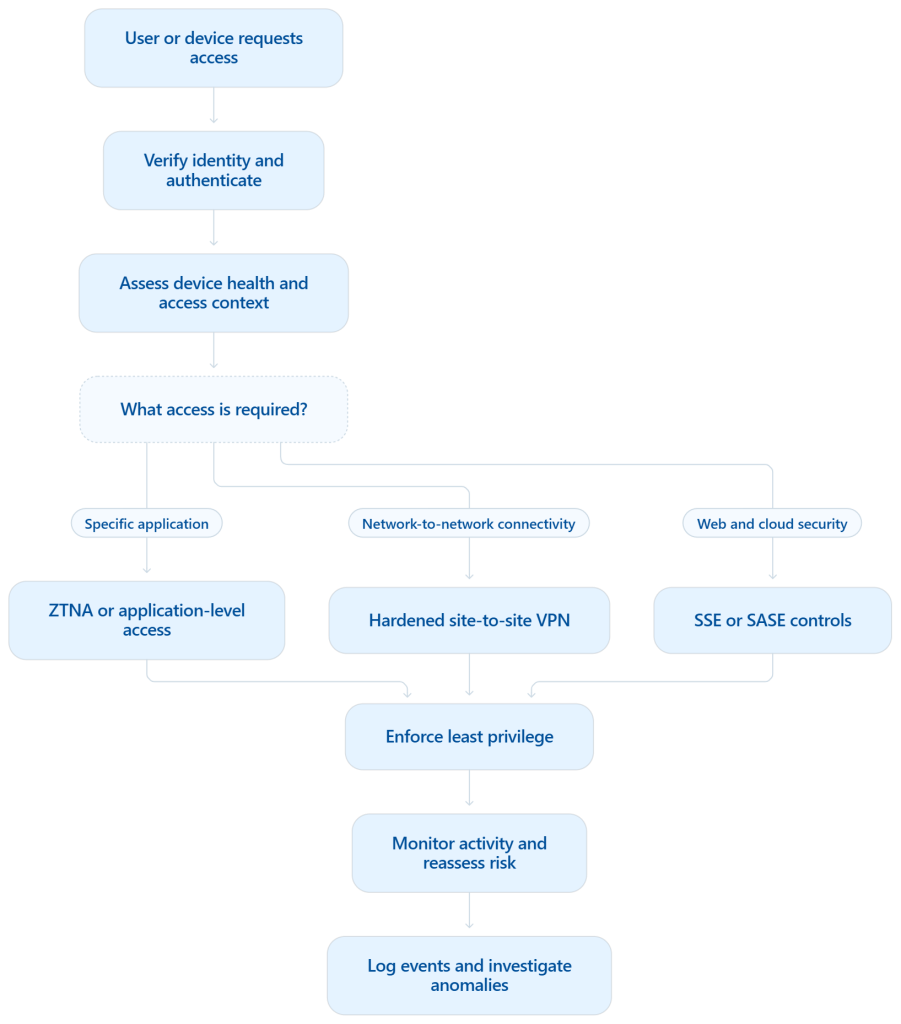
These technologies serve different purposes and can complement one another. For example, an organization may retain site-to-site VPNs for network connectivity while adopting ZTNA for employee access to sensitive applications. The diagram below illustrates how organizations can evaluate access requests and choose an appropriate security control without assuming every connection requires a traditional VPN.
How Organizations Should Secure VPNs in 2027
Organizations should evaluate VPN deployments according to their risk exposure, business requirements, and threat models. The following controls provide a practical foundation:
- Patch promptly. Prioritize known exploited vulnerabilities, maintain supported software, and replace end-of-life appliances.
- Strengthen authentication. Enforce multifactor authentication (MFA), preferably phishing-resistant methods where feasible, particularly for privileged access.
- Apply least privilege. Restrict users and devices to the specific networks, applications, and services they require.
- Secure endpoints. Use endpoint detection and response (EDR), device health checks, and appropriate controls for unmanaged or compromised devices.
- Segment networks. Limit unnecessary communication between systems and restrict pathways that attackers could use for lateral movement.
- Monitor and respond. Review authentication events, unusual access patterns, configuration changes, and suspicious sessions. Maintain procedures for revoking access and responding to gateway compromise.
Businesses should also assess whether VPN access remains the most appropriate solution for each use case. Where application-specific access controls offer better security and operational fit, ZTNA may provide a suitable alternative or complement.
What Does the Future Hold for VPNs?
Three developments will influence VPN security in 2027 and beyond:
- AI-powered cyberattacks: AI is enabling cybercriminals to accelerate reconnaissance, amplify the reach and effectiveness of phishing scams, and conduct extensive vulnerability detection. It does not automatically defeat VPN encryption, but it reinforces the need for rapid patching, strong identity controls, and continuous threat monitoring.
- Cloud-first and identity-centric security: As applications and data spread across SaaS platforms, multiple clouds, and distributed infrastructure, organizations will increasingly combine secure connectivity with identity-aware, resource-specific authorization. VPNs will remain relevant where network-level connectivity is necessary, but they may become one component of a broader access architecture.
- Post-quantum cryptography: A sufficiently capable quantum computer could threaten widely used public-key cryptographic algorithms. This is not a reason to assume VPNs will become obsolete in 2027, but rather to assess cryptographic dependencies, monitor vendor roadmaps, and plan for migration to post-quantum cryptography where appropriate.
VPNs Are Only One Part of a Larger Cybersecurity Regiment
VPNs will remain relevant in 2027 because organizations still need secure communications, remote access, and protected connections between networks. However, effective cybersecurity requires more than an encrypted VPN channel. Professionals must understand identity security, endpoint protection, network segmentation, Zero Trust, cloud security architecture, and emerging cryptographic risks to make informed architectural decisions.
The advanced cybersecurity education offered by EC-Council University (ECCU) equips professionals with the technical knowledge, practical skills, and strategic perspective needed to assess and counter evolving digital threats. Preparing for the future means knowing not only how to deploy cybersecurity technologies, but also when to use them, how to strengthen them, and when to adopt a better approach. Learners can deepen their understanding of such modern-day cybersecurity considerations through ECCU’s 100% online cybersecurity degrees and certification courses.
For more information on how studying at ECCU can drive career growth in cybersecurity:
Frequently Asked Questions
What is a VPN, and How Does It Work?
No. VPNs will continue to support remote access, secure network connections, and data protection in transit. However, some organizations will complement or replace traditional remote-access VPNs with ZTNA and other identity-centric controls.
Are VPNs still secure enough for businesses?
A properly configured and maintained VPN can provide effective protection. Security depends on strong cryptography, timely patching, robust authentication, least-privilege access, endpoint security, and monitoring.
What is the difference between a VPN and Zero Trust?
A VPN establishes a protected connection and may provide network-level access. Zero Trust is a broader security approach that requires explicit authentication and authorization rather than automatically trusting a user or device because it is connected to a network.
Is ZTNA better than a VPN?
ZTNA can offer more granular, application-specific access and reduce unnecessary network exposure. However, it does not replace every VPN use case. Organizations should select technologies according to their systems, security requirements, and operational constraints.
Can a VPN prevent phishing and malware attacks?
No. A VPN primarily protects network traffic in transit. It does not inherently prevent phishing, malware infections, credential theft, or malicious actions by an authenticated user. Additional security controls are necessary.
Should businesses replace VPNs with SASE or SSE?
Not automatically. SASE and SSE can consolidate cloud-delivered networking and security capabilities, but the business case depends on existing infrastructure, access requirements, risk, and cost. A hybrid architecture may be appropriate.
Will quantum computing break VPN encryption by 2027?
There is no basis to assume that quantum computers will render VPN encryption universally ineffective by 2027. Future quantum capabilities could threaten certain public-key cryptographic algorithms, so organizations should assess their cryptographic dependencies and plan for post-quantum migration.
What cybersecurity skills will professionals need as VPN technology evolves?
Professionals will benefit from expertise in network security, identity and access management, Zero Trust, cloud security, endpoint protection, incident response, cryptography, and security architecture. Understanding how these disciplines work together will be increasingly important as organizations modernize their defenses.