

Malware Worms Are No Longer Primitive
Malware worms have been a cybersecurity concern since the early days of the internet. Initially designed to replicate independently and spread across computer networks, these malicious programs have evolved into sophisticated threats capable of facilitating large-scale cyberattacks. Today, they can exploit software vulnerabilities, steal credentials, compromise cloud environments, and propagate through trusted software supply chains.
As organizations become dependent on interconnected networks, cloud platforms, Internet of Things (IoT) devices, and third-party applications, modern malware worms have more opportunities to spread and cause widespread damage. Understanding their evolution is essential to recognizing emerging threats and developing effective cybersecurity defenses.
What Are Malware Worms?
A malware worm is a self-contained malicious program that can replicate and spread across computers, devices, and networks without requiring a host program or user intervention. Unlike computer viruses, which typically attach themselves to legitimate files or programs, worms can operate independently. They commonly exploit software vulnerabilities, weak credentials, misconfigured systems, or network access to identify additional targets and propagate.
Depending on their design, malware worms can:
- Exploit vulnerabilities in operating systems and applications.
- Spread across connected devices and enterprise networks.
- Consume system resources and disrupt network operations.
- Steal sensitive information and authentication credentials.
- Install additional malware, including ransomware and spyware.
The Evolution of Malware Worms Over the Years
1. Early Worms: Establishing the Foundations of Self-Replication
2. Network-Aware Worms: Faster and More Destructive Propagation
- The Conficker worm (2), discovered in 2008, demonstrated this evolution. It exploited a Windows vulnerability and used multiple propagation techniques, including network shares and removable storage devices, to infect additional systems.
- In 2017, WannaCry (3) demonstrated how worm-like propagation could be combined with ransomware. Exploiting the EternalBlue vulnerability, it spread across vulnerable Windows systems while encrypting files and demanding ransom payments.
- NotPetya (4), which emerged in the same year, also used worm-like propagation techniques but caused destructive damage rather than functioning as conventional ransomware.
3. Multifunctional Worms: Beyond Replication and Disruption
- Credential harvesting: Stealing passwords, authentication tokens, and API keys.
- Ransomware deployment: Encrypting sensitive files and disrupting business operations.
- Backdoor installation: Establishing persistent unauthorized access.
- Botnet recruitment: Enrolling compromised devices into remotely controlled networks.
- Cryptocurrency mining: Exploiting infected systems for unauthorized cryptocurrency generation.
4. Supply Chain Propagation: A New Dimension of Worm Threats
One of the most significant developments in recent years is the expansion of worm-like propagation into software development and supply chain environments.
The Shai-Hulud worm (5), identified in September 2025, illustrates this development. It targeted the npm software ecosystem, compromising hundreds of software packages through self-propagating malicious code. After gaining access, the malware searched for sensitive credentials, including GitHub personal access tokens and cloud service API keys. It then used compromised developer credentials to inject malicious code into additional packages and publish compromised versions. This approach extended the potential impact beyond individual computers and conventional enterprise networks to include developers, software repositories, and downstream organizations that use affected packages.
How Emerging Technologies Are Changing Malware Worms
- Cloud and IoT targeting: Modern organizations operate across interconnected cloud services, network appliances, and IoT devices. Weak authentication, unpatched software, and misconfigured environments can expose additional systems to compromise.
- Greater automation: Worms can automate network scanning, exploitation of vulnerabilities, credential discovery, and propagation. This reduces the need for continuous manual intervention by attackers.
- Stealth and evasion: Some modern malware uses fileless execution, legitimate administrative tools, obfuscation, and other techniques to make detection more difficult. These are complementary techniques rather than defining characteristics of worms.
- AI-assisted malicious operations: Threat actors can potentially use AI to accelerate malicious code development, create convincing phishing messages, and automate selected attack activities. However, AI assistance does not automatically make malware a worm. Its ability to self-replicate and propagate remains the defining distinction.
How Can Organizations Defend Against Malware Worms?
Protecting organizational environments from malware worms requires a proactive, multilayered cybersecurity strategy. Key measures include:
- Prioritize vulnerability management: Regularly patch operating systems, applications, network devices, and firmware to eliminate known security weaknesses.
- Strengthen identity security: Implement multifactor authentication (MFA), least-privilege access, and regular credential reviews to reduce unauthorized access.
- Implement network segmentation: Separate critical systems and restrict unnecessary communication between network segments to limit lateral movement.
- Deploy advanced threat detection: Use endpoint detection and response (EDR), extended detection and response (XDR), and network monitoring to identify suspicious activity.
- Secure software supply chains: Review third-party dependencies, monitor package integrity, protect developer credentials, and secure CI/CD pipelines.
- Maintain reliable backups: Keep isolated, regularly tested backups to support recovery from destructive malware and ransomware incidents.
- Strengthen incident response: Establish procedures to isolate infected systems, revoke compromised credentials, investigate propagation paths, and restore affected environments.
Employee cybersecurity awareness training and regular security assessments should complement these technical controls.
Upskill to Repel Modern-Day Malware Worms
Malware worms have evolved from relatively straightforward self-replicating programs into sophisticated cyberattack enablers capable of compromising interconnected digital environments. Their ability to propagate independently, exploit vulnerabilities, harvest credentials, and facilitate additional malicious operations makes them a continuing organizational security concern. As these types of cyber threats become more complex, cybersecurity professionals must develop expertise in malware analysis, vulnerability assessment, network defense, threat intelligence, and incident response.
At EC-Council University (ECCU), we provide advanced cybersecurity education and practical skill development for professionals to combat emerging threats, strengthen security strategies, and contribute to organizational cyber resilience. Our 100% online cybersecurity degrees and certification courses offer in-depth training across a wide range of cybersecurity disciplines.
For more information on cybersecurity upskilling at ECCU:
Frequently Asked Questions About Malware Worms
What is a malware worm, and how does it work?
A malware worm is a self-contained malicious program that replicates and spreads independently across computers, devices, and networks. It typically exploits software vulnerabilities, weak credentials, or network access to infect additional systems without requiring user intervention for replication.
What is the difference between a computer virus and a malware worm?
A computer virus typically attaches itself to a legitimate file or program and spreads when that infected host is executed. A worm operates independently and can replicate across networks without requiring a host program or user intervention.
What are some examples of notorious malware worms?
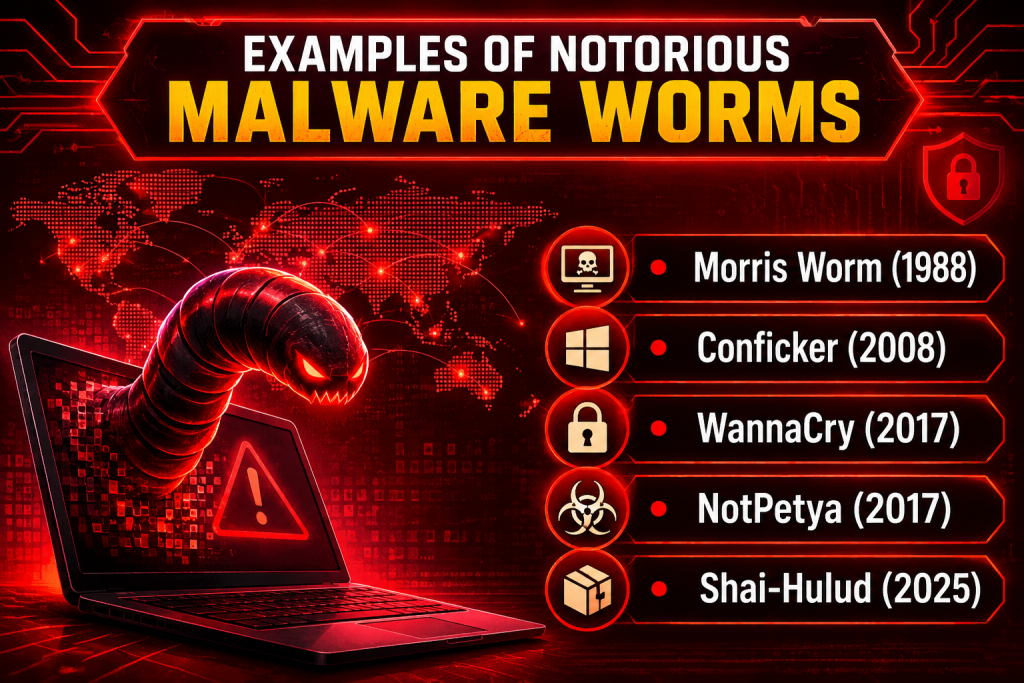
Notable examples include the Morris Worm (1988), Conficker (2008), WannaCry (2017), NotPetya (2017), and Shai-Hulud (2025). These incidents demonstrate how worms have evolved from basic self-replicating programs into threats capable of facilitating ransomware attacks, credential theft, and software supply chain compromises.
How has AI influenced the evolution of malware worms?
Artificial intelligence can help threat actors accelerate malicious code development, automate selected attack activities, and create more convincing phishing campaigns. AI may also support vulnerability research and attack adaptation. However, AI-assisted malware is not necessarily a worm, since self-replication remains the defining characteristic of worms.
How can organizations prevent malware worm infections?
Organizations can reduce worm-related risks through regular security patching, network segmentation, multifactor authentication, endpoint protection, software supply chain security, continuous network monitoring, employee awareness training, and tested incident response and recovery plans.
References & Sources:
- https://www.fbi.gov/history/cases-and-criminals/morris-worm
- https://en.wikipedia.org/wiki/Conficker
- https://www.ibm.com/think/x-force/wannacry-worm-ransomware-changed-cybersecurity
- https://www.hypr.com/security-encyclopedia/notpetya
- https://www.microsoft.com/en-us/security/blog/2025/12/09/shai-hulud-2-0-guidance-for-detecting-investigating-and-defending-against-the-supply-chain-attack/