
Why Cryptocurrency Needs Cybersecurity
Cryptocurrency was built on the promise of decentralization, transparency, and trustless transactions. But in reality, while the blockchain technology that underpins cryptocurrency is inherently secure, the ecosystem surrounding it is not. From exchanges and wallets to DeFi protocols and NFT marketplaces, every touchpoint introduces varying degrees of risk. Cybercriminals pilfered over $2.1 billion from crypto services in 2025, emphasizing just how important cybersecurity for cryptocurrency has become.
Be in no doubt, cybersecurity is an essential component in the cryptocurrency domain.
Latest Cryptocurrency Trends and Their Cybersecurity Implications
1. Rise of DeFi (Decentralized Finance)
DeFi platforms eliminate intermediaries but also remove traditional safeguards. Around $3.1 billion was stolen from DeFi protocols in 2022 alone, and smart contract vulnerabilities remain the #1 attack vector.
- Cybersecurity Implication: Flawed code and protocols result in catastrophic losses.
2. Expansion of Cross-Chain Bridges
Cross-chain bridges have significantly increased cyberattack surfaces. In fact, vulnerabilities in bridge protocols accounted for 69% of all crypto stolen in 2022.
- Cybersecurity Implication: Every new connection is a new vulnerability.
3. Institutional Adoption of Crypto
Large financial players like J.P. Morgan Chase have entered the cryptocurrency space, thereby creating higher-value targets for cybercriminals. These institutions control a growing share of crypto liquidity.
- Cybersecurity Implication: Threat actors are evolving to target enterprise-grade systems.
4. Growth of Web3 and NFTs
User ownership comes with user responsibility, but human error remains the weakest link in cybersecurity.
- Cybersecurity Implication: Phishing and social engineering attacks are leading causes of NFT thefts.
Pervasive Cybersecurity Threats to Cryptocurrency
From code-level vulnerabilities to human deception, cybercriminals try to exploit every possible angle. And as the value locked in cryptocurrencies continues to grow, so will the sophistication and scale of these threats:
1 - Smart Contract Exploits
Smart contracts are self-executing programs that run on blockchain networks like Ethereum. They automatically enforce agreements without intermediaries, but they are only as secure as the code that underpins them. A smart contract exploit occurs when attackers identify and abuse flaws in that code.
How they work:
- Logic flaws: Poorly written conditions allow attackers to manipulate outcomes
- Reentrancy attacks: Hackers repeatedly call a function before the previous execution is completed, draining funds
- Access control issues: Unauthorized users gain elevated privileges

2 - Phishing Attacks
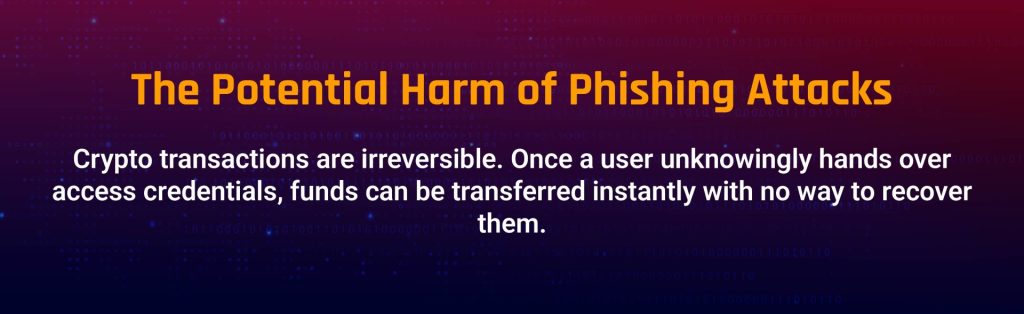
Phishing attacks remain one of the simplest and most effective ways to steal cryptocurrency. These attacks manipulate people into divulging sensitive information, such as private keys or wallet credentials, by impersonating legitimate platforms.
Common tactics include:
- Fake versions of popular wallets like MetaMask
- Emails or messages posing as exchanges or support teams
- Malicious links that redirect users to lookalike websites
3 - Exchange Hacks
Centralized exchanges act as custodians of user funds, making them high-value targets for attackers. A crypto exchange hack involves breaching the platform’s infrastructure to gain access to wallets, private keys, or internal systems.
How attacks happen:
- Exploiting server vulnerabilities
- Insider threats or compromised credentials
- Weak security practices (e.g., poor key management, simple passwords)

4 - Rug Pulls and Exit Scams
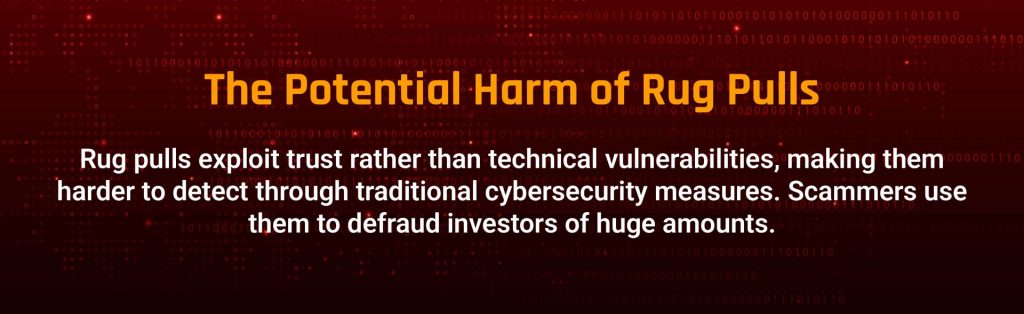
Rug pulls are a form of fraud unique to the crypto and DeFi space, where project creators deliberately deceive investors. In a rug pull, developers launch a project, attract investment, and then suddenly withdraw all funds and disappear without a trace.
Common red flags:
- Anonymous development teams
- Unrealistic returns or hype-driven marketing
- Lack of audited smart contracts
Variants include:
- Liquidity rug pulls: Developers remove liquidity from trading pools
- Token dumps: Insiders sell large holdings, crashing the price
5 - Malware and Cryptojacking
Malware in the crypto space is designed to either steal assets or exploit computing resources. Cryptojacking is a type of attack in which malicious software secretly uses a victim’s device to mine cryptocurrencies.
How it works:
- Malware is installed via phishing emails, downloads, or compromised websites
- The victim’s CPU/GPU is used to mine crypto without their knowledge
- In other cases, malware scans for stored private keys or clipboard data

Real-World Examples of Cryptocurrency Cyberattacks
- Ronin Network Hack (2022): Attackers exploited vulnerabilities in validator nodes, resulting in a loss of over $600 million.
- FTX Collapse and Breach (2022): Billions in user funds were lost in this infamous crypto scam, followed by a post-bankruptcy hack that drained roughly $400 million.
- Poly Network Hack (2021): Cybercriminals exploited a cross-chain contract vulnerability to steal more than $600 million. Thankfully, these funds were mostly returned later.
- KuCoin Hack (2020): The KuCoin cryptocurrency platform suffered a notorious cyberattack that wiped out over $280 million in user funds.
Regulatory Considerations and Consequences
Governments and regulators are getting serious about cybersecurity for cryptocurrency, and fast.
Key Developments:
- The U.S. Securities and Exchange Commission (SEC) is increasing enforcement actions in the cryptocurrency space.
- The Financial Action Task Force is pushing for the adoption of AML/KYC standards for cryptocurrency exchanges.
- EU’s MiCA regulation has tightened the rules relating to cryptocurrency compliance.
Implications:
- Non-compliance can bring heavy financial penalties or platform blacklisting
- Exchanges must implement robust cybersecurity frameworks
Notable Example
In 2023, the SEC filed lawsuits against popular cryptocurrency exchanges Coinbase and Binance for non-compliance and failing to safeguard user funds.
The Impact of AI / ML in Cryptocurrency Cybersecurity
AI and machine learning (ML) are reshaping both sides of the battlefield. Here’s how:
| How AI / ML Strengthens Security | How Attackers Use AI / ML |
|---|---|
| Real-time anomaly detection | Automated phishing campaigns |
| Fraud pattern recognition | Deepfake-based social engineering |
| Behavioral analytics for wallet activity | AI-powered vulnerability scanning |
The Future of Cybersecurity for Cryptocurrency
Expect these major shifts in cybersecurity for cryptocurrency:
- Security-First Development: Security will move from “afterthought” to “default setting.”
- Zero Trust Architectures: No user or system will be trusted by default.
- Decentralized Identity (DID): Identity verification without centralized control.
- Increased Regulation: Global frameworks will standardize cybersecurity expectations.
Cybersecurity Skills Needed to Protect Cryptocurrency Platforms
To secure cryptocurrency platforms, professionals must go beyond traditional cybersecurity and hone the following skillsets:
| Core Skills | Advanced Skills |
|---|---|
| Blockchain architecture and cryptography | AI-driven security analytics |
| Smart contract auditing (Solidity, Rust) | Penetration testing for DeFi platforms |
| Threat intelligence in Web3 ecosystems | Regulatory compliance expertise |
| Incident response for decentralized systems |
Why Continuous Upskilling is Non-Negotiable
The cyber threats to cryptocurrency aren’t sitting still. Cybercriminals are becoming more sophisticated, attack surfaces are expanding, and the stakes are higher than ever. If you’re a cybersecurity professional, standing still isn’t an option.
To stay relevant and effective, you need continuous, specialized education that keeps pace with real-world threats. That’s where EC-Council University (ECCU) stands apart. As a global leader in cybersecurity education for working professionals, ECCU’s online degrees and certification courses equip learners with practical, hands-on expertise in areas like blockchain security, AI-driven defense, and advanced threat intelligence.
In a world where billions of dollars can vanish in seconds, the difference between vulnerability and resilience comes down to the skills of those entrusted to defend cryptocurrency ecosystems. And the professionals who invest in elevating their skills will define the future of cybersecurity for the cryptocurrency industry.
To know more about cybersecurity education at ECCU:
Frequently Asked Questions About Cybersecurity for Cryptocurrency
Cryptocurrency platforms handle high-value digital assets and operate in decentralized environments, making them prime targets for cybercriminals. Weak security can lead to massive financial losses, reputational damage, and regulatory penalties.
The most prevalent threats include smart contract exploits, phishing attacks, exchange breaches, rug pulls, and cryptojacking. These attacks target both technical vulnerabilities and human error.
Smart contracts are self-executing code, and attackers can exploit any flaw in their logic. Common vulnerabilities include reentrancy attacks, integer overflows, and improper access controls, often resulting in significant financial losses.
AI enhances cybersecurity by enabling real-time threat detection, anomaly identification, and predictive analytics. However, cybercriminals also use AI to automate attacks, create sophisticated phishing scams, and identify system vulnerabilities more efficiently.
Yes, DeFi platforms are often more vulnerable due to their reliance on smart contracts and lack of centralized oversight. While they offer transparency and innovation, they also introduce new and complex attack surfaces.
Regulations enforce cybersecurity standards, promote transparency, and protect investors. Organizations such as the Financial Action Task Force and the U.S. Securities and Exchange Commission require compliance with anti-money laundering (AML) laws and cybersecurity frameworks.
Users can improve security by using hardware wallets, enabling multi-factor authentication (MFA), avoiding suspicious links, verifying transactions, and keeping software up to date.
Professionals need expertise in blockchain technology, cryptography, smart contract auditing, threat intelligence, and AI-driven security tools. Knowledge of regulatory compliance and incident response is also important.