Cybersecurity is not a static field. It never was. But the pace at which AI is reshaping it has forced a specific question for anyone considering a master’s degree: does this program reflect how the field actually works today?
EC-Council University’s Master of Science in Cyber Security does not offer a separate AI degree. What it does instead is more practical. It integrates AI directly into its cybersecurity curriculum through dedicated courses, industry certifications, and hands-on application. Students graduate with AI fluency built into their cybersecurity foundation, not bolted on as an afterthought.
What a master’s in cybersecurity teaches has never mattered more
Why AI Has Become Non-Negotiable in Cyber Security
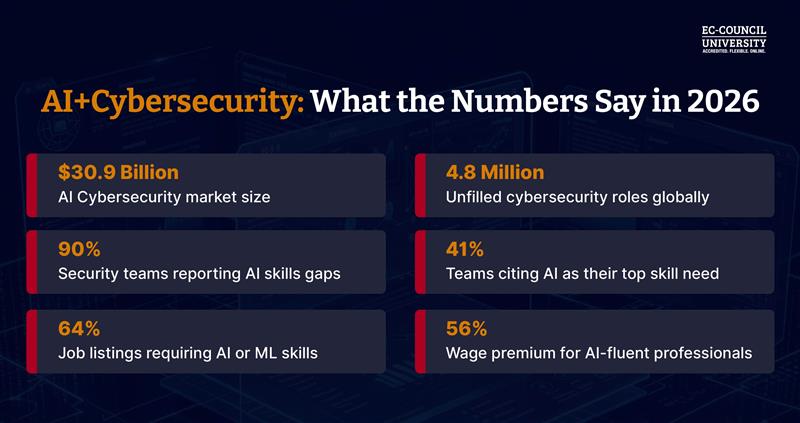
The cybersecurity industry is growing fast. The talent keeping up with it is not. AI is not a future concern here. It is already reshaping hiring, salaries, and skill requirements. The numbers make that clear:
EC-Council University's Master of Science in Cyber Security
EC-Council University (ECCU) runs a fully online Master of Science in Cyber Security (MSCS). The program is accredited by the Distance Education Accrediting Commission (DEAC). It was ranked among Fortune’s Top 10 Online Master’s in Cybersecurity.
The MSCS is built for working professionals. It combines virtual labs, applied case studies, and industry-recognized EC-Council certifications. Those include CEH, C|PENT, C|ND, and the newer COASP. Students choose from five specializations. These are Security Analyst, Cloud Security Architect, Digital Forensics, Incident Management and Cyber Operations, and Executive Leadership in Information Assurance.
What distinguishes ECCU is not just the range. It is how AI runs through the program’s structure. It is not sitting as an idle elective.
AI Integration Across the Curriculum
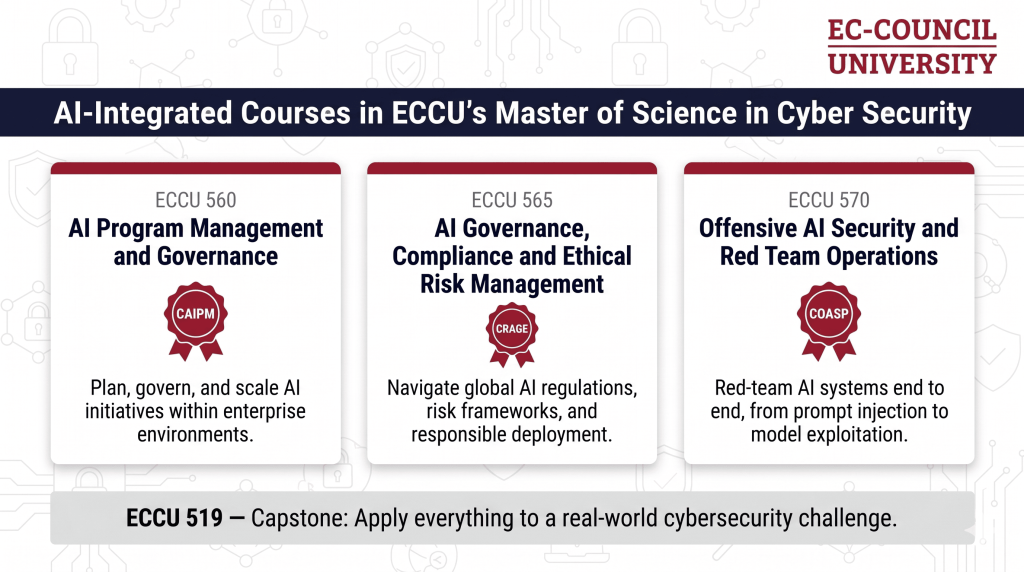
Most cybersecurity programs add an AI module and call it done. ECCU embeds AI across dedicated courses with its own certifications. Here is where it shows up:
- ECCU 560 – AI Program Management and Governance (CAIPM) This course covers how AI, automation, and analytics create business value. Students learn to assess AI maturity, evaluate high-impact use cases, and build governance roadmaps. It also addresses MLOps, DataOps, and ethical frameworks for safe AI deployment.
- ECCU 565 – AI Governance, Compliance, and Ethical Risk Management (CRAGE) Students gain working knowledge of global AI governance frameworks and regulatory requirements. The course covers AI risk management across the full lifecycle, including compliance controls, third-party risks, data protection, and model auditing. Real-world case studies ground the theory in practice.
- ECCU 570 – Offensive AI Security and Red Team Operations (COASP) This is the most technically specialized of the three. Students learn to red-team AI systems end to end, covering prompt injection, model exploitation, agentic function attacks, and API vulnerabilities. The goal is to find compromises in AI systems before attackers do. It is paired with the Certified Offensive AI Security Professional (COASP) certification.
- ECCU 519 – Capstone The capstone is where everything comes together. Students draw on the full program to solve a real cybersecurity problem. For many, that means applying AI-driven approaches to challenges their industries actually face.
The COASP Specialization: A Real Differentiator
The Security Analyst specialization houses ECCU 570. It is built around EC-Council’s COASP certification. This matters for one specific reason. Most graduate programs do not teach students how to attack AI systems.
As organizations push AI into their operations, those systems become targets. Language models, API integrations, agentic workflows, and data pipelines all carry vulnerabilities. The COASP trains students to find those gaps before attackers do.
This is not a theoretical exercise. It is a practiced skill set. And it covers a threat category growing across every industry.
Hands-On Learning: From Classroom to Real Scenarios
Theory without application has a short shelf life in cyber security. ECCU addresses this through virtual labs running alongside coursework. Students work with security analytics platforms and AI-powered threat detection tools in practice environments.
The capstone (ECCU 519) is genuinely summative. Students demonstrate all program learning outcomes through a single project. That pressure builds real confidence, not just credential confidence.
Skills You Graduate With and Where They Take You
Graduates of the ECCU MSCS leave with a skill set built for where the industry is going, not where it was five years ago:
- AI-driven threat intelligence: identifying and interpreting signals that automated systems surface
- Predictive risk analysis: applying machine learning logic to model security risks early
- Security automation: designing workflows that cut manual bottlenecks in security operations
- AI governance and compliance — navigating the regulatory and ethical dimensions of AI in security
- Executive communication — translating technical risk into language that nontechnical stakeholders understand
These skills map to roles that did not exist at scale a decade ago. Today, they are actively hired for. AI Security Engineer, ML Security Researcher, and AI Governance Analyst are fast-growing titles. More established roles now carry AI literacy as a baseline expectation. Cybersecurity Cloud Security Architect and Operations Leader are two clear examples.
How ECCU's Approach Stands Out
Other programs teach theoretical cybersecurity. ECCU teaches it in the context of how the field operates now.
What makes the MSCS distinctive is the range of what it covers. The Security Analyst specialization goes deep on offensive AI through ECCU 570 and the COASP certification. The Executive Leadership in Information Assurance specialization takes a different angle. It pairs AI program management (ECCU 560) and AI governance (ECCU 565) with executive leadership skills, including CCISO certification and global business leadership. Students graduate able to lead AI security strategy, not just execute it.
That combination is rare. Most programs train either technical practitioners or business leaders. ECCU builds both.
Who Should Consider This Program?
This degree suits professionals already working in IT or security who want senior roles. It also works for those transitioning from adjacent fields. Military, IT consulting, law enforcement, engineering — security exposure exists in all of them. Formal credentials often do not.
The AI-integrated curriculum gives career changers a genuine edge. They are not catching up to the field. They are entering it with skills the field currently lacks.
If you have been watching the cybersecurity space, the data gives a consistent answer. The gap between what employers need and what the market supplies is not closing on its own.
The Future of Cyber Security Runs on AI Fluency
The threats are not slowing down. 80% of phishing attacks now use AI in some form. Deepfakes are reaching boardroom-level sophistication. Automated reconnaissance runs at a speed no human analyst can match manually.
The security professionals who lead organizations through this are a specific kind. They are not the ones who only learned to patch systems. They understand AI as both the threat vector and the defense mechanism.
EC-Council University built its MSCS to produce exactly that kind of professional. The curriculum reflects the threat landscape as it stands. The certifications reflect what employers want. Graduates arrive ready to work, not ready to catch up.
Explore EC-Council University’s Master of Science in Cyber Security and see how the program prepares you for what this field demands next.
Frequently Asked Questions
AI is integrated into cybersecurity education through courses that cover both offensive and defensive applications. Students learn to use AI for threat detection, risk modeling, and security automation, while also learning how attackers weaponize it through deepfakes, automated phishing, and model exploitation. This ECCU blog on AI in cybersecurity breaks down how the technology is reshaping both sides of the threat landscape.
Yes. ECCU integrates AI across three dedicated courses in its MSCS program. CAIPM Certification covers AI program management and governance, CRAGE Certification focuses on AI governance and ethical risk management, and COASP Certification trains students in offensive AI security and red team operations. Each course is paired with an industry certification. You can explore the full program structure on the MSCS program page.
An AI-integrated cybersecurity degree builds skills in AI-driven threat intelligence, predictive risk analysis, security automation, and AI governance and compliance. Graduates also develop the ability to assess organizational AI maturity and lead AI security strategy at an executive level. ECCU’s blog on cybersecurity skills for 2026 outlines how these capabilities map to what employers are actively hiring for.
AI skills are now a baseline requirement in cybersecurity hiring. Over 64% of cybersecurity job listings in 2026 require AI, ML, or automation skills, and ISC2 ranks AI and ML as the number one skill need across security teams. Professionals with AI fluency command a 56% wage premium over peers without it. ECCU’s cybersecurity career guide covers how these trends are reshaping hiring across experience levels.
Roles that require combined AI and cybersecurity expertise include AI Security Engineer,
ML Security Researcher, AI Governance Analyst, Cybersecurity Architect, and Security Operations Leader. These positions span finance, healthcare, defense, and enterprise technology. ECCU’s guide to careers in cyber threat intelligence is a useful starting point for understanding how these roles are evolving.