Most cybersecurity job listings today aren’t just asking for security awareness. They want engineers who can read code, architects who understand threat surfaces, and developers who build with security baked in. A Master of Computer Science with a cybersecurity focus — the MCS — sits at exactly that intersection. Unlike a standalone cybersecurity master’s, it gives you CS fundamentals alongside security depth. That combination is increasingly what employers want, and increasingly rare.
So what does it actually unlock? The seven roles below span offensive security, cloud infrastructure, software engineering, and AI system defense. What they share is one requirement: you must understand how systems are built, not just how they fail. The MCS is designed to make you effective in these roles, not just credentialed for them.
Why the MCS and Cybersecurity Combination Works
The talent shortage in cybersecurity isn’t just about headcount. It’s about the kind of professionals who are missing. Organizations need people who understand how software is built and how it gets broken. They need security engineers who can read a codebase. They need cloud architects who know what a misconfiguration actually costs.
An MCS graduate can operate in both worlds. You come out understanding algorithms, systems architecture, and data structures alongside threat modeling, cryptography, and secure design. That combination opens doors that a narrower credential typically doesn’t.
[Learn more about ECCU’s Master of Computer Science program →]7 Cybersecurity Roles MCS Graduates Are Getting Hired For
1. Application Security Engineer
Most security professionals can spot a vulnerability in a report. AppSec engineers find it in the code itself. That distinction is what makes this role hard to fill.
They work inside the software development lifecycle, reviewing code, running SAST and DAST scans, and building secure coding standards that teams actually follow. The job requires fluency in a programming language or two, OWASP Top 10 knowledge, and tools like Burp Suite and Checkmarx.
Without CS fundamentals, you’re auditing code that you don’t fully understand. The MCS closes that gap. AppSec engineers earn an average salary of $164,593 per year.
2. Penetration Tester / Ethical Hacker
Organizations pay pen testers to break in before someone else does. That means simulating real attacks on networks, applications, and systems- finding gaps that internal teams have stopped seeing. The technical floor is high: scripting in Python or Bash, deep OS-level knowledge, and hands-on comfort with Kali Linux, Metasploit, and Nmap. EC-Council’s C|EH and C|PENT certifications are industry-recognized benchmarks for this path and pair directly with MCS coursework.
Demand isn’t softening. The BLS projects 29% employment growth for information security analysts through 2034. Average salary: $154,271 per year.
3. ML Security Engineer / Cybersecurity Data Scientist
Here’s a number worth pausing on. Analysts skilled in ML threat modeling, earn up to 35% more than peers without AI-focused skills. That premium exists because the role is genuinely difficult to staff.
ML security engineers build models that detect anomalies, classify malicious behavior, and automate threat response at scale. They also work on adversarial robustness, hardening ML systems against manipulation. Python, TensorFlow or PyTorch, and statistical modeling are the core of the skillset.
This is where a pure cybersecurity degree hits a ceiling. You can’t build a detection model without understanding what’s underneath it. Average salaries range from $121,750 to $172,500 per year.
4. DevSecOps Engineer
Security that shows up at the end of development isn’t security; it’s a bottleneck. DevSecOps engineers embed security checks directly into CI/CD pipelines, from the first commit to final deployment. The toolset is broad: Jenkins, GitHub Actions, Docker, Kubernetes, Trivy, Snyk, plus scripting ability and cloud infrastructure fluency. The MCS gives you the software engineering literacy this role demands. Most cybersecurity-only graduates don’t have it.
Entry-level roles start at $90,000 to $115,000. Senior professionals earn $150,000 to $180,000 or more, with total compensation at top tech firms exceeding $250,000.
5. Cloud Security Engineer
Global cloud security spending is projected to grow 18% annually over the next several years, and that growth is creating sustained demand for engineers who can secure what organizations are building. The work involves configuring IAM policies, hardening AWS, Azure, or GCP environments, and responding to cloud-native incidents. Terraform fluency, container security, and SIEM platforms are increasingly non-negotiable. AWS Security Specialty and Microsoft SC100 certifications strengthen your profile considerably.
Average salary: $167,905 per year, with senior roles reaching $213,000+.
6. Security Software Developer
The tools security teams run every day, vulnerability scanners, SIEM integrations, incident response platforms, custom detection scripts, were built by someone. That someone is a security software developer. It’s one of the less visible roles in this list, rarely appearing in mainstream cybersecurity career guides. But without it, the rest of the security stack doesn’t exist.
The work is fundamentally software engineering with a security mandate. Strong C++, Python, or Go, low-level systems knowledge, and applied cryptography are the core requirements. The security context shapes what you build, not how you think about building it.
That’s exactly why the MCS fits naturally here. Average salary: $162,014 per year.
7. AI/LLM Security Engineer
Only 14% of organizations believe they currently have adequate AI security talent. That’s not a minor gap; it’s a structural shortage in one of the fastest-moving areas in tech. AI/LLM security engineers red-team large language models, test for prompt injection and jailbreak vulnerabilities, and implement frameworks like OWASP LLM Top 10 and MITRE ATLAS in live production environments. The role barely existed three years ago.
Salaries reflect the scarcity. Companies like SandboxAQ already offer $184,000 to $230,000, with top-tier firms reaching $150,000 to $280,000+. To do this work, you need ML knowledge, security instincts, and the CS foundation to bridge both. This is the one role on this list where an MCS genuinely has no substitute.
[Learn more about ECCU’s Master of Computer Science program→]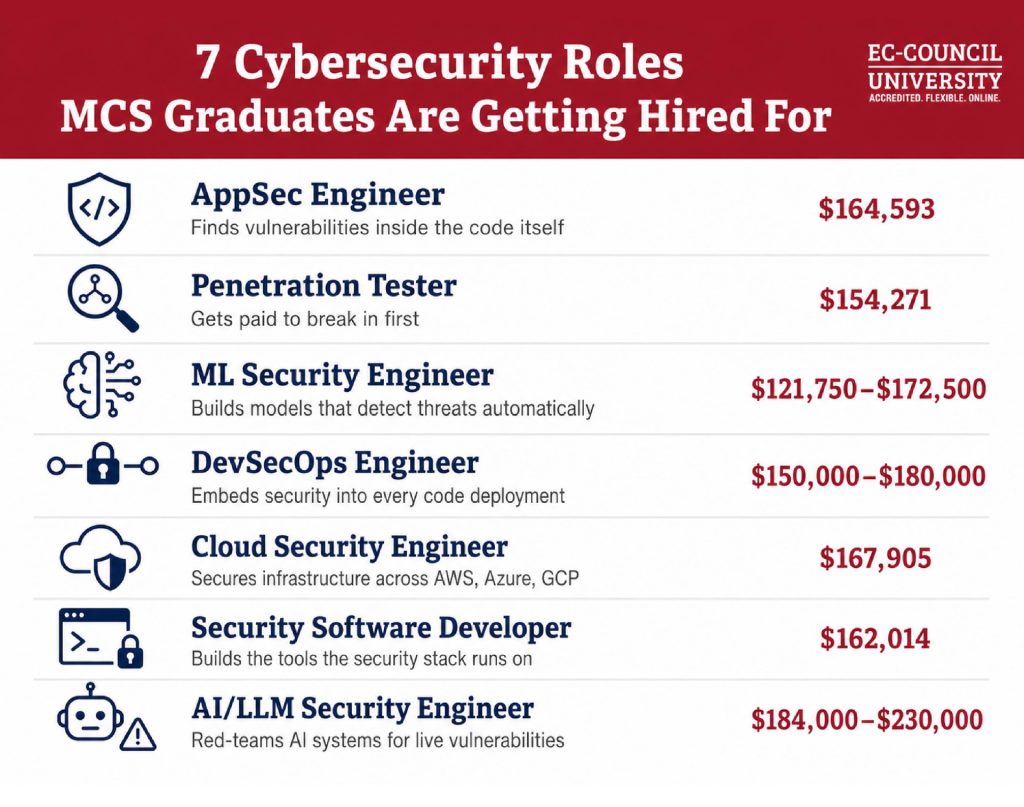
How ECCU's MCS Program Is Built for These Roles
EC-Council University’s MCS program is designed around the reality that security work today requires engineering fluency. Core CS coursework covers algorithms, software systems, and data structures. The cybersecurity layer adds cryptography, network security, ethical hacking, and secure software development.
What makes the program particularly relevant is its integration with EC-Council’s certification tracks. Students gain exposure to C|EH, C|PENT, and other globally recognized credentials within their academic journey. Virtual labs give hands-on experience with tools used across all seven roles in this article. And because the program is delivered online, working professionals can build their portfolios while they study.
Matching Your Background to the Right Role
| If you come from… | Start targeting… |
|---|---|
| Software development | AppSec Engineer or DevSecOps Engineer |
| Data / analytics | ML Security Engineer / Cybersecurity Data Scientist |
| Network / infrastructure | Cloud Security Engineer or Penetration Tester |
| Systems engineering or hardware | Security Software Developer |
| Academic / research background | AI/LLM Security Engineer or ML Security Engineer |
| IT administration or SOC | DevSecOps Engineer or Cloud Security Engineer |
Conclusion
The seven roles in this article aren’t outliers. They’re where cybersecurity is heading, toward people who understand systems deeply enough to secure them from the inside. A credential alone doesn’t get you there. The combination of CS fundamentals and security depth does. That’s what the MCS is built for, and it’s what the job market is increasingly asking for by name.
If that’s the kind of professional you’re building toward, ECCU’s Master of Computer Science program is worth a close look.
[Learn more about the MCS program →]Frequently Asked Questions
It depends on what you want to do. An MSCS is a broader research-oriented degree. It covers computer science deeply but doesn’t always include a security track. An MCS with a cybersecurity focus is purpose-built for the roles in this article. You get CS fundamentals alongside applied security coursework, which is the combination most hiring managers in AppSec, DevSecOps, and cloud security are actively looking for. For cybersecurity-specific career outcomes, the MCS is the more direct path.
Yes, and in many cases it gives you an edge. The roles that are hardest to fill in cybersecurity today aren’t pure security roles. They’re hybrid roles that require engineering depth alongside security knowledge. A computer science master’s, especially one with a cybersecurity focus, signals exactly that profile. Roles like application security engineer, DevSecOps engineer, and security software developer are regularly filled by CS graduates.
It varies significantly by role. Application security engineers average around $164,593 per year. Cloud security engineers average $167,905. AI/LLM security engineers at specialized firms can reach $230,000 or more. The common thread is that roles requiring both CS depth and security knowledge consistently command higher salaries than those requiring only one. An MCS positions you for the higher end of that range.
Yes. ECCU’s Master of Computer Science program integrates core CS coursework with applied cybersecurity across the curriculum. Students cover algorithms, software systems, and data structures alongside cryptography, network security, and secure software development. The program also connects to EC-Council’s globally recognized certification tracks, including C|EH and C|PENT, giving students both academic grounding and industry-recognized credentials within the same program.