Article Overview
This article explores the key facets of threat intelligence in cybersecurity, how it has evolved over the years, what present-day threat intelligence entails, the benefits of earning a globally recognized threat intelligence certification, the cybersecurity roles that require certified threat intelligence skills, and more.
What Is Threat Intelligence in Cybersecurity?
Cyber threat Intelligence (often abbreviated to CTI) is the process of collecting, analyzing, and interpreting cybersecurity threat data to help organizations anticipate, detect, prevent, and respond to cyberattacks more effectively. Rather than reacting to cyber incidents after they occur, threat intelligence enables security teams to proactively identify adversaries, understand attacker behavior, and predict emerging risks. Modern-day CTI combines technical indicators, geopolitical context, behavioral analysis, and real-time threat feeds to transform raw data into actionable intelligence.
Threat intelligence has become one of the most strategic disciplines in cybersecurity, as organizations face increasingly sophisticated attacks, primarily driven by automation and artificial intelligence.
Nearly 47% of organizations now cite AI-powered cyber threats as a primary cybersecurity concern.
- World Economic Forum
Why Threat Intelligence Is a Vital Domain of Cybersecurity
In recent years, cybercriminals and malicious actors have become more organized and are increasingly leveraging AI-driven cyberattack techniques. Threat intelligence is crucial to keeping them at bay by helping organizations:
- Identify emerging attack patterns before they spread
- Detect adversary tactics, techniques, and procedures (TTPs)
- Improve incident response and threat hunting
- Strengthen vulnerability management
- Reduce dwell time and operational disruption
- Support executive-level risk management decisions
The IBM X-Force Threat Intelligence Index 2025 revealed that attackers abused valid user accounts in 30% of incidents, while phishing campaigns increased by 84% year over year. These trends demonstrate why businesses increasingly depend on skilled threat intelligence analysts who can interpret threat data and translate it into decisive actions.
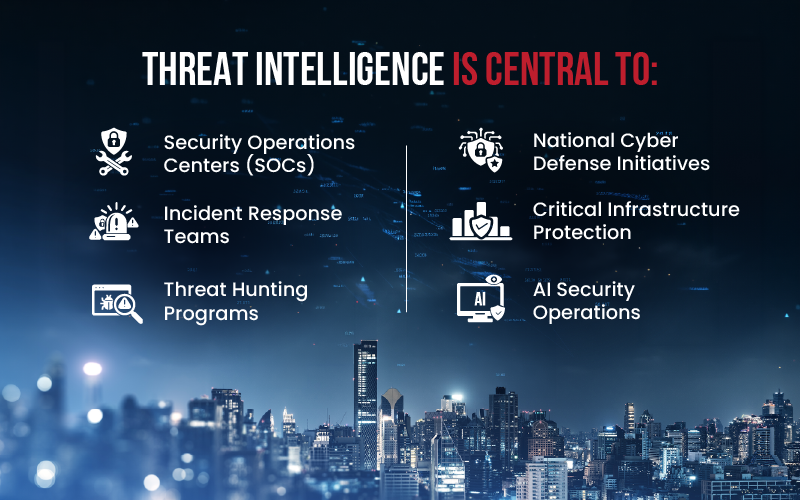
How Threat Intelligence Has Evolved: 2015 vs. 2020 vs. 2026
The threat intelligence landscape has changed dramatically over the past decade:
| Year | CTI Landscape | Primary Challenges | AI Impact |
|---|---|---|---|
| 2015 | Mostly reactive intelligence sharing and IOC-based detection | Limited automation, siloed data | Minimal AI integration |
| 2020 | Growth of threat hunting, ATT&CK frameworks, and intelligence platforms | Proliferation of ransomware and nation-state attacks | Early machine learning for detection |
| 2026 | Predictive and AI-assisted intelligence ecosystems with real-time correlation | AI-powered phishing, deepfakes, supply chain attacks, and AI model exploitation | AI now accelerates detection, analysis, prioritization, and adversary simulation |
Today’s threat intelligence platforms can analyze billions of security events daily, correlate indicators across global infrastructures, prioritize threats in real time, and automate actions to neutralize threats before they manifest.
At the same time, AI has become both a defensive tool and an offensive weapon. Threat actors increasingly use generative AI to automate phishing campaigns, create convincing impersonation attacks, accelerate vulnerability discovery, and much more. This evolution has significantly increased the demand for cybersecurity professionals with advanced threat intelligence expertise.
Key Aspects of Modern-Day Threat Intelligence
Beyond traditional threat intelligence practices, present-day CTI includes:
1. Threat Intelligence Platforms (TIPs)
Organizations now use centralized TIPs to aggregate and correlate intelligence from multiple sources. Popular platforms include MISP, Recorded Future ThreatConnect, IBM X-Force Exchange, and Anomali. These platforms help analysts prioritize high-confidence threats and reduce alert fatigue.
2. Threat Hunting
Threat hunting involves proactively searching networks for hidden adversaries using behavioral analysis and threat intelligence insights. Today’s threat hunters rely heavily on frameworks such as MITRE ATT&CK, Diamond Model of Intrusion Analysis, and Cyber Kill Chain.
3. AI-Assisted Threat Analysis
AI-driven CTI systems can detect abnormal behavioral patterns, correlate massive datasets, automate IOC enrichment, and prioritize incidents based on risk scoring. However, human analysts remain essential for context analysis and strategic decision-making.
4. Intelligence Sharing
Organizations increasingly participate in intelligence-sharing communities such as ISACs (Information Sharing and Analysis Centers), government cyber alliances, and industry consortia. Collaborative intelligence sharing helps defenders respond faster to emerging threats.
5. Strategic Threat Intelligence
Modern CTI isn’t limited solely to cybersecurity teams. Executives and boards now rely on strategic intelligence to understand business risk exposure, supply chain vulnerabilities, consequences of geopolitical cyber warfare, and regulatory implications.
Cybersecurity Roles That Require Threat Intelligence Expertise
Threat intelligence skills are now highly valuable across multiple cybersecurity roles, such as:
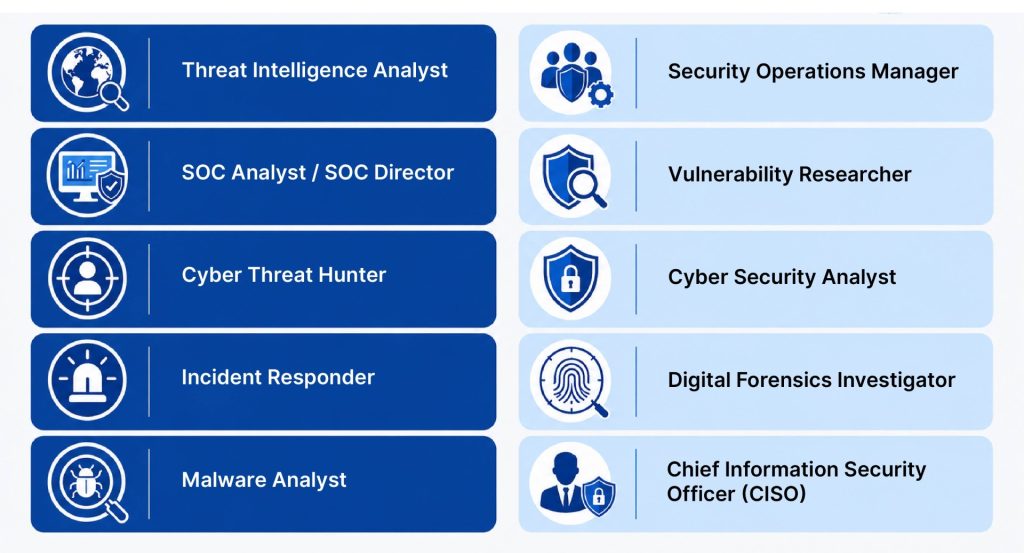
Even professionals in cloud security, AI security, and governance are increasingly building their CTI knowledge to stay ahead of evolving adversaries.
What Does a Threat Intelligence Certification Entail?
A professional threat intelligence certification validates a cybersecurity professional’s ability to collect, analyze, and operationalize cyber threat data effectively. A high-quality CTI certification typically covers:
- Threat intelligence lifecycle
- Open-source intelligence (OSINT)
- Dark web intelligence gathering
- Malware analysis fundamentals
- Threat hunting methodologies
- MITRE ATT&CK framework
- Threat attribution
- Tactical, operational, and strategic intelligence
- Intelligence reporting and dissemination
- AI-driven threat analysis
One respected option for aspiring professionals is the Certified Threat Intelligence Analyst (C|TIA) certification offered by EC-Council University. The C|TIA certification focuses on real-world threat intelligence operations and prepares professionals to build actionable intelligence programs for modern enterprises.
Benefits of a Threat Intelligence Certification
Having a threat intelligence certification brings the following career advantages:
- Career Differentiation: As organizations increasingly prioritize proactive defense, CTI-certified professionals stand out in hiring and promotion decisions.
- Industry Validation: Certifications validate practical skills and demonstrate expertise in intelligence analysis, threat detection, and cyber defense operations.
- Higher Earning Potential: Threat intelligence professionals often command competitive salaries due to the specialized nature of their role and the growing demand for their skill set.
- Strategic Career Growth: CTI expertise opens pathways to leadership roles, threat-hunting teams, national cyber defense programs, AI security operations, and advanced SOC environments.
- Enhanced Decision-Making Skills: Threat intelligence training develops analytical thinking, adversary profiling, and risk assessment capabilities that apply across cybersecurity disciplines.
Acquiring ECCU’s Certified Threat Intelligence Analyst (C|TIA) Certification
Professionals seeking to strengthen their threat intelligence credentials can pursue the Certified Threat Intelligence Analyst (C|TIA) pathway through EC-Council University (ECCU).
ECCU’s cybersecurity-focused online programs and courses help learners develop practical, career-ready skills aligned with modern cyber defense requirements. One relevant learning pathway includes the Managing Risk in Information Systems course, which helps students understand cyber risk management, threat modeling, vulnerability assessment, data analysis for threat intelligence, cyber defense mechanisms, and much more. Combined with hands-on practice with the latest CTI tools in virtual lab environments, these skills help professionals build a strong foundation for intelligence-driven cybersecurity operations.
To know more about obtaining the C|TIA certification:
Frequently Asked Questions About Threat Intelligence
A threat intelligence certification validates a cybersecurity professional’s ability to collect, analyze, and operationalize cyber threat data to improve organizational security and cyber defense strategies.
Yes. Threat intelligence remains a fast-growing cybersecurity discipline due to increasingly sophisticated cyber threats, AI-driven attacks, and the global demand for proactive cyber defense expertise.
Key skills include threat analysis, OSINT, malware analysis, threat hunting, intelligence reporting, MITRE ATT&CK knowledge, and AI-assisted security analysis.
Job roles you can get with a threat intelligence certification include Threat Intelligence Analyst, SOC Analyst, Incident Responder, Threat Hunter, Malware Analyst, Cyber Risk Analyst, and Security Operations Manager.
Yes. The Certified Threat Intelligence Analyst (C|TIA) certification from EC-Council University validates practical CTI expertise and helps professionals develop real-world intelligence analysis skills aligned with modern cybersecurity operations.