
Being a Cybersecurity Manager Today is Not What it Once Was
If you had asked 15 years ago what a Cybersecurity Manager does, you would have received a fairly straightforward answer: manage security operations, respond to incidents, oversee security tools, and keep attackers out. Today, however, this answer is incomplete. In 2026, a Cybersecurity Manager is expected to understand technology, manage people, evaluate risk, communicate with executives, navigate regulatory requirements, secure cloud environments and AI systems, and help the organization make better business decisions while prioritizing digital security.
In other words, you are no longer simply managing cybersecurity. You are managing cyber risk as a business priority. And keep in mind, this evolution in responsibilities is happening against the backdrop of a rapidly changing cyber threat landscape.
Considering the above, what does the role of a Cybersecurity Manager fully entail in 2026? And what does it take to become one? Let’s investigate:
What is a Cybersecurity Manager?
In essence, a Cybersecurity Manager is responsible for helping an organization identify, manage, reduce, and respond to cybersecurity risk. That can involve overseeing:
- Security operations
- Vulnerability assessment and management
- Incident response
- Identity and access management
- Cloud security
- AI security
- Stakeholder/leadership cybersecurity briefings and report management
- Security awareness training
- Compliance protocols
- Third-party risk assessment
- Miscellaneous cybersecurity projects and initiatives
If a critical vulnerability affects 10,000 endpoints, for example, your job isn’t simply to tell the IT team to patch them. You need to understand the business systems involved, assess the potential impact, prioritize remediation, communicate the risk to stakeholders, and ensure the organization has an appropriate response in place. This is what cybersecurity management is about these days.
The Cybersecurity Manager's Role in 2026
Let’s expand on the role of a Cybersecurity Manager in greater detail.
One of the clearest indicators of where this profession is heading is NIST’s Cybersecurity Framework 2.0. The framework expanded its structure to include ‘Govern’ alongside Identify, Protect, Detect, Respond, and Recover, reinforcing the idea that cybersecurity is fundamentally a governance and risk-management responsibility, not simply a technical function.
In March 2026, NIST went a step further by publishing SP 1308, which connects cybersecurity risk management with enterprise risk management and workforce management. It emphasizes the need for organizations to adapt their workforce capabilities as threats and technologies evolve. These factors are highly relevant to the modern-day Cybersecurity Manager, whose role commonly entails:
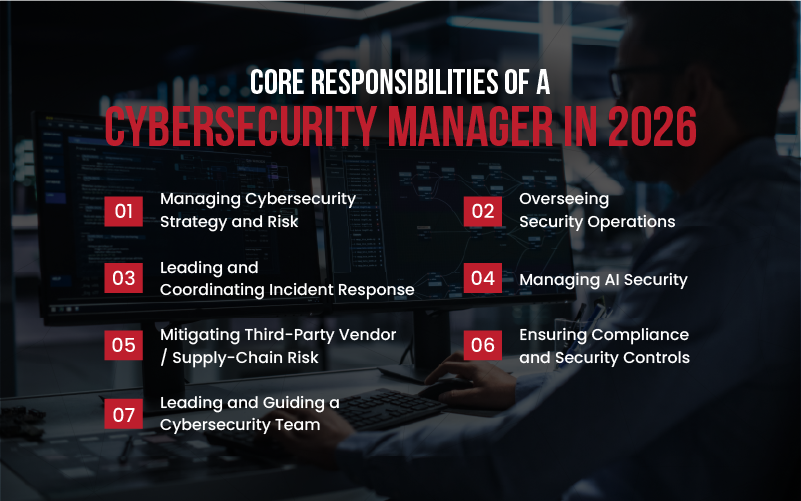
1. Managing Cybersecurity Strategy and Risk
A Cybersecurity Manager helps translate organizational objectives into cybersecurity priorities. You may be responsible for:
- Conducting cybersecurity risk assessments
- Identifying critical assets and systems
- Establishing security priorities
- Developing security policies and procedures
- Aligning security initiatives with business objectives
- Tracking cybersecurity metrics and key risk indicators
- Communicating cyber risk to senior leadership
You need to be comfortable answering questions such as:
“What is our greatest cybersecurity risk?”
“What would happen if that risk materialized? How much should we invest to reduce it?”
2. Overseeing Security Operations
In the absence of a dedicated SOC Head, a Cybersecurity Manager may be tasked with handling teams responsible for security monitoring, threat detection, vulnerability management, endpoint security, network defense, identity management, and secure software engineering.
You don’t necessarily have to investigate every alert personally. Instead, you need to ensure that the right people, processes, technologies, and procedures are in place to detect and respond to threats effectively.
That means understanding technologies such as SIEM, EDR/XDR, vulnerability scanners, IAM platforms, cloud security tools, threat-intelligence platforms, and security orchestration and automation. The goal is to build and maintain an effective cybersecurity apparatus for the entire organization.
3. Leading Incident Response
When a major breach occurs, the Cybersecurity Manager can become one of the most important people in the organization. Imagine discovering that an employee’s credentials have been compromised and an attacker has gained access to a critical business system. Someone needs to coordinate the collective response in such a scenario, and this usually involves:
- Determining the scope of the incident
- Coordinating SOC, IT, legal, communications, and leadership teams
- Containing affected systems
- Supporting forensic investigation
- Coordinating recovery
- Assessing regulatory and notification requirements
- Documenting lessons learned
- Improving controls to prevent recurrence
4. Managing AI Security
This is one of the biggest additions to the Cybersecurity Manager’s responsibilities in 2026. Organizations are rapidly deploying generative AI, AI agents, machine-learning systems, and AI-enabled business applications. These technologies create tremendous opportunities, but also introduce new attack surfaces. As a Cybersecurity Manager, you may therefore be involved in:
- AI security assessments
- Protecting sensitive information used with AI systems
- Managing AI-related access controls
- Addressing prompt injection threats and LLM manipulation
- Evaluating third-party AI platforms
- Establishing responsible AI security policies
- Monitoring AI-related vulnerabilities
- Coordinating AI security governance with legal, compliance, and business teams
You don’t need to become an AI researcher.
But you do need to understand how AI affects the organization’s cybersecurity operations and policies.
5. Managing Third-Party and Supply-Chain Risk
Modern enterprises rarely operate in isolation. Cloud providers, software vendors, managed service providers, contractors, SaaS platforms, and technology partners can all introduce cybersecurity risk. This makes third-party vendor risk management an important responsibility.
A Cybersecurity Manager may help evaluate vendors before they are approved, assess security controls, review contractual requirements, monitor vendor risk, and respond to a supplier’s security incident.
6. Governing Compliance and Security Controls
Cybersecurity Managers frequently work alongside legal, compliance, audit, privacy, and risk teams.
Depending on the organization, this can involve frameworks and requirements such as NIST CSF 2.0, NIST SP 800-53, PCI DSS, HIPAA, SOX, state privacy requirements, and industry-specific regulations.
7. Maintaining the Talent Roster
In any organization, technology is only part of the equation. You can purchase an impressive security platform and still have a weak security program if your people don’t know how to use it effectively.
A Cybersecurity Manager must recruit, mentor, train, evaluate, and retain cybersecurity professionals. Retention is especially important given the well-documented worldwide cybersecurity talent shortage. Additional responsibilities may include identifying skills gaps, developing training plans, and deciding when to hire, outsource, automate, or upskill.
Business Skills That Cybersecurity Managers Can't Ignore
Technical expertise alone will not elevate a cybersecurity professional into management. Possessing business skills is also a crucial factor in this regard. Consider the following:
- You need to explain complicated cybersecurity problems to a CEO without overwhelming the person with technical terminology
- You need to justify a security investment
- You need to negotiate with vendors
- You need to present risk assessments to board members
- You need to manage budgets
- And you need to make decisions when you don’t have complete information
A great Cybersecurity Manager is part technologist, part strategist, part risk professional, and part people leader.
Career Growth Potential for a Cybersecurity Manager
Becoming a Cybersecurity Manager is a significant career milestone, but it doesn’t have to be the destination. With experience and continued professional development, you may progress toward roles such as:
- Senior Cybersecurity Manager
- Director of Cybersecurity
- Director of Information Security
- SOC Director
- Head of Cybersecurity
- Chief Information Security Officer (CISO)
The common thread is increasing responsibility for people, technology, risk, budgets, strategy, and organizational resilience.
ECCU: Where Cybersecurity Professionals Learn to Become Leaders
If you’re serious about going from cybersecurity practitioner to cybersecurity leader, you need the right skill set, experience, credentials, and qualifications. EC-Council University’s (ECCU) online Master of Science in Cyber Security (MSCS) program offers the ideal learning path for aspiring Cybersecurity Managers.
This state-of-the-art program combines an industry-aligned curriculum with hands-on practice in virtual labs to empower you with advanced technical skills, in-depth knowledge, and business leadership capabilities. Available in 5 specialization options, the program also integrates multiple EC-Council certifications into the coursework to complement your master’s degree with globally recognized cybersecurity credentials. You’ll hone your ability to understand threats, manage risk, lead people, evaluate technology, communicate with executives, and build resilient security programs.
To know more about how the MSCS program can help you become a well-rounded Cybersecurity Manager:
Frequently Asked Questions About Cybersecurity Managers in 2026
A Cybersecurity Manager oversees an organization’s cybersecurity strategy, operations, risk management, incident response, security controls, compliance, and cybersecurity personnel. In 2026, the role includes AI security, cloud security, third-party risk, cyber resilience, and executive-level risk communication.
A successful Cybersecurity Manager needs a combination of technical, business, and leadership skills. Important capabilities include cybersecurity operations, cloud security, incident response, risk management, governance, AI security, project management, communication, budgeting, strategic planning, and team leadership.
Yes. AI security is becoming an increasingly important responsibility. Cybersecurity Managers may need to evaluate AI tools, protect sensitive data used with AI systems, address AI-related vulnerabilities, establish security controls, and work with business and governance teams to manage AI risks.
Yes. Although the role becomes increasingly managerial and strategic with seniority, strong technical knowledge remains important. Cybersecurity Managers should understand areas such as network security, cloud security, identity and access management, vulnerability management, incident response, security architecture, and security monitoring.
A master’s degree is not universally required, but it definitely strengthens your qualifications for cybersecurity management and leadership positions. A master’s degree in cybersecurity can provide structured knowledge across technical security, risk management, governance, leadership, and emerging technologies while demonstrating advanced academic preparation.
A typical path involves earning a degree in cybersecurity or a related field, developing hands-on technical experience, gaining expertise in cybersecurity operations and risk management, taking on project or team leadership responsibilities, and continuing professional education. An advanced degree, such as EC-Council University’s online Master of Science in Cyber Security, can help professionals develop the technical, strategic, and leadership capabilities required for cybersecurity management.