Picking a cybersecurity certification sounds simple until you compare the big names. CISSP, CEH, and CISM all carry weight with employers. Yet each proves a different skill set. CISSP signals broad security leadership. CEH shows you can think like an attacker. CISM proves you can run governance and risk programs. The right credential can shape your whole career path. The wrong one can cost you months of study.
This guide compares them side by side. You will see who issues each one and what it tests. We also cover costs, experience rules, pay, and this year’s policy changes. Then we match each certification to a clear career goal. By the end, you should know which one fits your next move.
Key Takeaways
- No single certification wins for everyone, so let your goal decide.
- CISSP suits architects and leaders with broad, proven experience.
- CEH suits hands-on practitioners who want offensive security roles.
- CISM suits managers who own governance, risk, and security programs.
- CEH no longer shortens the CISSP experience requirement.
- Many professionals earn CEH early, then add CISSP or CISM later.
What Changed for These Certifications in 2026?
What Is CISSP? (Certified Information Systems Security Professional)
ISC2 issues the CISSP. It confirms you can design and manage a complete security program. The exam spans eight CISSP domains:
- Security and Risk Management
- Asset Security
- Security Architecture and Engineering
- Communication and Network Security
- Identity and Access Management
- Security Assessment and Testing
- Security Operations
- Software Development Security
CISSP requirements are strict. You need five years of paid work in at least two domains. A relevant bachelor’s or master’s degree can waive one year. Short on experience?
Pass anyway and become an Associate of ISC2.
The CISSP exam cost is $749 per attempt. The adaptive test runs 100 to 150 questions. Once certified, you pay $135 each year to stay active. CISSP fits security architects, directors, senior engineers, and aspiring CISOs.
What Is CEH? (Certified Ethical Hacker)
EC-Council created the Certified Ethical Hacker credential. EC-Council still develops and issues the CEH exam today. No other body grants the official certification.
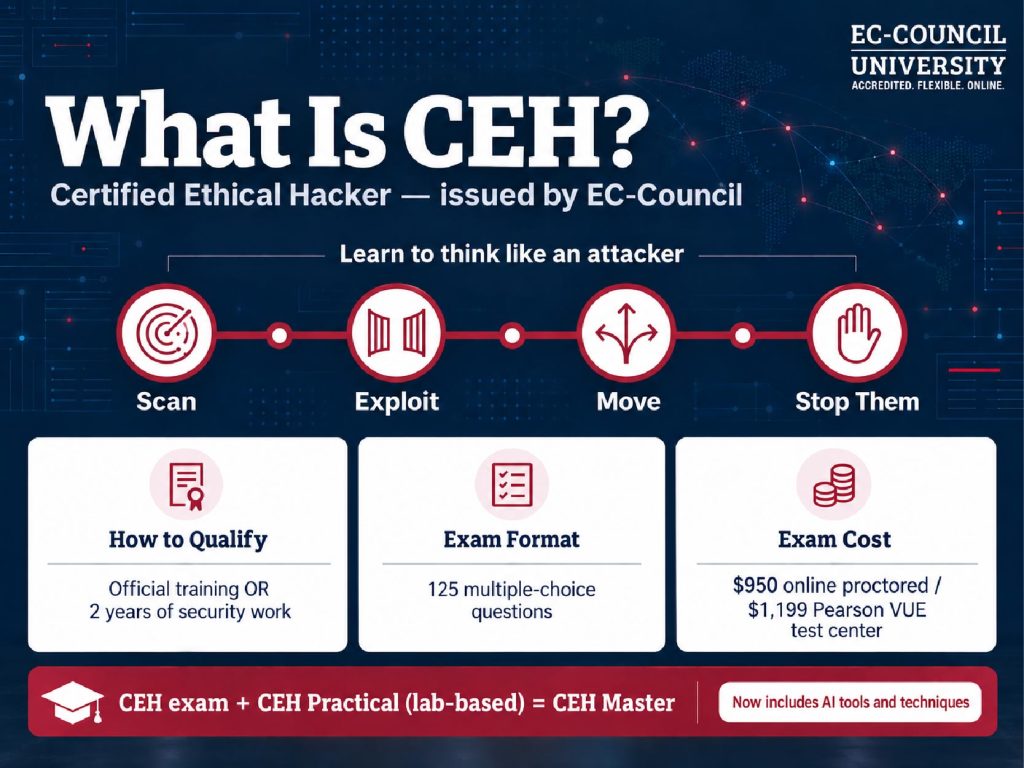
CEH focuses on offensive security. You learn how attackers scan, exploit, and move through systems. Then you learn to stop them.
You qualify through official training or two years of security work. Self-study candidates also pay a $100 eligibility fee. The CEH exam cost is $950 with online proctoring. A Pearson VUE test center costs $1,199. The knowledge exam has 125 multiple-choice questions.
Some critics call CEH too theory-heavy. The lab-based CEH Practical exam answers that. Pass both, and you earn the CEH Master title.
At ECCU, BSCS students prepare for CEH inside their coursework. They learn on EC-Council’s own material, not a third-party bootcamp. Here is why certifications like CEH matter for graduates.
What Is CISM? (Certified Information Security Manager)
ISACA issues the CISM. It targets people who run security programs rather than build controls. The exam tests governance, risk management, security programs, and incident management.
CISM certification requirements focus on leadership. You need five years of security management experience.
The CISM exam cost depends on membership. ISACA members pay $575. Non-members pay $760. Expect a $50 application fee after you pass. The exam holds 150 questions.
CISM fits security managers, GRC leads, and engineers moving into leadership.
CISSP vs. CEH vs. CISM: Head-to-Head Comparison
| CISSP |
CEH | CISM | |
|---|---|---|---|
| Issuing body | ISC2 | EC-Council | ISACA |
| Primary focus | Security leadership and architecture | Offensive security and pen testing | Governance, risk, and program management |
| Experience required | 5 years in 2+ domains |
Official training or 2 years | 5 years in security management |
| Exam cost | $749 | $950 online, $1,199 test center |
$575 member, $760 non-member |
| Exam format | 100 to 150 adaptive questions | 125 questions | 150 questions |
| Ideal role | Architect, director, CISO | Pen tester, ethical hacker, analyst | Security manager, GRC lead |
| Typical U.S. salary range | $84k to $181k |
$60k to $142k |
$87k to $200k |
Salary ranges reflect Payscale data for certified U.S. professionals.
CISSP draws far more online searches than CEH or CISM. That reflects awareness, not better value.
Which Certification Should You Pursue in 2026?
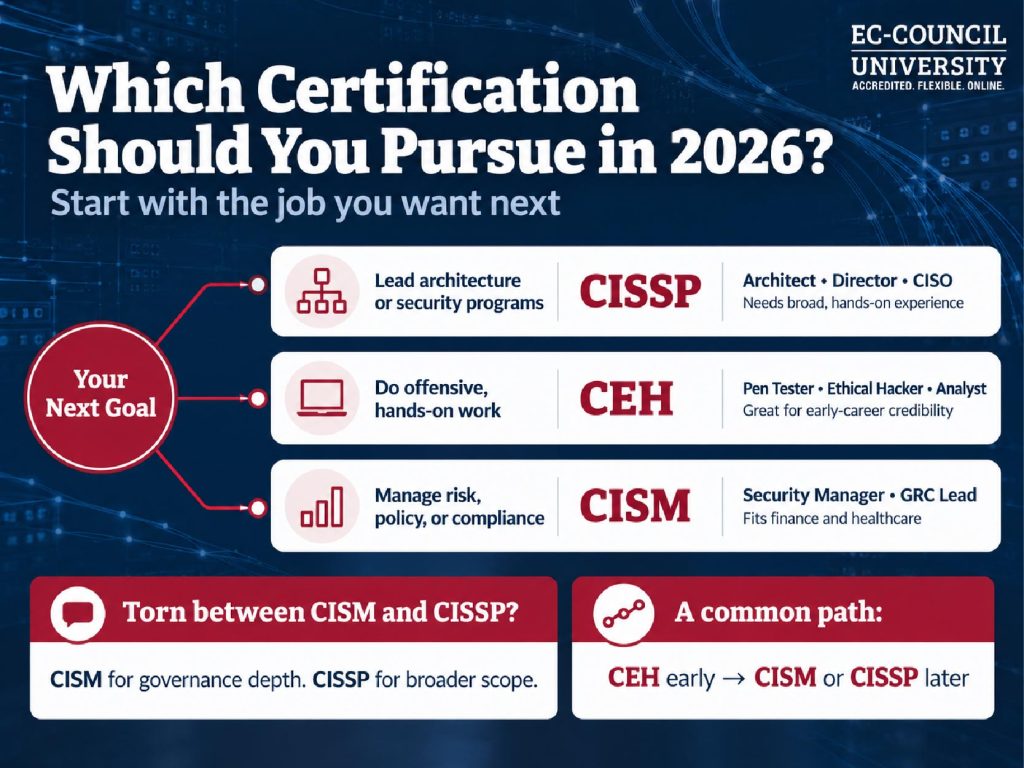
- Choose CISSP if you want to lead architecture or security programs. You should already have broad, hands-on experience.
- Choose CEH if you want offensive, hands-on work. It also helps early-career analysts build credibility fast
- Choose CISM if you manage risk, policy, or compliance. It fits regulated fields like finance and healthcare.
How ECCU Supports All Three Certification Paths
EC-Council University is part of EC-Council, the body that issues CEH.
The Bachelor of Science in Cyber Security is a 60-credit completer program. Its core courses map to CEH, CND, CHFI, CTIA, and CSA exams. A new applied AI elective adds the AIE exam. Students can sit each exam after passing the matching course. Courses on risk, policy, and compliance build early governance skills. The degree can also count toward CISSP’s experience requirement.
The Master of Science in Cyber Security runs 36 credits. Its core includes CEH and CND courses plus leadership and management study. The Executive Leadership specialization adds a CCISO-mapped governance course. Students who pass it can attempt the Associate C|CISO exam. This coursework covers governance and risk topics CISSP and CISM test. See how the MSCS compares with CISSP.
ECCU holds accreditation from the Distance Education Accrediting Commission. Its courseware also maps to the NICE cybersecurity framework. See how graduates use dual certifications to boost their careers.
Ready to build your career on the right certification track? Explore ECCU’s BSCS in Cyber Security. EC-Council’s own CEH exam sits right inside your coursework.
Aiming for leadership instead? The MSCS in Cyber Security builds governance skills CISSP and CISM value.