Colleges exist to open minds and protect young futures. Yet campuses now sit high on attacker target lists. Few people hear about it. That silence is the quiet crisis.
Universities hold a rare mix of valuable data. They also run open networks built for sharing. A single cyber attack can stall classes, payroll, and research for weeks.
This blog explains why campuses have become prime targets. It covers the threats hitting schools right now. It shows why so few incidents make news. It also makes a harder case. The deepest problem is a shortage of skilled defenders and cyber-literate leaders. Both gaps can be closed.
Key Takeaways
- Ransomware attacks on colleges rose this year while K-12 attacks fell.
- One vendor breach can now expose thousands of campuses at once.
- Most campus breaches reach regulators long before they reach reporters.
- Stolen logins and phishing emails open the door to most attacks.
- Many universities lack the in-house skills to stop attacks in time.
- Cyber-literate leaders shorten incidents and protect institutional trust.
- Growing your own defenders beats renting outside help forever.
Why Campuses Have Become Prime Targets for Cyber Attacks
Universities are built to connect people. For attackers, that openness looks like an unlocked door.
One campus can run hundreds of separate systems. Departments often buy and manage their own tools. Students bring laptops, phones, and consoles onto the network. Each is another way in.
The data behind that door is rich. Few sectors face cyber security threats aimed at so much at once:
- Social Security numbers and financial aid records
- Student health and counseling files
- Research data and unpublished intellectual property
- Passport and visa details for international students
Budgets rarely match that risk. Many campus teams are small groups of generalists. They juggle patching, help desk tickets, and audits. No wonder education ranks among the industries most vulnerable to cyber attacks.
The Numbers Behind the Quiet Crisis
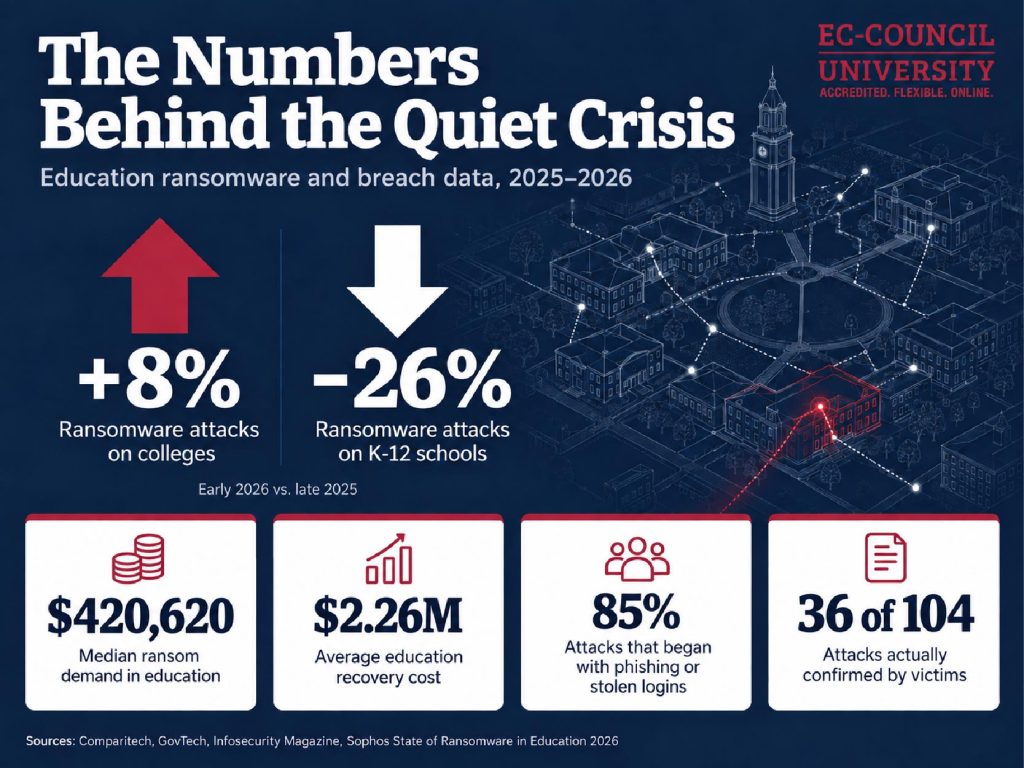
Recent ransomware attacks reveal a clear split in education. In early 2026, attacks on colleges rose more than 8%. Attacks on K-12 schools fell 26% over the same stretch. Both compare against late 2025.
The median ransom demand in education hit $420,620. Many gangs rent their tools through ransomware-as-a-service models. That lowers the skill bar.
Recovery costs more. Sophos puts average education recovery costs at $2.26 million.
The largest shock of 2026 came from a vendor. This spring, hackers hit Instructure, the company behind Canvas. The group claimed data on 275 million students, teachers, and staff. It said nearly 9,000 schools were caught up. Instructure has not confirmed those totals. Still, outages hit many colleges during finals. It proved online learning platforms can become single points of failure.
Recent cyber attacks on single campuses hurt too. A 2025 Columbia University breach exposed about 870,000 people. Stolen files included financial aid and health details.
AI now lets attackers write flawless phishing emails in seconds. Sophos found identity-based techniques in 85% of education ransomware attacks.
Why So Few Campus Breaches Make the News
Colleges do face reporting rules. Schools handling federal student aid fall under the FTC Safeguards Rule. They must report breaches affecting 500 or more people. The deadline is 30 days after discovery.
Those notices go to regulators and state attorneys general, not front pages. A pending federal rule, CIRCIA, keeps slipping.
Many attacks are never confirmed. Trackers logged 104 education ransomware attacks in early 2026. Victims confirmed only 36 of them.
Some intrusions hide. Strayer and Capella’s parent company missed one for 87 days.
Recent data breaches at vendors blur the story further. When Canvas goes down, no single school owns the headline. Enrollment also runs on trust, so silence feels safer. Yet the consequences of data breaches still land on students for years.
The Real Gap Is People, Not Tools
Most advice stops at one step: hire a vendor. Managed services help. But someone inside must still know the network and make the calls.
Sophos surveyed education leaders hit by ransomware in 2026. At colleges, 53% lacked the skills to catch attacks in time. The cross-sector average was 35%.
Tools are rarely the missing piece. A June 2026 FireMon study reviewed firewall rules. It found 69% of rules sat unused. Another 45% had no owner or documentation. The technology existed. Nobody had time to steer it.
Thin teams burn out. Security leadership was replaced after 29% of college ransomware attacks. The toll on CISO mental health is real.
EC-Council University builds certification prep directly into its degrees. EC-Council created the CEH, CND, and CHFI certifications. The BSCS covers all three in core courses. Students can sit for each exam after passing the matching course. Virtual labs add hands-on practice.
ECCU’s MSCS goes deeper for working IT staff. Its core covers network defense and ethical hacking. The Digital Forensics specialization prepares students for CHFI. The Incident Management and Business Continuity track covers incident handling. These match the SOC and response roles campuses need.
The Governance Blind Spot
Presidents, provosts, and CFOs make the hardest incident calls. Should we pay? What do we tell students? When do we call the FBI?
Many leaders lack the fluency to answer quickly. After attacks, 53% of college teams felt more pressure from leadership.
Campuses need people who translate technical risk into budget decisions. ECCU’s MBA offers a Cybersecurity Executive Leadership and Governance specialization. Courses span executive governance, change management, and AI governance. One prepares students for the C|CISO exam.
What Campuses Can Do Now
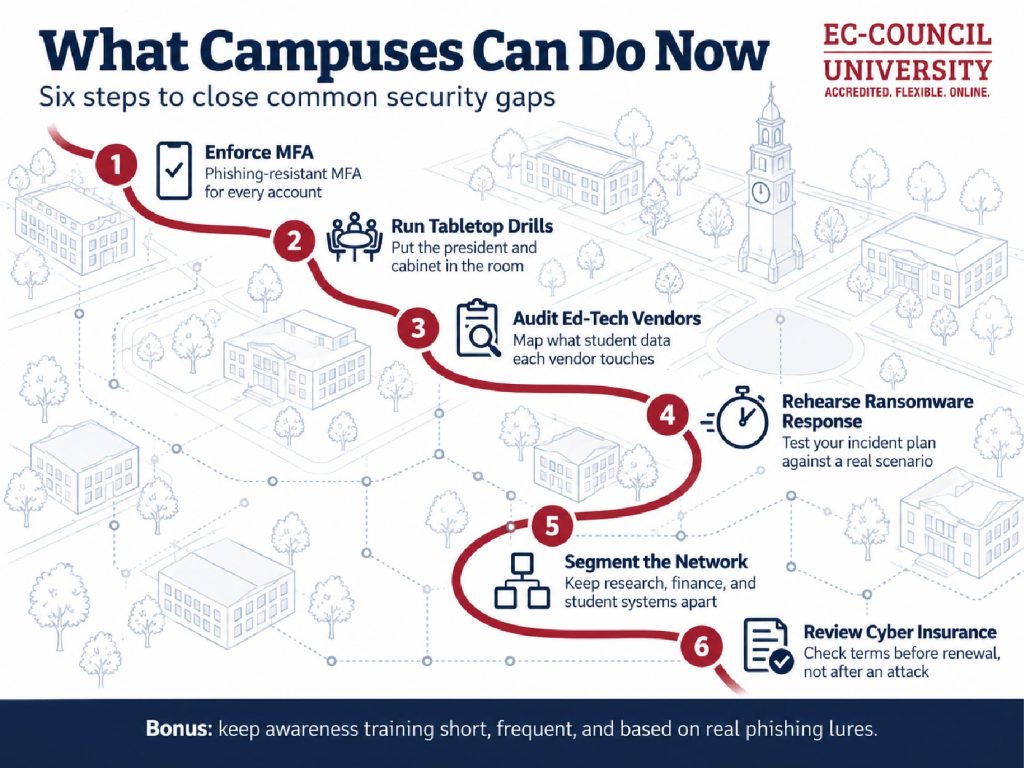
These steps close common gaps without a huge budget:
- Require phishing-resistant MFA for every account, including students.
- Run tabletop exercises with the president and cabinet present.
- Audit ed-tech vendors yearly and map what data they touch.
- Test your incident response plan against a ransomware scenario.
- Separate research, finance, and student networks from each other.
- Review cyber insurance terms before renewal, not after an attack.
From Reactive to Resilient
The quiet crisis in higher education has clear causes: open networks, rich data, and thin teams. Each can change.
Tools help, but people make them work. Campuses that grow their own defenders respond faster. Cyber-literate leaders make steadier calls under pressure.
Higher ed doesn’t need more vendors. It needs more defenders. Explore ECCU’s cybersecurity degrees, built around EC-Council’s CEH, CND, and CHFI certifications.