
Why Cybersecurity Will Remain a Smart Career Choice in 2027
For tech-savvy professionals looking for a career with strong earning potential, long-term relevance, and opportunities to work with emerging technologies, cybersecurity remains one of the most compelling fields to consider in 2027. Here’s data to underscore why:
- The U.S. Bureau of Labor Statistics (BLS) projects employment of information security analysts to grow 21% from 2025 to 2035(1), adding approximately 14,100 job openings each year during that period. That is dramatically faster than the 3% projected growth for all other occupations.
- CyberSeek(2) recorded 514,359 U.S. cybersecurity job listings during its May 2024–April 2025 reporting period, while 10% of listings specifically referenced AI security skills.
- ISC2’s 2025 Cybersecurity Workforce Study (3) states that 95% of survey respondents identified AI security, cloud security, risk assessment, application security, security engineering, and GRC as critical cybersecurity domains facing urgent talent shortages.
So the message is clear. As cybersecurity evolves, the highest-value career opportunities are at the intersection of cybersecurity and AI, cloud, software, identity, risk, governance, and executive leadership.
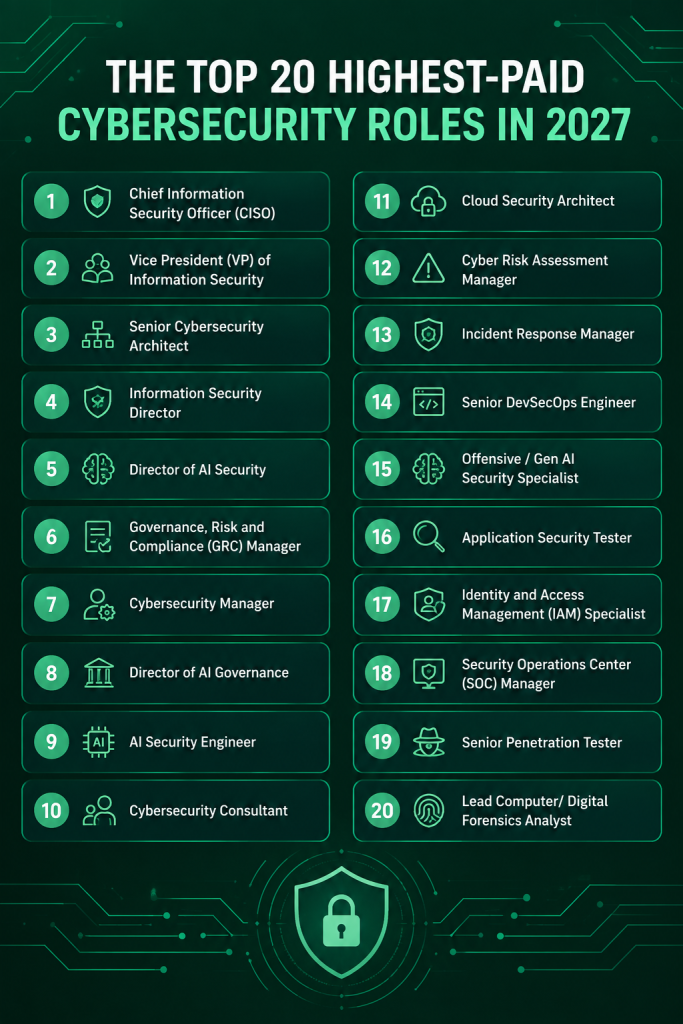
Let’s take a look at the 20 most lucrative cybersecurity job roles for 2027:
The Top 20 Highest-Paid Cybersecurity Roles to Watch in 2027
1. Chief Information Security Officer (CISO)
- Annual salary range: $348,529 – $430,645 (Salary.com)
CISOs establish enterprise cybersecurity strategy, oversee security teams and budgets, manage cyber risk, and communicate security priorities to executive leadership and boards. Demand for certified CISOs will climb in 2027 as organizations increasingly treat cybersecurity as an enterprise risk and business-resilience function. ISC2 reports continued demand for leadership and governance skills in the global cybersecurity industry.
Core Skills:
- Cybersecurity strategy & leadership
- Enterprise cyber risk management
- Governance, Risk & Compliance (GRC)
- Security budgeting & resource management
- Executive & board communication
2. Vice President (VP) of Information Security
- Annual Salary range: $234,090 – $270,608 (Salary.com)
VPs of Information Security translate corporate strategy into security programs, lead large teams, and oversee enterprise security architecture, risk, and operations. Growing technology complexity, cloud adoption, and AI deployment will require senior security leaders capable of connecting technical controls with business objectives.
Core Skills:
- Enterprise security strategy
- Security program leadership
- Cyber risk management
- Security architecture oversight
- Executive stakeholder management
3. Senior Cybersecurity Architect
- Annual Salary range: $197,701 – $220,692 (Salary.com)
Senior cybersecurity architects design enterprise security architectures, establish security protocols, and ensure infrastructure, applications, and data are protected by design. The role should benefit from continued cloud migration, AI adoption, and increasingly complex digital environments.
Core Skills:
- Enterprise security architecture
- Threat modeling
- Cloud & infrastructure security
- Security design & engineering
- Zero Trust architecture
4. Information Security Director
- Annual Salary range: $191,822 – $219,982 (Salary.com)
Information Security Directors manage security programs, personnel, policies, technology investments, and enterprise risk initiatives. Demand should grow as organizations expand cybersecurity programs and require experienced leaders to coordinate in increasingly complex security environments.
Core Skills:
- Information security management
- Cyber risk assessment
- Security governance
- Incident management
- Team & program leadership
5. Director of AI Security
- Annual Salary range: $262,000 – $517,000 (Christian & Timbers 2026 Corporate AI Compensation Study)
A role gaining rapid prominence, the Director of AI Security leads an organization’s efforts to identify and mitigate security vulnerabilities in AI models, applications, agents, and supporting infrastructure. Responsibilities can include AI threat modeling, adversarial testing, AI red teaming, model security, AI application security, and oversight of security controls.
Core skills:
- AI threat modeling
- Adversarial machine learning
- LLM security
- AI red teaming
- Penetration testing
- Incident response
- Security architecture
- Executive leadership
Want to know More About These Cybersecurity Job Roles?
6. Governance, Risk and Compliance (GRC) Manager
- Annual Salary range: $151,197 – $172,870 (Salary.com)
GRC managers build governance frameworks, coordinate compliance activities, assess cyber risk, and translate regulations and security requirements into organizational controls. GRC is one of the fastest-growing cybersecurity domains, making professionals who can bridge technical security and regulatory requirements particularly valuable.
Core Skills:
- Cybersecurity GRC
- Risk assessment & analysis
- Regulatory compliance
- Security policy development
- Audit & control management
7. Cybersecurity Manager
- Annual Salary range: $151,231 – $178,568 (Salary.com)
Cybersecurity managers supervise security personnel and operations, establish controls, manage projects, and help organizations respond to cyber threats. BLS projects 16% growth for information systems security management roles through 2035, supporting continued demand for technically proficient cybersecurity managers.
Core Skills:
- Security operations management
- Cyber risk management
- Incident response
- Security project management
- Team leadership
8. Director of AI Governance
- Annual Salary range: $250,000 – $575,000 (Christian & Timbers 2026 Corporate AI Compensation Study)
Directors of AI Governance establish the frameworks organizations use to manage AI risk, security, privacy, compliance, ethics, and accountability. They may oversee AI risk assessments, governance policies, model inventories, regulatory compliance, AI assurance, and cross-functional AI governance programs.
Core skills:
- AI governance
- Cybersecurity risk management
- Regulatory compliance
- NIST AI RMF
- AI security, privacy, and model risk
- Executive communication
9. AI Security Engineer
- Annual Salary range: $147,924 – $232,603 (AISec Engineer’s AI Security Engineer Salary Guide 2026)
AI Security Engineers design and implement controls that protect AI models, applications, data pipelines, and AI-enabled infrastructure. Their responsibilities can include securing machine-learning pipelines, identifying vulnerabilities in AI applications, protecting model interfaces, implementing access controls, and defending AI systems against adversarial attacks. The demand for this role will skyrocket as enterprise AI adoption continues to gather pace in 2027.
Core skills:
- Machine learning security
- Application security
- Cloud security
- LLM security
- Secure AI architecture
- Threat detection
- Python
- DevSecOps
10. Cybersecurity Consultant
- Annual Salary range: $131,811 – $156,003 (Salary.com)
Cybersecurity consultants assess security environments, identify vulnerabilities, develop security strategies, and advise organizations on risk reduction. Demand should benefit from organizations seeking specialized expertise without necessarily building every capability internally. ISC2 reports that organizations are increasingly using external providers and contractors to address skills shortages.
Core Skills:
- Security assessment
- Vulnerability analysis
- Risk assessment
- Security strategy & advisory
- Client & stakeholder communication
11. Cloud Security Architect
- Annual Salary range: $96,322 – $117,019 (Salary.com)
Cloud security architects design secure cloud environments, establish identity and access controls, protect workloads and data, and integrate security into cloud architectures. The continued expansion of cloud computing services is driving strong demand for expertise in cloud security architecture.
Core Skills:
- Cloud security architecture
- Identity & access management
- Cloud infrastructure security
- Data protection
- Zero Trust security
Cybersecurity Career Guidance Tip:
Consult with an ECCU Advisor for a Personalized Career Growth Blueprint
12. Cyber Risk Assessment Manager
- Annual Salary range: $117,539 – $139,249 (Salary.com)
Cybersecurity risk assessment managers are responsible for identifying cyber risks, quantifying business impact, developing mitigation strategies, and helping leadership make informed security investments. Risk assessment is a leading area of cybersecurity growth, boosting continued demand for professionals who can connect cybersecurity with enterprise risk management.
Core Skills:
- Cyber risk assessment
- Risk analysis & quantification
- Risk mitigation planning
- Governance & compliance
- Business impact analysis
13. Incident Response Manager
- Annual Salary range: $113,506 – $133,371 (Salary.com)
Incident response managers coordinate the detection, containment, investigation, and recovery of cybersecurity incidents. As organizations face increasingly sophisticated cyberattacks and AI-enabled threats, the ability to respond rapidly and minimize business disruption will remain critical in 2027.
Core Skills:
- Incident detection & response
- Digital forensics
- Threat analysis
- Incident containment & Disaster recovery
- Crisis & stakeholder management
14. Senior DevSecOps Engineer
- Annual Salary range: $119,015 – $141,998 (Salary.com)
Senior DevSecOps engineers integrate security into software development and CI/CD pipelines, automate security testing, and help development teams build secure applications faster. Digital-first businesses need secure software programming experts as they prioritize a security-by-design approach to software development.
Core Skills:
- Secure CI/CD pipelines
- Application security
- Security automation
- Infrastructure as Code (IaC) security
- Vulnerability & dependency management
15. Offensive / Gen AI Security Specialist
- Annual Salary range: $124,000 – $160,000 (ZipRecruiter)
Offensive / Gen AI security specialists deliberately attempt to compromise AI systems so organizations can identify weaknesses before malicious actors exploit them. Their highly valued work encompasses prompt-injection testing, jailbreak testing, model manipulation, data exfiltration testing, adversarial testing, and security assessment of AI agents and LLM-powered applications.
Core skills:
- LLM security
- Prompt injection
- Adversarial machine learning
- Penetration testing
- Vulnerability research
- Threat modeling
- Python
- Agentic AI
- Offensive cybersecurity
16. Application Security Tester
- Annual Salary range: $88,180 – $106,058 (Salary.com)
Application security testers identify software vulnerabilities, conduct app security testing, and embed secure development practices throughout the software lifecycle. ISC2 lists application security among the most pressing cybersecurity skills needs in 2027.
Core Skills:
- Secure software development
- Application vulnerability assessment
- Penetration testing
- DevSecOps
- Secure coding practices
17. Identity and Access Management (IAM) Specialist
- Annual Salary range: $102,710 – $119,926 (Salary.com)
IAM specialists manage authentication, authorization, identity lifecycle processes, privileged access, and access controls. As organizations expand cloud services, remote access, and digital identities, controlling who can access what, and under which conditions, will remain fundamental to enterprise security in 2027.
Core Skills:
- Identity lifecycle management
- Authentication & authorization
- Privileged access management (PAM)
- Access governance
- Identity security & Zero Trust
18. Security Operations Center (SOC) Manager
- Annual Salary range: $95,312 – $123,353 (Salary.com)
SOC managers lead security monitoring and detection teams, oversee incident escalation, and improve operational security processes. The continuing volume and sophistication of cyber threats should sustain demand for professionals capable of managing 24/7 detection and response capabilities over the coming years.
Core Skills:
- Security monitoring & detection
- Incident response
- SIEM management
- Threat detection & analysis
- SOC team & operations management
19. Senior Penetration Tester
- Annual Salary range: $123,223 – $143,446 (Salary.com)
Senior penetration testers simulate attacks against networks, applications, and infrastructure to expose vulnerabilities before real attackers can exploit them. As organizations deploy more applications, APIs, cloud workloads, and AI-enabled systems, penetration testing expertise will become increasingly valuable for validating defensive controls.
Core Skills:
- Penetration testing
- Vulnerability exploitation
- Network & application security testing
- Threat modeling
- Offensive security
- Threat reporting
20. Lead Computer / Digital Forensics Analyst
- Annual Salary range: $138,571 – $151,420 (Salary.com)
Computer or digital forensics analysts are highly technical cybersecurity professionals. At a senior level, they are responsible for acquiring and analyzing digital evidence, investigating compromised systems, reconstructing events, documenting findings, and supporting legal or organizational investigations, all of which are important cybersecurity functions in 2027.
Core Skills:
- Disk forensics
- Memory analysis
- File-system analysis
- Evidence acquisition
- Malware investigation
- Timeline reconstruction
- Chain of custody
- Forensic documentation and reporting
Equip Yourself for Success in 2027’s Cybersecurity Employment Landscape
If you’re targeting any of the job roles listed above, EC-Council University (ECCU) can give you the perfect platform to achieve your career goals. Our accredited cybersecurity degrees and certification courses are ideal for working professionals seeking to balance a range of responsibilities while pursuing impactful qualifications.
Explore our portfolio of learning options based on your area of cybersecurity interest:
- Executive leadership in enterprise security
- Ethical hacking
- Penetration testing
- Network defense
- Digital forensics
- Threat intelligence
- SOC operations
- Application security
- Cloud security
- Incident response
- Offensive AI security
- AI governance and ethics
Need help making the right learning choice?
Frequently Asked Questions about cybersecurity jobs in 2027
What is the highest-paying cybersecurity job in 2027?
The Chief Information Security Officer (CISO) is among the highest-paid U.S. cybersecurity positions. Salary.com benchmarks in September 2026 place the annual salary range of this role at approximately $348,529–$430,645, although compensation varies significantly by organization, industry, location, experience, and total compensation structure.
Are cybersecurity jobs expected to grow in 2027?
Yes. The U.S. Bureau of Labor Statistics projects 21% employment growth for information security analysts from 2025 to 2035, which is much faster than the average for all other occupations. Growing needs in AI, cloud, and application security, as well as cyber risk management, are driving a boom in cybersecurity hiring.
Which cybersecurity skills will be most valuable in 2027?
AI security, cloud security, risk assessment, application security, security engineering, and GRC are among the most important cybersecurity skills of 2027. Combining these technical capabilities with communication, business management, and leadership skills can elevate your career prospects and professional standing.
Is cybersecurity a good career choice for tech professionals in 2027?
Yes. Cybersecurity offers strong long-term career stability and growth potential because organizations must continuously protect increasingly complex digital environments from ever-evolving cyber threats. AI and other innovations have accelerated the demand for skilled cybersecurity professionals, and this trend shows no signs of slowing down in 2027.
What are the highest-paying AI cybersecurity jobs in 2027?
The highest-paying AI cybersecurity roles include Director of AI Security, Director of AI Governance, AI Security Engineer, and Offensive AI Security Specialist. Senior leadership positions can command compensation well above $250,000 annually, particularly at large multinational corporations.