
Quick Answer
How Surveillance and Cybersecurity Coexist
Walk through an airport, enter a downtown office building, use a smartphone, drive on a major highway, or connect to a public Wi-Fi network, and there is a good chance that some form of digital monitoring is taking place around you. Cameras record activity. License-plate readers identify vehicles. Access-control systems authenticate people. Telecommunications networks generate metadata. Online services create activity logs. Security systems monitor network traffic. Increasingly, AI can analyze all this information and identify patterns that are nearly impossible for humans to detect manually.
This expanding surveillance ecosystem is usually discussed in terms of privacy, civil liberties, law enforcement, espionage, or national security. But there is another dimension that deserves closer attention: cybersecurity.
From a cybersecurity perspective, surveillance can be both a source of risk and a defensive asset. The basic proposition is relatively simple: you cannot detect what you cannot see. Cybersecurity teams depend on visibility into networks, endpoints, identities, applications, and user activity to recognize suspicious behavior. The Cybersecurity and Infrastructure Security Agency (CISA), for example, recommends centralized logging and monitoring because defenders with insufficient visibility may struggle to identify unauthorized activity, lateral movement, and other indicators of compromise.
At a larger scale, surveillance can provide governments and security organizations with information that may help identify criminal activity, investigate incidents, understand foreign cyber threats, and protect critical infrastructure.
But there is an important distinction to make before going further:
Surveillance Does Not Automatically Mean Mass Surveillance
Targeted surveillance and mass surveillance are technically and operationally different. Targeted surveillance generally focuses on a defined individual, device, account, location, communication, or threat. Mass surveillance, by contrast, involves collecting or analyzing information about very large populations, potentially including people who are not themselves suspected of wrongdoing.
There are also many different technologies involved. Mass surveillance can include:
- CCTV and other video surveillance
- Facial recognition systems
- License plate readers
- Telecommunications metadata
- Network monitoring
- Location information
- Biometric identification
- Access-control systems
- Internet and communications monitoring
- Sensor networks
- Large-scale data analytics
Consequently, there is no single technology called “mass surveillance.” Rather, it is better understood as a large-scale information-collection and analysis ecosystem. And this ecosystem creates a fundamental cybersecurity tension: The more information defenders can observe, the more opportunities they may have to identify threats. But the more information they collect, the more information there is to protect.
This article examines that tension in three steps: the cybersecurity advantages of mass surveillance, its disadvantages, and how AI is changing both.
| Area | Cybersecurity Benefit | Cybersecurity Risk |
|---|---|---|
| Data volume | Greater visibility and earlier threat detection | Larger attack surface and more data to protect |
| Centralization | Cross-system correlation and threat intelligence | High-value repository attractive to attackers |
| Biometrics | Stronger identity verification and access control | Irreplaceable data if compromised |
| Access | Faster investigation and forensics | Insider misuse and function creep |
| AI analysis | Automated anomaly detection at scale | New attack surfaces, false positives, re-identification |
Advantages: How Mass Surveillance Can Strengthen Cybersecurity
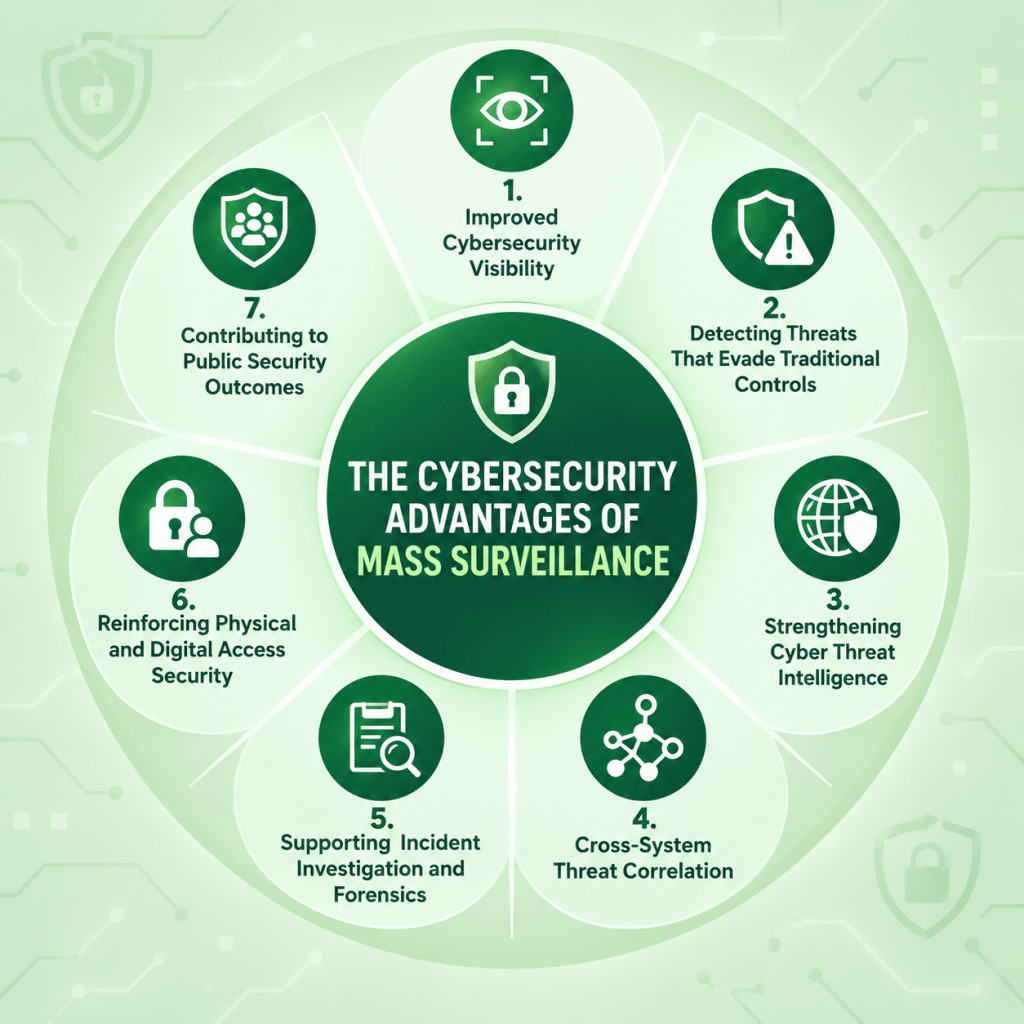
1. Improved Cybersecurity Visibility
Modern attacks often begin with subtle indicators rather than obvious alarms. Consider an employee account that:
- Logs in at an unusual time
- Accesses an unfamiliar server
- Downloads an unusually large amount of data
- Communicates with a suspicious external address
Individually, these events might not appear conclusive. Correlated together, they could reveal a potential compromise.
CISA’s cybersecurity guidance emphasizes logging and constant monitoring precisely because centralized data can help defenders identify anomalies, lateral movement, and other indicators of compromise. Mass surveillance helps turn isolated events into meaningful cybersecurity signals.
2. Detecting Threats That Evade Traditional Controls
Attackers increasingly use legitimate credentials, administrative tools, and other techniques designed to blend into normal activity.
In a CISA red-team assessment, simulated attackers were able to establish access and move laterally through an environment. CISA identified insufficient monitoring as a significant weakness and recommended stronger visibility into lateral movement, persistence, and command-and-control activity.
This illustrates an important role for mass surveillance. It may not prevent every intrusion, but it can help reduce the time between compromise and detection in critical circumstances. The longer an attacker remains undetected, the greater the opportunity to escalate privileges, move through systems, and access sensitive information.
3. Strengthening Cyber Threat Intelligence
Mass surveillance can also provide information beyond an individual network. At the national security level, intelligence acquired through mass surveillance can reveal information about foreign cyber actors, their operations, and their attack activity.
For example, the Privacy and Civil Liberties Oversight Board’s 2026 report found that information collected under Section 702 contributed to 24% of NSA intelligence reports in both 2024 and 2025. During the second half of fiscal year 2025, the report said that information collected through Section 702 accounted for 95% of the FBI’s unminimized technical reporting on cyber threats. Importantly, Section 702 is legally structured as targeted foreign intelligence collection, rather than indiscriminate surveillance of the entire U.S. population. Nevertheless, the figures demonstrate how intelligence collection using mass surveillance can contribute to cyber-threat awareness.
4. Cross-System Threat Correlation
- The same malicious infrastructure
- Similar attack techniques
- Recurring timing patterns
- Identical malware behavior
5. Supporting Incident Investigation and Forensics
After an attack, defenders need to reconstruct what happened. Surveillance data can help establish:
- When suspicious activity began
- Which accounts were used or compromised
- Which systems were accessed
- How an attacker moved through an environment
- Whether physical and digital events were connected
6. Reinforcing Physical and Digital Access Security
Mass surveillance technologies can also become security controls themselves. The U.S. Government Accountability Office found that 16 of 24 surveyed federal agencies reported using facial recognition for digital access or cybersecurity purposes, while five reported using it for physical security. Fourteen agencies reported using facial recognition to unlock government-issued smartphones.
Similarly, cameras and access-control systems can help protect critical infrastructure like power plants and data centers.
The underlying principle is that modern cybersecurity increasingly depends on protecting both digital systems and the physical environments in which they operate.
7. Contributing to Public Security Outcomes
Mass surveillance can also support security outside conventional cybersecurity environments. A systematic review covering 40 years of CCTV research found a statistically significant but modest overall reduction in crime associated with CCTV. Effects were stronger in certain environments, particularly parking lots, and when CCTV was combined with other interventions.
This finding highlights an important qualification: More surveillance does not automatically produce proportionally more security.
Effectiveness depends on where surveillance is deployed, what threat it addresses, how actively it is monitored, and whether other security measures support it.
The Central Advantage: Visibility
Across network monitoring, intelligence collection, video surveillance, biometrics, and access-control systems, one benefit consistently emerges: Surveillance increases visibility. And visibility can help organizations and governments:
- Detect suspicious activity
- Correlate seemingly unrelated events
- Investigate security incidents
- Identify potential threats
- Respond more quickly
- Protect physical and digital infrastructure
But that same visibility creates a fundamental cybersecurity dilemma. Every additional camera, sensor, database, biometric record, and intelligence platform produces information that must itself be protected.
A surveillance system can therefore become both a tool for detecting attackers and a target worth attacking. This is where the cybersecurity advantages of mass surveillance begin to collide with its disadvantages.
Disadvantages: How Mass Surveillance Can Weaken Cybersecurity
Visibility has another side. The more information an organization collects, the more information it must secure; the more systems it connects, the more potential entry points it creates. This creates the surveillance paradox: a system designed to improve security can itself introduce significant cybersecurity and privacy risks. These 11 concerns are hard to overlook:
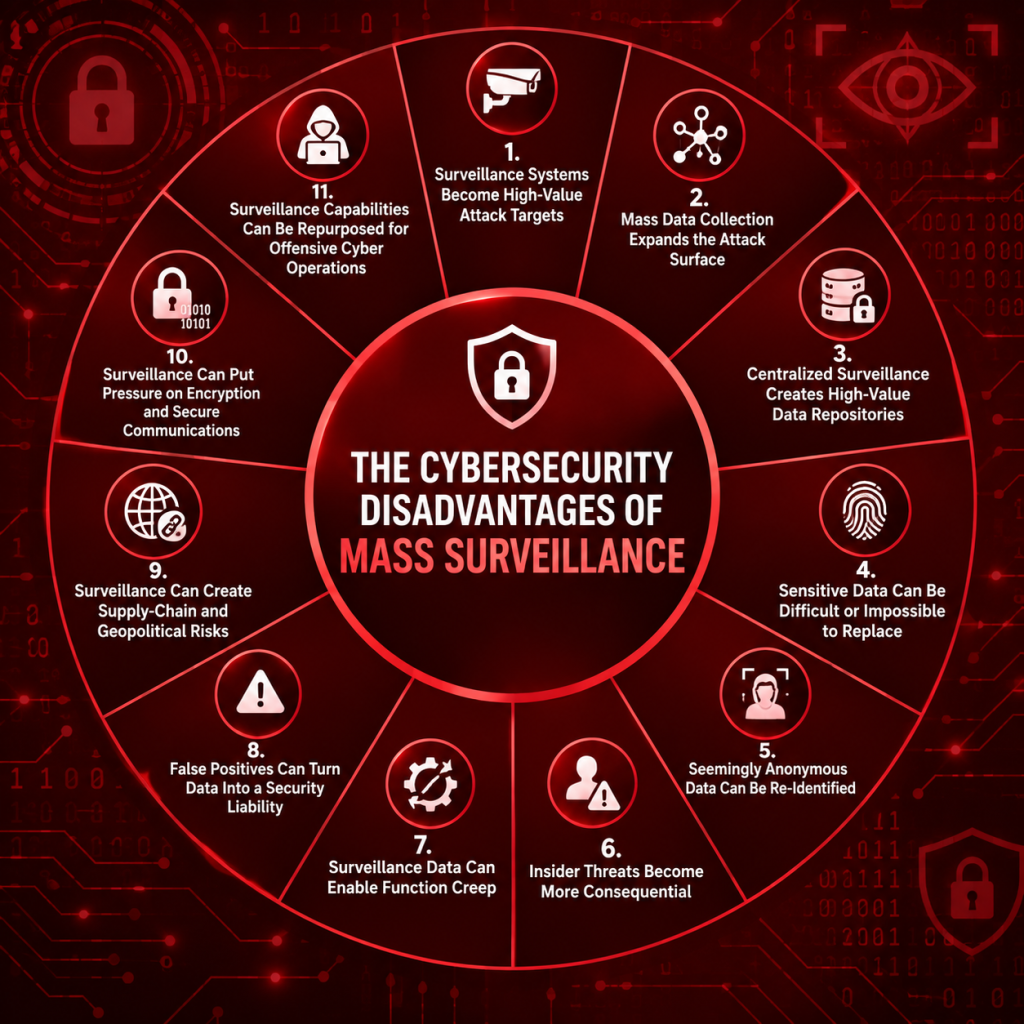
1. Surveillance Systems Become High-Value Attack Targets
A surveillance system can be both a security control and an attractive target. Cameras, biometric databases, monitoring platforms, sensors, access-control systems, cloud dashboards, and associated networks can contain valuable information about people, locations, movements, facilities, and security procedures. This information can be useful to attackers for intelligence gathering, extortion, fraud, stalking, espionage, or preparation for a larger intrusion.
The risk is not theoretical. In 2023, the U.S. Federal Trade Commission (FTC) alleged that security-camera company Ring failed to adequately protect customer accounts against credential-stuffing attacks. According to the FTC’s complaint, attackers gained access to stored videos, live video streams, and account profiles associated with approximately 55,000 U.S. customers. The incident, which resulted in hefty financial penalties for Ring, also illustrates a fundamental cybersecurity problem: the security system itself can become the target of the breach.
2. Mass Data Collection Expands the Attack Surface
Mass surveillance rarely depends on a single device. A large surveillance ecosystem may include cameras, microphones, sensors, mobile devices, networks, APIs, cloud storage, analytics platforms, identity systems, third-party providers, and administrative interfaces. Every additional component introduces another opportunity for misconfiguration, exploitation of vulnerabilities, credential theft, or unauthorized access.
The U.S. Government Accountability Office (GAO) states that federal agencies rely on extensive telecommunications and video-surveillance equipment and warns that foreign adversaries could exploit vulnerabilities in that equipment. The report also noted that agencies had identified vulnerable devices connected to their networks. The lesson for cybersecurity professionals is important: surveillance architecture must be treated as part of an organization’s attack surface, not as an isolated security tool.
3. Centralized Surveillance Creates High-Value Data Repositories
Centralization can make surveillance data easier to analyze. It can also make it more attractive to attackers. Consider a database that combines facial images, location histories, access records, vehicle information, timestamps, and behavioral patterns. An attacker who compromises that repository may obtain considerably more intelligence than they would from compromising any individual camera or sensor.
This is one reason cybersecurity and privacy cannot be treated as the same problem. NIST explains that cybersecurity focuses on protecting systems and information against unauthorized access, disclosure, disruption, modification, or destruction. At the same time, privacy addresses risks created by the processing of information throughout its lifecycle. In other words, a database can be securely protected from hackers and still create privacy risks simply because of what it collects, how it is processed, or what can be inferred from it.
4. Sensitive Data Can Be Difficult or Impossible to Replace
Passwords can be changed, encryption keys can be rotated, and access tokens can be revoked. But biometric characteristics are different. A person’s face, fingerprint, iris pattern, voice, or other physical characteristics are intrinsically connected to that person. If sensitive biometric information is compromised, the affected individual cannot simply replace the underlying characteristic. This makes surveillance systems containing biometric information particularly consequential targets.
The problem becomes even more significant when biometric data is combined with other information. A facial image may identify a person; a location record may reveal where they go; access records may show where they work; and timestamps can establish patterns of behavior. The resulting dataset can reveal far more than any single data point.
5. Seemingly Anonymous Data Can Be Re-Identified
Removing a name from a dataset does not necessarily make the underlying information anonymous. A widely cited study published in Nature analyzed 15 months of mobility data involving 1.5 million people and found that four randomly selected spatiotemporal points were sufficient to uniquely identify 95% of individuals in the dataset. This demonstrates why surveillance datasets can become particularly sensitive when they contain persistent behavioral or location information.
For cybersecurity teams, the implication is significant: data minimization and de-identification should not be treated as purely administrative concerns. They can directly reduce the amount of information an attacker can exploit if a surveillance repository is compromised.
6. Insider Threats Become More Consequential
Not every surveillance breach requires an external hacker. Employees, contractors, administrators, investigators, or other authorized users may already possess legitimate access to surveillance systems. This creates a difficult security challenge: the organization must determine not only who can access the data, but also what they are allowed to do with it, why they are accessing it, and whether their activity is appropriate.
The risks can increase when organizations rely on third-party surveillance platforms. The GAO has previously identified situations in which federal law enforcement agencies used non-federal facial recognition systems without adequate mechanisms to track employee use. Therefore, strong authentication, least-privilege access, audit logging, monitoring, separation of duties, and regular access reviews become essential controls.
7. Surveillance Data Can Enable Function Creep
Information collected for one security purpose can later become useful for another. A camera originally installed to protect a facility might subsequently be used for behavioral analysis. A biometric system introduced for authentication might later support identification. Location information collected for operational purposes might become useful for investigative or analytical activities.
This phenomenon, often described as function creep, creates cybersecurity and governance challenges because the original security justification may no longer describe how the data is actually being used. For surveillance systems, it means organizations need clear rules governing what is collected, why it is collected, how long it is retained, who can access it, and whether it can be repurposed. ECCU’s overview of the ethical dilemmas security professionals face explores how privacy and security are balanced in practice.
8. False Positives Can Turn Data Into a Security Liability
More surveillance data does not automatically mean more accurate security decisions. Surveillance technologies can generate false matches, incorrect alerts, incomplete context, or misleading correlations. From a cybersecurity perspective, false positives can have two consequences. First, security teams may waste time investigating harmless activity. Second, repeated inaccurate alerts can contribute to alert fatigue, potentially making genuinely important signals harder to recognize.
Effective surveillance requires not just data collection, but reliable analysis, appropriate thresholds, human review, and continuous validation.
9. Surveillance Can Create Supply-Chain and Geopolitical Risks
Surveillance infrastructure frequently depends on hardware and software supplied by multiple vendors. That creates supply chain risks involving firmware, cloud services, software updates, remote management capabilities, credentials, vendor access, and component security.
In May 2026, the GAO reported that U.S. federal agencies had taken steps to identify and address cybersecurity risks associated with certain telecommunications and video-surveillance equipment thought to originate in China. The broader cybersecurity lesson is not limited to any particular country or vendor: surveillance technology must be evaluated within the entire technology supply chain.
10. Surveillance Can Put Pressure on Encryption and Secure Communications
Efforts to increase surveillance can create tension with end-to-end encryption and other security mechanisms. The Internet Architecture Board (IAB) has warned that mandatory client-side scanning can undermine end-to-end encryption and create technologies that could facilitate broader surveillance or censorship. The IAB has also emphasized that mechanisms designed to weaken secure communications can reduce security for Internet users more broadly. This creates an important cybersecurity dilemma: a mechanism introduced to make communications more observable may simultaneously make those communications less resistant to interception or abuse.
For cybersecurity professionals, the question is therefore not simply whether information can be made visible. It is whether increasing visibility weakens the protective mechanisms that keep the underlying infrastructure secure.
11. Surveillance Capabilities Can Be Repurposed for Offensive Cyber Operations
Surveillance technology does not always remain a passive monitoring capability. Highly capable surveillance tools can become offensive assets when they are used to identify targets, exploit devices, obtain sensitive information, or maintain persistent access. The Citizen Lab’s investigation of the Pegasus spyware ecosystem provides a notable example. Researchers documented FORCEDENTRY, a zero-click exploit targeting Apple’s iMessage processing that was used to install Pegasus spyware on a targeted device.
This illustrates a broader point: surveillance capability and offensive cyber capability can overlap. Once powerful monitoring capabilities exist, protecting them from unauthorized use becomes as important as protecting the data they collect.
The Central Disadvantage: More Visibility Means More Responsibility
The cybersecurity disadvantages of mass surveillance do not necessarily invalidate every surveillance application. Instead, they expose a critical principle: Collecting more information does not automatically create more security.
Surveillance can improve visibility while simultaneously increasing the number of systems to defend, the volume of sensitive data to protect, the consequences of a breach, and the complexity of determining appropriate access and use. The strongest cybersecurity architecture for surveillance ecosystems must clearly define:
- What information do we actually need?
- What happens if the system is compromised?
- Who can access the data?
- How long should data be retained?
- Can the information be minimized or de-identified?
- What happens if surveillance technology produces an incorrect result?
- Could the capability be repurposed?
- Does increased monitoring weaken other security controls?
- What’s the chain of command in the event of a cyberattack?
These questions become even more important as AI takes center stage.
The Influence of AI on Mass Surveillance and Cybersecurity
Traditional surveillance primarily focused on collecting, storing, and retrieving information. AI increasingly allows surveillance systems to analyze, correlate, classify, predict, and act on information at scale. That can make surveillance more useful as a cybersecurity capability, but it can also make its failures more consequential. This shift is part of a broader change described in ECCU’s top cybersecurity trends of 2026. Here are eight ways AI is altering mass surveillance and the cybersecurity implications that result:
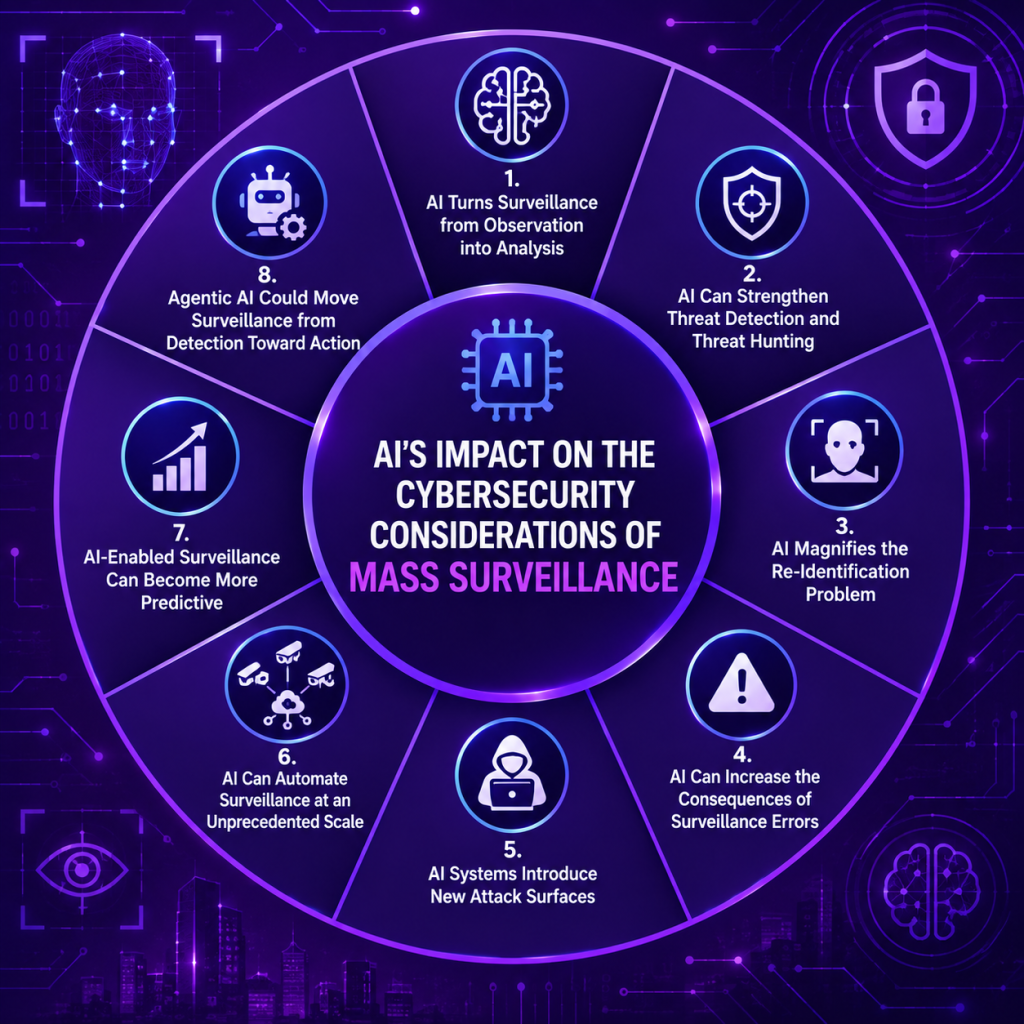
1. AI Turns Surveillance from Observation into Analysis
A conventional camera records what happened. An AI-enabled surveillance system can attempt to determine what is happening. AI can analyze images, video, audio, text, location information, access records, and other data sources to identify patterns that humans may not recognize quickly enough.
AI’s predictive capabilities can reveal greater insights about people while also amplifying behavioral tracking and surveillance. From a cybersecurity perspective, this can be valuable. An AI system could correlate an unusual physical access event with a suspicious network login, identify unusual movement around a protected facility, or detect patterns across thousands of security events.
The important change is therefore not simply more surveillance. It is a more automated interpretation of surveillance data.
2. AI Can Strengthen Threat Detection and Threat Hunting
AI can help process surveillance information at a scale that would be difficult for human analysts to manage manually. This could support applications such as:
- Anomaly detection
- Behavioral analysis
- Automated video analysis
- Identity verification
- Suspicious-access detection
- Threat intelligence gathering and correlation
- Security-event prioritization
- Automated threat hunting
This can be particularly valuable when security teams face enormous volumes of alerts and data. However, automation does not eliminate the need for human expertise, a theme explored in ECCU’s look at the role of AI in cybersecurity. AI can improve cybersecurity capabilities, such as threat hunting, while also potentially increasing false positives, making explainability and interpretability important considerations.
3. AI Magnifies the Re-Identification Problem
One of the most significant cybersecurity implications of AI-enabled surveillance is its ability to connect information that previously appeared unrelated. A dataset containing location information may not identify someone by itself. A separate facial image may not reveal where that person has been. Access records may reveal neither. AI can potentially correlate these different datasets.
NIST specifically identifies new AI-driven re-identification risks arising from the ability to analyze disparate datasets. It also notes that AI can amplify behavioral tracking and surveillance. This means that the privacy risk of surveillance may increasingly depend not only on what data is collected, but on what can be inferred from combining it.
That distinction will become increasingly important as organizations deploy multimodal AI systems capable of processing different types of information simultaneously.
4. AI Can Increase the Consequences of Surveillance Errors
AI-generated surveillance outputs are not automatically accurate. Facial recognition systems, for example, can produce false positive and false negative results. NIST’s Face Recognition Technology Evaluation continues to measure differences in error rates across demographic groups, and its current evaluation materials note that demographic variations can occur in both false-positive and false-negative performance. This matters because an AI system can process surveillance information extremely quickly, but speed does not guarantee correctness.
A false match involving a low-consequence application may be inconvenient. A false match used to trigger an investigation, deny access, identify a suspected intruder, or escalate a security response can have much more significant consequences.
The cybersecurity principle is therefore straightforward: Automated security decisions require validation, monitoring, appropriate thresholds, and human oversight when the consequences of error are high.
5. AI Systems Introduce New Attack Surfaces
AI does not merely analyze surveillance data. The AI system itself becomes part of the security architecture. That introduces new cybersecurity concerns.
NIST’s 2025 Adversarial Machine Learning: A Taxonomy and Terminology of Attacks and Mitigations identifies attack categories, including evasion, poisoning, privacy attacks, and misuse attacks, across AI and machine learning systems. For surveillance applications, this could mean an attacker attempting to manipulate what an AI system sees or how it interprets information.
For example, an adversary could attempt to:
- Poison training or operational data
- Manipulate inputs to evade detection
- Trigger false classifications
- Extract sensitive information from an AI system
- Exploit weaknesses in the AI application’s surrounding infrastructure
6. AI Can Automate Surveillance at an Unprecedented Scale
Human analysts have practical limits. An analyst cannot continuously review thousands of camera feeds, compare millions of records, and identify subtle relationships across years of data. AI can dramatically reduce these limitations, which creates one of the most important shifts in the surveillance landscape: the transition from selective observation to continuous automated analysis.
The cybersecurity benefit is obvious. More activity can potentially be monitored for anomalies. But the cybersecurity risk is equally important. A compromised or poorly governed AI system could potentially analyze enormous quantities of sensitive information at machine speed. The scale of both legitimate monitoring and potential misuse, therefore, increases.
7. AI-Enabled Surveillance Can Become More Predictive
Traditional surveillance generally answers questions about past or ongoing events. AI can attempt to answer a different question: “What is likely to happen next?”
Predictive analytics can identify patterns associated with unusual behavior, security incidents, equipment failures, or other risks. This may help organizations move from reactive security toward proactive threat management.
But prediction is inherently different from observation. An observed event can be verified. A prediction is an inference. This distinction means cybersecurity teams need to understand the confidence, limitations, training data, assumptions, and context behind AI-generated predictions rather than treating them as facts.
8. Agentic AI Could Move Surveillance from Detection Toward Action
The next development may be particularly significant: AI systems that do more than analyze information. Agentic AI systems can be designed to perform tasks autonomously using data, tools, and applications. NIST’s 2026 work on agentic AI security highlights concerns surrounding agent identity, authorization, auditing, non-repudiation, and prompt injection.
If an AI system has access to mass surveillance data and operational systems, compromising that system could give an attacker more than information. It could potentially provide a pathway to automated actions. This makes identity, authorization, least privilege, auditing, human oversight, and system isolation increasingly important.
The Future Outlook: More Capable, More Connected, and More Complex
- Multimodal surveillance: AI systems are increasingly capable of processing data from multiple modalities. Future surveillance architectures may combine video, audio, text, location, identity, network telemetry, and other signals into unified analytical systems.
- Edge AI: More processing may occur closer to cameras, sensors, vehicles, and other endpoints. This can reduce latency and potentially limit the amount of raw information transmitted to centralized systems, but it also places AI capabilities on more distributed devices that must be secured.
- Predictive security: Organizations may increasingly use AI to identify patterns associated with potential security incidents before conventional alerts are triggered.
- Autonomous security workflows: AI agents could increasingly connect detection systems with response mechanisms, reducing the time between identifying a potential threat and taking action.
- Stronger AI security standards: As AI becomes embedded in cybersecurity and surveillance infrastructure, organizations will need more mature approaches to testing, evaluation, verification, validation, identity, authorization, monitoring, and incident handling and response.
Conclusion: Mass Surveillance Is a Cybersecurity Trade-Off
Across advantages, disadvantages, and AI, one theme remains consistent: surveillance creates visibility, and visibility creates both security opportunities and cybersecurity responsibilities.
Mass surveillance can strengthen cybersecurity by improving visibility, threat detection, intelligence, incident handling and response, physical security, and cross-system correlation. But the same infrastructure can become a high-value target. Centralized datasets can lead to significant consequences if breached, biometric information is difficult to replace, insiders can misuse legitimate access, and excessive data collection can create risks that conventional security controls cannot address on their own.
AI adds a third dimension. It can transform surveillance from passive observation into active analysis, correlate disparate information, and even connect monitoring with automated response. But models can be attacked, data can be manipulated, outputs can be inaccurate, and automated decisions can scale mistakes as efficiently as they scale successes.
The result is not a simple argument for or against mass surveillance. The cybersecurity question becomes: How can organizations obtain legitimate security value from surveillance while controlling the additional risks created by collecting, connecting, analyzing, and acting on enormous quantities of information? It is a question that will only grow in importance as mass surveillance and AI converge. For related reading, see ECCU’s guides to ethical AI for enterprises and AI governance in cybersecurity.
Build the Skills to Secure Surveillance and AI Systems
- The Master of Science in Cyber Security covers areas such as cyber defense, digital forensics, cloud security, and enterprise risk management, with hands-on virtual labs.
- The MBA with a specialization in Cybersecurity Executive Leadership and Governance is designed for leaders who set policy on security, risk, and AI governance.
- The Master of Science in Computer Science suits professionals who want to combine computing depth with cybersecurity skills.
- The Bachelor of Science in Cyber Security offers a foundation for those building a cybersecurity career.
- The Certified Responsible AI Governance & Ethics (C|RAGE) course focuses on AI governance, compliance, and ethical risk management.
Frequently Asked Questions About the Cybersecurity Advantages of Mass Surveillance
What are the main cybersecurity benefits of mass surveillance?
The primary cybersecurity benefits are improved visibility, earlier threat detection, threat-intelligence collection, incident investigation, behavioral analysis, physical security, and stronger monitoring of critical infrastructure. Large-scale data can also help security teams correlate otherwise isolated events and identify broader attack patterns.
How can surveillance help detect cyberattacks?
Surveillance systems can collect information such as authentication events, network traffic, system activity, and access records. Security teams can analyze this information for deviations from normal behavior.
Can facial recognition improve cybersecurity?
Facial recognition can be used for identity verification, physical access control, and digital authentication. However, biometric systems introduce their own security and privacy considerations, which become particularly important when biometric information is collected at scale.
Does more surveillance necessarily mean better security?
No. Research indicates that surveillance effectiveness depends on factors such as how information is monitored, what threats the system is designed to address, and whether surveillance is combined with other security measures. A 40-year systematic review found that CCTV produced a modest overall reduction in crime, with stronger results in certain settings and when combined with other interventions.
Why is visibility important in cybersecurity?
Visibility allows defenders to understand what is happening across their systems and identify activity that deviates from established patterns. Inadequate monitoring can allow attackers to maintain access and move laterally without detection. In modern cybersecurity, visibility is therefore an important prerequisite for effective detection and response.
What are the biggest cybersecurity disadvantages of mass surveillance?
The major disadvantages include expanded attack surfaces, high-value centralized data repositories, exposure of biometric data, insider threats, re-identification risks, supply chain vulnerabilities, false positives, function creep, and potential weakening of encryption and secure communications.
Can surveillance systems themselves be hacked?
Yes. Surveillance systems can contain cameras, sensors, networks, cloud platforms, databases, credentials, and administrative interfaces that attackers may target. Compromising these systems can expose sensitive information or allow attackers to manipulate surveillance capabilities.
Why is biometric surveillance particularly sensitive from a cybersecurity perspective?
Biometric characteristics such as faces and fingerprints are difficult to replace if compromised. Unlike passwords or access tokens, they are intrinsic characteristics of an individual. A breach can therefore have long-lasting consequences.
Does collecting more surveillance data always improve cybersecurity?
Does collecting more surveillance data always improve cybersecurity?
How is AI changing mass surveillance?
AI is shifting surveillance from primarily collecting and storing information toward automatically analyzing, correlating, classifying, and predicting patterns across large datasets. This can improve threat detection but also creates additional cybersecurity, privacy, and accuracy risks.
Can AI make mass surveillance more effective for cybersecurity?
Can AI make mass surveillance more effective for cybersecurity?