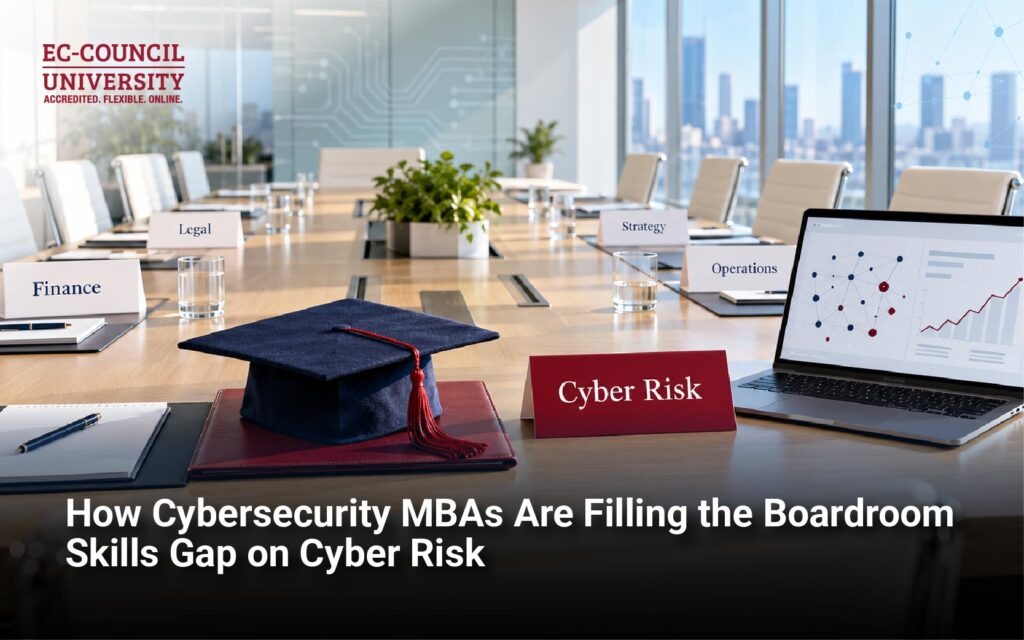
Every board now answers for cyber risk. Most directors never trained for it. They built careers in finance, law, sales, or operations. Still, regulators and investors expect them to challenge security plans. That mismatch creates a serious gap in cyber risk governance.
Security executives with MBA training are stepping in to close it. They speak both languages, so boards finally hear risk in business terms.
This blog explains why boards lack cyber fluency. You’ll see where CISO reporting breaks down with directors. We’ll cover what NACD now recommends on board
expertise. Then we’ll explain how the right MBA builds board-ready leaders. Finally, we’ll map the path from practitioner to board advisor.
Key Takeaways
- Boards carry full accountability for cyber risk without matching expertise.
- SEC rules demand oversight disclosure, not director cyber credentials.
- Many CISO reports miss because they speak security, not business.
- NACD warns boards against handing cyber oversight to one expert.
- A cybersecurity MBA adds finance, strategy, and governance to technical depth.
- The degree builds board candidacy, but proven judgment earns the seat.
Why Boards Structurally Lack Cyber Fluency
Boards recruit for skills they already understand. Most directors bring finance, legal, or operations backgrounds. Those skills matter, but they rarely include security.
Disclosed cyber expertise among S&P 500 directors reached 27% by late 2025. In 2021, it sat at 15%.
The SEC’s cyber disclosure rules raised the stakes. Public companies must describe how their boards oversee cyber risk. They must also report material incidents within four business days. Yet the final rules dropped a proposed board expertise disclosure.
Boards gained accountability without any matching competence standard.
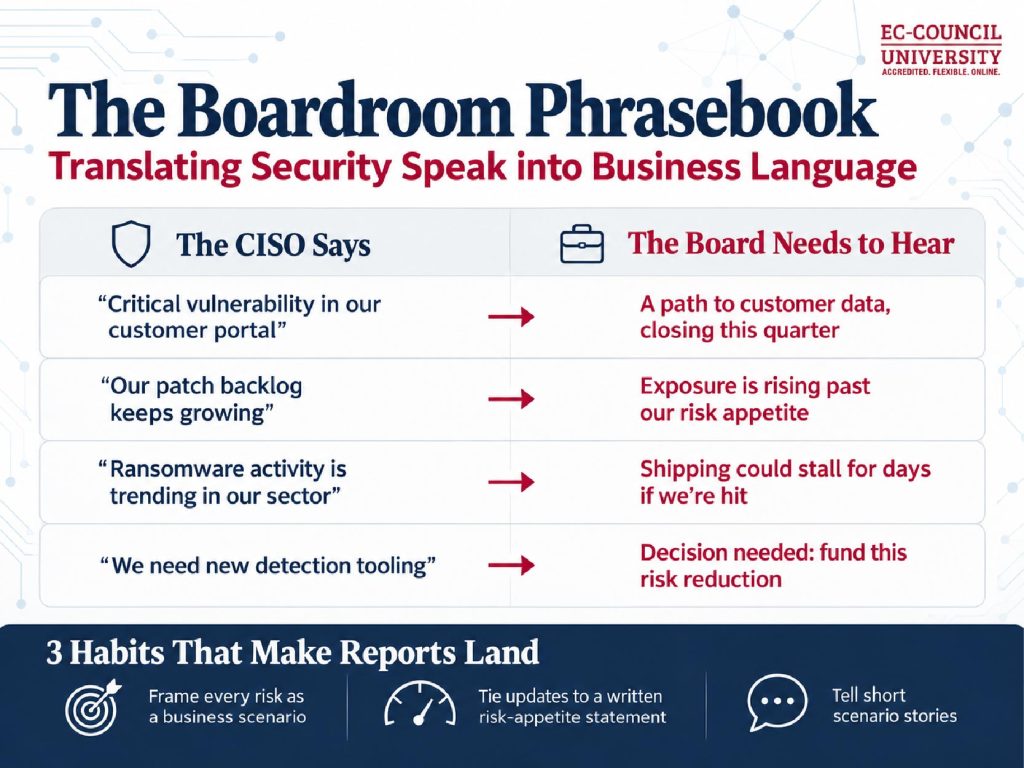
Language deepens the problem. Security teams talk in CVSS scores and patch counts. Directors think in revenue, liability, and capital.
In practice, the gap usually looks like this:
- Cyber lives in the IT budget: Boards treat it as a cost line, not an enterprise risk.
- Engagement starts after a breach: Many boards lean in only once damage is done.
- Risk appetite drifts during big bets: Acquisitions, digital overhauls, and AI rollouts quietly expand exposure.
Directors now rank cyber and data threats as their top AI concern. In PwC’s newest director survey, 69% said so.
The CISO-to-Board Communication Breakdown
CISOs think in threats, controls, and incidents. Boards think in enterprise risk and capital allocation.
Then there’s the “two audiences, one report” problem. The same update often serves the risk committee and the full board. One group wants detail. The other wants decisions. Most reports try to please both and satisfy neither.
Good cyber risk reporting starts with the board’s own questions. What could hurt us, and how badly? Is exposure growing or shrinking? Does it fit the risk appetite we approved? What do you need us to decide?
A few habits make those answers land. First, frame every risk as a business scenario. Second, tie each update to a written risk-appetite statement. Third, tell short scenario stories. A ransomware tale about stalled shipments beats a colorful heat map.
This translation work now sits at the heart of the CISO role. In PwC’s survey, 58% reported more board contact with the CISO.
Why One Cyber Expert on the Board Isn't Enough
The quick fix is tempting. Recruit a former CISO and call it solved.
The NACD Director’s Handbook on Cyber-Risk Oversight pushes back on that idea. Its latest edition rests on six validated oversight principles. Principle 3 covers board oversight structures and access to expertise. It calls the cyber-expert director an open question for each board. It also warns against handing the whole duty to one person.
Instead, NACD points boards toward:
- A skills matrix that maps each director’s cyber knowledge
- Committee charters that assign cyber oversight clearly
- Independent experts who can test management’s claims
- Ongoing director education, including tabletop exercises
Boards decide as a group. Every director must add value on strategy, finance, and fiduciary duty.
Directors see the need. About 34% of public company directors call improving cyber expertise highly important. And 86% of Fortune 100 companies cite cyber expertise in board disclosures.
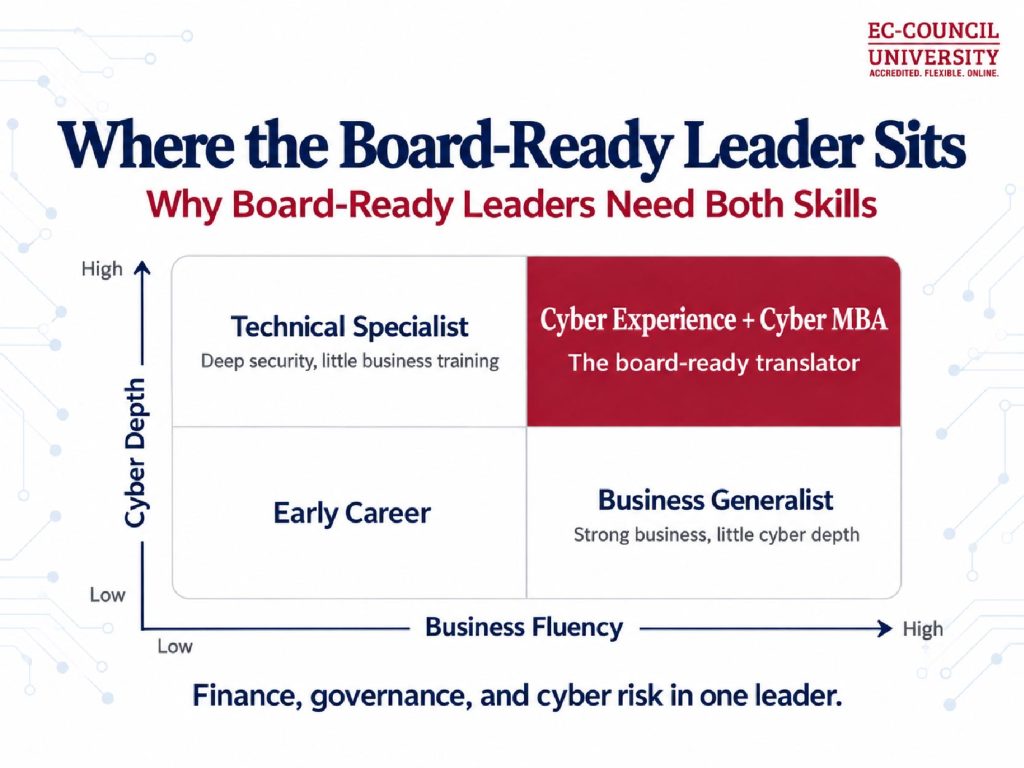
So boards need cyber leaders who also speak fluent business. That profile remains rare.
How a Cybersecurity MBA Builds the Translation Layer
Technical credentials prove you can defend systems. They rarely teach corporate finance or enterprise strategy. Governance and stakeholder communication often get skipped too. So a skilled CISO can still lose the room.
An MBA closes those blind spots. Yet a generic MBA treats cyber as a side topic.
ECCU’s cybersecurity MBA offers a track built for this exact gap. It’s called Cybersecurity Executive Leadership and Governance. ECCU also builds AI-integrated courses into the program.
The core covers managerial accounting and financial management. You’ll study discounted cash flow and capital structure decisions. Leadership and organizational behavior courses sharpen stakeholder communication. Then you choose specialization courses from a focused menu. Options include Executive Governance and Management, which aligns with CCISO. Others cover AI governance, compliance, and ethical risk management. Learn more about this CCISO-aligned MBA route.
The payoff is dual fluency. Graduates can restate technical risk in financial terms. They can frame exposure in legal and reputational language too. That builds real depth in cyber governance risk and compliance. It’s also why future CISOs need business skills to rise.
Board-ready leaders should also know the frameworks directors trust. These include NACD’s principles, the NIST Cybersecurity Framework, and COSO ERM. With that grounding, you become a credible adviser to risk committees.
The Career Path from Practitioner to Board Advisor
Few people leap straight from the SOC to the boardroom.
It starts in technical roles like analyst, engineer, or architect. Some move through GRC roles next. That work builds cybersecurity governance, risk, and compliance instincts. Then comes security leadership as a CISO or vCISO. Many leaders then add an MBA for business fluency. Target roles include CISO and Chief Risk Officer. From there, board advisory work becomes realistic. That might mean advising a risk committee or joining an advisory board. A director seat usually comes later, if at all.
Be honest about that final step. Boards still prize fit and judgment over credentials. In PwC’s survey, 81% called cultural fit very important in director candidates. Only 27% said the same about specialized expertise. Strong MBA cybersecurity programs build the judgment boards notice. But you still earn the seat through proven results.
The real proof is simple. Show you can turn cyber risk into business decisions. Boards lack that skill today. The right MBA helps you build it. Explore how an MBA in cybersecurity shapes leadership careers.