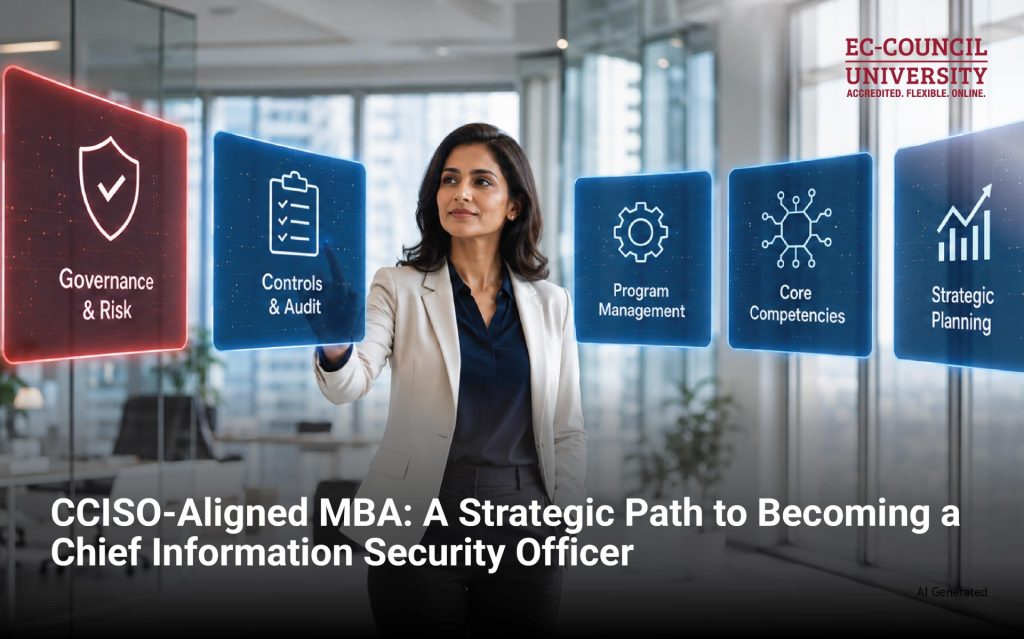
A CISO title used to mean deep technical mastery. That is no longer enough. Boards now expect security leaders fluent in risk, capital, and growth. This shift changes what preparation for the role should look like. Pairing an MBA with the CCISO framework builds both sides. It gives professionals a structured path into that balance. This piece breaks down why that pairing works. It also maps EC-Council University’s MBA to the five CCISO domains. And it traces the climb from practitioner to executive.
Key takeaways
- CCISO certification is now built directly into ECCU’s Governance-track MBA.
- The five CCISO domains map onto real MBA coursework, not just theory.
- CISOs today are judged on board fluency, not just technical depth.
- Executive certifications carry more weight when paired with an MBA.
- The path from analyst to CISO takes structured, sequenced experience.
- This MBA specialization suits professionals already leading security teams.
The Evolving Role of the CISO
Ten years ago, the CISO managed firewalls and incident logs. Today, the CISO sits at the board table. Regulators now hold security leaders personally accountable for disclosures. Investors ask about cyber risk on earnings calls. This changes what makes someone promotable into the role. Technical fluency still matters. But it no longer decides who gets the corner office. Business acumen increasingly decides that.
What the CISO Role Demands
The job now runs through governance, budgeting, and vendor strategy. Controls alone are not enough anymore. A CISO has to defend a security roadmap in financial terms. They have to negotiate with vendors and manage third-party risk. They have to brief a board fluent in dollars, not exploits. Balancing that with day-to-day security posture is the real skill.
The Five CCISO Domains as a Competency Map
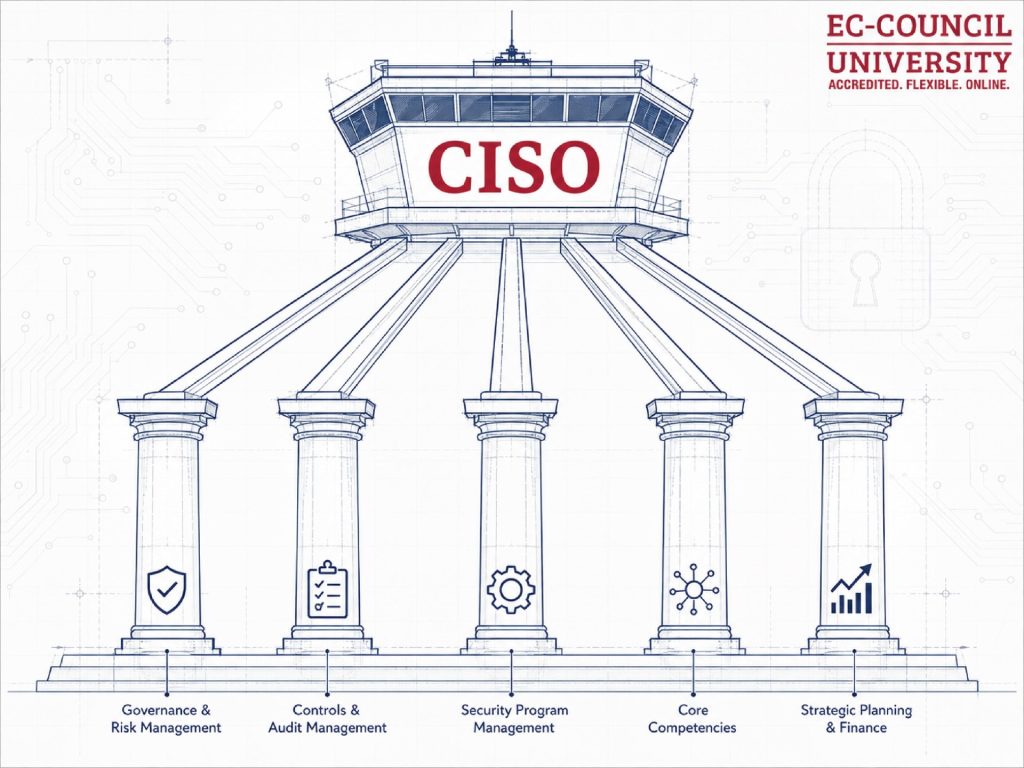
The CCISO framework breaks the executive security job into five domains. Each one reflects a real responsibility on a CISO’s desk.
- Governance and risk management: setting risk appetite and policy direction.
- Information security controls and audit management: proving controls actually work.
- Security program management and operations: running the day-to-day security function.
- Information security core competencies: staying technically credible with the team.
- Strategic planning, finance, and vendor management: budgeting, procurement, and board reporting.
Why an MBA Bridges the Gap
A CCISO certification proves you understand these five domains. An MBA teaches you to operate inside them at scale. Finance, negotiation, and organizational leadership rarely show up in security certifications. Yet a CISO’s daily work runs through all three.
EC-Council University built this MBA for exactly this transition. The specialization is called Cybersecurity Executive Leadership and Governance. The program bundles the CCISO certification directly into the degree. It also includes credentials in AI program management and responsible AI governance. That means graduates leave with an MBA and executive certifications. Both arrive already in hand. Nobody has to pursue certification separately after graduation. ECCU’s broader 2026 career overview covers why this shift matters industry-wide.
Aligning the MBA to CCISO
The MBA specialization’s course list lines up closely with the CCISO blueprint.
- Executive Governance and Management (ECCU 523) covers governance and risk.
- Project Management in IT Security (ECCU 515) covers program operations.
- AI Governance, Compliance, and Ethical Risk Management (ECCU 565) covers AI-era governance.
- Financial Management and Managerial Accounting cover the finance and vendor domain.
The capstone project (ECCU 519) ties it all together. Students apply the coursework to one strategic security problem before graduating. Controls and audit management gets lighter coverage in the MBA itself. That domain leans more on CCISO exam content and audit experience. A related ECCU post covers this edge for CTOs and IT leaders.
The Path From Practitioner to Executive
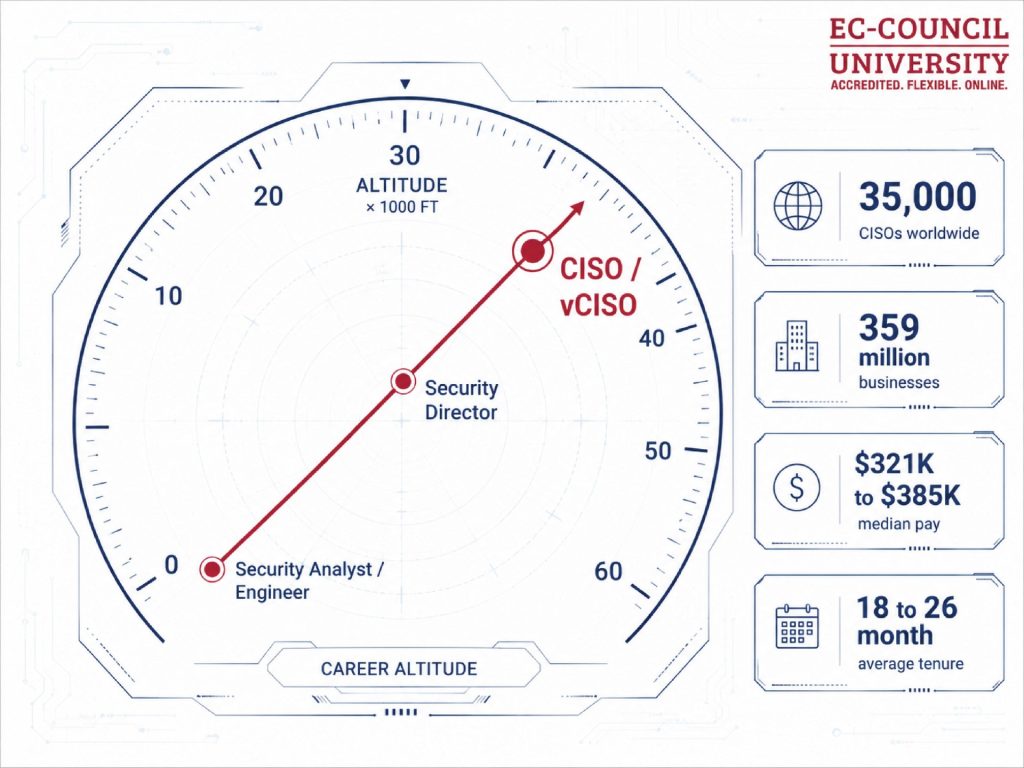
Most CISOs do not arrive in the role directly. The typical route runs through senior engineering or management roles. From there, professionals move into security director positions. The CISO or virtual CISO seat usually comes next.
Demand for this leadership layer keeps climbing. Cybersecurity Ventures counts only 35,000 CISOs serving roughly 359 million businesses worldwide. That gap keeps compensation high. Reported CISO pay commonly lands between $321,000 and $385,000 a year. It tops $500,000 at large enterprises. Even so, average tenure in the role runs 18 to 26 months. Boards expect fast results, and burnout is real. Roughly 40% of Fortune 500 firms now add deputy CISO roles. That spreads the load across two people.
Sequencing matters here. Build domain experience first, then add CCISO. Layer the MBA around both.
Is This Path Right for You?
This path fits people who already enjoy governance work. It fits people who want to lead teams, not just secure systems. It is not for someone chasing an MBA just for pay. Working professionals typically finish ECCU’s specialization in 18 to 24 months. That timeline assumes a steady, part-time pace alongside a full-time job.
Conclusion
Cybersecurity leadership is no longer a purely technical career. It is a business career built on top of technical judgment. Pairing CCISO with an MBA trains both sides at once. Few paths do that as directly. If that fits your direction, this MBA specialization was built for it.
FAQs
No. Many CISOs reach the role through certifications and hands-on experience alone. An MBA speeds up the business side of that transition. It also signals board readiness earlier in your career.
CCISO is EC-Council’s executive certification for security leaders. It tests five domains: governance, controls, program management, core competencies, and strategy. ECCU’s Governance-track MBA includes this certification as part of the degree.
Most working professionals finish in 18 to 24 months. Pace depends on course load and transfer credits. ECCU accepts up to 18 transfer credits from prior coursework.
A technical master’s deepens hands-on security skills. An MBA builds financial, strategic, and leadership capability instead. CISOs typically need both, gained through different programs or work experience.
Yes. Virtual CISO work demands the same governance and communication skills. ECCU’s specialization builds those skills alongside the CCISO credential. That combination fits fractional and full-time CISO work equally well.