The Rise of the AI Program Manager Role
Organizations are pouring billions of dollars into AI initiatives to improve efficiency, automate operations, strengthen cybersecurity, and unlock new revenue streams. However, successfully implementing enterprise-wide AI systems requires skilled professionals who can align AI projects with business strategy, manage cross-functional teams, mitigate cyber risks, and ensure measurable outcomes. This growing need has given rise to a coveted corporate leadership role – the AI Program Manager.
This article examines what AI Program Managers do, why demand for them continues to rise, their earning potential, the skills of this role, and the right qualifications to acquire. Let’s dive into it:
What Is an AI Program Manager?
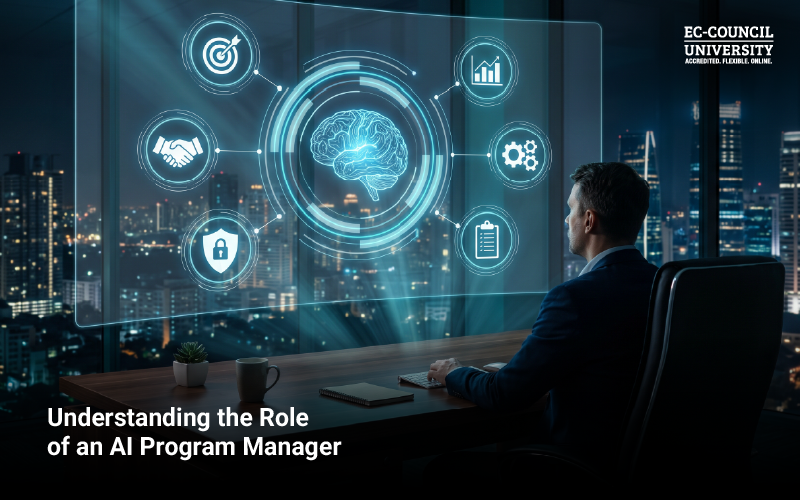
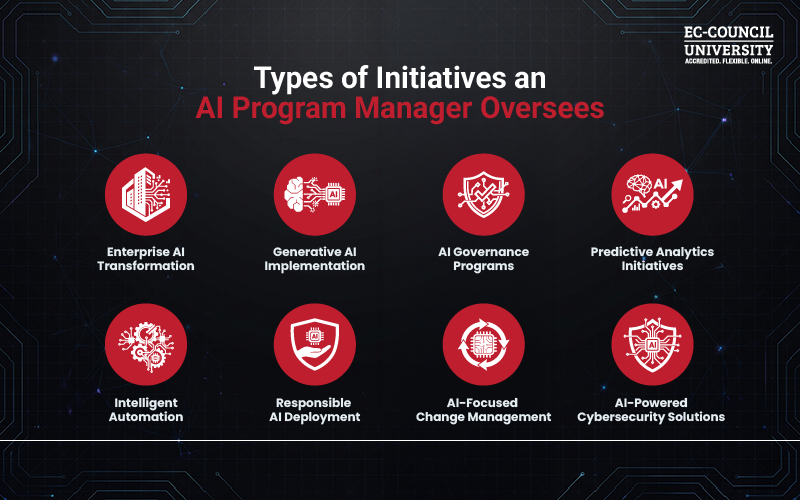
An AI Program Manager oversees an organization’s AI initiatives from planning through execution. Unlike project managers focusing on individual projects, AI program managers coordinate multiple initiatives to support broader business objectives.
AI Program Managers work with executives, AI engineers, cybersecurity professionals, software developers, legal teams, and business stakeholders to ensure AI systems are operational on time, within budget, and in compliance with organizational policies and emerging regulations. They serve as conduits between technical teams and executive leadership by translating complex AI concepts into practical business use-cases.
Career Scope: Why AI Program Managers Are in High Demand
The global AI market continues to expand at an extraordinary pace, projected to grow at a 30.6% CAGR through 2033(1). At the same time, organizations face significant challenges implementing AI responsibly. The World Economic Forum(2) has identified governance, trust, workforce readiness, and ethical deployment as the biggest barriers to successful AI adoption.
AI Program Managers help organizations overcome these challenges by:
- Aligning AI investments with business goals
- Managing organizational change
- Coordinating technical and business teams
- Reducing project risk
- Establishing AI governance frameworks
- Ensuring responsible and ethical AI implementation
How to Become an AI Program Manager
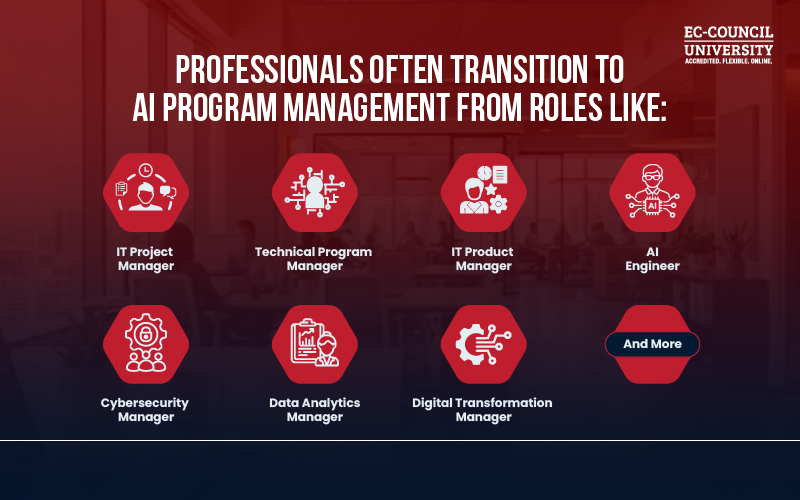
Most successful AI Program Managers build experience across several disciplines before moving into leadership roles. A common career path includes:
- Earn a degree in cybersecurity, computer science, information technology, business management, or a related field.
- Gain experience managing technology or digital transformation projects.
- Develop foundational knowledge of AI, machine learning, cloud computing, and data analytics.
- Learn AI governance, ethics, compliance, and risk management.
- Strengthen communication, leadership, budgeting, and stakeholder management skills.
- Earn an industry-recognized AI program management certification.
- Build experience leading cross-functional AI initiatives.
Earning Potential: How Much Does an AI Program Manager Get Paid?
AI Program Managers rank among today’s highest-paid technology leaders, as per multiple U.S. salary aggregators. Compensation varies based on industry, experience, certifications, and geographic location. Typical annual salary ranges include:
| Experience Level | U.S. Salary Range |
|---|---|
| Entry-Level | $120,000 to $145,000 |
| Mid-Level | $145,000 to $180,000 |
| Senior AI Program Manager | $180,000 to $230,000+ |
In addition to fixed salaries, AI Program Managers may also receive annual performance bonuses, stock options, and profit-sharing incentives.
Top 5 Industries That Need AI Program Managers
- Healthcare: Hospitals use AI for diagnostics, patient monitoring, predictive analytics, and administrative automation.
- Financial Services: Banks deploy AI for fraud detection, risk analysis, algorithmic trading, and customer service automation.
- Cybersecurity: Organizations are integrating AI into cybersecurity analysis, security operations centers (SOCs), vulnerability management, and incident response.
- Manufacturing: Manufacturers leverage AI for predictive maintenance, robotics, quality assurance, and supply chain optimization.
- Government and Defense: Public sector agencies use AI for intelligence analysis, cybersecurity, emergency response, logistics, and citizen services while maintaining strict governance requirements.
Core Responsibilities of an AI Program Manager
AI Program Managers oversee both strategic planning and day-to-day execution. Their responsibilities often include:
- Developing enterprise AI roadmaps
- Managing AI implementation programs
- Coordinating cross-functional teams
- Aligning AI initiatives with business objectives
- Managing budgets and resources
- Identifying program risks
- Ensuring AI governance and compliance
- Monitoring project performance metrics
- Communicating progress to executive leadership
- Supporting organizational AI adoption and change management
Successful AI Program Managers focus equally on technology, people, and business outcomes.
Skills You Need to Become a Successful AI Program Manager
AI Program Managers should possess a balanced combination of technical expertise and leadership skills:
| Technical Skills | Business / Leadership Skills |
|---|---|
| Artificial Intelligence fundamentals | Strategic planning |
| Machine Learning concepts | Executive communication |
| Generative AI technologies | Team & stakeholder management |
| Cloud computing | Budget management |
| Data analytics | Business process optimization |
| AI governance & ethics | Conflict resolution |
| Cybersecurity fundamentals | Organizational change management |
| Risk management | Critical thinking |
| Agile and Scrum methodologies | Decision-making |
The most effective AI Program Managers understand both the technical capabilities of AI and the organizational challenges of deploying it successfully.
Why AI Governance Matters
The pressure to deploy AI responsibly is growing worldwide. The National Institute of Standards and Technology (NIST) AI Risk Management Framework(3) emphasizes governance, transparency, accountability, and continuous risk management throughout the AI lifecycle. Similarly, the European Union’s AI Act(4) has introduced comprehensive rules governing high-risk AI systems, influencing global AI governance practices. Failure to comply with evolving AI rules and regulations can lead to severe legal, financial, and reputational consequences for any business that violates them.
C|AIPM: The Credential Built for AI Program Managers
The Certified AI Program Manager (C|AIPM) certification from EC-Council University (ECCU) is the ideal credential for professionals who want to plan, manage, deploy, and govern enterprise AI programs.
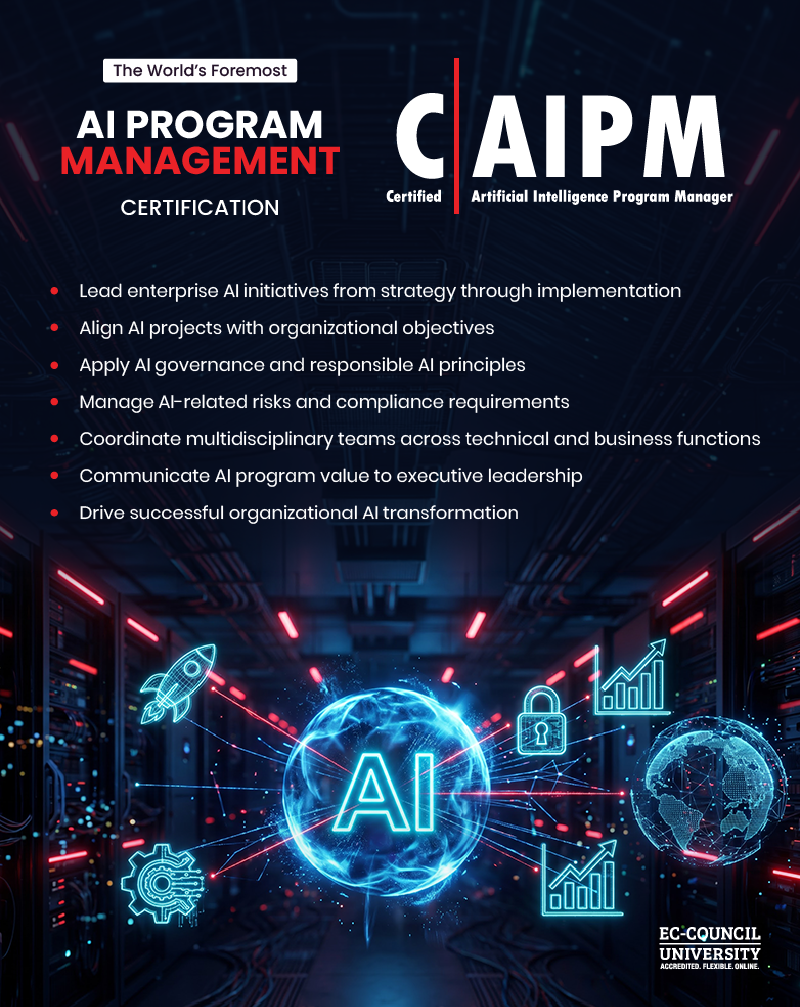
C|AIPM is available via:
- A short-term, standalone certification course
- ECCU’s Master of Science in Cyber Security degree (Executive Leadership in Information Assurance specialization)
- ECCU’s Master of Business Administration degree (Cybersecurity Executive Leadership and Governance specialization)
Whether you’re an experienced project manager, technology leader, cybersecurity professional, or business executive, the C|AIPM certification helps validate the leadership competencies employers expect from AI Program Managers today. For more information:
Frequently Asked Questions About AI Program Managers
An AI Program Manager oversees multiple AI initiatives, aligns them with business goals, manages cross-functional teams, and ensures successful AI implementation.
Not necessarily. While technical literacy is valuable, AI Program Managers primarily focus on leadership, governance, planning, and stakeholder coordination rather than writing code.
Yes. As organizations increase AI investments, demand for professionals who can manage enterprise AI programs continues to grow across nearly every industry.
Certifications covering AI program management, AI governance, project management, cloud technologies, and cybersecurity can strengthen your qualifications. ECCU’s Certified AI Program Manager (C|AIPM) is designed specifically for this role.
Healthcare, financial services, cybersecurity, manufacturing, government, retail, and technology companies are among the largest employers.
Most professionals spend several years building experience in technology or project management before transitioning into AI Program Management, though specialized training and certifications can accelerate career progression.
Yes. Project managers oversee individual AI projects, while AI Program Managers coordinate multiple related AI initiatives that support broader organizational strategy.