

Deceiving the Criminal: An Overview of Cybersecurity Honeypots
What if you could trick cybercriminals into revealing their tactics, techniques, and tools without putting your organization’s systems at risk? That’s precisely what honeypots make possible. Organizations nowadays need more than traditional security measures to identify sophisticated cyberattacks and understand how malicious actors operate. Network firewalls, intrusion detection systems, and endpoint protection solutions play essential roles in this regard. However, cybersecurity teams also need ways to observe adversaries, gather actionable threat intelligence, and anticipate their next moves. This is where honeypots in cybersecurity become particularly valuable.
A honeypot is a deliberately designed decoy system that attracts cybercriminals and allows cybersecurity professionals to monitor their activities in a controlled environment. By studying interactions with these decoys, defenders can uncover attack patterns, identify vulnerabilities, and strengthen their organization’s overall cybersecurity posture.
Let’s explore how honeypots work, their different types, popular tools, benefits, and limitations, and why cybersecurity professionals should understand this increasingly important defensive technique.
What is a Honeypot in Cybersecurity?
The National Institute of Standards and Technology (NIST) (1) defines a cybersecurity honeypot as a system or system resource designed to attract potential attackers and intruders. In simple terms, think of a honeypot as a digital trap. Instead of waiting for cybercriminals to target legitimate organizational assets, cybersecurity teams deliberately create an attractive decoy that encourages unauthorized interaction.

These decoys appear legitimate to attackers but are created primarily for observation and threat intelligence gathering.
An important distinction:
A honeypot is not intended to replace conventional security controls. It complements existing defenses by providing visibility into malicious activities that might otherwise go unnoticed.
How Do Cybersecurity Honeypots Work?
A honeypot works by attracting attackers, recording their interactions, and providing security teams with information to improve organizational defenses. A typical honeypot deployment involves 5 stages:
- Deployment: Security professionals configure a decoy system, application, or network resource to resemble a legitimate organizational asset.
- Attraction: The decoy is exposed in a controlled manner, making it discoverable to potential attackers.
- Interaction: An attacker attempts to access, exploit, or compromise the honeypot, believing it contains valuable resources.
- Monitoring: Security tools capture the attacker’s activities, including login attempts, commands, malware uploads, and exploitation techniques.
- Analysis: Cybersecurity teams examine the collected information to identify attack patterns, understand adversary behavior, and improve security controls.
For effective deployment, organizations must implement appropriate isolation and access restrictions. This prevents a compromised honeypot from becoming a launchpad for attacks against legitimate systems.
What Are the Different Types of Cybersecurity Honeypots?
Cybersecurity honeypots can be classified into 2 categories according to their interaction levels and intended purposes.
Category A: Honeypots Based on Interaction Levels
- Low-Interaction Honeypots: These honeypots simulate basic network services, ports, or applications to attract attackers and record suspicious activities. They are relatively easy to deploy and maintain but offer limited insight into sophisticated attack techniques.
- Medium-Interaction Honeypots: These provide more functionality than basic simulations, allowing attackers to interact with a broader range of services and features. They help security teams collect additional information without exposing a fully functional operating system.
- High-Interaction Honeypots: These use real operating systems, applications, and services to create realistic environments for observing attackers. They provide deeper insights into attacker behavior but require stronger isolation, monitoring, and maintenance.
Category B: Honeypots Based on Their Purpose
Organizations also deploy the following honeypots for specific security objectives:
| Honeypot type | Primary purpose |
|---|---|
| Production honeypots | Detect malicious activities targeting organizational networks and systems. |
| Research honeypots | Study emerging threats, malware, and attacker techniques. |
| Database honeypots | Detect unauthorized database access and data-extraction attempts. |
| Email honeypots | Identify spam campaigns, phishing attempts, and malicious email activity. |
| Malware honeypots | Capture and analyze malicious software and its behavior. |
Why Are Honeypots Important in Cybersecurity?
- Early Threat Detection: Interactions with decoy resources can reveal suspicious activities, including reconnaissance, unauthorized access attempts, and exploitation efforts.
- Threat Intelligence Collection: Honeypots help security teams collect information about emerging malware, attack patterns, adversary behavior, and commonly exploited vulnerabilities.
- Improved Incident Response: Understanding how attackers gain access and operate within an environment helps security professionals prepare more effective incident response strategies.
- Vulnerability Identification: Honeypots can reveal weaknesses in exposed services and applications, helping organizations prioritize improvements to their security posture.
- Reduced False Positives: Since legitimate users should not normally interact with properly deployed decoys, such interactions can strongly indicate malicious activity.
- Cybersecurity Research: Researchers can use honeypots to study malware behavior, investigate attack techniques, and understand how cyber threats evolve.
Honeypots vs. Traditional Cybersecurity Defenses
Honeypots serve a different purpose from conventional cybersecurity defenses. While traditional security solutions primarily focus on preventing, detecting, or blocking malicious activities, honeypots are designed to attract attackers and observe their behavior. Here’s how they differ:
| Traditional security defenses | Honeypots |
|---|---|
| Block unauthorized access | Attract unauthorized access attempts |
| Protect legitimate assets | Provide decoy assets |
| Prevent or limit attacks | Observe and analyze attacks |
| Enforce security policies | Generate threat intelligence |
| Monitor legitimate infrastructure | Monitor interactions with decoy resources |
Honeypots work particularly well alongside firewalls, intrusion detection systems (IDS), intrusion prevention systems (IPS), and endpoint security solutions. They also complement deception technologies such as honeytokens, decoy credentials, and decoy files. These techniques help organizations create misleading digital resources that expose unauthorized access and suspicious behavior.
MITRE D3FEND (2) recognizes decoy environments as a deception technique and includes honeypots as part of this broader defensive approach.
What Are Some Popular Honeypot Tools?
Cybersecurity professionals use several open-source tools and platforms to deploy honeypots, capture malicious activities, and analyze attack patterns. 4 notable examples are:

- Cowrie: Cowrie (3) is a medium-to-high-interaction SSH and Telnet honeypot. It captures brute-force login attempts, attacker commands, and files transferred during suspicious sessions.
- T-Pot: T-Pot (4) is a multi-honeypot platform that combines different honeypot technologies with visualization and monitoring capabilities.
- Dionaea: Dionaea (5) is designed to capture malware by exposing vulnerable network services and recording exploitation attempts.
- OpenCanary: OpenCanary (6) is a lightweight honeypot that simulates network services and generates alerts when someone interacts with them.
Limitations and Risks of Cybersecurity Honeypots
Although honeypots provide valuable cybersecurity intelligence, deploying them requires careful planning and ongoing management. Here are some important limitations to consider:
- Detection by Experienced Attackers: Sophisticated adversaries may recognize simulated environments and avoid interacting with them.
- Limited Visibility: Honeypots only capture activities directed toward the decoys. They cannot provide complete visibility into an organization’s threat landscape.
- Security Risks: A compromised high-interaction honeypot could be misused to launch attacks against other systems if improperly isolated.
- Maintenance Requirements: Honeypots need regular updates, monitoring, and configuration reviews to remain effective.
- Resource Requirements: High-interaction honeypots may require significant infrastructure, security expertise, and operational resources.
Organizations should therefore establish clear deployment boundaries, restrict unnecessary network access, monitor all interactions, and integrate honeypot alerts into their existing security operations.
An Example of How Organizations Use Cybersecurity Honeypots
Consider a financial institution that wants to identify unauthorized attempts to access its database infrastructure. Their cybersecurity team creates a fake database containing fictional customer records. The database is configured to resemble a legitimate organizational resource but is isolated from production systems.
An attacker scanning the institution’s network discovers the exposed database and attempts to access it using stolen credentials. However, the attacker has unknowingly entered a honeypot. The cybersecurity team is notified of this activity and begins monitoring the interaction. They document important details, including:
- The attacker’s source IP address and connection details.
- The credentials and authentication techniques attempted.
- The commands executed after gaining access.
- Attempts to extract or manipulate database records.
- Any malware or additional tools introduced into the environment.
Security analysts then examine these observations to understand the attacker’s methods, investigate potentially related threats, and strengthen defenses around the institution’s actual databases. This example demonstrates how honeypots can turn attempted intrusions into actionable security intelligence without deliberately exposing legitimate customer information.
What Skills Do Cybersecurity Professionals Need to Work with Honeypots?
Deploying and managing honeypots requires a combination of technical knowledge, analytical capabilities, and practical cybersecurity experience. Some of the most important skills include:
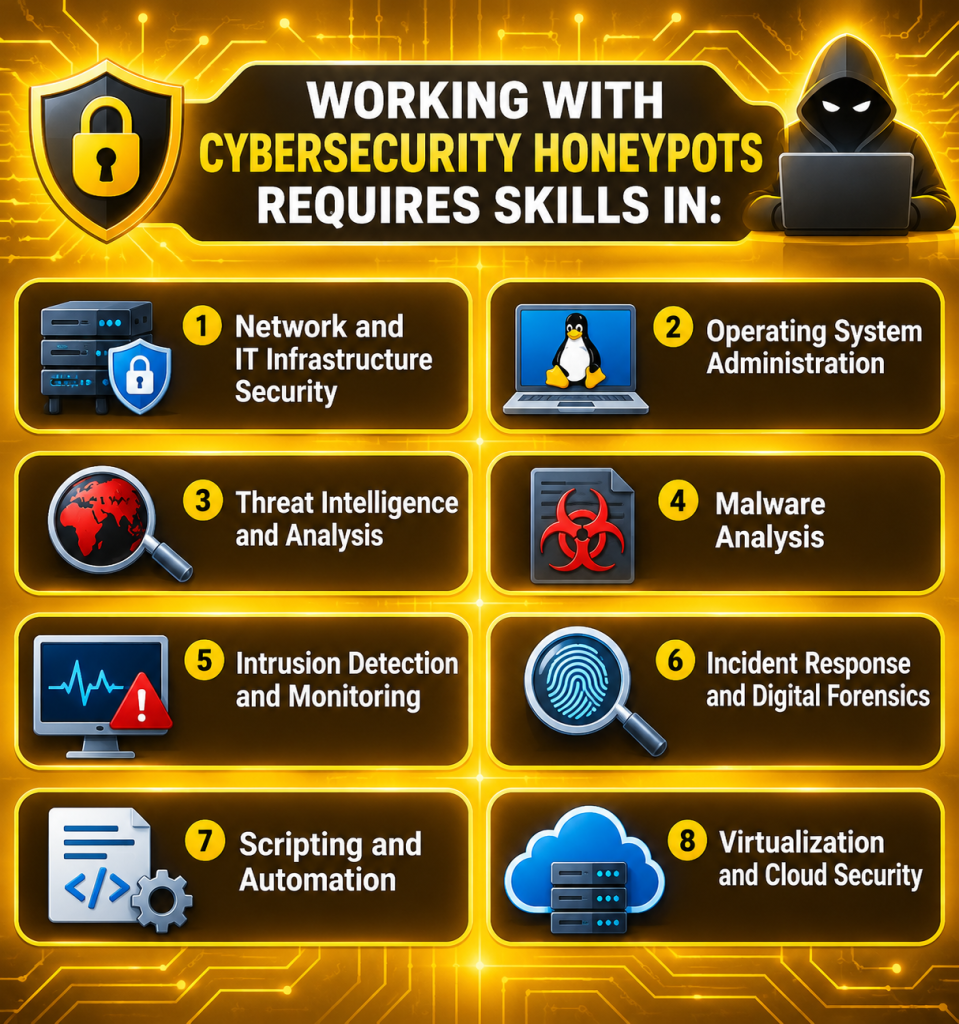
- Network and IT Infrastructure Security: Understanding TCP/IP, DNS, ports, network protocols, routing, and network segmentation.
- Operating System Administration: Working with Linux and Windows environments, system configurations, permissions, and virtualization.
- Threat Intelligence and Analysis: Identifying attack patterns, interpreting indicators of compromise (IoCs), and understanding adversary TTPs.
- Malware Analysis: Examining suspicious files, identifying malicious behavior, and understanding malware execution techniques.
- Intrusion Detection and Monitoring: Working with IDS/IPS, security information and event management (SIEM) platforms, and log analysis tools.
- Incident Response and Digital Forensics: Investigating suspicious activities, preserving evidence, reconstructing attack sequences, and supporting incident investigations.
- Scripting and Automation: Using Python, Bash, and PowerShell to automate deployment, monitoring, and log analysis.
- Virtualization and Cloud Security: Building isolated cloud environments, managing virtual machines, and understanding cloud infrastructure security.
Developing these skills helps cybersecurity professionals move beyond deploying decoy systems to extracting meaningful intelligence from attacker interactions.
The Future of Cybersecurity Honeypots
Honeypots are gaining importance in modern defensive cybersecurity strategies. Organizations are exploring more sophisticated deception technologies that go beyond traditional decoy servers. These include decoy cloud environments, fake credentials, deceptive network resources, and honeytokens embedded in seemingly legitimate digital assets.
Cloud computing, AI, and interconnected enterprise technologies also present new opportunities for deception-based defenses. For example, organizations can use decoy cloud workloads to detect unauthorized access, use deceptive credentials to identify compromised accounts, and create simulated AI services to observe suspicious interactions.
The broader objective is to identify adversaries earlier, understand their behavior, and strengthen security controls before attacks escalate.
Learn to Create State-of-the-Art Cybersecurity Honeypots at ECCU
Honeypots provide crucial strategic advantages in modern cybersecurity defense. Rather than focusing solely on preventing attacks, organizations can intentionally dupe cybercriminals into revealing their methods and tactics. That being said, designing, deploying, and managing effective honeypots requires more than familiarity with individual tools.
This is where EC-Council University (ECCU) can help aspiring and experienced cybersecurity professionals advance their expertise. As a global leader in immersive cybersecurity education, ECCU offers virtual lab exercises in simulated environments that are the ideal training grounds for developing the deep technical knowledge and practical competencies needed to address evolving cyber threats. By building proficiency in areas such as network defense, ethical hacking, digital forensics, threat intelligence, cloud security, and incident management, learners can gain the broader skill sets required to work with deception technologies such as honeypots and strengthen organizational cyber resilience.
In an increasingly complex threat landscape, understanding how attackers think and operate is just as important as knowing how to stop them. Developing such capabilities is an essential step toward becoming a well-rounded cybersecurity professional.
For more information on the cybersecurity learning pathways available at ECCU:
Frequently Asked Questions About Cybersecurity Honeypots
What is a honeypot in cybersecurity?
A honeypot is a deliberately designed decoy system, application, or network resource used to attract cybercriminals, monitor their activities, and collect threat intelligence.
What is the primary purpose of a cybersecurity honeypot?
The primary purpose of a honeypot is to detect suspicious activity, observe attacker behavior, identify attack techniques, and gather information to help organizations strengthen their cybersecurity defenses.
What are the 3 main types of honeypots based on interaction levels?
The three main types are low-interaction, medium-interaction, and high-interaction honeypots. They differ in how much functionality and access they provide to attackers.
What is the difference between a honeypot and a honeynet?
A honeypot is an individual decoy system or resource designed to attract attackers. A honeynet is a network of interconnected honeypots and other decoy resources designed to create a broader environment for observing malicious activity.
Are cybersecurity honeypots used for detecting malware?
Yes. Malware honeypots can capture suspicious files and provide controlled environments for examining malware behavior, infection methods, and exploitation techniques.
What are some popular honeypot tools?
Popular honeypot tools include Cowrie, T-Pot, Dionaea, and OpenCanary. Each offers different capabilities for monitoring network activity, capturing malware, and analyzing suspicious interactions.
Can cybersecurity honeypots replace firewalls and intrusion detection systems?
No. Honeypots complement traditional security controls rather than replace them. They provide additional visibility into attacker behavior and generate threat intelligence that organizations can use to improve their overall security posture.