Why is Endpoint Security Important?
Endpoints are at the heart of modern cybersecurity. Laptops, desktops, servers, smartphones, and tablets are all endpoint devices that organizations must secure constantly. Without robust protection, cybercriminals can exploit these devices to access sensitive business data, install malware, or gain unauthorized access to networks. As endpoint threats grow more sophisticated, traditional cybersecurity measures alone will struggle to keep pace. That’s where AI comes to the fore.
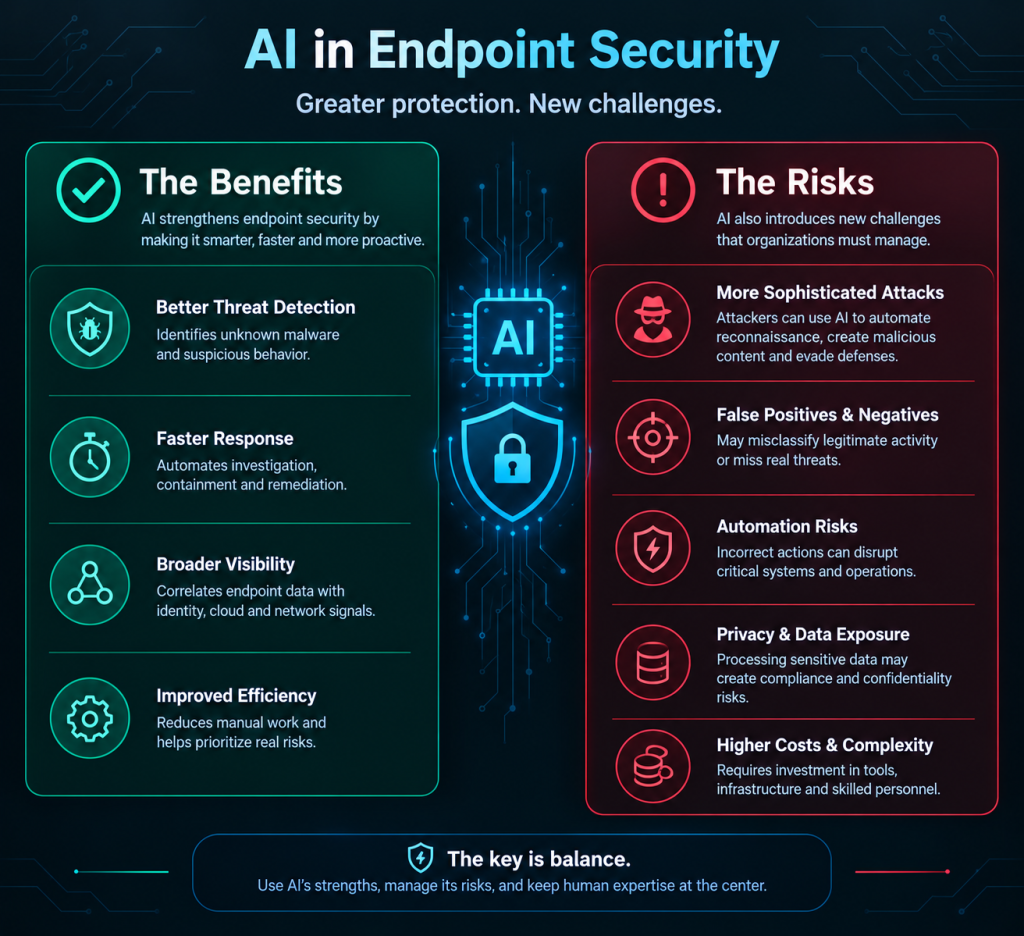
AI is changing how organizations protect endpoint devices. By analyzing behavioral patterns, identifying suspicious activity, correlating security events, and assisting with incident response, AI is helping cybersecurity teams detect threats more effectively and make faster, more informed decisions. However, AI also introduces new downsides alongside these benefits. Attackers can use AI to amplify malicious online activities, while defenders must account for false positives, model manipulation, privacy concerns, and excessive automation.
Understanding both sides of this transformation is essential for cybersecurity professionals who want to build resilient endpoint defenses.
What Is AI-Powered Endpoint Security?
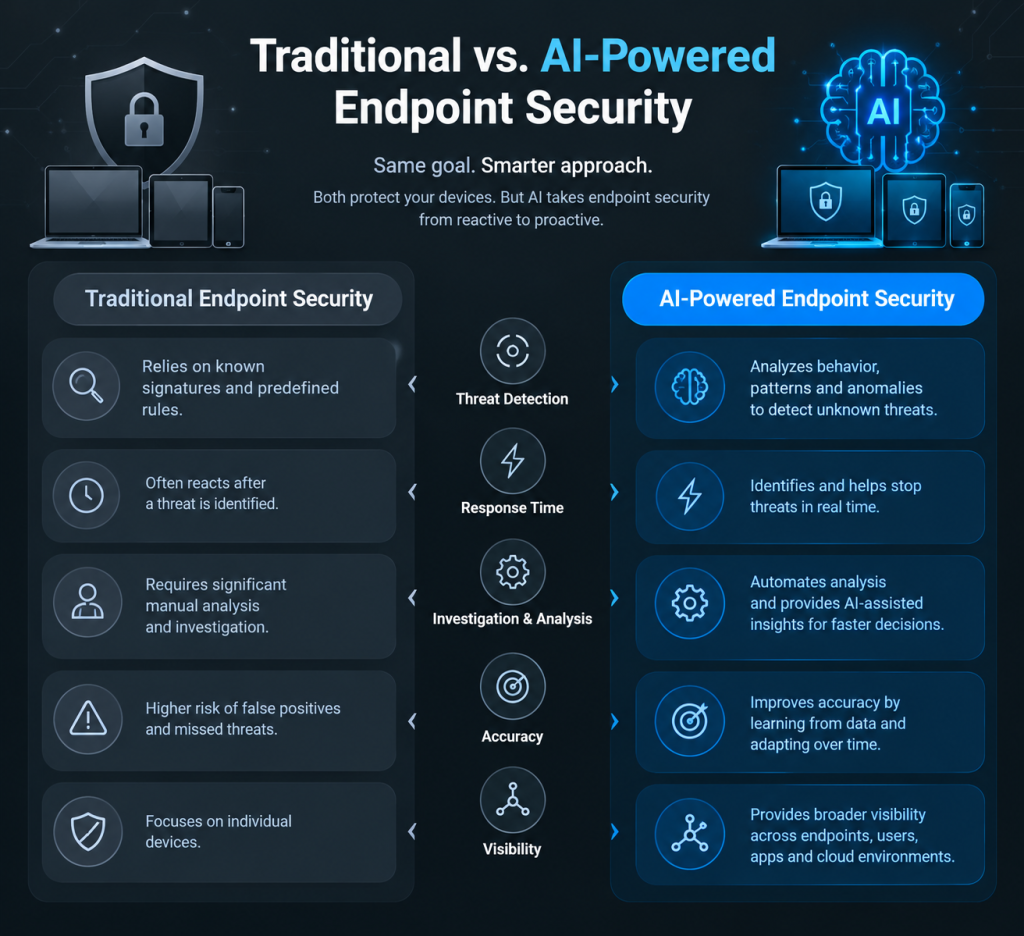
AI-powered endpoint security uses machine learning (ML), behavioral analytics, and, increasingly, generative AI to strengthen the protection of devices and the systems they access.
Traditional antivirus solutions primarily rely on known malware signatures, reputation data, and predefined rules. Modern endpoint detection and response (EDR) platforms supplement these techniques by monitoring processes, examining execution patterns, and investigating suspicious behavior. AI can strengthen these capabilities by recognizing patterns that may not match previously documented threats. AI can also help correlate endpoint activity with identity, email, network, and cloud security signals. This broader visibility enables cybersecurity teams to investigate attacks as connected events rather than isolated alerts.
5 Ways AI Is Transforming Endpoint Security
1. Detecting Unknown Malware and Suspicious Behavior
AI can identify potentially malicious activity by examining process execution, file modifications, memory behavior, and other endpoint signals. This helps complement signature-based detection when attackers use unfamiliar malware variants or legitimate administrative tools for harmful purposes.
For example, Microsoft’s Defender for Endpoint combines machine learning techniques with behavioral signals to identify suspicious activity associated with human-operated ransomware attacks. In a documented 2022 case, Microsoft (1) described detecting and disrupting an attack after files had been encrypted on 3.9% of the organization’s devices. The example demonstrates how correlating evidence across devices can help contain an attack before it spreads further.
2. Strengthening Ransomware Prevention and Response
Ransomware attacks often involve multiple stages, including credential theft, privilege escalation, lateral movement, data exfiltration, and file encryption. AI-assisted analytics can help identify suspicious sequences across endpoints and support faster containment. Depending on the platform and configured policies, security teams may isolate a compromised device, terminate a malicious process, or block related activity on other systems.
Nevertheless, organizations should combine AI-driven detection with application control, least-privilege access, network segmentation, and tested backups. These foundational controls remain essential to limiting ransomware damage, especially given the rise of Ransomware-as-a-Service (RaaS) platforms.
3. Accelerating Threat Hunting and Incident Investigation
Security analysts frequently investigate large volumes of alerts and reconstruct complex attack timelines. AI can assist their efforts by summarizing incidents, explaining technical findings, suggesting investigative questions, and helping analysts navigate security telemetry.
As an example, Microsoft Security Copilot (2), integrated with Microsoft Defender, can generate incident summaries that describe how an attack unfolded, identify involved assets and indicators of compromise, and suggest follow-up investigative prompts. These capabilities can reduce repetitive work and help analysts focus on validating evidence and making response decisions. However, AI-generated summaries may omit details or misinterpret events, so analysts must verify important conclusions against the underlying logs and telemetry.
4. Prioritizing Vulnerabilities and Reducing Exposure
AI-assisted analytics can help security teams prioritize vulnerabilities by considering factors such as exploitability, asset criticality, exposure, and suspicious activity. Consider an organization managing thousands of endpoints. Rather than treating every vulnerability as an equally urgent task, security teams can combine vulnerability intelligence with asset inventories and business context to identify systems that warrant immediate attention.
The resulting prioritization can help teams allocate remediation resources more effectively. However, AI-generated risk scores should not replace sound vulnerability management practices or accurate asset inventories.
5. Monitoring AI Applications and Autonomous Agents
As organizations deploy AI assistants, coding agents, and other agentic AI applications, endpoint security must increasingly account for what these systems can access and execute. An AI agent with access to files, terminals, credentials, or external tools may create risks if attackers manipulate instructions or exploit excessive permissions. Security teams therefore need to monitor AI-related processes, restrict access to sensitive resources, and investigate suspicious use of tools.
The National Institute of Standards and Technology (NIST)(3) identifies evasion, data poisoning, and privacy attacks among the important threats to AI and ML systems.
The Risks and Limitations of AI in Endpoint Security
AI can improve detection and response, but it also introduces operational and security challenges.
- False positives and missed threats: AI may misclassify legitimate activity or fail to identify a carefully concealed attack.
- Adversarial manipulation: Attackers may manipulate inputs or training data to influence a model’s behavior.
- Excessive automation: An incorrect automated response could isolate a critical server or interrupt legitimate business operations.
- Privacy and data exposure: Security investigations may process sensitive endpoint logs, source code, credentials, and user information.
- Operational costs: AI capabilities may introduce additional licensing, computing, storage, and integration expenses.
- Overreliance on AI: Analysts who accept generated explanations without checking evidence may overlook important details or act on incorrect recommendations.
How Cybersecurity Professionals Should Approach Using AI in Endpoint Security
To use AI-powered endpoint security effectively, professionals should develop both technical expertise and sound security judgment.
- Start with the fundamentals: Maintain endpoint visibility, enforce least privilege, patch vulnerable systems, strengthen identity security, and implement reliable incident response procedures.
- Develop EDR and XDR expertise: Learn to interpret endpoint telemetry, investigate process trees, correlate security events, and distinguish malicious behavior from legitimate administrative activity.
- Practice AI-assisted investigations: Use approved environments to examine incident summaries, test investigative queries, and validate AI-generated recommendations against real evidence.
- Understand AI security risks: Study adversarial machine learning, prompt injection, data exposure, agent permissions, and the security of AI integrations.
- Measure results: Evaluate detection quality, false-positive rates, response times, business disruption, and total cost of ownership instead of assuming that AI adoption automatically improves security.
The Future of AI-Powered Endpoint Security
Endpoint security will increasingly combine behavioral detection, AI-assisted investigation, risk-based prioritization, and coordinated response across endpoints, identities, cloud services, and AI applications. More autonomous systems may handle routine investigations and predefined response actions, allowing cybersecurity teams to focus on complex incidents. At the same time, organizations will need stronger safeguards to ensure that automated decisions remain reliable, explainable, and proportionate to the risk.
AI will also expand the scope of endpoint protection. Security teams will need to understand not only which devices are protected, but also which AI applications and agents run on them, what permissions they hold, and how they interact with sensitive systems.
The organizations best prepared for this future will combine modern security technology with skilled professionals who understand how to evaluate, configure, monitor, and govern it.
Practical Education to Develop Endpoint Security Expertise
AI is transforming endpoint security from a largely reactive discipline into a more adaptive approach to detecting threats, investigating incidents, and coordinating responses. Yet its effectiveness depends on more than algorithms. Organizations need reliable cybersecurity fundamentals, carefully governed automation, and professionals capable of translating AI-generated insights into sound security decisions.
EC-Council University (ECCU) empowers professionals to build the advanced knowledge and practical capabilities needed to navigate this changing AI-driven threat landscape. Through hands-on cybersecurity education that emphasizes applied learning and real-world security challenges, professionals can strengthen their ability to assess emerging tech disruptions and make informed defensive decisions as AI reshapes endpoint security.
Discover more benefits of studying cybersecurity at ECCU: