
Cybersecurity sounds intimidating from the outside. Hackers, code, and endless acronyms can scare off beginners fast. Many people wonder if they are smart enough to break in.
Here is the truth. Cybersecurity is challenging, but it is not out of reach. Plenty of professionals switched in from other careers. What matters most is curiosity, steady practice, and the right path.
This blog gives you an honest answer. You will learn what makes cybersecurity hard. You will also see what is easier than you think. We cover whether you need math or coding. Then we map out realistic timelines and a step-by-step learning path. Finally, you can check the signs that this field fits you.
Key Takeaways
- Cybersecurity is challenging, but beginners can absolutely learn
- The hardest part is breadth, not genius-level
- Many professionals moved into security from other
- Most roles need little advanced
- Hands-on practice matters as much as
- Entry-level jobs are competitive, so proof of skill
- Curiosity and persistence predict success better than
The Honest Answer: Is Cybersecurity Hard?
Cybersecurity is challenging but learnable. It is not reserved for math geniuses or lifelong coders. It is hard mainly because it covers so much ground.
The good news is that difficulty drops with structure. Beginners who follow a clear path and practice often make steady progress. Those who jump between random tutorials tend to stall.
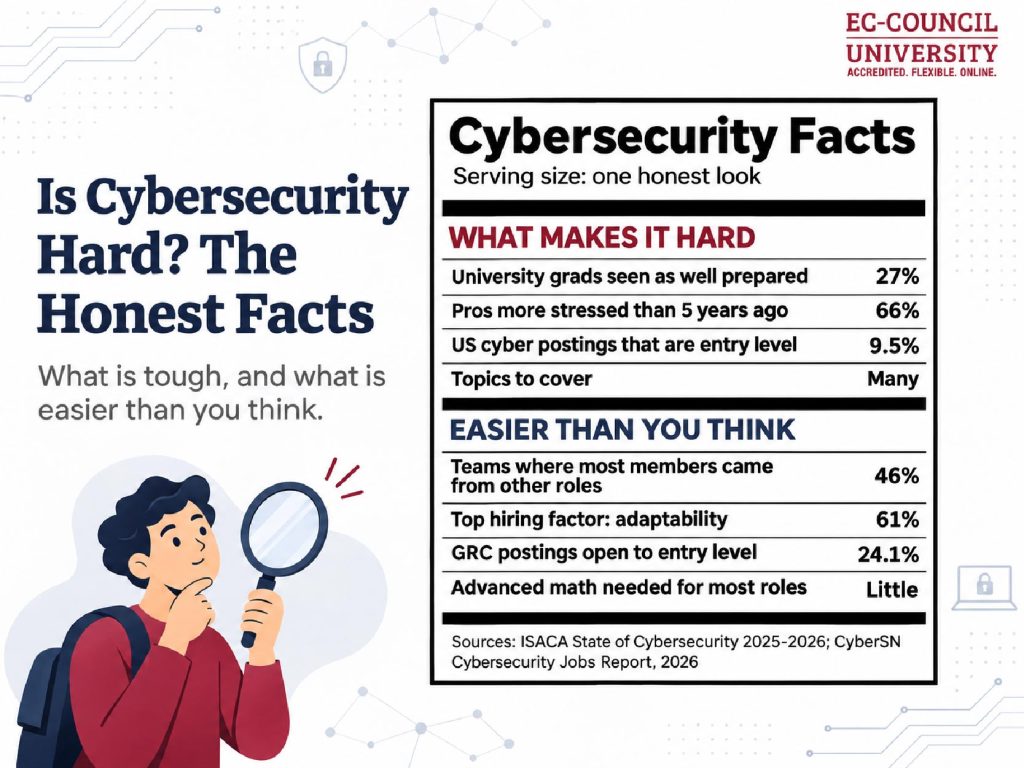
The field also welcomes newcomers. ISACA surveyed security professionals for its 2025-2026 report. 46% said more than half their team came from other roles. In other words, people learn this field mid-career all the time.
What Makes Cybersecurity Hard
Let’s be honest about the tough parts first.
It covers a huge range of topics. Networks, operating systems, cloud, identity, law, and human behavior all matter. The NICE Framework maps dozens of distinct work roles. Nobody masters them all at once.
It never stops changing. New attacks, tools, and AI threats appear every month. Learning never really ends, even for experts.
Theory alone is not enough. Employers want proof you can do the work. In ISACA’s 2025-2026 report, only 27% believed university graduates were well prepared. Incident response was the top gap, cited by 43%.
The pressure is real. ISACA found 66% feel more stressed than five years ago. Security teams handle urgent, high-stakes problems. Good teams manage this with clear playbooks and shared on-call duties.
Entry-level roles are competitive. In CyberSN’s 2026 data, only 9.5% of US postings were entry level. You need to stand out with skills, not just interest.
What Is Easier Than You Think
Now for the good news. Several common fears do not hold up.
You do not need a tech background to start. Backgrounds in audit, law, IT support, and teaching often transfer well. Your past experience is rarely wasted.
Employers value adaptability most. In ISACA’s 2025-2026 survey, adaptability was the top qualification factor at 61%. Hands-on experience came next at 60%. Both can be built with practice.
Soft skills count for a lot. Critical thinking, communication, and problem-solving top employers’ wish lists. If you explain ideas clearly, you already have an edge.
Some paths are friendlier to beginners. In CyberSN’s data, 24.1% of GRC postings were entry level. That is far above the overall average. Governance, risk, and compliance suits careful, organized thinkers.
Do You Need Math or Coding?
This is the question beginners ask most. The short answer is less than you fear.
Math: Most cybersecurity roles need basic math and logic, not calculus. Cryptography is the main exception, and it is a niche specialty. If you can follow a step-by-step process, you can handle most of the math.
Coding: You do not need to be a software developer. But basic scripting helps a lot. Python and command-line skills let you automate tasks and read attack code. Many beginners learn both alongside their security studies.
Some roles lean more technical than others. Penetration testers and security engineers code often. GRC analysts and policy roles rarely do. Pick a path that matches your comfort level, then stretch from there.
How Long Does It Take to Learn Cybersecurity?
It depends on your starting point and your goal. Learning the basics takes months. Becoming job-ready usually takes longer. Mastery takes years, because the field keeps moving.
Here is a rough guide to common paths:
| Path | Typical Time | Best For |
|---|---|---|
| Self-study of fundamentals | A few months of steady practice | Testing your interest before committing |
| Entry-level certifications | Several weeks to a few months each | Proving specific skills to employers |
| Bachelor’s degree | About four years full time, often less with transfer credits | Building a complete foundation and credential |
| Career switch from IT | Often faster, since networking skills transfer | IT support and system admin professionals |
These are estimates, not promises. Consistent weekly practice matters more than the calendar.
A Beginner's Learning Path
- Learn IT fundamentals first. Start with networking, operating systems, and how the internet works. Security makes far more sense on this base.
- Get comfortable with Linux and the command line. Many security tools run there.
- Study core security concepts. Learn about threats, vulnerabilities, encryption, and access control.
- Practice in safe labs. Use virtual labs and capture-the-flag challenges to build real skills. Never practice on systems you do not own.
- Pick a direction. Explore defense, offense, or GRC, then go deeper in one.
- Earn a credential that fits. A degree or certification shows employers your commitment.
- Build a portfolio. Document labs and projects to prove your skills. This guide to building your first cybersecurity portfolio can help.
- Find a mentor. A good mentor can shorten your learning curve and open doors.
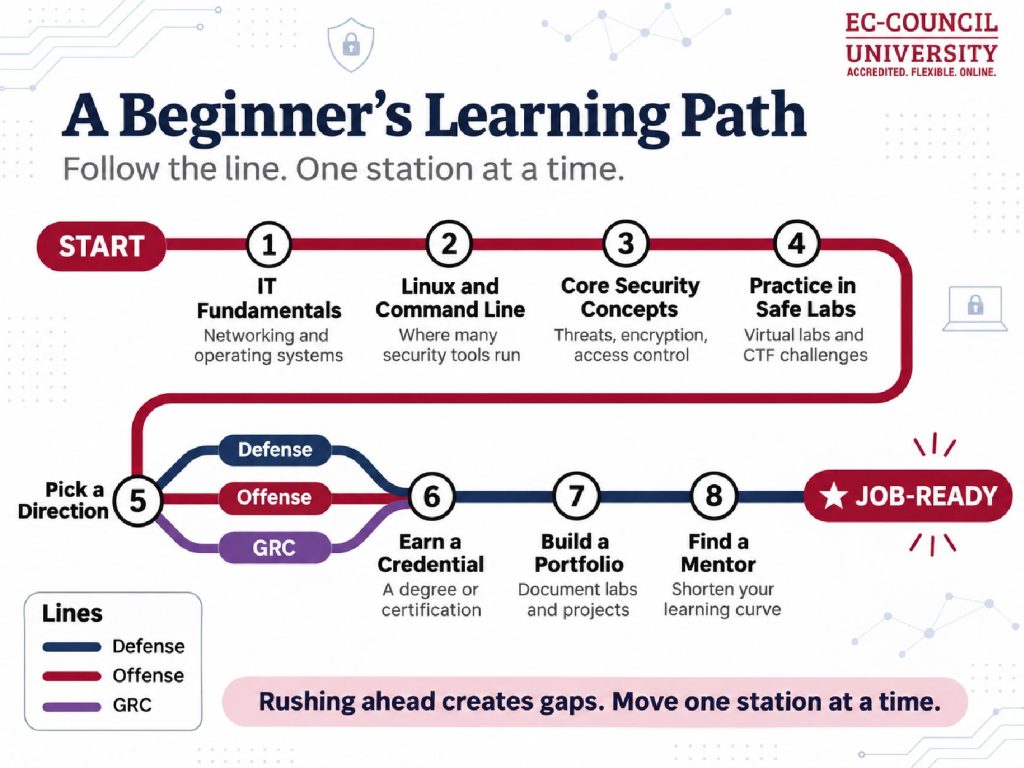
Move one step at a time. Rushing ahead usually creates gaps you must fill later.
Signs Cybersecurity Is Right for You
- You enjoy solving puzzles and figuring out how things
- You ask “what could go wrong?” before others
- You stay calm when things
- You like learning new tools and
- You care about protecting people and their
- You can explain technical ideas in plain
Start Your Cybersecurity Journey With ECCU
The right structure turns a hard field into a learnable one. ECCU’s Bachelor of Science in Cyber Security is built for beginners. It starts with the fundamentals and builds step by step. You learn how attacks work and how to stop them.
You also practice in hands-on virtual labs, so theory turns into real skill. Flexible online classes fit around work and family. That makes it a practical choice for career changers, too.
Wondering if you are ready? Talk to an ECCU enrollment advisor and map your first step.
Frequently Asked Questions
Is cybersecurity hard for beginners?
It is challenging, but beginners learn it every day. The hardest part is the wide range of topics. A structured path makes it far more manageable.
Can I learn cybersecurity with no experience?
Yes. Start with IT fundamentals like networking and operating systems. Then add security concepts and hands-on lab practice.
Do I need to be good at math?
No. Most roles need only basic math and logic. Advanced math matters mainly in cryptography.
Is cybersecurity harder than programming?
They are hard in different ways. Programming goes deep on building software. Cybersecurity goes wide across systems, people, and threats.
How long does it take to get a cybersecurity job?
It varies by background and path. Many beginners need a degree or certifications plus hands-on practice. Those with IT experience often move faster.
What is the easiest area of cybersecurity to start in?
Many beginners start in security operations or GRC. GRC roles are often more open to entry-level candidates. Both offer clear paths to grow from there.