Security programs have a split mission. They must find weaknesses before attackers do. They must also catch attackers who slip through anyway. In cybersecurity, colored teams own those jobs.
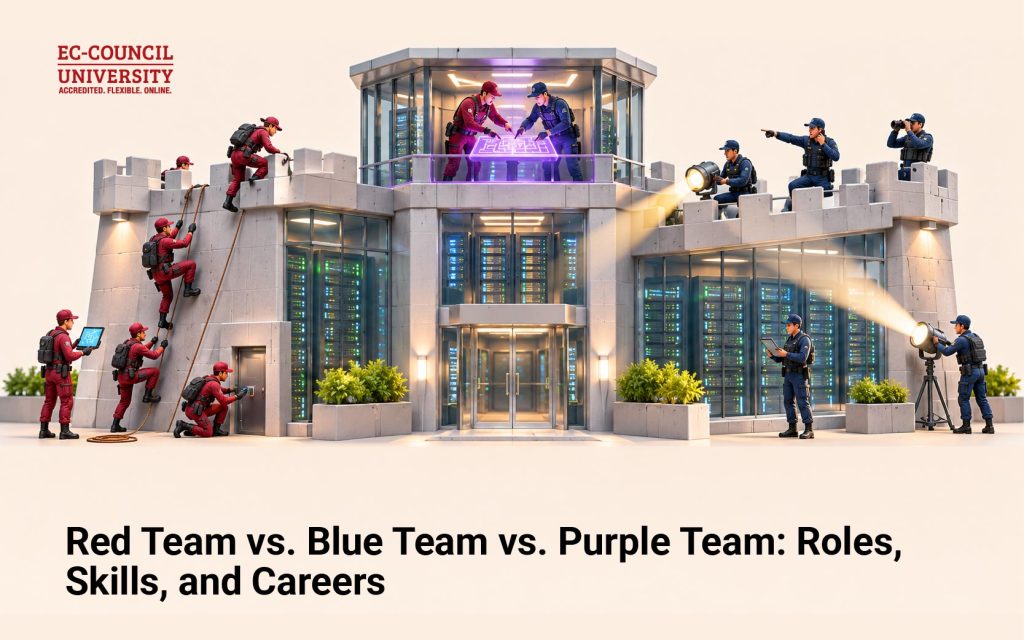
Red teams play the attacker. Blue teams defend the network. Purple teams make both sides work as one. Each role asks for a different mindset and skill set.
This blog breaks down every team side by side. You will learn what each team does day to day. You will see a real red team exercise that put defenders to the test. Then you will find the skills and certifications for each path. Finally, you can decide which team fits you best.
Key Takeaways
- Red teams think like attackers to expose hidden
- Blue teams detect, respond to, and recover from real
- Purple teams turn attack findings into better
- Tools that log an attack do not always raise an
- Skills that blend offense and defense are growing more
- Certifications help you prove your skills on either
- The right team depends on how you like to solve
What Are Red, Blue, and Purple Teams?
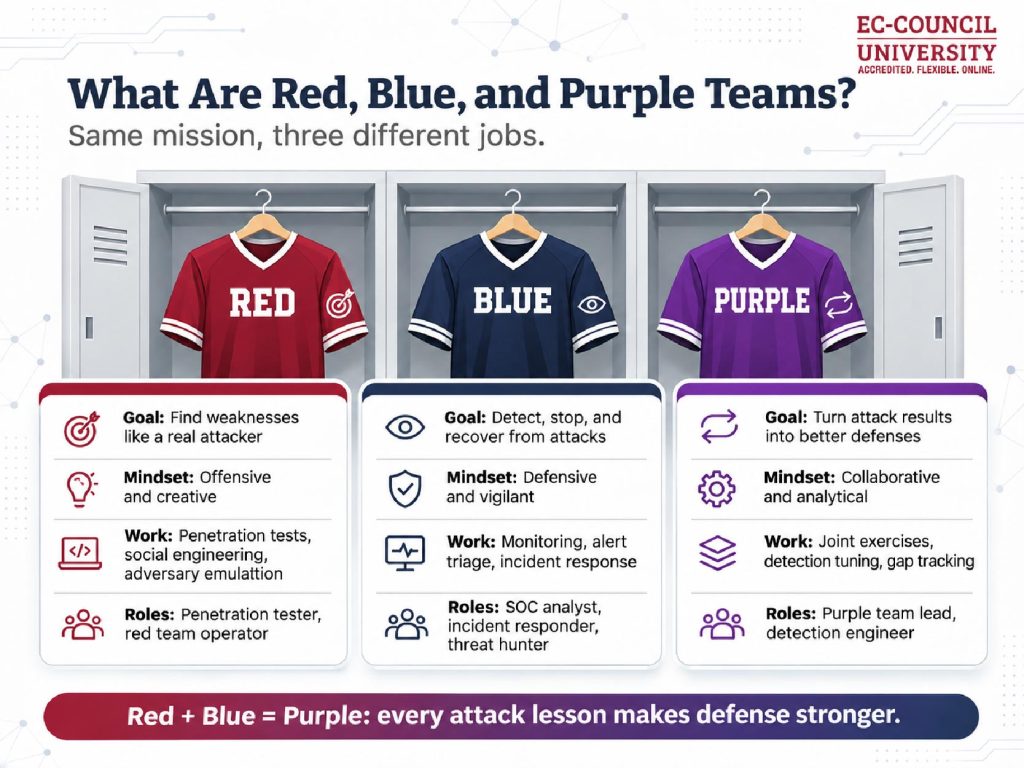
Red, blue, and purple teams are roles in a security program. A red team attacks systems to find weaknesses. A blue team defends systems and responds to threats. A purple team connects both so every attack lesson improves defense.
The terms come from military war games. One side played the enemy while the other defended. Security teams borrowed the idea, and it stuck.
| Red Team | Blue Team | Purple Team | |
|---|---|---|---|
| Main Goal | Find weaknesses like a real attacker | Detect, stop, and recover from attacks | Turn attack results into better defenses |
| Mindset | Offensive and creative | Defensive and vigilant | Collaborative and analytical |
| Typical Work | Penetration tests, social engineering, adversary emulation | Monitoring, alert triage, incident response | Joint exercises, detection tuning, gap tracking |
| Common Roles | Penetration Tester, Red Team Operator | SOC Analyst, Incident Responder, Threat Hunter | Purple Team Lead, Detection Engineer |
| Success Looks Like | Reaching a goal without getting caught | Catching and containing threats quickly | Fewer blind spots after every exercise |
The Red Team: Thinking Like an Attacker
Red teams act as friendly adversaries. Their job is to break in before real criminals do. They chase a goal, such as reaching sensitive data, without being detected.
Red teaming goes beyond a standard penetration test. A pen test checks for as many vulnerabilities as possible. A red team engagement tests whether defenders notice a realistic attack. Many professionals start with a penetration testing career before moving into red teaming.
Red teams often copy real attackers. They study advanced persistent threats and mimic their methods. Some engagements also test physical security threats, like tailgating into offices.
Others test people with phishing emails and pretext calls.
Good red teamers share a few traits. They are curious, patient, and creative. They write clear reports, because a finding nobody understands fixes nothing.
The Blue Team: Detecting and Defending
Blue teams protect the organization every single day. They watch networks, investigate alerts, and respond when something breaks through. Most blue team work happens inside a security operations center (SOC).
Blue teamers rely on a stack of security tools. SIEM platforms collect logs from across the network. Endpoint detection tools watch laptops and servers. Firewalls and identity systems add more signals.
The hard part is not collecting data. It is spotting the real threat inside a flood of noise. Blue teams tune detections, hunt for hidden attackers, and follow incident response playbooks.
Strong blue teamers stay calm under pressure. They think in patterns, document carefully, and communicate fast during incidents.
The Purple Team: Where Attack Meets Defense
Purple teaming is not always a separate team. Often, it is a way of working. Red and blue sit together, plan attacks, and review results in real time.
The process is simple. The red side runs a known attack technique. The blue side checks whether its tools caught it. Together, they fix what was missed and test again.
Purple teams speak a shared language called MITRE ATT&CK. This framework catalogs real attacker tactics and techniques. Each test maps to a technique, so gaps are easy to track. For AI systems, MITRE ATLAS extends the same idea.
Why does this matter so much? Logging an attack is not the same as alerting on it. Security Risk Advisors is a consultancy that runs purple team exercises. It studied more than 160 of them for its 2026 report. Pass-the-ticket attacks were logged 42% of the time. Yet they triggered alerts only 16% of the time. Command-and-control traffic over HTTPS fared even worse. It was logged 47% of the time but alerted just 10%.
The fix is practice. Teams running purple exercises two to four times yearly did significantly better.
What CISA's "Tale of Two SOCs" Teaches All Three Teams
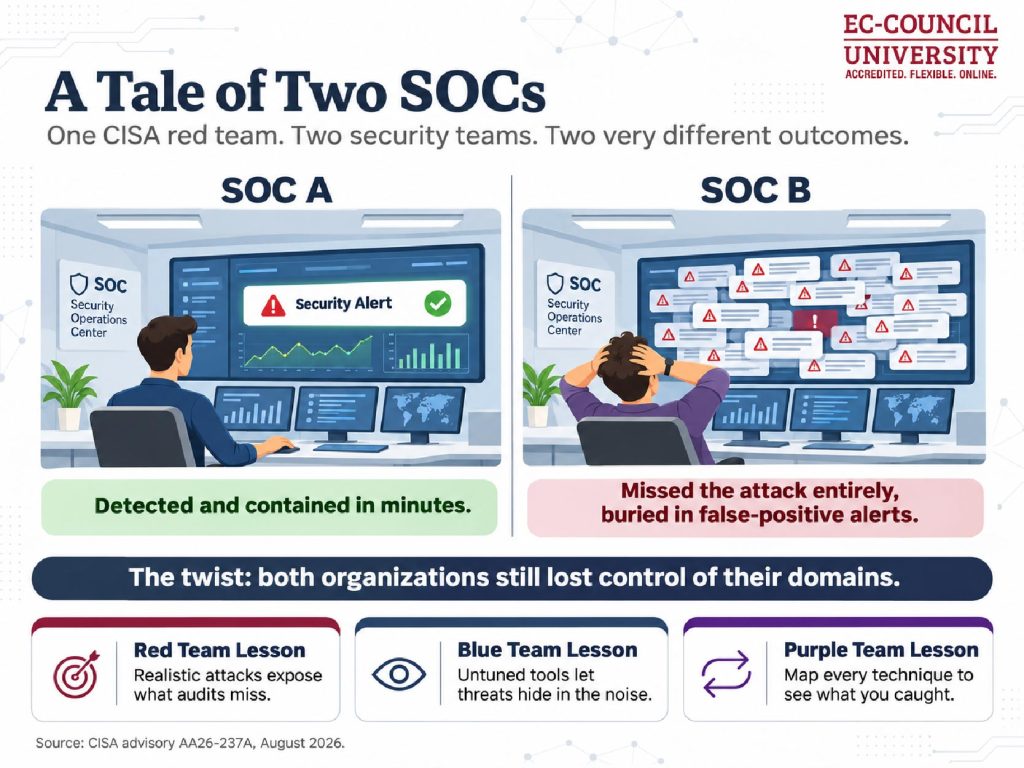
In August 2026, CISA published a rare look at red versus blue in action. Its advisory, A Tale of Two SOCs, describes simultaneous red team assessments. CISA’s red team targeted two US critical infrastructure organizations. It used similar tactics against both.
The results split sharply. One SOC detected and contained the intrusion within minutes. The other never noticed the attack at all. Even so, both organizations lost control of their domains and cloud environments.
Why did one SOC miss everything? Its tools were not blind. The red team’s activity was buried under thousands of false-positive alerts. The signals existed, but nobody could see them through the noise.
The lessons land differently for each team. For red teams, realistic attacks exposed weaknesses that audits never would. For blue teams, untuned tools let real threats hide in plain sight. For purple teams, CISA mapped every technique to MITRE ATT&CK. That scorecard shows exactly which stages each SOC caught or missed. CISA also warned that cloud identity risk is often underestimated.
Skills and Certifications for Each Team
Each team needs a different toolkit. The NICE Framework work roles can help you map these skills to real jobs.
Red Team
- Network and web application exploitation, scripting, and social engineering
- Clear reporting that turns findings into fixes
- Certifications: CEH, CPENT, and COASP for offensive AI security
Blue Team
- Log analysis, SIEM tuning, and endpoint investigation
- Incident handling under pressure
- Certifications: CND for network defense, ECIH for incident handling, and CTIA for threat intelligence
Purple Team
- Working knowledge of both offense and defense
- MITRE ATT&CK mapping and detection engineering
- Certifications: a blend of both sides, often CEH paired with CND or ECIH
Outside EC-Council, OSCP is another popular red team credential. To weigh your options, compare major certifications side by side. You can also browse the top cybersecurity certifications for this year.
Which Team Fits You?
Start with how you like to solve problems.
- Choose red if you love puzzles, breaking things, and outsmarting Then learn how to break into penetration testing.
- Choose blue if you enjoy spotting patterns and staying calm in a
- Choose purple if you want to understand both sides and improve the whole
- Not sure yet? Start on the blue Defense skills transfer well to every other role.
What the Job Market Says
Demand for security talent remains strong overall. The BLS projects 29% job growth for information security analysts.
But the mix is shifting. CyberSN’s 2026 data shows penetration tester postings down 45.9% year over year. Threat hunter postings dropped 40%.
That does not mean offense is dying. It means pure attack skills alone are harder to sell. Employers increasingly want people who connect attack findings to stronger defenses. That is exactly what purple teaming rewards.
Wherever you start, two things speed you up. First, decide between a degree or certifications, or combine both. Second, find a mentor who already works on the team you want.
Build Your Team Skills With ECCU
Whichever color you choose, ECCU offers a path that fits.
MSCS Security Analyst: This track covers both sides of the fight. You learn threat monitoring, vulnerability assessment, and SOC operations. It also includes Offensive AI Security and Red Team Operations, aligned to COASP. That mix suits future purple teamers.
MSCS Incident Management and Cyber Operations: This track builds deep blue team skills. You train in incident handling, disaster recovery, and business continuity. It prepares you for the ECIH exam.
Bachelor of Science in Cyber Security: New to the field? This degree teaches how attacks work and how to stop them. You practice in hands-on virtual labs before choosing a side.
Not sure which team suits you? Talk to an ECCU enrollment advisor and map your next step.
Frequently Asked Questions
What is the difference between a red team and a blue team?
A red team simulates real attacks to find weaknesses. A blue team defends systems and responds to threats. Together, they show how well an organization holds up.
What does a purple team do?
A purple team connects red and blue work. It runs attacks, checks what defenders caught, and fixes the gaps. The goal is better detection after every exercise.
Is red teaming the same as penetration testing?
Not quite. A penetration test hunts for as many vulnerabilities as possible. A red team pursues a specific goal while trying to stay hidden.
Which team is best for beginners?
Many people start on the blue side, often in a SOC. Defense roles teach how attacks look from the inside. Those skills transfer well to red and purple work later.
Do I need certifications to join a red or blue team?
Certifications are not always required, but they help. They prove your skills to employers. Hands-on labs and real projects matter just as much.
Is purple teaming a job title?
Sometimes, but not always. Many organizations treat it as a way of working. Detection engineers and purple team leads often own the process.