ATP Campaigns in 2027: More Sophisticated, More Prevalent
Advanced Persistent Threat (APT) campaigns remain among the most challenging cybersecurity threats facing organizations. Unlike opportunistic attacks that seek quick financial gains, APT operations typically pursue specific strategic objectives, such as corporate espionage, intellectual property theft, intelligence gathering, or disruption of critical infrastructure.
And now, AI is adding another dimension to ATP campaigns. Threat actors are using AI to accelerate reconnaissance, create convincing phishing campaigns, develop malicious tools, and analyze compromised systems. As these capabilities evolve, cybersecurity professionals must understand how modern APT campaigns operate and how to detect and disrupt them.
What is an APT Campaign?
An APT campaign is a coordinated, targeted cyber operation in which an attacker establishes and maintains access to a target environment over an extended period. The U.S. National Institute of Standards and Technology (NIST) (1) describes an advanced persistent threat as one in which adversaries with substantial expertise and resources adapt to defensive measures and remain determined to achieve their objectives.
Nation-state-sponsored groups, intelligence services, and well-funded cybercrime syndicates are usually the ones who conduct APT-style operations. Their targets can include government agencies, defense contractors, financial institutions, healthcare providers, energy infrastructure, and tech companies.
How Does a Modern APT Campaign Work?
- Reconnaissance and target selection: Attackers research an organization’s employees, systems, vendors, and publicly exposed infrastructure to identify potential entry points.
- Initial compromise: They gain access through spear-phishing, stolen credentials, exploited vulnerabilities, compromised software, or third-party relationships.
- Persistence and privilege escalation: Attackers establish mechanisms to maintain access and obtain additional permissions to access sensitive systems.
- Lateral movement and command and control: They move between connected systems and communicate with compromised devices to coordinate further activity.
- Mission execution: Depending on their objectives, attackers may steal confidential information, conduct surveillance, disrupt operations, or position themselves for future attacks.
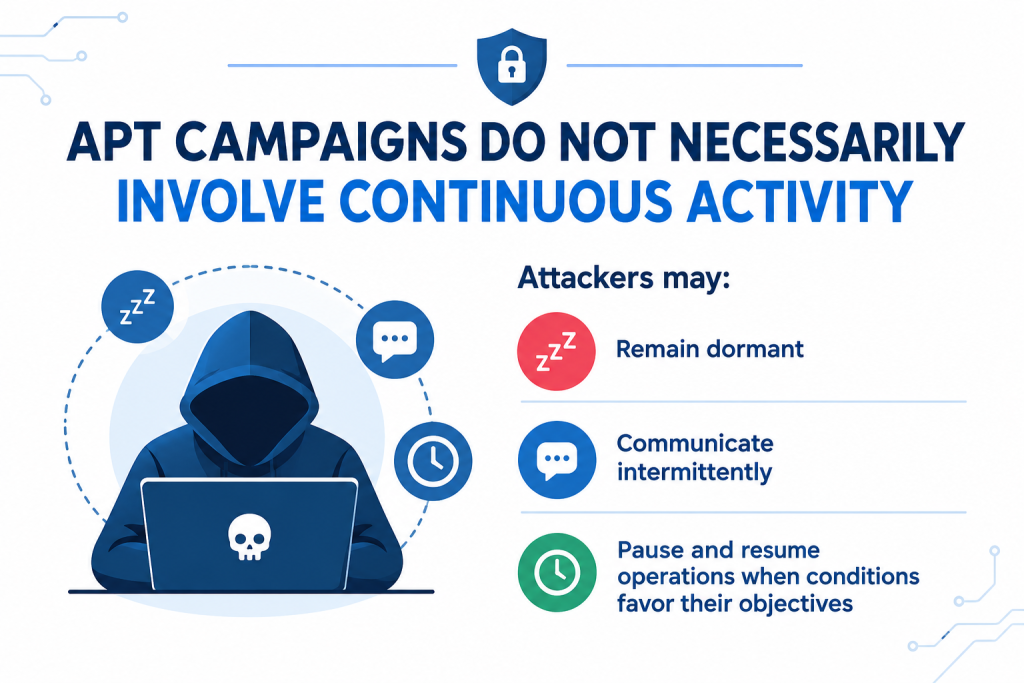
These stages are not always linear. Attackers may revisit earlier steps, change tactics, or operate across several stages simultaneously.
How is AI Transforming Modern APT Campaigns?
AI is increasingly helping threat actors improve established attack techniques. Google Threat Intelligence Group’s (GTIG) February 2026 report (2) documented state-linked actors using generative AI for research, phishing content creation, coding, and other operational tasks. However, the group also noted that it had not observed breakthrough capabilities fundamentally changing the threat landscape.
Here are 6 important applications of AI in APT campaigns:
1. AI-Assisted Reconnaissance
Attackers can use AI to summarize publicly available information, analyze technical documentation, research vulnerabilities, and identify potentially valuable targets. These capabilities can reduce the manual effort required to prepare targeted intrusions.
2. More Convincing Social Engineering
Generative AI can help attackers create polished, personalized phishing emails, translate messages, and impersonate professional communication styles. AI-generated audio and video can also support impersonation attempts. For organizations, the implications extend to executive impersonation, fraudulent vendor communications, and targeted attacks against employees with privileged access.
3. Malware Development and Tooling
Threat actors can use AI to explain code, troubleshoot errors, translate programming languages, and accelerate the development of malicious tools. In November 2025, Google (3) reported novel malware implementations that incorporated AI capabilities during execution, indicating an emerging shift beyond using AI solely as a development assistant.
4. Post-Compromise Analysis
After gaining access, attackers can use AI to interpret system information, summarize documents, examine permissions, and prioritize valuable data. These capabilities can help operators determine where to focus their efforts within a compromised environment.
5. Evasion and Adaptability
AI-assisted development may help attackers modify tools and troubleshoot operations when security controls interfere. Experimental AI-enabled malware also raises concerns about more adaptive behavior. However, defenders should distinguish demonstrated capabilities from speculative scenarios involving fully autonomous attacks.
6. Data Discovery and Exploitation
AI can help process large collections of stolen files, summarize communications, and identify information relevant to espionage, fraud, or extortion. This can increase the efficiency with which attackers extract value from a successful compromise.
Real-World APT Threat Cases and AI-Enabled Operations
- APT41: GTIG reported in 2025 (3) that this China-linked threat actor used Gemini to support code development, technical research, and troubleshooting related to offensive tooling.
- APT42: Google also documented (3) an Iranian-linked group’s use of generative AI to develop phishing material, conduct research, and assist with malicious tooling.
- KONNI: In January 2026, Check Point Research (4) reported a phishing campaign linked to this North Korea-aligned threat actor that used an AI-generated PowerShell backdoor to target software developers and engineering teams.
The 3 Levels of AI Involvement in Modern APT Campaigns
Cybersecurity professionals should distinguish between the following 3 degrees of AI involvement in ATP campaigns:
- AI-assisted operations: Human attackers use AI to research targets, generate content, write code, or interpret information.
- Partially automated operations: AI tools and conventional scripts handle selected tasks within a broader, human-directed campaign.
- Agentic operations: AI systems attempt to plan and execute multiple steps, evaluate results, and adapt their actions with limited human intervention.
AI-assisted operations are documented in real-world threat intelligence. More autonomous attack workflows remain an evolving area, and their reliability and adoption vary. The key concern is that increasingly capable tools could allow threat actors to conduct more operations simultaneously while reducing the time required for selected tasks.
How Organizations Can Defend Against Modern AI-Enabled APT Campaigns
Effective defense requires multiple layers of protection rather than dependence on a single security product:
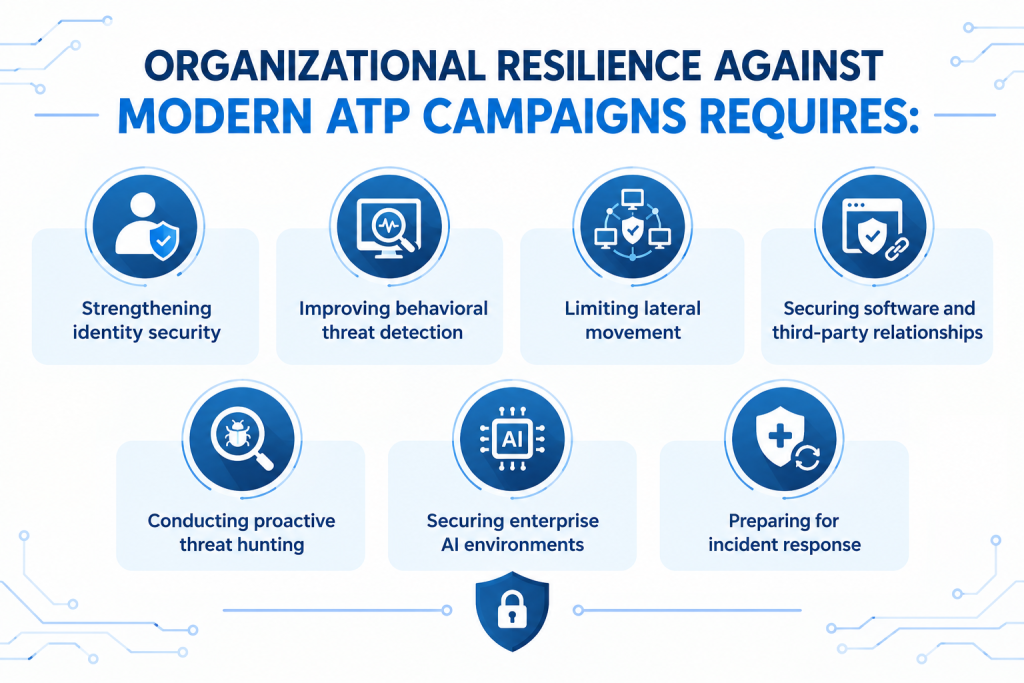
- Strengthen identity security: Implement phishing-resistant multifactor authentication, least-privilege access, privileged account monitoring, and regular access reviews.
- Improve behavioral threat detection: Use endpoint detection and response (EDR), extended detection and response (XDR), security information and event management (SIEM), and centralized logging to identify suspicious behavior across systems.
- Limit lateral movement: Segment networks, restrict administrative privileges, monitor unusual authentication activity, and isolate critical assets.
- Secure software and third-party relationships: Assess supplier risks, verify software integrity, patch known vulnerabilities, and monitor trusted applications and dependencies.
- Conduct proactive threat hunting: Investigate suspicious scripts, unexpected administrative activity, unusual outbound connections, and abnormal data transfers. Use the MITRE ATT&CK framework (5) to map observed behavior to known adversary tactics and techniques.
- Secure enterprise AI environments: Establish access controls for AI tools and APIs, monitor sensitive data flows, evaluate connected agents and integrations, and test AI applications for risks such as prompt injection and unauthorized data access.
- Prepare for incident response: Maintain tested backups, establish clear escalation procedures, and regularly exercise containment, investigation, and recovery plans.
Gain the Expertise to Combat Modern APT Threats
Modern APT campaigns demand cybersecurity professionals who can combine technical depth, analytical thinking, and strategic risk management. AI adds urgency to this requirement by accelerating selected attack activities and creating new security challenges across enterprise environments.
At EC-Council University (ECCU), cybersecurity professionals can acquire advanced knowledge and develop practical skills to address evolving ATP threats. Our world-class online cybersecurity degrees and certification courses encompass relevant areas of expertise, including threat intelligence analysis, adversary tactics and techniques, penetration testing, digital forensics, incident response, malware analysis, network defense, identity security, offensive AI security, and AI and cybersecurity governance.
By strengthening these capabilities, you can better identify early indicators of compromise, investigate sophisticated intrusions, contain persistent threats, and build resilient security architectures. As adversaries continue to adapt, forward-thinking cybersecurity education can help you prepare to defend the systems, information, and critical services on which modern organizations depend.
For more information on how ECCU can help you achieve your cybersecurity learning and upskilling objectives:
Frequently Asked Questions About APT Campaigns
What does APT stand for in cybersecurity?
APT stands for Advanced Persistent Threat. It describes a targeted, sustained cyber threat in which an adversary seeks to establish and maintain access to an organization’s systems to achieve specific objectives.
What is the primary goal of an APT campaign?
Common objectives include cyber espionage, intellectual property theft, intelligence collection, surveillance, data exfiltration, and disruption of critical systems. The goal depends on the threat actor and the target.
How does AI make APT campaigns more dangerous?
AI can help attackers accelerate reconnaissance, personalize phishing messages, develop malicious tools, analyze compromised systems, and process stolen data. These capabilities may increase operational efficiency, although AI does not automatically make every attack more sophisticated or successful.
Are APT campaigns always sponsored by nation-states?
No. Nation-state-linked groups are strongly associated with APT activity, but sophisticated criminal organizations and other well-resourced adversaries can also conduct targeted, persistent campaigns.
How can organizations detect an APT campaign?
Organizations can combine endpoint and network monitoring, identity analytics, centralized logging, threat intelligence, and proactive threat hunting. Detecting suspicious behavior across multiple systems is particularly important because attackers may use legitimate tools and compromised accounts.
What is the difference between an APT campaign and a ransomware attack?
An APT campaign is a sustained, targeted operation, whereas ransomware is a type of attack that encrypts data or systems and is often accompanied by an extortion demand. A ransomware incident can form part of a broader intrusion, but the terms are not interchangeable.
Can AI-powered security tools stop APT campaigns?
AI-powered security tools can help detect anomalies, correlate alerts, prioritize threats, and accelerate investigations. However, they cannot guarantee prevention. Organizations still need strong access controls, validated security configurations, trained analysts, and tested incident response procedures.
What skills do cybersecurity professionals need to defend against modern APT campaigns?
Important skills include threat hunting, threat intelligence, network and endpoint security, penetration testing, malware analysis, digital forensics, incident response, identity and access management, AI security testing, and security governance. Practical experience applying these capabilities helps professionals investigate and respond to complex intrusions.
- – https://csrc.nist.gov/topics/security-and-privacy/risk-management/threats/advanced-persistent-threats
- – https://cloud.google.com/blog/topics/threat-intelligence/distillation-experimentation-integration-ai-adversarial-use
- – https://cloud.google.com/blog/topics/threat-intelligence/threat-actor-usage-of-ai-tools
- – https://research.checkpoint.com/2026/konni-targets-developers-with-ai-malware/
- – MITRE ATT&CK framework