
The Aviation Industry Would Come to a Standstill Without Cybersecurity
The aviation industry is one of the world’s most technologically advanced and interconnected sectors. From aircraft navigation and air traffic management to airport operations, passenger services, and airline reservation systems, nearly every aspect of modern aviation depends on digital infrastructure. While these technologies have improved operational efficiency, connectivity, and passenger experiences, they have also expanded the industry’s cybersecurity attack surface.
Cybercriminals and other threat actors view aviation companies as attractive targets due to their reliance on sprawling interconnected systems. A successful large-scale cyberattack would inflict far-reaching damage, including compromising sensitive passenger information, disrupting airport services, hampering flight operations, and affecting systems that support aviation safety. Worst of all, it could cause catastrophic events that result in loss of human life.
The challenge is particularly significant because aviation infrastructure combines legacy IT systems, operational technology (OT), cloud platforms, wireless networks, aircraft communication systems, and third-party software services. Securing this complex digital environment requires a comprehensive approach to cybersecurity that considers both information security and operational safety.
The Top 10 Cybersecurity Vulnerabilities in the Aviation Industry
Listed below are the 10 major cybersecurity vulnerabilities in the aviation industry, their potential consequences, and why addressing them is essential to protecting aircraft, airports, airlines, and critical aviation infrastructure:
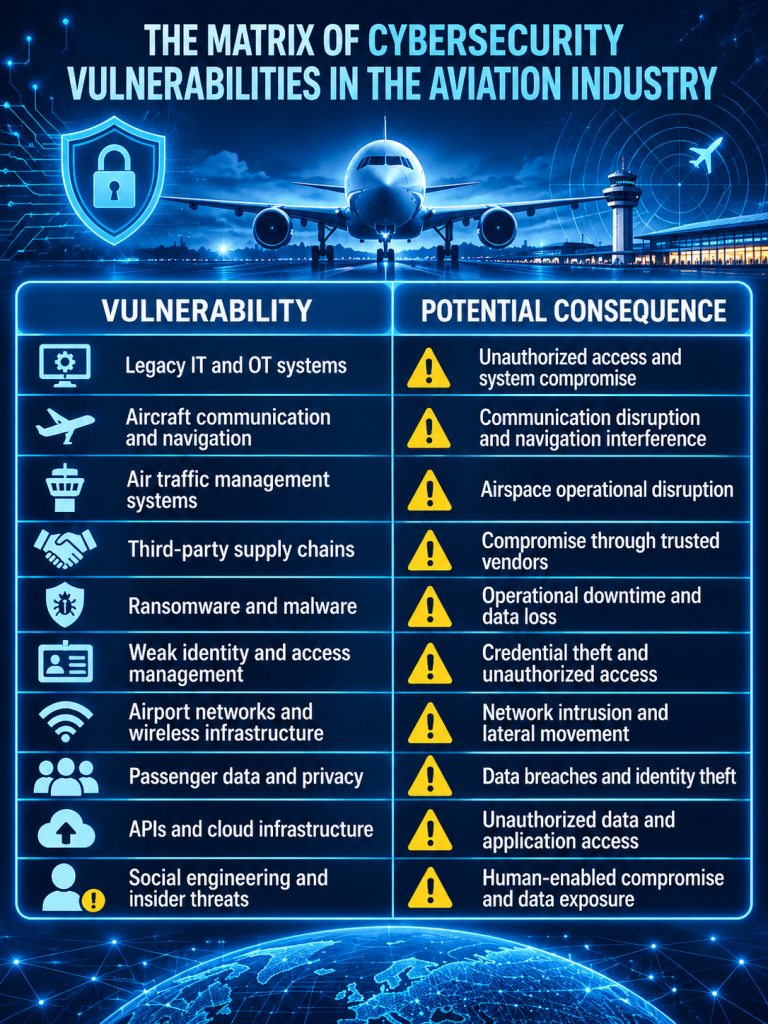
1. Legacy IT and Operational Technology (OT) Systems
Many aviation organizations continue to operate legacy IT and OT systems that were developed before modern cybersecurity threats became widespread. These systems may support airport operations, baggage handling, aircraft maintenance, and air traffic management. Some common vulnerabilities include:
- Outdated operating systems and unsupported software
- Unpatched security vulnerabilities
- Insecure communication protocols
- Limited compatibility with modern security solutions
- Difficulty implementing updates without disrupting operations
Legacy infrastructure can be particularly challenging to secure because replacing or updating mission-critical systems requires extensive testing and operational planning.
How to mitigate this vulnerability:
Aviation organizations should maintain comprehensive IT and OT asset inventories, prioritize vulnerability assessments, implement risk-based patch management, and isolate systems that cannot be updated. Network segmentation and continuous monitoring can further reduce exposure.
2. Insecure Aircraft Communication and Navigation Systems
Modern aircraft rely on sophisticated electronic systems for navigation, communication, flight management, and situational awareness. These technologies exchange information with ground-based infrastructure, satellites, and other aviation systems. Potential vulnerabilities include:
- Weaknesses in aircraft-to-ground communication systems
- Insufficient authentication and encryption in supporting communication services
- Vulnerabilities in satellite-based navigation services
- Inadequate integrity checks for transmitted data
- Exposure to GPS jamming and spoofing
For example, GPS jamming disrupts satellite navigation signals, while GPS spoofing transmits misleading signals that can cause receivers to calculate incorrect positions. Such interference can affect aircraft navigation and increase the workload of flight crews and air traffic controllers. However, interference with external navigation signals should not be confused with gaining control of an aircraft’s flight systems.
How to mitigate this vulnerability:
Aviation stakeholders should strengthen communication security, implement appropriate authentication and integrity protections, monitor navigation interference, and maintain alternative navigation and operational procedures.
3. Vulnerabilities in Air Traffic Management Systems
Air Traffic Management (ATM) systems coordinate aircraft movements, monitor airspace, and help maintain safe separation between aircraft. These systems rely on interconnected technologies, including radar, surveillance infrastructure, communication networks, and air traffic control applications. Potential vulnerabilities include:
- Inadequate network segmentation
- Vulnerable radar and surveillance infrastructure
- Insecure interfaces between interconnected systems
- Weak access controls
- Insufficient resilience against distributed denial-of-service (DDoS) attacks
A successful attack against supporting ATM infrastructure could disrupt operational visibility, delay flights, and force authorities to implement contingency procedures.
How to mitigate this vulnerability:
Air navigation service providers should implement strict access controls, secure system interfaces, conduct regular security assessments, monitor network traffic, and maintain tested business continuity and disaster recovery plans.
4. Third-Party Contractor and Aviation Supply Chain Vulnerabilities
The aviation industry depends on an extensive network of external suppliers, including aircraft manufacturers, maintenance organizations, software developers, cloud computing service providers, and airport technology vendors. This creates opportunities for attackers to exploit weaknesses outside an organization’s direct security perimeter. Common vulnerabilities include:
- Inadequate cybersecurity assessments of suppliers
- Compromised third-party software and updates
- Excessive vendor access privileges
- Weak security controls in maintenance systems
- Poor visibility into subcontractor cybersecurity practices
For instance, attackers may compromise a technology supplier and use its trusted access or software distribution channels to target multiple aviation organizations.
How to mitigate this vulnerability:
Aviation organizations should implement third-party risk management programs, conduct supplier security assessments, restrict vendor access, monitor external connections, and establish clear cybersecurity requirements in supplier agreements.
5. Ransomware and Malware Attacks
Ransomware and other malware attacks pose significant threats to airline IT environments and airport infrastructure. Attackers can target systems that support essential business and operational functions, potentially disrupting services and compromising sensitive information. Potential targets include:
- Airline reservation and ticketing systems
- Airport check-in and baggage-handling systems
- Flight scheduling and dispatch platforms
- Aircraft maintenance databases
- Corporate networks and employee workstations
A ransomware infection can prevent authorized personnel from accessing essential information, disrupt passenger services, and cause flight delays or cancellations.
How to mitigate this vulnerability:
Organizations should deploy endpoint detection and response (EDR) solutions, maintain offline backups, implement email security controls, conduct regular vulnerability assessments, and establish tested ransomware incident response and recovery plans.
6. Weak Identity and Access Management (IAM)
Aviation organizations manage extensive networks of employees, pilots, ground crews, air traffic controllers, maintenance personnel, and external contractors. Each user may require access to different applications and operational resources. Weak identity and access management can expose these systems to unauthorized access. Common vulnerabilities include:
- Weak or reused passwords
- Lack of multifactor authentication (MFA)
- Excessive user privileges
- Inadequate privileged access management
- Poor management of employee and contractor accounts
Compromised credentials could allow attackers to access sensitive information, impersonate legitimate users, or move laterally across enterprise networks.
How to mitigate this vulnerability:
Aviation organizations should adopt role-based access control (RBAC), enforce MFA, implement privileged access management (PAM), and regularly review user permissions. Zero Trust security principles can further strengthen identity verification and access decisions.
7. Insecure Airport Networks and Wireless Infrastructure
Modern airports operate extensive networks that support passenger Wi-Fi, employee communications, airline services, baggage handling, surveillance, and other operational functions. Poorly secured networks can create opportunities for attackers to access sensitive systems or disrupt airport services. Common vulnerabilities include:
- Poor segmentation between public and internal networks
- Unsecured public Wi-Fi configurations
- Weak network authentication
- Misconfigured network devices
- Unsecured Internet of Things (IoT) endpoints
For example, inadequate network segmentation could allow an attacker who compromises a less-secure airport network to attempt lateral movement toward more sensitive enterprise systems.
How to mitigate this vulnerability:
Organizations should implement network segmentation, secure wireless authentication, network access controls, firewalls, and continuous network monitoring. Public-facing networks must remain isolated from critical operational environments.
8. Data Privacy Vulnerabilities
Airlines and airports process substantial amounts of sensitive personal and financial information through booking platforms, mobile applications, loyalty programs, and passenger management systems. This information may include:
- Passenger names and contact details
- Passport and identification information
- Payment card information
- Travel itineraries and booking records
- Frequent-flyer account information
Weak database security, inadequate encryption, insecure APIs, excessive data retention, and compromised customer accounts can expose this information to cybercriminals. The consequences may include identity theft, financial fraud, privacy violations, regulatory penalties, and reputational damage.
How to mitigate this vulnerability:
Aviation organizations should implement encryption at rest and in transit, secure database configurations, data loss prevention (DLP), strong authentication, and regular privacy assessments. They should also comply with applicable data protection regulations and minimize the unnecessary collection and retention of passenger information.
9. Insecure APIs and Cloud Infrastructure
Airlines increasingly depend on cloud computing and application programming interfaces (APIs) to support reservation systems, mobile applications, payment processing, customer services, and operational platforms. However, insecure cloud configurations and poorly protected APIs can expose sensitive information and business applications. Common vulnerabilities include:
- Misconfigured cloud storage
- Weak API authentication and authorization
- Exposed application endpoints
- Inadequate encryption
- Poor cloud access management
- Unsecured integrations between aviation applications
Attackers may exploit these weaknesses to access confidential information, compromise applications, or disrupt digital services.
How to mitigate this vulnerability:
Aviation organizations should adopt secure cloud configuration practices, API security testing, encryption, identity-based access controls, and continuous cloud security monitoring. Regular penetration testing can also help identify weaknesses before attackers exploit them.
10. Social Engineering and Insider Threats
Despite technological advancements, human behavior remains a significant cybersecurity risk in aviation. Employees and contractors may unknowingly expose organizational systems to cyberattacks through phishing, credential theft, and other social engineering techniques. Common threats include:
- Phishing and spear-phishing
- Business email compromise (BEC)
- Credential harvesting
- Impersonation of executives and vendors
- Malicious activities by employees or contractors
For example, an employee who unknowingly clicks a malicious email attachment could introduce malware into an organization’s network. Similarly, an insider with excessive access privileges could intentionally steal confidential information or misuse operational systems.
How to mitigate this vulnerability:
Organizations should conduct regular cybersecurity awareness training, phishing simulations, insider threat assessments, and, where appropriate, background screening. Strong access controls, user activity monitoring, and well-defined incident reporting procedures are equally important.
Building a Stronger Cybersecurity Framework for the Aviation Industry
- Adopting a risk-based security approach: Regularly identify, assess, and prioritize vulnerabilities across IT, OT, aircraft-supporting systems, and third-party environments.
- Strengthening network security: Implement network segmentation, Zero Trust principles, secure remote access, and continuous monitoring.
- Improving threat detection and incident response: Use threat intelligence, security information and event management (SIEM), and incident response exercises to improve organizational resilience.
- Securing aviation supply chains: Establish cybersecurity requirements for suppliers, manufacturers, maintenance providers, and technology partners.
- Investing in cybersecurity awareness: Train employees in cybersecurity best practices that enable them to recognize phishing attempts, social engineering, suspicious activities, and potential security breaches.
- Strengthening regulatory compliance: Align cybersecurity programs with applicable aviation security requirements, industry standards, and recognized frameworks such as the NIST Cybersecurity Framework.
Gain the Cybersecurity Expertise to Protect the Aviation Industry
As the aviation industry becomes increasingly digitalized and interconnected, cybersecurity will remain essential to protecting aircraft, airports, airline operators, and critical aviation infrastructure. From legacy IT vulnerabilities and insecure aircraft communications to ransomware, supply chain attacks, and in b bh b b sider threats, aviation organizations must address a broad range of risks that can affect operational continuity, passenger privacy, and safety. Meeting these challenges requires cybersecurity professionals who understand not only conventional IT security but also operational technology, critical infrastructure protection, risk management, incident response, and regulatory compliance.
In that respect, EC-Council University (ECCU) provides advanced cybersecurity education that helps aspiring and experienced professionals develop extensive technical knowledge and practical cybersecurity skills across a broad range of disciplines. Through our online cybersecurity degrees and certification courses, specialized learning pathways, and industry-aligned curriculum, ECCU empowers learners with the expertise to solve complex cybersecurity challenges across critical infrastructure sectors, including aviation.
If you’re interested in protecting the aviation industry from cyber threats for a living, find out how ECCU can help you accomplish this career goal:
Frequently Asked Questions About Cybersecurity in the Aviation Industry
Why is the aviation industry vulnerable to cyberattacks?
The aviation industry depends on interconnected IT, OT, aircraft communication, navigation, and airport management systems. Legacy infrastructure, third-party dependencies, complex networks, and human-related security weaknesses create multiple opportunities for cyberattacks.
What are the biggest cybersecurity threats facing the aviation industry?
Major threats include ransomware, malware, phishing, supply chain attacks, GPS spoofing and jamming, unauthorized system access, denial-of-service attacks, and data breaches.
Can cyberattacks affect aircraft navigation systems?
Yes. Cyber-related interference, including GPS jamming and spoofing, can disrupt or manipulate satellite navigation signals. Such incidents can affect navigation accuracy and require pilots to rely on alternative navigation procedures. However, they do not automatically indicate that an aircraft’s avionics or flight controls have been compromised.
How do ransomware attacks affect airports and airlines?
Ransomware can disrupt reservation systems, check-in services, baggage handling, employee networks, and access to operational information. Depending on the systems affected, these disruptions can cause flight delays, cancellations, financial losses, and reputational damage.
What is the role of OT cybersecurity in aviation?
OT cybersecurity protects the hardware and software systems that monitor and control physical processes. In aviation, these systems can support baggage handling, airport infrastructure, maintenance operations, and other essential functions. Securing OT helps maintain operational availability, reliability, and safety.
Which cybersecurity frameworks are relevant to the aviation industry?
Relevant frameworks and standards include the NIST Cybersecurity Framework (CSF), ISO/IEC 27001, IEC 62443 for industrial automation and control system security, and applicable aviation-specific regulatory requirements such as EASA Part-IS. Their applicability depends on the organization and the systems involved.
What skills do cybersecurity professionals working in the aviation sector need?
Important skills include network security, cloud security, OT security, vulnerability assessment, penetration testing, threat intelligence, digital forensics, incident response, risk management, and regulatory compliance. Knowledge of aviation systems and safety management is also valuable.
How can cybersecurity education help protect the aviation industry?
Cybersecurity education helps professionals develop the technical, analytical, and strategic competencies required to identify vulnerabilities, assess cyber risks, secure interconnected systems, and respond to incidents. Advanced education can also prepare professionals for cybersecurity leadership and critical infrastructure protection responsibilities.