When a Convincing Email Becomes a Costly Mistake
Imagine a finance director receiving an urgent wire transfer request via email that appears to be from the CEO. The email reflects the executive’s writing style, references a legitimate business transaction, and demands confidentiality. But it’s a fraudulent request sent by a cybercriminal impersonating the CEO. The email in such a scenario is what’s known in cybersecurity circles as business email compromise (BEC), and AI is making scenarios like this increasingly plausible. Generative AI (GenAI) can produce convincing emails, personalize fake messages, and help criminals mimic written communications from trusted individuals.
The FBI’s 2025 Internet Crime Complaint Center Report (1) documented more than $30 million in losses from AI-related BEC scams in the U.S. alone. Alarmingly, this figure represents AI-involved BEC specifically, not total BEC losses.
So, how can organizations protect themselves when fraudulent communications increasingly resemble legitimate business interactions? Let’s find out.
What is Business Email Compromise (BEC)?
Business email compromise (BEC) is a cyber fraud in which attackers impersonate trusted individuals or compromise legitimate email accounts to manipulate victims into transferring money, disclosing sensitive information, or changing payment instructions.
Common BEC targets include finance teams, executives, human resources departments, procurement professionals, and real estate businesses. Unlike conventional phishing scams, BEC often relies on persuasion rather than malicious links or attachments.
Does AI Make BEC Scams More Effective?
Yes. AI can pour the proverbial fuel on the BEC fire in the following ways:
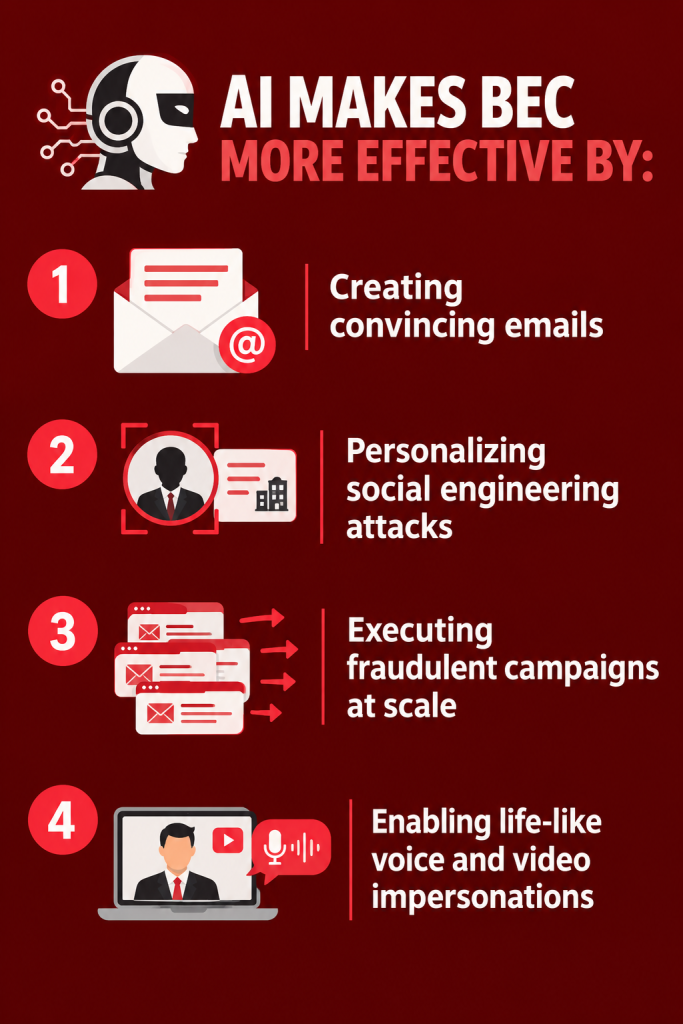
1. Creating convincing emails
Generative AI can produce polished, professional messages with fewer grammatical errors and more natural phrasing. This makes traditional warning signs, such as spelling mistakes and awkward language, less reliable.
2. Personalizing social engineering attacks
AI can help attackers analyze publicly available information about executives, employees, vendors, and business relationships. They can use that context to create plausible payment requests or impersonate trusted suppliers. When combined with compromised accounts or stolen documents, this personalization can make fraudulent messages harder to recognize.
3. Executing fraudulent campaigns at scale
AI can help criminals generate message variations, translate communications, and personalize attacks for different recipients. This reduces the effort required to produce targeted messages at scale. Microsoft’s Digital Defense Report 2025 (2) discusses the industrialization of cybercrime, including the use of compromised accounts and automation to facilitate fraud.
4. Enabling life-like voice and video impersonations
AI-generated audio and video can reinforce fraudulent requests by imitating executives or colleagues during calls and virtual meetings. A familiar voice or convincing video is no longer sufficient proof of identity. High-risk requests must be verified through established, independent procedures.
Why Traditional BEC Defenses May Fall Short Against AI
| Traditional warning signs | Why it may be insufficient |
|---|---|
| Poor grammar | AI can produce fluent, professional messages. |
| Familiar writing style | AI can imitate communication patterns. |
| Knowledge of business details | Attackers may gather information publicly or steal it. |
| Familiar sender name | Names can be spoofed, or legitimate accounts can be compromised. |
| Recognizable voice | AI can imitate a trusted person’s voice. |
| Email filtering | Fraudulent messages may contain no malicious links or attachments. |
Six Ways Organizations Can Prevent AI-Enabled BEC
These steps can protect your organization from suffering BEC-inflicted financial losses:
- Independently verify financial requests: Confirm changes to vendor banking details, wire transfers, and unusual payments through trusted contact information obtained separately from the request.
- Require dual authorization: Implement independent approvals for high-value or unusual transactions. Ensure both approvers verify the request rather than simply approving it.
- Strengthen email and identity security: Use multi-factor authentication, secure email gateways, SPF, DKIM, and DMARC. Monitor suspicious sign-ins, mailbox forwarding rules, and unusual account activity.
- Verify voice and video requests: Never authorize payments solely because a caller sounds like an executive. Use established callback procedures and authenticated communication channels.
- Train employees with realistic scenarios: Practice identifying invoice manipulation, executive impersonation, payroll diversion, and fraudulent vendor changes. Encourage employees to report suspicious requests without fear of blame. (Here are the 10 best practices for employee cybersecurity training.)
- Prepare for rapid incident response: If a fraudulent transfer occurs, immediately contact the originating financial institution and request assistance with recalling or freezing the funds. Preserve evidence and report the incident to law enforcement. Recovery is not guaranteed, so speed matters.
Can AI Also Help Detect and Prevent BEC?
Once again, the answer is yes. AI-augmented security tools can identify unusual communication patterns, flag suspicious login activity, prioritize potentially fraudulent messages, and help digital forensic investigators correlate threat signals.
However, defensive AI can produce false positives or miss novel attacks. Organizations should combine automated detection with human oversight, strong authentication, and independent financial approvals. The objective is not to replace human judgment, but to strengthen it with technology and reliable processes.
Always Verify, Never Assume
In conclusion, AI is making business email compromise (BEC) more scalable and more convincing. Still, the underlying strategy remains the same: exploit trust to persuade someone to take an action that benefits the attacker. Effective BEC prevention requires layered security, independently verified financial requests, secure identities, employee awareness, and clear incident handling and response procedures. No single email filter or AI detection tool can eliminate BEC risk.
Cybersecurity professionals must understand both the technical mechanisms behind BEC attacks and the organizational weaknesses that allow them to succeed. Advanced training in cybersecurity operations, digital forensics, incident response, and cybersecurity leadership helps professionals strengthen defenses against such threats. EC-Council University (ECCU) recognizes this reality and offers 100% online cybersecurity certification courses designed to empower professionals with the knowledge and real-world capabilities to protect modern organizations.
For more information on ECCU’s cybersecurity certification courses:
Frequently Asked Questions
What is AI-enabled BEC?
It is business email compromise in which AI supports impersonation, message generation, personalization, or the use of synthetic voice and video.
How can employees recognize AI-generated BEC emails?
Look for unusual payment requests, urgency, confidentiality demands, or deviations from established procedures. Independently verify requests rather than relying on writing style.
What is the most effective BEC prevention strategy?
A layered approach combining independent payment verification, dual authorization, secure identities, employee training, and incident-response planning.
Can SPF, DKIM, and DMARC prevent BEC?
These email-authentication technologies help reduce domain spoofing but cannot independently prevent fraud involving compromised accounts or other impersonation techniques.
What should businesses do after a BEC incident?
Contact the bank immediately, request a transfer recall or freeze, preserve evidence, secure affected accounts, and report the incident to relevant law enforcement authorities.
What skills help cybersecurity professionals combat AI-enabled BEC?
Email and identity security, threat detection, digital forensics, incident response, fraud investigation, and security risk management.