Cybersecurity has never had a shortage of career paths. But not every path grows at the same pace. Digital forensics has moved from niche to necessary. It shows up in corporate boardrooms after a breach, in courtrooms as expert evidence, and inside financial institutions hunting fraud. The job is part investigator, part technologist, part legal analyst. That combination is rare. And that rarity is why this field is attracting serious attention from employers and career builders right now. This blog covers what the market looks like, what the work involves in 2026, which skills matter most, and how a structured academic path with the right certification changes your position.
Key Takeaways:
- Digital forensics sits at the intersection of law, technology, and investigation, making it one of the hardest skill sets to replace or outsource.
- The global market is on track to more than double by 2030, and over half a million US cybersecurity roles sit unfilled right now.
- Financial services alone drive nearly 40% of forensic litigation support demand, making the private sector as critical as law enforcement for career growth.
- In 2026, cloud forensics, mobile investigations, and AI-assisted analysis are the baseline, not the specialization.
- The talent shortage is structural, not cyclical, which means the career window in digital forensics is wide open right now.
The Market Signal: What the Data Says
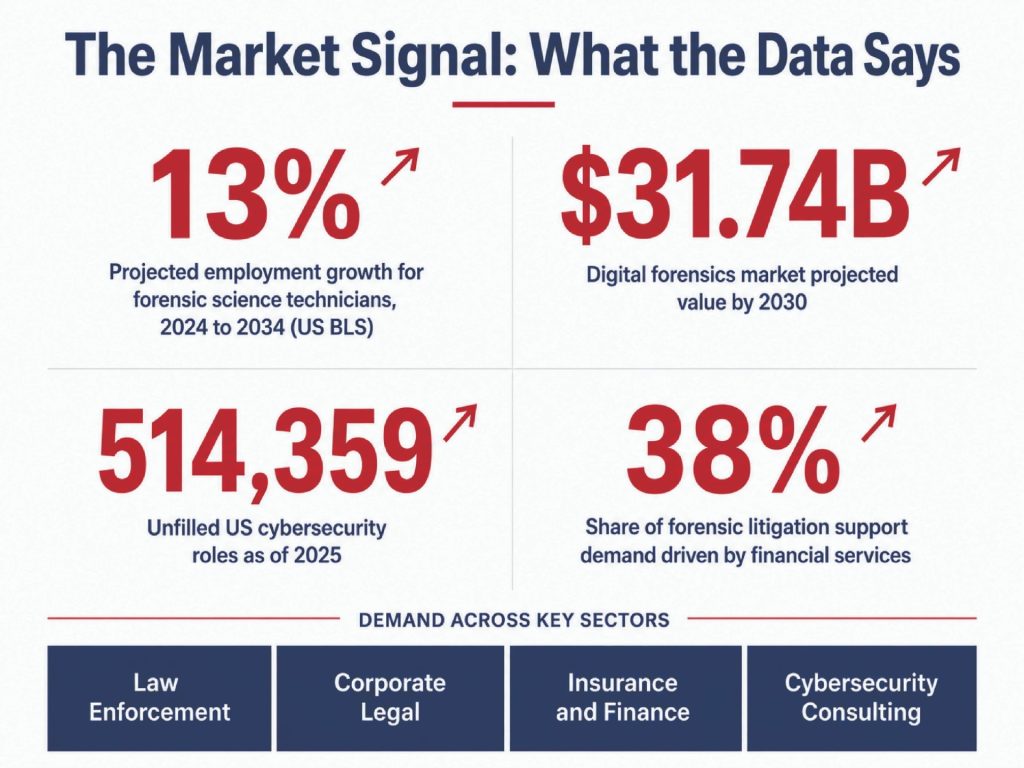
The numbers are hard to ignore. The digital forensics market is projected to grow from roughly USD 14.85 billion in 2025 to USD 31.74 billion by 2030. The US Bureau of Labor Statistics projects 13% employment growth for forensic science technicians from 2024 to 2034. On the wider cybersecurity side, 514,359 US cybersecurity roles remain unfilled as of 2025, and forensics talent is among the hardest to source because it demands a blend of legal knowledge and technical depth that generalist roles do not build.
Salary benchmarks reflect this gap. The average digital forensics analyst earns USD 124,578 annually in the US. Examiners average around USD 96,924, and senior DFIR professionals earn upward of USD 170,000.
Demand is converging from multiple directions:
- Law enforcement and government agencies need analysts to build legally sound digital cases.
- Corporate legal and compliance teams hire forensic professionals for eDiscovery and internal investigations.
- Insurance and financial institutions, which account for roughly 38% of total forensic litigation support demand, rely on forensics for fraud investigation.
- Cybersecurity consulting firms run DFIR retainers that place analysts inside active incidents at major enterprises.
Ransomware, cloud breaches, and AI-generated evidence are all creating investigative demand faster than qualified professionals can enter the field.
Why Digital Forensics Is Structurally Different
Most cybersecurity disciplines focus on prevention or response. Digital forensics is built around what happens after something goes wrong.
A penetration tester finds vulnerabilities before attackers do. A SOC analyst monitors traffic for threats. A forensic investigator reconstructs what happened, establishes a timeline, identifies who was responsible, and presents findings that hold up under legal scrutiny. Evidence not collected or preserved correctly can be thrown out entirely, regardless of what it proves.
This is why the field sits at the intersection of law, technology, and investigation. An analyst working a corporate fraud case might pull data from encrypted cloud storage, build a behavioral timeline, and write an expert witness report for litigation, all in the same engagement.
The evidence environment in 2026 is also more complex than it was three years ago. Investigative workflows that once centered on seizing devices and manually reviewing artifacts are rapidly being replaced by remote, cloud-centric, and AI-assisted approaches. App-level data, encrypted cloud environments, and mobile operating systems are all standard forensic territory now. Cloud and mobile forensics are among the most sought-after specialist skills in the field.
Core Competencies That Define a Strong Digital Forensics Professional
Technical proficiency is the foundation, but not the whole picture.
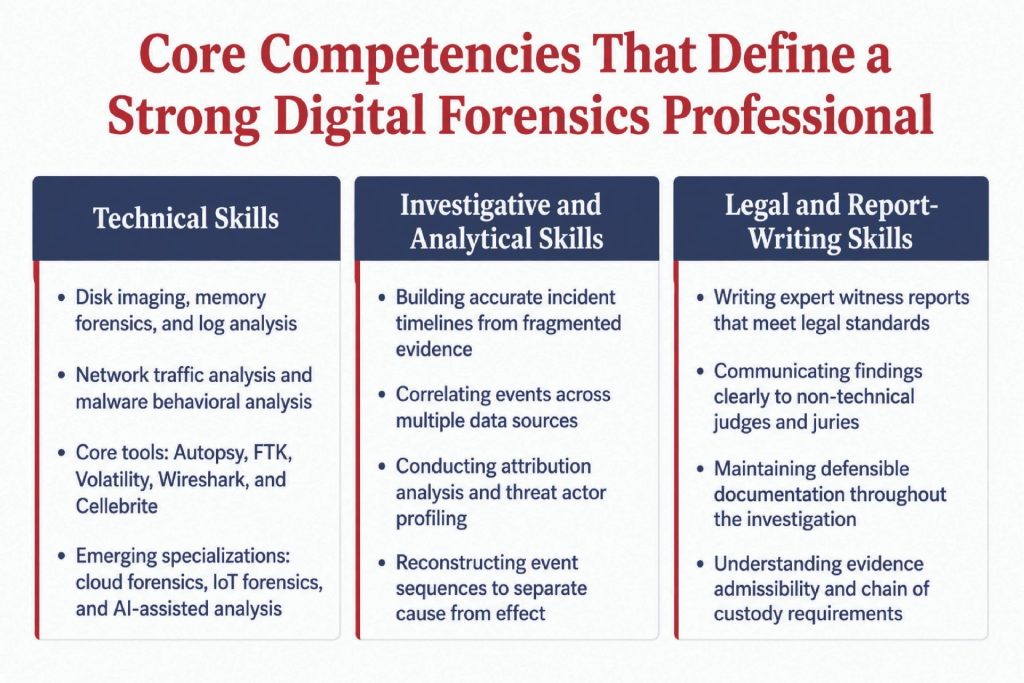
- Technical skills include disk imaging, memory forensics, log analysis, network traffic analysis, and malware behavioral analysis. Standard tools include Autopsy, FTK, Volatility, Wireshark, and Cellebrite. Cloud forensics, IoT forensics, and AI-assisted analysis are high-value specializations with limited talent supply and strong salary premiums.
- Investigative and analytical skills are equally critical. Building accurate incident timelines, correlating events across data sources, and conducting attribution analysis are core to the work. Reconstructing events in sequence from fragmented evidence is what separates a strong analyst from a competent technician.
- Legal and report-writing skills frequently go underdeveloped in self-taught paths. Writing an expert witness report is its own discipline. Findings that cannot be communicated clearly to a non-technical judge or jury have limited legal value, however technically accurate they are.
The CHFI Certification and Its Role in a Forensics Career
The Computer Hacking Forensic Investigator (CHFI) from EC-Council is one of the most recognized credentials in this field. CHFI covers file systems forensics, steganography, email analysis, network forensics, malware analysis, cloud forensics, mobile device forensics, and the legal aspects of cyber investigations. It is ANSI-accredited and aligned with the US DoD Directive 8570/8140, giving it credibility across government and enterprise contexts.
Compared to other options: GCFE (GIAC) is tightly mapped to SANS FOR500 and favored by incident response teams. CFCE (IACIS) carries strong courtroom credibility but follows law enforcement workflows with a rigorous peer-review process. EnCE (OpenText) is vendor-specific, valued where EnCase is the primary tool. CHFI is vendor-neutral, lab-supported, and practical across tools and sectors. For professionals entering from IT or general cybersecurity, it is the most accessible and immediately applicable starting point.
Why Employers Value Graduate-Level Digital Forensics Training
Certifications prove tool knowledge. A graduate degree proves something harder to overlook: the ability to think through a complex investigation from first principles.
Hiring managers in forensics-heavy roles want analysts who understand why evidence handling procedures exist, not just how to follow them. They want professionals who have worked through supervised cloud and malware forensics scenarios before facing them in a live incident. Structured graduate training with CHFI alignment delivers exactly that. The academic depth and the certification reinforce each other, rather than running as two separate tracks. For employers where a wrong forensic decision can compromise an entire legal case, that combination is the baseline they screen for.
Where ECCU's MSCS Digital Forensics Specialization Fits
The MSCS with a Digital Forensics specialization at EC-Council University is built for professionals who want academic depth alongside practical readiness. The curriculum covers digital evidence handling, cybercrime investigation, malware forensics, and threat reconstruction. Coursework is delivered online with hands-on lab components. The program is aligned with CHFI content, so students work toward a globally recognized certification while completing their degree. A graduate who holds both an accredited master’s degree and CHFI arrives with documented analytical depth and verified practical competency. Graduates are positioned for roles including Digital Forensics Investigator, Incident Response Analyst, Forensic Examiner, Cybercrime Analyst, and DFIR Consultant, across law enforcement, consulting, corporate legal, and financial sectors.
Build the Investigative Expertise the Industry Needs
Digital forensics is not going to get simpler. Evidence environments are more complex, legal stakes are higher, and the talent shortage is not closing. That is a genuine opening for professionals willing to invest in the right combination of academic depth and handson skill.
Explore ECCU’s MSCS Digital Forensics specialization, combining graduate-level theory with hands-on lab work and a direct path to CHFI certification.
Frequently Asked Questions
What is the difference between digital forensics and incident response?
Incident response focuses on containing an active threat and restoring systems quickly. Digital forensics is the investigative layer that follows, examining what happened, how, and who was responsible. DFIR teams often handle both, but forensics demands strict evidence preservation and legal chain of custody, while incident response prioritizes speed.
Do I need a law enforcement background to work in digital forensics?
No. Many professionals enter from IT, systems administration, or general cybersecurity. Technical grounding, familiarity with forensic methodology, and the ability to produce clear, legally sound documentation matter far more than a policing background.
What tools do digital forensics professionals use most in 2026?
Core tools include Autopsy for file analysis, FTK for disk and memory examination, Volatility for memory forensics, Wireshark for network traffic, and Cellebrite for mobile investigations. Cloud forensics and AI-assisted analysis platforms are also increasingly standard at larger organizations.
Is CHFI a good certification for someone new to forensics?
Yes. CHFI covers the full investigation lifecycle, is vendor-neutral, and pairs well with IT or security backgrounds. It is more accessible than CFCE and broader than EnCE. Pursued alongside a degree program, it carries real weight with hiring managers.
Can digital forensics skills transfer to private sector corporate roles?
Absolutely. Corporate legal teams, financial institutions, insurance companies, and consulting firms all hire forensic professionals for fraud investigation, eDiscovery, compliance, and breach response. The core skills transfer directly across all of these contexts.
What is DFIR?
DFIR stands for Digital Forensics and Incident Response. It refers to the combined discipline of investigating what happened during a cyber incident and containing the threat at the same time. In practice, DFIR teams handle both the live response, stabilizing systems and limiting damage, and the forensic investigation that follows, preserving evidence and reconstructing the attack timeline for legal or operational purposes.
Is digital forensics a good career in 2026?
Yes, and the data supports that clearly. The US Bureau of Labor Statistics projects 13% employment growth for forensic science technicians from 2024 to 2034. The global digital forensics market is on track to reach USD 31.74 billion by 2030. Demand is coming from law enforcement, financial services, consulting, and corporate legal teams simultaneously, while qualified talent remains scarce. That supply and demand gap makes it one of the more stable career bets in cybersecurity right now.
How much do digital forensics professionals earn?
Salaries vary by role and seniority. Digital forensics analysts average around USD 124,578 annually in the US, while examiners average closer to USD 96,924. Senior DFIR professionals earn upward of USD 170,000. Specializations in cloud forensics, cryptocurrency investigation, and AI-assisted analysis command additional premiums due to limited talent supply in those areas.
What is cloud forensics?
Cloud forensics is the application of digital forensic techniques to cloud environments. It involves collecting, preserving, and analyzing evidence from cloud platforms, SaaS applications, and virtual infrastructure where traditional device-seizure methods do not apply. It is one of the fastest-growing specializations in the field because most modern breaches now involve cloud-hosted data, and investigators need to work within shared responsibility models and multi-tenant architectures that complicate standard evidence collection.
What industries hire digital forensics professionals?
Law enforcement and government agencies are the traditional employers, but private sector demand has grown significantly. Financial institutions and insurance companies hire forensic professionals for fraud investigation and litigation support. Corporate legal and compliance teams rely on them for eDiscovery and internal investigations. Cybersecurity consulting firms place forensic analysts inside client incidents through DFIR retainer agreements. Healthcare, defense contracting, and technology companies are also active hiring sectors.