
The History and Growing Role of Linux in Cybersecurity
If you’ve ever used tools like Kali Linux, Metasploit, or Wireshark, you’ve already experienced the impact Linux has had on modern cybersecurity. What began as a personal project by Linus Torvalds in 1991 has grown into the world’s most widely deployed operating system for servers, cloud computing, supercomputers, networking, and cybersecurity. Linux is now the dominant operating system powering everything from banking platforms and e-commerce websites to AI infrastructure and government systems.
This widespread adoption positions Linux as a natural choice for cybersecurity. Organizations need professionals who can secure Linux servers, investigate Linux-based cyber incidents, perform penetration testing, automate security operations, and protect cloud-native environments. Whether you aspire to become a Security Analyst, Ethical Hacker, Incident Responder, Digital Forensics Investigator, Cloud Security Engineer, or Chief Information Security Officer (CISO), Linux is a foundational competency you must possess.
Linux is One of the Most Important Operating Systems in Cybersecurity
Linux has earned its reputation in cybersecurity by combining flexibility, stability, transparency, and security. Unlike proprietary operating systems, Linux is open source, allowing organizations, researchers, and cybersecurity professionals to inspect its source code, identify vulnerabilities, and contribute to improvements. Its modular architecture also enables organizations to build highly secure systems with a minimal number of software components, reducing the overall attack surface.
Linux has become indispensable in cybersecurity because:
- It underpins most cloud infrastructure and enterprise servers.
- Many cybersecurity tools are developed specifically for Linux.
- It offers powerful command-line capabilities for system administration and security analysis.
- It supports automation through shell scripting and Python.
- Most containerized applications, Kubernetes clusters, and DevSecOps pipelines run on Linux.
- Security researchers and ethical hackers rely on Linux-based distributions such as Kali Linux and Parrot Security OS.
The Linux Foundation also recently introduced a global Cybersecurity Skills Framework, recognizing Linux proficiency as a critical capability across numerous cybersecurity job roles.
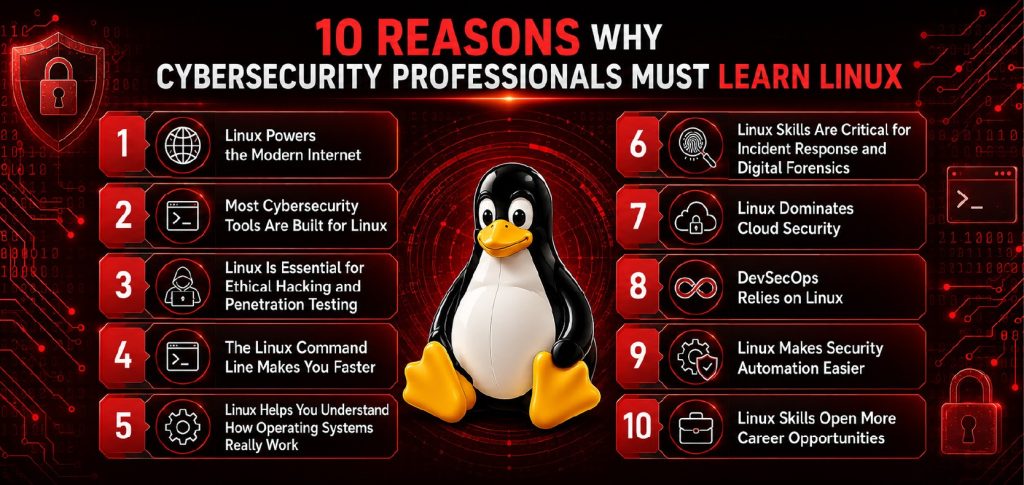
10 Reasons Why Cybersecurity Professionals Need to Know Linux
1. Linux Powers the Modern Internet
Most websites, cloud applications, web servers, databases, and networking appliances operate on Linux. If you’re responsible for protecting digital infrastructure, chances are you’ll be securing Linux systems every day. Understanding Linux enables you to manage servers, investigate suspicious activity, and harden systems against cyber threats.
2. Most Cybersecurity Tools Are Built for Linux
Many of today’s industry-standard security tools either run exclusively on Linux or perform best within Linux environments. Examples include:
- Nmap
- Metasploit Framework
- Aircrack-ng
- John the Ripper
- Hydra
- OpenVAS
- Nikto
- tcpdump
Knowing Linux allows you to use these tools more effectively while understanding what happens behind the scenes.
3. Linux Is Essential for Ethical Hacking and Penetration Testing
Nearly every certified professional penetration tester uses a Linux-based operating system. Popular distributions like Kali Linux include hundreds of integrated tools for vulnerability assessments, password auditing, wireless security testing, web application testing, digital forensics, and reverse engineering.
4. The Linux Command Line Makes You Faster
Graphical interfaces are useful, but cybersecurity often happens in the terminal. Security professionals routinely use command-line tools to:
- Analyze log files
- Monitor processes
- Search large datasets
- Manage permissions
- Investigate malware
- Configure firewalls
- Troubleshoot network connections
5. Linux Helps You Understand How Operating Systems Really Work
Cybersecurity is fundamentally about understanding systems. Linux teaches you how operating systems manage users and groups, file permissions, authentication, processes, memory, services, networking, scheduling, and more. These concepts help you identify vulnerabilities, recognize suspicious behavior, and implement stronger security controls.
6. Linux Skills Are Critical for Incident Response and Digital Forensics
Many enterprise servers targeted by attackers run on Linux. When responding to a cyber incident, investigators often need to collect forensic evidence, analyze authentication logs, review running processes, examine scheduled tasks, detect persistence mechanisms, and investigate privilege escalation.
7. Linux Dominates Cloud Security
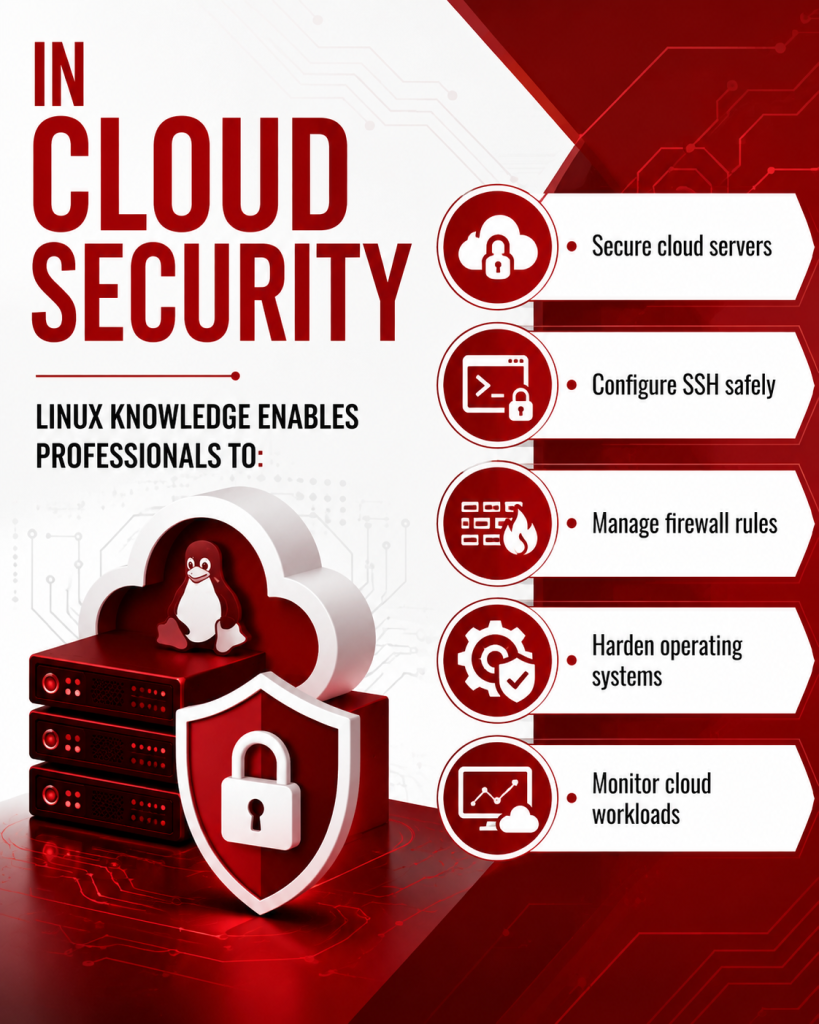
Cloud computing and Linux go hand in hand. Linux powers over 90% of public cloud workloads, making expertise in it indispensable for cloud security professionals. Whether you’re securing workloads on AWS, Microsoft Azure, or Google Cloud, you’ll regularly encounter Linux virtual machines, containers, Kubernetes clusters, and cloud-native applications.
8. DevSecOps Relies on Linux
Modern secure software engineering depends heavily on Linux. Technologies such as Docker, Kubernetes, Git, Jenkins, Terraform, and Ansible were designed around Linux environments. As organizations embrace DevSecOps, cybersecurity professionals increasingly need Linux skills to integrate security throughout the software development life cycle (SDLC).
9. Linux Makes Cybersecurity Automation Easier
Cybersecurity teams face thousands of repetitive tasks every day. Linux simplifies the automation of these tasks using Bash scripting, Python, Cron jobs, or Command-line utilities. Automating vulnerability scans, log analysis, backups, compliance checks, and threat detection allows cybersecurity professionals to respond faster while reducing manual workloads.
10. Linux Skills Open More Career Opportunities
Linux proficiency appears in job descriptions across virtually every cybersecurity discipline. Employers consistently seek professionals who can confidently work with Linux in roles such as:
- Security Analyst
- SOC Analyst
- Ethical Hacker / Penetration Tester
- Incident Responder
- Threat Hunter
- Cloud Security Architect
- DevSecOps Engineer
- Security Consultant
- Malware Analyst
- Digital Forensics Investigator
Even professionals working primarily in Windows environments benefit from understanding Linux, as hybrid infrastructures have become the norm in modern enterprises.
Cybersecurity Career Benefits of Knowing How to Use Linux
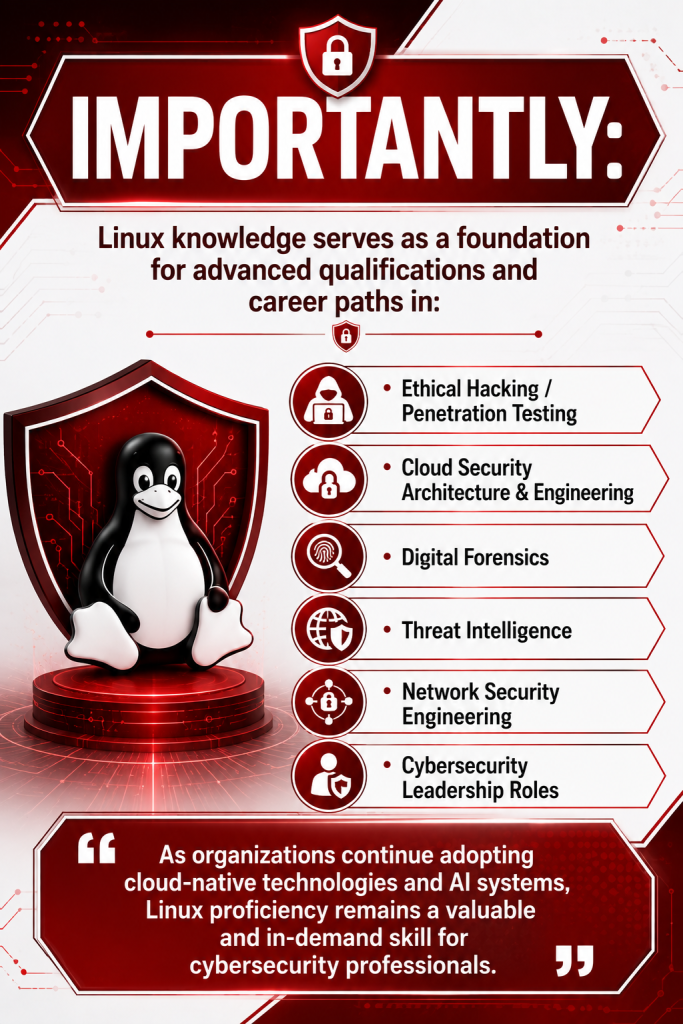
Learning Linux is one of the highest-return investments you can make in your cybersecurity career. Professionals with Linux expertise are better prepared to work across cloud platforms, security operations centers (SOCs), penetration testing engagements, digital forensics investigations, DevSecOps environments, and incident response teams. Linux also strengthens your understanding of networking, operating systems, scripting, and automation, which are core competencies that apply across virtually every cybersecurity specialization.
How to Become an Expert in Linux: A Practical Learning Path
Becoming proficient in Linux doesn’t happen overnight, but with a structured learning approach, you can build practical skills that employers value:
- Start by learning the fundamentals of the Linux operating system, including file navigation, user and group management, permissions, package installation, process management, and networking. Once you’re comfortable using the command line, begin learning Bash scripting to automate everyday administrative and security tasks.
- Next, practice securing Linux systems by configuring SSH, firewalls, authentication policies, and system services. Build hands-on experience using virtual machines or cloud-based Linux environments where you can safely experiment without affecting production systems.
- As your confidence grows, explore Linux-focused cybersecurity tools, practice log analysis, perform vulnerability assessments, and learn container technologies such as Docker and Kubernetes.
- Finally, validate your expertise through industry-recognized training and certifications, and continuously apply your skills through labs, Capture the Flag (CTF) challenges, and real-world projects.
By combining theory with extensive hands-on practice, you’ll develop the Linux proficiency needed to excel across today’s rapidly evolving cybersecurity landscape.
How ECCU Can Help Build Your Linux Expertise in Cybersecurity
At EC-Council University (ECCU), Linux is a core part of our curriculum. When integrated as a foundational skill rather than taught as a standalone subject, you gain hands-on experience with Linux across key disciplines, including ethical hacking, penetration testing, cloud security, digital forensics, incident response, Security Operations (SOC), threat intelligence, and DevSecOps.
Several of ECCU’s online degrees and certification courses emphasize practical Linux learning through interactive labs, technical exercises, and real-world cybersecurity scenarios, enabling you to skillfully secure Linux systems, investigate cyber incidents, automate security tasks, and work with industry-standard security tools. By combining Linux with broader competencies, we can prepare you for today’s most in-demand cybersecurity roles.
For more information on studying Linux at ECCU:
Frequently Asked Questions About Linux in Cybersecurity
Linux powers much of today’s internet infrastructure, including cloud servers, enterprise systems, networking devices, and security platforms. Because many cyberattacks target Linux-based environments, cybersecurity professionals need Linux skills to secure systems, investigate incidents, and use industry-standard security tools effectively.
No. Many professionals begin learning Linux after entering the cybersecurity field. However, developing Linux skills early gives you a significant advantage, as it builds the technical foundation needed for many cybersecurity roles and certifications.
Linux is commonly required or preferred for cybersecurity roles such as Security Analyst, SOC Analyst, Ethical Hacker, Penetration Tester, Incident Responder, Cloud Security Engineer, DevSecOps Engineer, Threat Hunter, Digital Forensics Investigator, and more.
Both operating systems are important. Windows dominates many corporate desktop environments, while Linux powers most cloud infrastructure, web servers, cybersecurity tools, and enterprise applications. Cybersecurity professionals benefit from understanding both, but knowledge of Linux is especially valuable for technical job roles.
For learning Linux fundamentals, beginner-friendly distributions such as Ubuntu or Linux Mint are excellent choices. Once you’re comfortable with Linux, specialized security distributions like Kali Linux or Parrot Security OS provide hundreds of built-in cybersecurity tools for ethical hacking, digital forensics, and security testing.
Yes. Learning Linux does not require coding experience. Most people start by learning basic terminal commands, file management, user administration, and system configuration before progressing to Bash scripting and automation.
The timeline varies depending on your experience and schedule. Most learners can develop practical Linux administration skills within three to six months of consistent practice. Becoming highly proficient typically requires continued hands-on experience through virtual labs, projects, and real-world cybersecurity work.
EC-Council University integrates Linux throughout its cybersecurity curriculum rather than teaching it as a standalone subject. Students gain practical experience using Linux while studying ethical hacking, cloud security, digital forensics, incident response, security operations, and DevSecOps, helping them build the hands-on skills employers seek.