Outlining the Evolution of Secure Software Engineering
Cybersecurity in software development has shifted from primarily finding bugs after software is built to engineering security into every phase of the software development lifecycle (SDLC). As cyber threats become more sophisticated through AI-powered attacks, third-party vendor supply chain compromises, cloud-native exploits, and zero-day vulnerabilities, coders have adopted more proactive, automated, and intelligence-driven security practices.
In this article, we’ll explore 15 secure software engineering practices developers rely on to mitigate advanced cyber threats. Let’s dive into it:
1. From Reactive Security to Secure-by-Design
In the past, security was often treated as a final testing step before software was released. Vulnerabilities were typically discovered after deployment, leaving the software exposed to attacks. Today, developers embrace the Secure-by-Design philosophy, in which security requirements are integrated from the earliest planning and architectural stages. This approach entails:
- Threat modeling before coding begins
- Security-focused software architecture
- Least privilege principles
- Secure defaults
- Privacy-by-design
- Zero Trust architecture considerations
Secure-by-Design has helped reduce the number of vulnerabilities introduced during development.
2. Adoption of the Secure Software Development Lifecycle (SSDLC)
Traditional SDLC models have evolved into the Secure SDLC (SSDLC), in which security activities are incorporated into every phase. Each stage now includes dedicated security practices:
| SDLC Phase | Security Activities |
|---|---|
| Planning | Risk assessments, compliance requirements |
| Design | Threat modeling, secure architecture reviews |
| Development | Secure coding standards, code reviews |
| Testing | Penetration testing, SAST, DAST, fuzz testing |
| Deployment | Secure configuration, infrastructure hardening |
| Maintenance | Vulnerability management, patching, and monitoring |
Rather than treating cybersecurity as a separate task, SSDLC makes it a continuous responsibility.
3. Secure Coding Standards Have Become More Mature
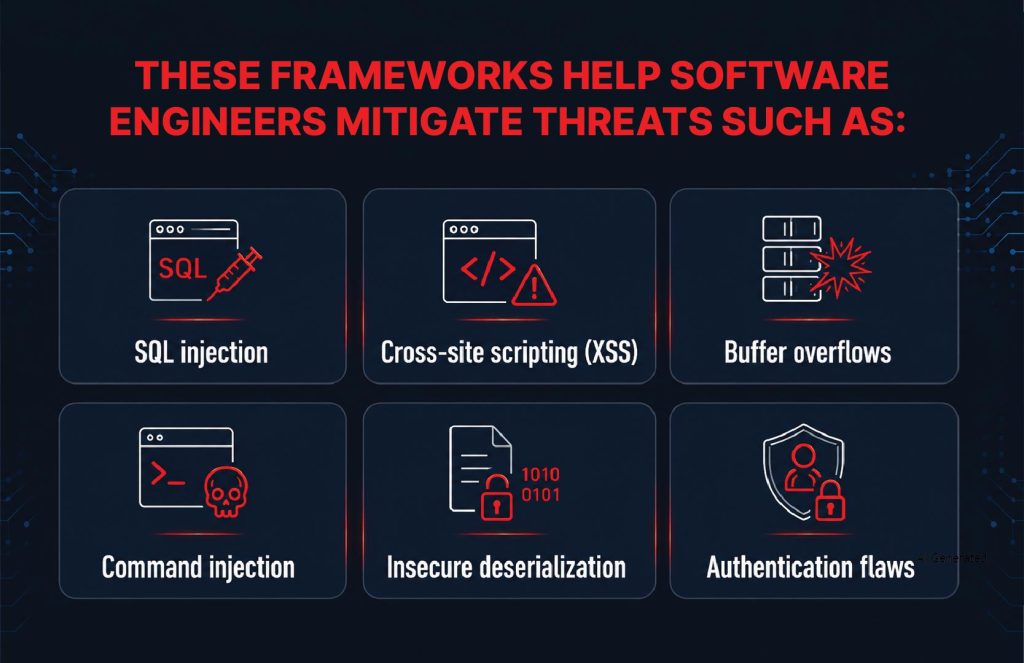
Developers now follow standardized secure coding frameworks to reduce common vulnerabilities. Widely adopted frameworks include:
- OWASP Secure Coding Practices
- CERT Secure Coding Standards
- MISRA (embedded systems)
- CWE (Common Weakness Enumeration)
- NIST Secure Software Development Framework (SSDF)
4. DevSecOps Integrates Security into CI/CD Pipelines
The rise of DevOps accelerated software delivery but also introduced new risks. To address these risks, organizations adopted DevSecOps, which embeds automated security controls throughout continuous integration and continuous deployment (CI/CD) pipelines. Modern CI/CD pipelines now automatically perform:
- Static Application Security Testing (SAST)
- Dynamic Application Security Testing (DAST)
- Software Composition Analysis (SCA)
- Secret scanning
- Container vulnerability scanning
- Infrastructure-as-Code (IaC) scanning
- License compliance checks
Developers receive security feedback within minutes instead of weeks.
5. AI Is Transforming Secure Software Engineering
AI has become both an opportunity and a threat.
| AI-Assisted Secure Coding Developers use AI coding assistants to: | AI-Powered Security Testing AI also enhances: |
|---|---|
| Detect vulnerable code | Vulnerability discovery |
| Recommend secure alternatives | Behavioral anomaly detection |
| Explain security risks | Malware identification |
| Generate unit tests | Automated code review |
| Improve code quality | Threat prioritization |
Important:
Software engineers must verify AI-generated code since it can introduce insecure patterns if not carefully reviewed.
6. Software Supply Chain Security Has Become Critical
Attackers often target third-party software rather than the organization directly. As a result, secure programming now extends beyond proprietary code. Developers increasingly:
- Inventory software dependencies
- Monitor open-source libraries
- Verify package authenticity
- Digitally sign software
- Generate Software Bills of Materials (SBOMs)
- Continuously scan dependencies for vulnerabilities
Supply chain security has become a core component of software engineering.
7. Memory-Safe Programming Languages Are Gaining Momentum
Many critical vulnerabilities originate from memory management errors. To reduce these risks, organizations are adopting memory-safe languages such as:
- Rust
- Go
- Swift
- Kotlin
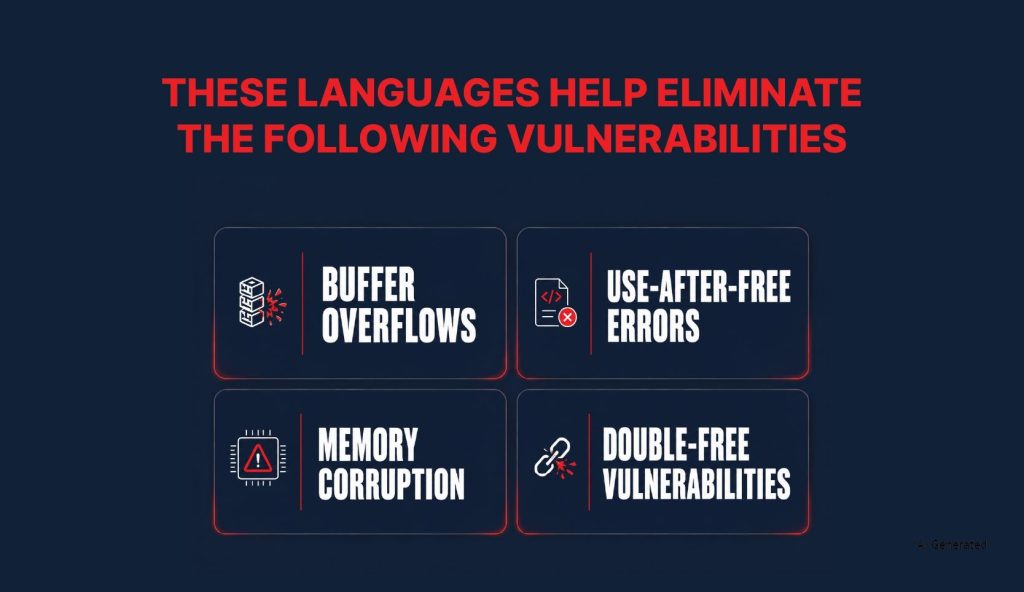
Memory safety has become especially important for operating systems, embedded devices, browsers, and critical infrastructure.
8. Zero Trust Principles Influence Software Design
Applications are no longer built assuming trusted internal networks. Modern secure software incorporates Zero Trust principles by:
- Continuously verifying identities
- Enforcing least privilege
- Authenticating every request
- Using strong authorization controls
- Encrypting communications
- Logging security events
Security is now embedded within the application itself rather than relying solely on network defenses.
9. Cloud-Native Security Has Changed Development Practices
As organizations migrate to cloud environments, software developers must secure distributed architectures. Secure cloud engineering now includes:
- Container security
- Kubernetes security
- Serverless security
- API security
- Secrets management
- Infrastructure as Code (IaC) security
- Identity and Access Management (IAM)
Cloud security is now considered a software engineering responsibility rather than solely an operations concern.
10. API Security Has Become a Development Priority
Modern applications depend heavily on APIs, making them a frequent target for attackers. Secure API programming emphasizes:
- Strong authentication
- Authorization validation
- Input validation
- Rate limiting
- Encryption
- API gateways
- Secure token management
- Continuous monitoring
Secure software engineers now treat APIs as critical security boundaries.
11. Shift-Left and Shift-Right Security
Secure programming now spans the entire software lifecycle.
| Shift-Left introduces security earlier by incorporating: | Shift-Right focuses on production by emphasizing: |
|---|---|
| Secure coding training | Runtime monitoring |
| Threat modeling | Threat detection |
| Code reviews | Security telemetry |
| Automated security testing | Incident response |
| Continuous vulnerability management |
This dual approach enables organizations to prevent vulnerabilities while rapidly detecting and responding to emerging threats.
12. Runtime Application Protection
Modern applications increasingly include built-in runtime protections such as:
- Runtime Application Self-Protection (RASP)
- Web Application Firewalls (WAFs)
- Behavioral monitoring
- Anomaly detection
- Attack surface management
Applications are becoming capable of identifying and responding to attacks while they are running.
13. Compliance Is Driving More Secure Software Engineering
Regulatory requirements increasingly mandate secure development practices. Organizations must now demonstrate secure software development through standards and regulations such as:
- NIST Secure Software Development Framework (SSDF)
- ISO/IEC 27034 (Application Security)
- PCI DSS
- HIPAA
- GDPR
- Sector-specific cybersecurity regulations
Compliance mandates have shifted secure software engineering from a best practice to a business necessity.
14. Security Training Must Be Continuous
Software engineers nowadays are expected to understand cybersecurity principles, which is why they need to participate in:
- Secure coding workshops
- Capture-the-flag competitions
- Security champions programs
- Hands-on practice in virtual lab environments
- Continuous developer education
15. Preparing for AI and Quantum-Era Threats
Secure software engineering continues to evolve in anticipation of future risks. Emerging priorities include:
- Defending against AI-assisted cyberattacks
- Securing AI models against prompt injection, data poisoning, and model theft
- Protecting software supply chains with cryptographic signing and provenance
- Transitioning to post-quantum cryptography to safeguard sensitive data against future quantum computing capabilities
- Increasing automation in vulnerability discovery and remediation
Software today is being designed with long-term cryptographic agility and resilience in mind.
Ready to Elevate Your Secure Software Engineering Credentials?
For professionals looking to develop the in-demand skills listed above, EC-Council University’s Certified Application Security Engineer (C|ASE) certification provides hands-on training in secure programming, application security testing, threat modeling, vulnerability mitigation, secure deployment, and more. Designed to address today’s evolving threat landscape, the C|ASE certification prepares you to build resilient applications for cloud-native and AI-driven environments.
Available as both a standalone 3-month professional certification course or an integral component of our Master of Science in Computer Science (MCS) and Master of Science in Cyber Security (MSCS) programs, C|ASE enables you to earn an industry-recognized credential while gaining the practical expertise needed to help organizations develop secure, trustworthy software in 2026 and beyond.
For more information:
Frequently Asked Questions About Secure Software Engineering
Secure software engineering is the practice of designing, developing, testing, and maintaining software with security integrated throughout the entire development lifecycle to minimize vulnerabilities and protect against cyber threats.
The Software Development Life Cycle (SDLC) focuses on building software. On the other hand, Secure Software Development Life Cycle (SSDLC) integrates security activities, such as threat modeling, secure coding, vulnerability testing, and risk assessments, into every phase of development.
Secure by Design is a software development philosophy that prioritizes security from the very beginning, rather than adding security controls after software has been built.
DevSecOps integrates automated security testing into continuous integration and continuous deployment (CI/CD) pipelines, allowing developers to identify and remediate vulnerabilities earlier and more efficiently.
Modern applications rely heavily on open-source libraries and third-party components. Compromising a single trusted dependency can affect thousands of organizations, making software supply chain security essential to reducing organizational risk.
AI assists developers by detecting vulnerabilities, reviewing code, prioritizing security issues, and automating security testing. At the same time, organizations must protect AI-enabled applications from emerging threats such as prompt injection, model poisoning, and adversarial attacks.
Memory-safe languages such as Rust, Go, Swift, and Kotlin reduce vulnerabilities associated with manual memory management, helping prevent buffer overflows, memory corruption, and use-after-free errors.
Professionals should develop expertise in secure coding, threat modeling, DevSecOps, cloud security, API security, software supply chain security, Zero Trust architecture, AI security, vulnerability assessment, penetration testing, and post-quantum cryptography.