A breach rarely waits for a convenient moment. It hits mid-shift, mid-quarter, sometimes mid-vacation, and it hits without asking permission. What separates containment from chaos is rarely the firewall. It is leadership. Incident management and business continuity are often treated as technical checklists, something teams run through once and file away. In practice, they are leadership disciplines that demand judgment, coordination, and calm decision-making under real pressure. This blog looks at why that distinction matters. It covers what incident response leadership actually demands, how business continuity keeps operations alive during disruption, and how professionals can build these skills through a focused certificate instead of a full degree.
Key Takeaways
- Breach costs are falling globally, but detection still takes months.
- Leadership under pressure matters more than any single security tool.
- Incident response follows a lifecycle, not a single reactive scramble.
- Business continuity keeps critical operations running when systems go down.
- Untested plans fail exactly when they are needed most.
- A short certificate can build real incident leadership skills fast.
- Certificate credits can count toward a future master’s degree.
Breaches Are Inevitable, Chaos Isn't
No system stays unbreached forever. That is simply reality now, and the real question is what happens next. Global breach costs dropped to $4.44 million in 2025, the first decline in five years, largely thanks to faster detection. Yet organizations still take 241 days on average to contain a breach. In the United States, average costs hit $10.22 million, the highest figure ever recorded. The gap between the global and US numbers shows something important: preparation changes outcomes far more than luck does. Poor coordination turns a manageable incident into a crisis, often within hours, and teams that stall on who owns communication lose time they cannot recover. Security today means resilience and recovery, not just prevention. Predicting and preventing IT incidents has become part of that shift too, as this guide on AI in IT operations explains.
Incident Management Is a Leadership Discipline
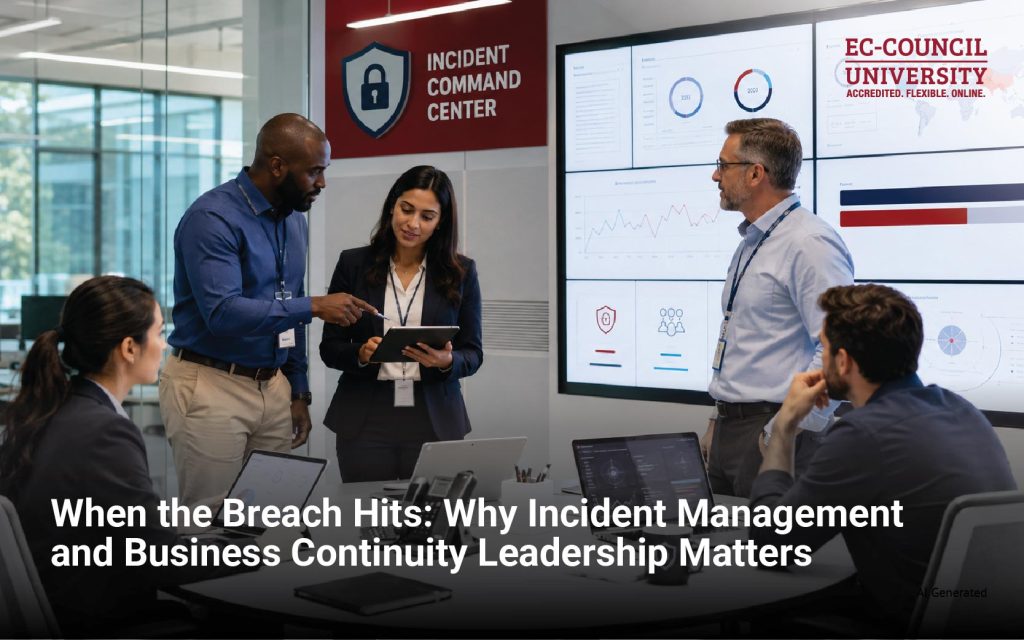
Handling a breach is not just a technical task. Someone has to run the room. Command structure matters here: someone decides who talks to legal, who briefs the executive team, and who manages public statements. Decisions happen fast, often with incomplete information, and that pressure is exactly what separates strong incident leaders from purely technical experts. The incident lifecycle gives structure to that pressure:
- Preparation, building playbooks before anything breaks
- Detection, spotting anomalies early
- Containment, stopping the spread fast
- Eradication, removing the threat completely
- Recovery, restoring systems safely
- Lessons learned, fixing what failed
This lifecycle mirrors what most cybersecurity incident response frameworks teach, and EC-Council’s ECIH body of knowledge builds around this same structure. SOC teams live this cycle daily, often under real pressure. Beyond the technical steps, leaders need softer skills too: crisis communication that keeps stakeholders calm and informed, stakeholder management that prevents finger-pointing after the fact, and post-incident reviews that turn mistakes into stronger defenses. It’s no surprise incident response has become cybersecurity’s most in–demand hire in recent years. Organizations are not just buying tools anymore. They are hiring people who can lead through the fire.
Business Continuity Keeps the Lights On

Incident response stops the bleeding. Business continuity keeps operations moving. A Business Impact Analysis identifies which functions matter most, while Recovery Time Objective and Recovery Point Objective set how fast systems must return and how much data loss the business can tolerate. These numbers shape every continuity plan built afterward. Tabletop exercises test that plan before a real crisis hits, letting teams walk through scenarios, spot gaps, and fix them early. Untested plans often fail at the worst possible moment, because paper plans look great right up until people actually try to run them. Governance matters too. Regulators expect documented continuity plans across many industries, and compliance failures during a crisis only add cost on top of chaos. Strong continuity planning is what turns a disaster into a manageable event.
Building These Skills Without a Full Degree
Not everyone wants a two-year degree to build this expertise, and a focused graduate certificate can work just as well. EC-Council University’s certificate covers incident management and business continuity, taking 3 to 9 months to complete across courses in incident handling, disaster recovery, and organizational change. Students can earn the ECIH and EDRP certifications along the way. A Director of Incident Response in the US earns well over six figures on average. Tuition runs $1,620 per course, with a total program cost of $4,860, and credits earned can later count toward a full master’s degree at ECCU. That path lets working professionals build leadership skills without pausing their careers.
Conclusion
Every organization will face a breach eventually. The difference lies in who leads the response, and whether that response follows a plan or scrambles for one. Incident management and business continuity together turn chaos into a managed event, but building that leadership takes real training, not just instinct. EC-Council University offers a graduate certificate in Incident Management and Business Continuity that gives you a focused, credit-bearing path to build these skills, one that also stacks toward a full master’s degree later. If leading through the next breach interests you, it’s worth exploring.
Frequently Asked Questions
Incident management focuses on detecting and containing a security event. Business continuity focuses on keeping critical operations running during that event. Both work together, but they solve different problems.
A focused certificate can build the same core skills a degree offers. Many senior incident leaders started with certifications and real-world practice. Formal degrees help, but they are not the only path.
It is a short, credit-bearing program in a specific cybersecurity discipline. ECCU’s Incident Management and Business Continuity certificate takes 3 to 9 months. It includes hands-on courses and industry-recognized certifications.
Yes, ECCU certificate credits can count toward a future master’s. This lets professionals start small and build up over time.
IT disaster recovery analysts and incident response managers need these skills. Security officers and compliance leads need them too.