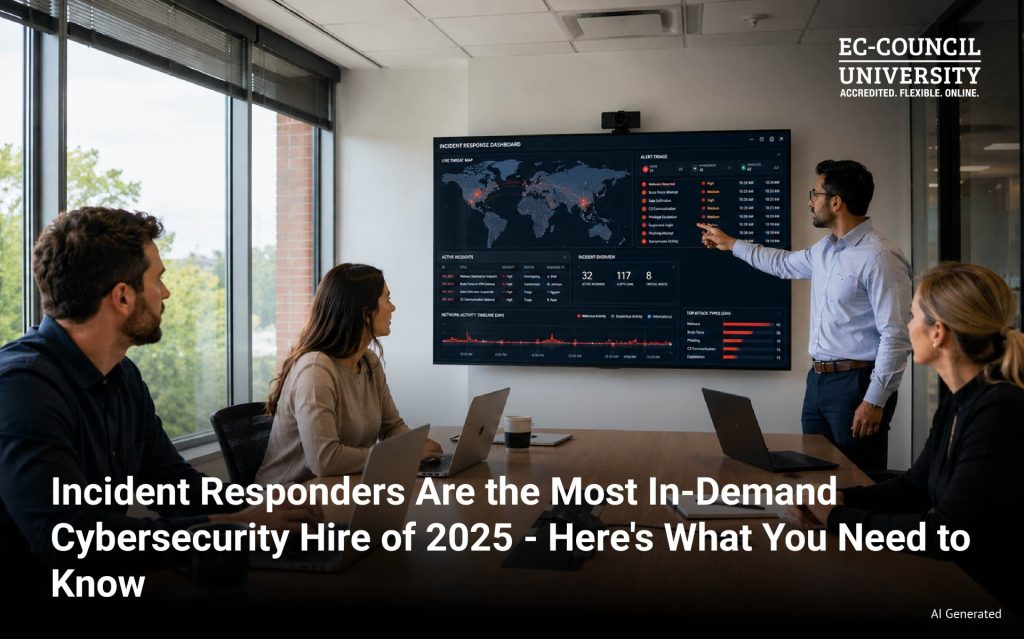
When a breach happens, no one calls the IT helpdesk. They call incident responders.
Ransomware gangs, nation-state actors, and supply chain attackers have fundamentally changed how organizations think about security hiring. The question is no longer whether an attack will happen. It’s whether your team can contain it fast enough to matter.
Incident response has become the most urgently filled role in enterprise security.
Organizations are realizing that technology alone won’t save them. Trained people, working a defined process, under pressure, make the difference between a managed incident and a front-page breach.
This blog breaks down what’s driving the demand, what incident responders actually do, the skills that set high-value professionals apart, and what career growth looks like in this field.
The Demand Is Real, and the Numbers Back It Up
The threat landscape has shifted faster than most security teams can keep up with. Ransomware, supply chain attacks, and nation-state intrusions are no longer headline anomalies. They are the baseline.
The scale of financial damage reflects this. And the time it takes organizations to even detect a breach, let alone contain one, tells you exactly why incident responders are the most urgently hired people in security right now.
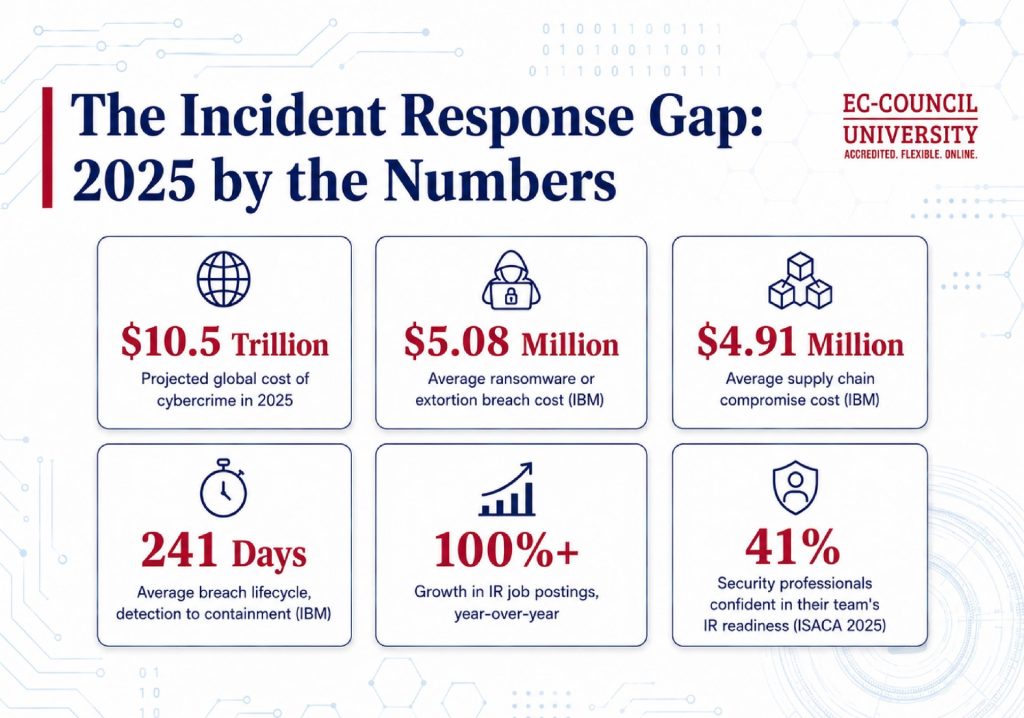
These numbers share one common thread. The gap between how fast attacks happen and how prepared organizations are to respond is not closing. It is widening. That is the environment into which incident responders are hired.
The industries feeling this most acutely are healthcare, financial services, critical infrastructure, and cloud-native SaaS. Federal contractors sit among the highest spenders on IR talent. Their environments carry the strictest compliance requirements and the most severe consequences for breaches, making experienced IR professionals genuinely difficult to replace.
What Incident Responders Actually Do
There is a persistent misconception that IR is reactive chaos. It is not. Incident response is a structured discipline. It follows a defined lifecycle:
- Preparation: Building runbooks, training teams, and establishing communication trees before anything goes wrong
- Identification: Detecting anomalies, triaging alerts, and confirming whether an event is an actual incident
- Containment: Isolating affected systems to stop lateral movement
- Eradication: Removing the threat, closing the access point, and cleaning compromised assets
- Recovery: Restoring systems safely and verifying the environment is clean
- Lessons Learned: Documenting what happened, what worked, and what changes to make
The work also splits into two tracks. Technical IR professionals handle forensic analysis, malware sandboxing, log investigation, and endpoint telemetry. Operational IR professionals manage runbooks, coordinate with legal and compliance, brief executives, and handle external communication.
At senior levels, incident response is a leadership function. CSIRT leads do not just investigate attacks; they also lead incident response. Additionally, they make decisions under pressure, manage teams with incomplete information, and own the narrative during a crisis. That combination of technical fluency and operational judgment is rare, and the market prices it accordingly.
Skills That Define High-Value IR Professionals
This is the skill profile that consistently appears in senior IR job descriptions in 2025:
- Threat intelligence consumption and practical application to active incidents
- SIEM log analysis, alert correlation, and triage at scale
- Malware sandbox analysis and behavioral pattern recognition
- Legal and regulatory awareness, particularly GDPR and HIPAA breach notification timelines
- Familiarity with EDR platforms, network forensics tools, and cloud-native environments
- Executive briefing skills and crisis communication under pressure
- The ability to make sound decisions with incomplete information
One skill most job descriptions understate: third-party risk awareness. Third-party involvement in breaches doubled from 15% to 30% year-over-year. Modern IR professionals need to understand vendor ecosystems, not just internal networks.
There is also an AI dimension worth noting. Routine tasks like log triage and basic alert response are increasingly automated. This is not reducing headcount. It is raising the floor. Mid- and senior-level IR roles are growing precisely because the work left to humans requires judgment that tools cannot replicate.
Explore ECCU’s Incident Management and Cyber Operations specialization to build these skills with real-world lab scenarios.
Career Path and Salary Benchmarks
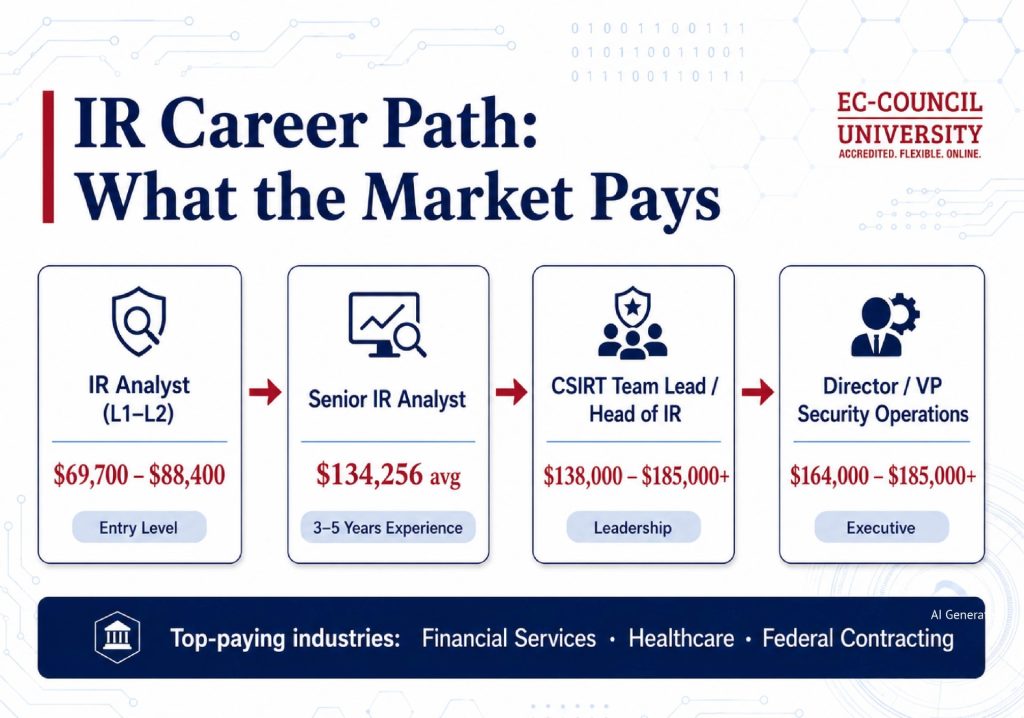
IR offers a clear, well-compensated progression. Here is what the market looks like, based on data from Glassdoor, ZipRecruiter, and Salary.com:
- IR Analyst (L1–L2) Entry-level analysts can expect salaries ranging from $69,700 to $88,400 This is the foundation: alert triage, initial investigation, runbook execution.
- Senior IR Analyst With three to five years of experience, salaries move to an average of $134,256, with top earners clearing $230,000.
- CSIRT Team Lead / Head of IR At this level, compensation reaches $138,000 to $185,000+. The role is part technical, part management, part crisis communications.
- Director-Level and VP Security Operations Director roles hit $164,000 to $185,000 in base compensation, with financial services and federal contractors paying above market.
Industries consistently paying premium compensation include financial services, healthcare, and federal contracting. These sectors incur the highest breach costs and face the strictest regulatory consequences, which drive their willingness to invest in experienced IR talent.
Ready to move into one of cybersecurity’s highest-growth specializations? Explore ECCU’s Incident Management and Cyber Operations track.
How ECCU Prepares Incident Responders
EC-Council University’s MSCS Incident Management and Cyber Operations track is built specifically for this career path.
The curriculum embeds the EC-Council Incident Handler (ECIH) certification, one of the most recognized IR credentials in the industry. Students do not just study the frameworks.
They work through virtual lab exercises built around realistic ransomware scenarios, insider threat simulations, and multi-stage breach response drills.
The program also covers the full operational picture. Technical response and organizational crisis management are both part of the training. Students learn how to contain a breach and how to brief a board.
One distinguishing factor matters here. EC-Council’s faculty includes authors of the IR frameworks now used across the industry. Students learn the methodology from the people who built it.
The program is fully online. Working professionals can apply IR frameworks to active situations at their current employer while they study, not years after they graduate.
Why IR Teams Fail at the Human Layer
The most common IR failure has nothing to do with tools.
Teams fail when decision-making breaks down under pressure. When no one owns the communication chain. When analysts escalate too late because they are not sure who to call. When a technically sound containment effort unravels because the executive briefing went sideways.
The skills that separate great CSIRT leads from capable analysts are not technical. They are about clarity under ambiguity. Stakeholder management. Post-incident process design that prevents the same incident from happening twice.
This is why IR experience, especially leadership experience, commands the salaries it does. The market is not just paying for technical knowledge. It is paying for people who can hold a team together while the situation is still on fire.
The Bottom Line
The organizations that recover fastest from breaches are not necessarily the ones with the best tools. They are the ones with the most prepared response teams.
IR is no longer a niche specialty. It is a core function in any mature security operation. The demand is there. The salaries reflect the value. The career path is real and well-defined.
If you are building toward a career in incident response or looking to formalize the experience you already have, ECCU’s Incident Management and Cyber Operations specialization offers a direct route into one of the most in-demand roles in cybersecurity today.
Frequently Asked Questions
Yes, and the timing is excellent. IR roles are among the fastest-growing in the field, with salaries that reflect genuine market demand. The work is challenging and varied, and strong performers move into leadership quickly. If you want a career with clear progression and a direct impact on organizational security, IR is one of the best entry points available.
The EC-Council Incident Handler (ECIH) is one of the most recognized credentials specifically for this role. CompTIA CySA+ is a solid entry-level option. For more advanced practitioners, SANS GIAC certifications like GCIH and GCFE are highly regarded. Many employers also value hands-on lab experience and familiarity with tools alongside formal credentials.
Yes. Many IR professionals transitioned from IT support, networking, or system administration. What matters more than a CS degree is practical knowledge of how systems behave, how networks communicate, and how logs tell a story. A relevant certification and hands-on lab practice can close the gap faster than most people expect.
A SOC analyst monitors for threats and escalates potential incidents. An incident responder takes over when a confirmed incident is underway. SOC analysts work in the detection layer. IR professionals own the response: containment, investigation, eradication, and recovery. In many organizations, IR is the natural next step after a few years in a SOC.