AI Bug Bounties: A Lucrative New Frontier for Ethical Hackers
For years, bug bounty programs have provided a practical way for companies to invite ethical hackers and cybersecurity researchers to identify IT vulnerabilities before malicious actors exploit them. It’s a model that has now expanded to include AI-powered applications, large language models (LLMs), AI agents, and the infrastructure supporting these advancements.
The opportunity is significant. HackerOne’s 2025 Hacker-Powered Security Report(1) analyzed more than 580,000 validated vulnerabilities and reported $81 million in payouts during the year. Even more striking, valid AI vulnerability reports grew 210%, with prompt injection reports increased 540%.
For aspiring ethical hackers, the message is clear:
The bug bounty landscape is evolving rapidly, and AI security is becoming a prime area of opportunity.
What Is a Bug Bounty Program?
Let’s quickly cover the basics. Think of an army war game. A bug bounty program is a structured initiative through which an organization invites qualified ethical hackers and cybersecurity researchers to identify and responsibly disclose vulnerabilities in controlled IT environments.
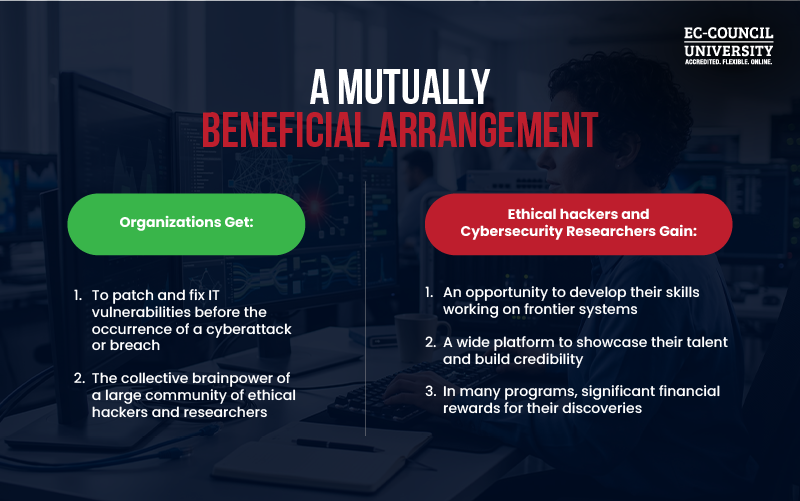
Participants typically receive financial rewards, recognition, or both for valid findings. The host organization generally establishes rules defining which systems can be tested, what activities are permitted, how vulnerabilities should be reported, which findings qualify for rewards, and more.
We’ll now dive into how bug bounty programs are being applied to AI systems today.
How Is AI Changing Bug Bounty Programs?
AI is transforming bug bounty programs in two important ways.
1. AI Is the Target
Traditional bug bounty research often focuses on websites, APIs, networks, applications, authentication mechanisms, and cloud infrastructure. AI introduces another layer to the attack surface, with a growing number of bug bounties dedicated to testing:
- LLM applications
- AI-powered chatbots
- AI agents
- Retrieval-augmented generation (RAG) systems
- AI APIs
- Model-integrated applications
- Plugins and external tools
- AI data pipelines
- Model and application interfaces
The OWASP GenAI Security Project(2) identifies prompt injection, sensitive information disclosure, supply chain weaknesses, data and model poisoning, excessive agency, system prompt leakage, vector and embedding weaknesses, and other risks as major security concerns affecting LLM and generative AI applications.
2. AI Is a Tool for Ethical Hackers and Researchers
AI can also help ethical hackers work more efficiently by assisting with tasks like:
- Generating test cases
- Analyzing application behavior
- Reviewing code
- Understanding unfamiliar APIs
- Creating scripts
- Brainstorming attack paths
- Interpreting technical documentation
- Analyzing large amounts of security data
However, AI should be treated as an assistant, not an autonomous ethical hacker. An AI-generated hypothesis still needs human verification. Researchers must understand whether a finding is genuinely exploitable, whether it falls within the program’s scope, and what impact it has.

The New AI Bug Bounty Attack Surface
One of the biggest changes is the emergence of vulnerabilities that don’t fit neatly into traditional application-security categories.
Prompt Injection: Prompt injection attacks occur when specially crafted input manipulates an AI model into behaving in an unintended way. OWASP identifies it as LLM01:2025(3), noting that successful prompt injection can potentially contribute to unauthorized access, data exposure, compromised decision-making, or other harmful outcomes.
For bug bounty researchers, prompt injection introduces an entirely new testing dimension:
Can an attacker manipulate the model to ignore intended instructions, reveal information, or perform an unauthorized action?
Excessive Agency: AI agents can increasingly interact with applications, APIs, files, browsers, and other tools without human intervention or oversight, leaving them prone to manipulation. OWASP lists excessive agency as one of its major risks for LLM applications. Researchers may therefore examine permissions, authorization boundaries, tool access, and the consequences of malicious inputs reaching an AI agent.
That creates another important question for ethical hackers and security researchers:
What happens if an attacker can manipulate an AI agent into doing something it should not do?
Sensitive Information Disclosure: AI systems may process substantial quantities of confidential information. Researchers can investigate whether carefully constructed inputs expose data that the user should never be able to access. This makes traditional security principles, including authentication, authorization, access control, input validation, and data protection, just as important in AI security as they are in conventional applications.
5 Notable AI Bug Bounty Programs Conducted Recently
| Company / Program | When | What Was Targeted? | Key Details |
|---|---|---|---|
| Google AI Vulnerability Reward Program (AI VRP)(4) | 2025–2026 | AI-specific security vulnerabilities in Google products, including Gemini and AI-powered services | Google introduced a dedicated AI-focused reward program offering up to $30,000 for qualifying vulnerabilities. Targets include prompt injection attacks that can lead to unauthorized actions or data exposure. |
| OpenAI Safety Bug Bounty(5) | Launched in March 2026 | AI safety and abuse risks, including agentic vulnerabilities, third-party prompt injection, and data exfiltration and misuse | OpenAI created this as a dedicated program, separate from its conventional Security Bug Bounty. It specifically addresses AI risks that may not fit traditional definitions of a security vulnerability. |
| Anthropic Constitutional Classifiers Bug Bounty(6) | May 2025 onward | Jailbreaks and weaknesses in Anthropic’s Constitutional Classifiers safeguards | This initiative asked researchers to stress-test safeguards designed to prevent models from providing information related to chemical, biological, radiological, and nuclear (CBRN) weapons. Anthropic subsequently described the bounty program as part of its broader monitoring approach. |
| Microsoft Copilot Bounty Program(7) | 2025–2026 | Security vulnerabilities in Microsoft Copilot and related components | Microsoft’s dedicated Copilot bounty offers eligible ethical hackers $250 to $30,000, depending on the vulnerability and impact. The program explicitly covers vulnerabilities in the Copilot service, including qualifying third-party and open-source components. |
| Meta AI / Llama Bug Bounty(8) | 2025–2026 | Security and privacy vulnerabilities involving Meta’s large language models and AI technologies | Meta’s bug bounty scope explicitly includes security and privacy issues associated with its large language models. Meta has also reported collaborating with researchers on GenAI security as part of its broader bug bounty program. |
AI Is Also Accelerating Traditional Vulnerability Research
The AI revolution doesn’t mean traditional vulnerabilities are disappearing. Quite the opposite. SQL injection attacks, cross-site scripting, authentication flaws, access-control weaknesses, server-side request forgery, insecure APIs, and other conventional vulnerabilities remain important bug bounty targets. AI is also being used to accelerate the discovery and exploitation of vulnerabilities, thereby shrinking the response window at an alarming rate.
That makes vulnerability discovery increasingly valuable. The faster defenders can identify and remediate weaknesses, the less opportunity attackers have to exploit them.
High up on Microsoft’s bug bounty leaderboards for skilled ethical hackers, Mr. Ashish Dhone gives you a personal and eye-opening perspective on the role of bug hunters in today’s AI-dominated business landscape.
Skills Needed to Succeed in AI Bug Bounties
To come out on top in AI bug bounty programs, your skill set should encompass:
- Reconnaissance: Understanding the target’s technologies, domains, applications, APIs, and exposed attack surface.
- Web and application security: Identifying weaknesses in authentication, authorization, sessions, input handling, APIs, and application logic.
- Network security: Understanding IT network security protocols, services, ports, architectures, and communication pathways.
- Vulnerability assessment: Determining whether a suspected weakness is actually exploitable and assessing its potential impact.
- Exploitation: Demonstrating vulnerabilities safely and within the boundaries established by the bounty program.
- Scripting and automation: Automating repetitive tasks and developing tools that improve research efficiency.
- AI security: Understanding prompt injection, AI application architecture, agentic systems, model interactions, data exposure, and emerging AI attack techniques.
- Communication: Clearly explain the vulnerability, demonstrate reproducibility, establish its impact, and provide useful remediation information.
Be Mindful of Ethical Boundaries
Bug bounties do not give license to attack anything found online. Every program has a defined scope and set of rules.
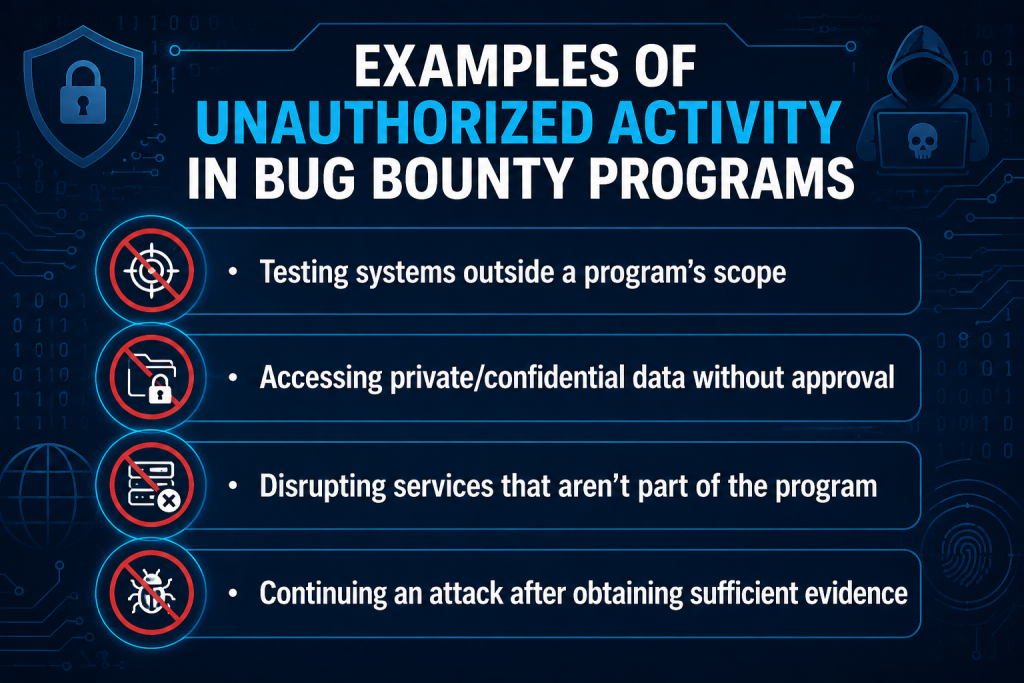
A professional bug bounty hunter, therefore, combines technical curiosity with discipline and ethics. Before testing, familiarize yourself with the program policy. Understand its safe-harbor provisions, prohibited activities, testing limitations, disclosure requirements, and reward criteria. When you find a vulnerability, collect only the evidence necessary to demonstrate the issue and report it responsibly.
How to Prepare for the AI Bug Bounty Landscape
The future of bug bounty hunting belongs to professionals who combine technical depth, creative thinking, responsible testing, and an understanding of how AI changes the security equation.
EC-Council University‘s Certified Ethical Hacker (C|EH) certification is globally acclaimed as the best certification for ambitious bug bounty hunters. Optimized for the AI era, the C|EH certification course includes structured learning, hands-on virtual lab exercises, practical ethical hacking scenarios, extensive attack techniques, AI security tools, AI-driven ethical hacking concepts, and opportunities to compete through CTF challenges. You’ll develop the skills, knowledge, and practical capabilities to excel in modern-day bug bounty programs.
To know more about the C|EH certification:
Frequently Asked Questions About AI Bug Bounty Programs
A bug bounty program is an initiative in which an organization invites security researchers to find and responsibly report vulnerabilities in specified systems. Researchers may receive monetary rewards or recognition for valid findings.
AI is creating new vulnerabilities in LLMs, AI applications, and autonomous agents while also helping researchers automate reconnaissance, generate test cases, analyze code, and investigate potential attack paths.
AI vulnerabilities can include prompt injection, sensitive information disclosure, excessive agency, system-prompt leakage, data and model poisoning, insecure tool integrations, and weaknesses in RAG or vector-based systems.
Yes. AI can assist with research, scripting, documentation, code analysis, and generating testing ideas. However, you still need human expertise to validate vulnerabilities, understand impact, follow program rules, and produce a high-quality report.
Important skills include network security, web application security, reconnaissance, vulnerability assessment, penetration testing, scripting, operating-system fundamentals, authentication and authorization, and responsible vulnerability disclosure.
C|EH can provide a structured foundation in ethical hacking, including reconnaissance, vulnerability identification, attack techniques, security tools, web application security, and hands-on practice. The current C|EH version focuses on AI-powered ethical hacking.
References & Sources:
- https://www.hackerone.com/report/hacker-powered-security
- https://owasp.org/www-project-top-10-for-large-language-model-applications/
- https://genai.owasp.org/llmrisk/llm01-prompt-injection/
- https://www.theverge.com/news/793362/google-ai-security-vulnerability-rewards
- https://openai.com/index/safety-bug-bounty/
- https://www.anthropic.com/news/testing-our-safety-defenses-with-a-new-bug-bounty-program
- https://www.microsoft.com/en-us/msrc/bounty-ai
- https://bugbounty.meta.com/scope/