The Luxury of Controlling Your Own Career After Earning a Master of Computer Science Degree
We begin by stating the indisputable fact that AI, robotics, cybersecurity, cloud computing, blockchain, and data-driven technologies are fundamentally changing what organizations expect from computer science professionals. In 2027, employers will increasingly need experts who, in addition to coding prowess, must understand how cutting-edge technologies are designed, integrated, secured, and applied to real-world scenarios and business use cases. It’s not hyperbole to say that business success and sustainability rely on the skills of such professionals.
That is where a Master of Computer Science (MCS) degree can make a big difference, one that has kept pace with the fast-moving technology landscape. One that combines future-focused computer science concepts and knowledge with hands-on, practical skill development using advanced tools for cybersecurity, AI, robotics, blockchain, cloud architecture, big data, and secure programming. The result is a multidisciplinary foundation of job readiness that elevates your candidacy for in-demand tech leadership positions.
Why Pursue a Master’s in Computer Science Degree in 2027?
If your goals are long-term career security, a very high ceiling for professional development, and eligibility for a wide range of well-paying jobs, a master’s degree in computer science is worth serious consideration. Most tech sector fields are booming, as evidenced by the growth rates of these prominent ones:
| Sector | Global Growth Rate | Forecast Period | Source and Projection |
|---|---|---|---|
| Artificial Intelligence (AI) | 30.6% CAGR | 2026–2033 | Grand View Research(1) projects that the global AI market will reach $3.4 trillion in valuation by 2033. |
| Robotics | 26.5% CAGR | 2025–2030 | Grand View Research(2) projects the global smart robots market to reach $131.46 billion by 2030, growing at a 26.5% CAGR. This is more relevant to modern AI/robotics positioning than the narrower industrial-robotics figure of 9.9%. |
| Cloud Computing | 16.0% CAGR | 2026–2033 | Grand View Research(3) projects the global cloud computing market to grow from $1.188 trillion in 2026 to $3.35 trillion by 2033, representing a 16.0% CAGR. |
| Cybersecurity | 13.8% CAGR | 2026–2034 | Fortune Business Insights(4) projects the global cybersecurity market to grow from $248.28 billion in 2026 to $699.39 billion by 2034, representing a 13.8% CAGR. |
| Data Science | 20.4% CAGR | 2026–2034 | Fortune Business Insights(5) projects the global data science platform market to grow from $220.9 billion in 2026 to $975 billion by 2034, a 20.4% CAGR. |
| Software Engineering | 13.58% CAGR | 2025–2031 | Research and Markets(6) projects the global software engineering market to grow from $66.33 billion in 2025 to $142.41 billion by 2031, representing a 13.58% CAGR. |
However, earning a master’s degree in computer science should be more than a single qualification. The program you choose must provide the technical breadth needed to adapt as technologies and job descriptions evolve, ideally by embedding industry-recognized certifications into the coursework (more on this below) rather than offering them as optional add-ons.
15+ Career Opportunities for MCS Graduates in 2027
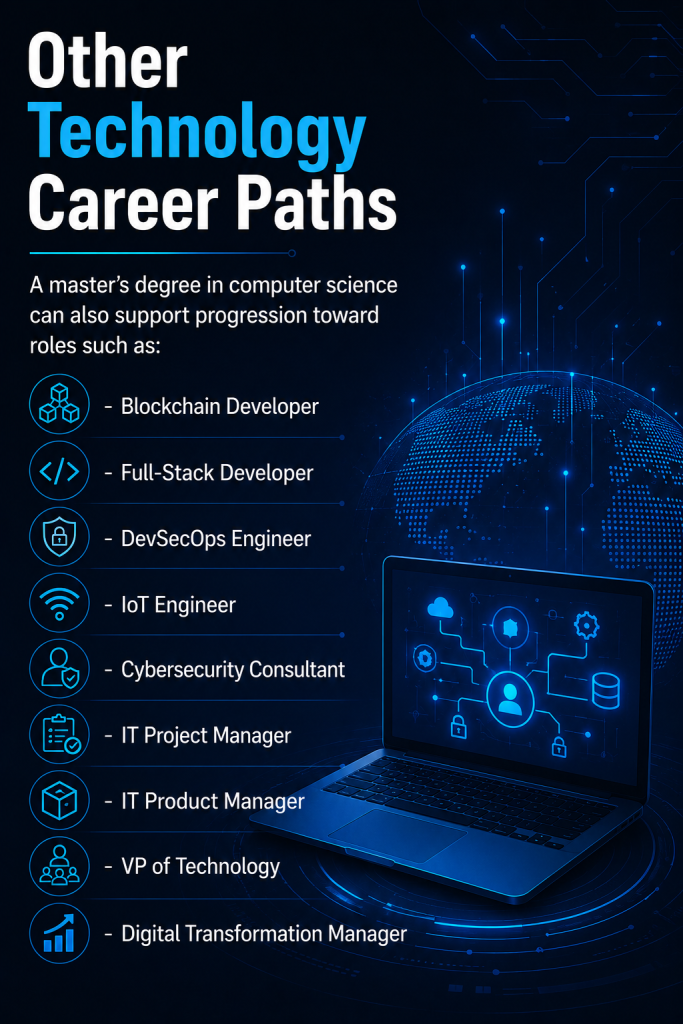
The beauty of a well-rounded master’s in computer science program is that it does not lock you into isolated career paths. Depending on your interests, experience, and technical specialization, you can pursue roles such as:
AI and Emerging Technology Careers
- AI/ML Engineer: Design, develop, train, and deploy AI and machine learning systems.
- AI Software Developer: Build software applications that incorporate machine learning, generative AI, intelligent automation, or AI-powered features.
- AI Security Specialist: Ensure enterprise AI systems operate within defined security parameters, test AI models for vulnerabilities or compromises, run AI red teaming exercises, and more.
- Robotics Engineer: Develop and integrate software, algorithms, sensing, control, and computing systems used in robotic applications. Robotics is also an established area of computer and information research.
- Computer Vision Engineer: Develop systems that enable computers and robots to interpret images, video, and other visual information.
- AI Research Scientist / Computer and Information Research Scientist
Explore new computing technologies, algorithms, intelligent systems, and emerging applications. The U.S. Bureau of Labor Statistics (BLS) projects 20% employment growth from 2024 to 2034 for computer and information research scientists, with a master’s degree typically required.
Software, Data, and IT Systems Careers
- Software Developer: Design and develop applications, platforms, and software systems. The BLS projects 16% growth in software developer employment from 2024 to 2034, driven in part by demand for software that supports AI, robotics, IoT, and automation.
- Data Scientist: Analyze large datasets, build predictive models, develop algorithms, and turn data into actionable insights.
- Data Engineer: Build and maintain the infrastructure required to collect, process, store, and analyze organizational data.
- Computer Systems Analyst: Evaluate existing technology environments and design systems that improve organizational performance.
- Systems Architect: Design the technical architecture underlying enterprise applications, platforms, networks, and computing environments.
- Cloud Engineer / Cloud Architect: Design and manage scalable cloud-based computing environments and services.
Cybersecurity and Technology-Protection Careers
- Cybersecurity Engineer: Design and implement technical controls that protect applications, systems, networks, and data.
- Application Security Engineer: Integrate security into the software development lifecycle through secure software engineering, testing, vulnerability assessment, and security architecture.
- AI/LLM Security Engineer: Assess and protect AI systems against emerging threats, including prompt injection, model abuse, data exposure, and adversarial attacks.
- Penetration Tester / Ethical Hacker: Identify IT vulnerabilities by simulating attacks against applications, networks, and systems.
- Security Software Developer: Develop software and tools designed to identify, prevent, or respond to cyber threats.
The combination of computer science and cybersecurity is particularly valuable as organizations are prioritizing the security of AI applications, software, cloud environments, and connected systems.
(Note: Job eligibility depends on an individual’s qualifications, professional experience, technical portfolio, employer requirements, location, area of expertise, and other factors.)
Experience the Career Impact of ECCU’s Master’s Degree in Computer Science
EC-Council University offers a 100% online master’s in computer science (MCS) program with a forward-thinking asynchronous learning model. Globally acclaimed for its academic depth and rigor, the MCS program is ideal for working professionals seeking to develop broad technology skill sets that can be readily applied on the job. The program emphasizes:
- AI and emerging technologies: Building knowledge and practical skills relevant to intelligent systems and the rapidly expanding AI ecosystems.
- Robotics: Understanding and executing computing concepts that support the development and application of robotic systems.
- Cybersecurity: Developing multi-faceted cybersecurity skills in ethical hacking, network security, secure software programming, and more, alongside core computer science capabilities.
- Data Science: Analyzing, filtering, and extracting meaningful and actionable insights from vast sets of data.
- Hands-On Learning: Theory that reinforces practice through immersive virtual lab exercises, real-world simulations, case studies, capstone projects, group discussions, and networking.
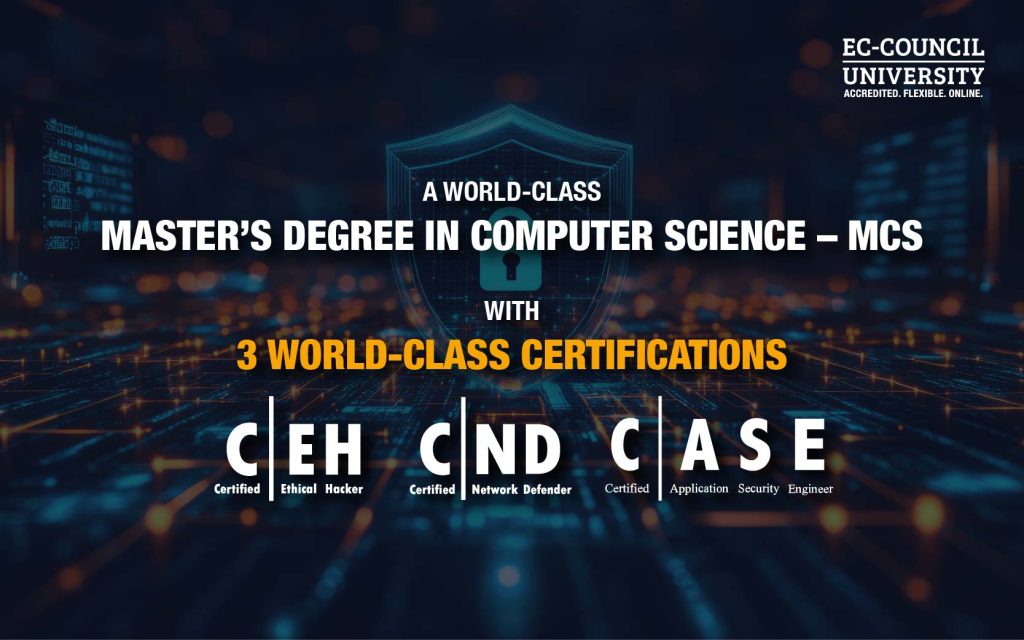
- Industry-Recognized Certifications: 3 valuable EC-Council cybersecurity certifications integrated into the curriculum at no extra cost.
- 100% Flexibility: For learners who want to study without putting their careers on hold.
Other program benefits include learning from a faculty of renowned computer science experts, credit transfer options, scholarship opportunities, career mentoring, and much more. For additional information or personalized guidance on ECCU’s 2-year Master’s Degree in Computer Science:
Frequently Asked Questions
A Master’s Degree in Computer Science can prepare you for a host of job roles, including software developer, AI/ML engineer, data scientist, data engineer, robotics engineer, systems architect, cloud engineer, cybersecurity engineer, application security engineer, blockchain developer, and computer and information research scientist.
For professionals seeking advanced technical expertise and aiming to move into specialized technology roles, a master’s degree in computer science can be very valuable. The continued growth of AI, robotics, cybersecurity, cloud computing, and data-driven systems is expanding the range of opportunities available to computer science professionals.
Yes. ECCU’s MCS program provides the comprehensive computer science foundation needed for roles such as AI engineer, machine learning engineer, AI software developer, computer vision engineer, and AI systems engineer. Specialized AI knowledge, programming skills, mathematical skills, and practical project experience further strengthen career prospects.
Yes. Robotics combines computer science with areas such as algorithms, software engineering, sensing, control, and intelligent systems. ECCU’s MCS specifically includes robotics as part of its multidisciplinary program framework.
Yes. A master’s degree in computer science can provide a strong foundation for technical cybersecurity careers, particularly where employers need professionals who understand both how computing systems are built and how to protect them. That’s why ECCU’s MCS program includes 3 industry-recognized cybersecurity certifications in the curriculum.
Yes. ECCU’s MCS program is offered exclusively as a 100% online learning experience, providing flexibility for working professionals and students who need remote learning.
References & Sources:
- https://www.grandviewresearch.com/industry-analysis/artificial-intelligence-ai-market
- https://www.grandviewresearch.com/industry-analysis/smart-robots-market
- https://www.grandviewresearch.com/industry-analysis/cloud-computing-industry
- https://www.fortunebusinessinsights.com/industry-reports/cyber-security-market-101165
- https://www.fortunebusinessinsights.com/data-science-platform-market-107017
- https://www.researchandmarkets.com/report/software-engineering-market