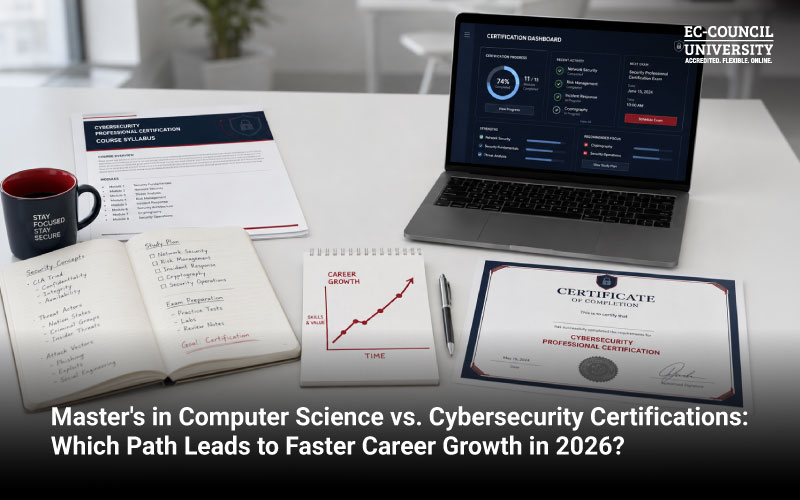
The degree vs. certifications debate never goes away in cybersecurity. But 2026 has added new pressure to that question. DoD 8140 compliance deadlines hit this year. AIdriven threats are reshaping what skills employers actually want. And senior roles are asking harder questions about who gets promoted and who gets passed over. This blog breaks down what each path genuinely offers, what it costs, and how to decide which one fits where you are in your career right now.
Key Takeaways
- A degree builds the systems thinking that certifications cannot replicate.
- Certifications signal role-specific competency fast, especially to hiring managers.
- Stacking certs without a strategy creates credential bloat, not career growth.
- DoD 8140 now recognizes degrees as valid qualification pathways, not just certs.
- Hidden certification costs compound significantly across a three-year maintenance cycle.
- ECCU’s MCS bundles both: a graduate degree with multiple embedded certifications.
- Your career stage, not the credential itself, should drive the decision.
What a Master's in Computer Science Gives You That Certifications Cannot
Certifications test what you know. A master’s degree changes how you think.
That distinction matters more as you move up. At the senior engineer or architect level, problems stop having clean answers. You are designing systems, evaluating tradeoffs, and explaining decisions to people who do not share your technical vocabulary. That requires different preparation than passing an exam.
An MCS builds depth in algorithm design, operating systems, data science, and secure programming. These are the foundations that separate someone who configures a tool from someone who can architect a solution. Employers filling cloud security architect, AI security engineer, and systems design roles increasingly expect this depth. A CISSP tells them you know the domains. A master’s degree tells them you can reason across all of them.
Academic programs also develop research and writing capability. Reading threat intelligence critically, structuring a risk analysis memo, decomposing an unfamiliar problem systematically: these skills matter at the director and CISO level. Certifications rarely develop them.
For federal, government, and national lab roles, a graduate degree carries significant weight in hiring panels. It signals the ability to operate in long-horizon, high-complexity environments where judgment matters as much as technical skill.
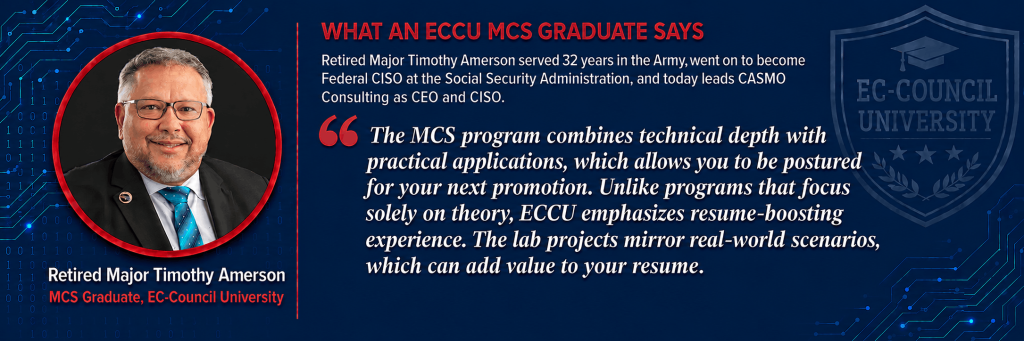
What sets ECCU’s MCS apart: The ECCU Master of Science in Computer Science integrates cybersecurity throughout its 12-course, 36-credit curriculum rather than treating it as a single elective. Students cover algorithm design, operating systems, data science, blockchain, robotics, and AI alongside dedicated coursework in ethical hacking, Linux security, and network security. The program runs 18 to 24 months, fully online, and includes up to three EC-Council certifications: CEH v13, CND, and C|ASE. Most computer science master’s programs treat security as an add-on. ECCU builds it into the spine of the degree.
What Certifications Offer That a Degree Cannot
Speed is the real advantage of the certification path. The Certified Network Defender or CompTIA Security+ can get you credentialed in months, not years. For someone pivoting into cybersecurity or breaking into a specific technical role, that timeline matters.
Certifications also communicate role-specific competency that hiring managers recognize immediately. When a recruiter sees CISSP, they know the candidate has verified experience across security architecture, risk management, and operations. When they see CISM, they know the candidate is governance-oriented and ready for a leadership role. That shorthand has real value at the screening stage.
Entry-level options like CompTIA Security+ start around $370 to $450. For early-career professionals building a foundation, that accessibility matters.
Certifications also update faster than degree curricula. When a new attack vector becomes dominant, certification bodies revise exam domains quickly. CEH v13 now includes AI-powered attack and defense scenarios. That responsiveness to current tooling is a genuine advantage.
The Hidden Costs of Each Path
Most people underestimate both sides of this equation.
Certifications:
- CISSP exam fee: $749, with total investment including training ranging from $1,200 to over $4,600
- Annual maintenance fee: $135 per year to keep the CISSP active
- CompTIA Security+ renewal: $150 plus continuing education requirements
- Multiply across three or four certifications and you carry a real ongoing expense with no terminal point
The bigger hidden cost is strategic drift. Collecting certifications without a plan produces credential bloat. A resume with seven certifications and no coherent career narrative can raise red flags with experienced hiring managers.
Degree: The time investment is real. Eighteen to 24 months of graduate study alongside a full-time job requires sustained discipline. Tuition costs vary, and the opportunity cost of consistent attention over nearly two years is significant. But degree costs terminate. You complete the program and carry the credential permanently, with no renewal fees and no annual maintenance charges.
Decision Framework: Which Path Is Right for You?
- If you are early in your career and need speed: Start with certifications. CEH gets you into the job market quickly and builds the vocabulary you need for technical interviews.
- If you are mid-career and targeting leadership or senior architect roles: The degree becomes the differentiator. Mid-career professionals holding CISSP or CISM earn in the $120,000 to $150,000 range. Senior leadership and architect roles push well beyond that, but they increasingly expect graduate-level credentials alongside certifications.
- If you are in or targeting federal or DoD roles: Under DoDM 8140.03, foundational qualification can be satisfied through a certification, a qualifying education credential, an approved training program, or documented experience, provided it covers at least 70% of the core tasks for the assigned work role. A graduate degree from an accredited institution qualifies. That is a significant and often overlooked option.
The optimal combination: Degree with embedded certifications. You build the systems thinking that leadership roles demand while earning the role-specific signals that hiring managers look for at every career stage. This is not a compromise. It is the strongest possible positioning.
Explore Career Paths for MCS Graduates: Wondering where an MCS can take you? This resource from ECCU maps specific cybersecurity job roles, salary ranges, and skills required for MCS graduates across application security, DevSecOps, cloud security, and AI security.
Not sure which path fits your goals? Talk to an ECCU enrollment advisor or explore the MCS program to see how graduate education and certification preparation work together.
Frequently Asked Questions
Does a master's in computer science help more than CISSP for a CISO role?
They serve different functions. CISSP validates technical breadth across security domains and remains among the most requested credentials in CISO job postings. A master’s in computer science builds the systems thinking, research capability, and academic credibility that boards and hiring committees look for at the executive level. For a CISO role in a large enterprise, government agency, or regulated sector, the strongest candidates typically hold both.
How many certifications should I have before considering a master's degree?
There is no fixed number. The more useful question is whether your certifications are actually opening the doors you are targeting. If you have two or three relevant certifications and keep hitting a ceiling on promotion or salary, that is a reliable signal. Accumulating more certifications beyond that point often produces diminishing returns.
Does ECCU's MCS include certification preparation?
Yes. The MCS curriculum integrates preparation for up to three EC-Council certifications: CEH v13 (Certified Ethical Hacker), CND (Certified Network Defender), and C|ASE (Certified Application Security Engineer). These are embedded across dedicated coursework in ethical hacking, Linux security, and network security, so students build toward the certifications while completing their degree requirements.
Are there roles that require a master's degree, not just certifications?
Yes. Cybersecurity research roles at national labs and government agencies regularly require graduate-level credentials. Senior architect positions at enterprise organizations and executive leadership roles at the director level frequently list a master’s degree as a minimum or preferred qualification, particularly in defense, healthcare, and financial services.
How does ECCU's MCS map to DoD 8140 work roles?
Under DoDM 8140.03, a qualifying education credential from an accredited institution can satisfy the foundational qualification requirement for assigned DCWF work roles, provided it covers at least 70% of the core tasks for that role. ECCU is a DEACaccredited, VA-approved institution. Its MCS curriculum covers ethical hacking, network security, secure programming, and operating systems, aligning to multiple DCWF work roles. Candidates should verify specific role alignment through the DoD Cyber Exchange qualification matrices or consult their workforce manager for role-specific guidance.