Cybersecurity Teams Have a Data Problem
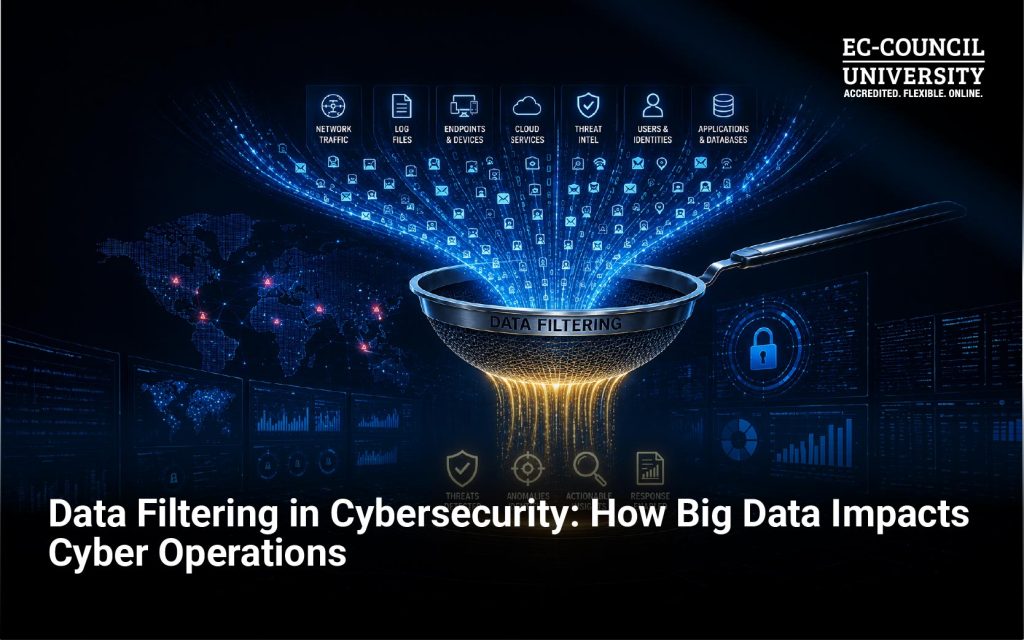
Imagine a cybersecurity team facing a tidal wave of security data. Their challenge lies in determining which data matters most, which is where data filtering becomes essential. By sorting, prioritizing, correlating, and analyzing massive volumes of information, cybersecurity professionals can turn raw data into actionable security intelligence.
Data filtering in cybersecurity has become even more important as AI, cloud computing, remote work, IoT devices, and third-party vendor services continue expanding the enterprise cyberattack surface. As such, effective data filtering has transitioned from an IT function to an important cybersecurity requirement.
What Is Data Filtering in Cybersecurity?
Data filtering is the process of examining large datasets and applying predefined rules, conditions, or analytical techniques to determine which information to allow, block, prioritize, investigate, or discard. In cybersecurity, filtering can be applied to virtually any type of security data, including:
- Network traffic
- Firewall and proxy logs
- Authentication events
- Email messages and attachments
- Endpoint activity
- Application logs
- Cloud activity
- DNS requests
- User behavior
- Threat intelligence feeds
- Security alerts
- Sensitive data transfers
For example, a security team may configure a monitoring system to ignore thousands of routine login events while immediately flagging a series of failed logins followed by a successful authentication from an unusual location. The objective is not simply to reduce data. The objective is to increase the security value of the data being analyzed.
Why Big Data Creates a Cybersecurity Challenge
The modern enterprise produces security telemetry at an extraordinary scale. Every application, endpoint, cloud workload, network connection, and identity transaction generates data. Multiply that across thousands of employees and devices, and cybersecurity teams can quickly become overwhelmed. The problem becomes particularly serious when organizations use centralized platforms such as Security Information and Event Management (SIEM) systems. These systems are designed to collect and correlate security events from multiple sources, but the resulting volume can create enormous analytical workloads.
NIST’s guidance on computer security log management emphasizes the importance of establishing effective processes for generating, transmitting, storing, analyzing, and disposing of security log data.
Gathering security data is not enough. Cybersecurity professionals must know what to do with the data once they have it.
10 Ways Data Filtering Strengthens Cyber Operations
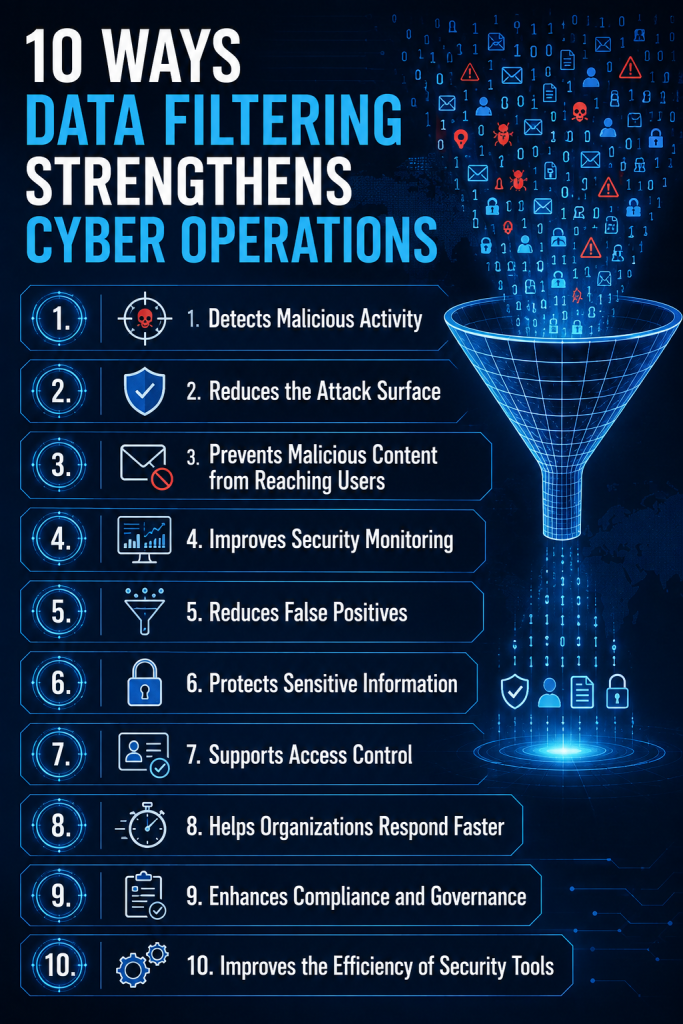
- Detects Malicious Activity: Data filtering can identify suspicious patterns, such as malicious IP addresses, unusual network requests, dangerous file types, or known attack signatures. This helps security tools detect threats before they cause significant damage.
- Reduces the Attack Surface: Organizations can use filtering rules to block unnecessary ports, protocols, domains, applications, or types of traffic. Limiting what is allowed into or out of an environment reduces opportunities for attackers to exploit vulnerabilities.
- Prevents Malicious Content from Reaching Users: Email and web filters can identify phishing messages, malicious links, suspicious attachments, and known harmful websites. This forms a secondary shield against social engineering and malware attacks.
- Improves Security Monitoring: Security teams can receive enormous quantities of logs and alerts every day. Filtering allows them to prioritize events that are genuinely relevant to security, making it easier to identify indicators of compromise and investigate incidents.
- Reduces False Positives: Not every unusual event represents an attack. Intelligent filtering can remove routine or low-risk events from security alerts, allowing analysts to focus their attention on higher-priority threats.
- Protects Sensitive Information: Data filtering can help prevent sensitive information—such as credentials, financial information, intellectual property, or personal data—from being transmitted to unauthorized destinations. This is particularly important in Data Loss Prevention (DLP) programs.
- Supports Access Control: Filtering can determine which users, devices, applications, or locations are permitted to access resources. For example, an organization might restrict access to sensitive systems based on user identity, device security, or network location.
- Helps Organizations Respond Faster: When security systems filter and prioritize relevant information, security analysts can identify potential incidents more quickly. Faster detection can lead to faster containment and reduce the potential impact of a breach.
- Enhances Compliance and Governance: Many organizations must control how sensitive information is collected, transmitted, stored, and accessed. Filtering mechanisms can help enforce organizational security policies and support compliance requirements.
- Improves the Efficiency of Security Tools: Security technologies such as SIEM, IDS/IPS, firewalls, email security gateways, and DLP systems can generate or process massive amounts of information. Effective filtering helps these systems concentrate resources on the data that matters most.
The Role of AI in Filtering Cybersecurity Data
AI and machine learning are changing how organizations approach data filtering. Traditional filtering often relies on predefined rules, but AI-driven systems can go further by identifying patterns and anomalies across large datasets. For example, an AI-enabled security analytics platform might detect that a user’s behavior deviates significantly from their historical baseline, even if the activity does not violate any predefined rule.
However, AI does not eliminate the need for sound data filtering. It makes data quality even more important. Poor-quality, irrelevant, duplicated, or improperly classified data can undermine analytical results. This is particularly relevant today because cybercriminals are also using AI to make their attacks more effective. Simultaneously, employees’ use of unapproved shadow AI tools creates additional opportunities for data leakage.
The Risks of Over-Filtered Data
It’s worth noting that more data filtering does not automatically mean better security. An overly aggressive filter can remove legitimate security signals.
Imagine an SOC Head setting a rule to suppress repeated authentication failures because most are harmless. An attacker could exploit that rule by generating activity that resembles the suppressed events.
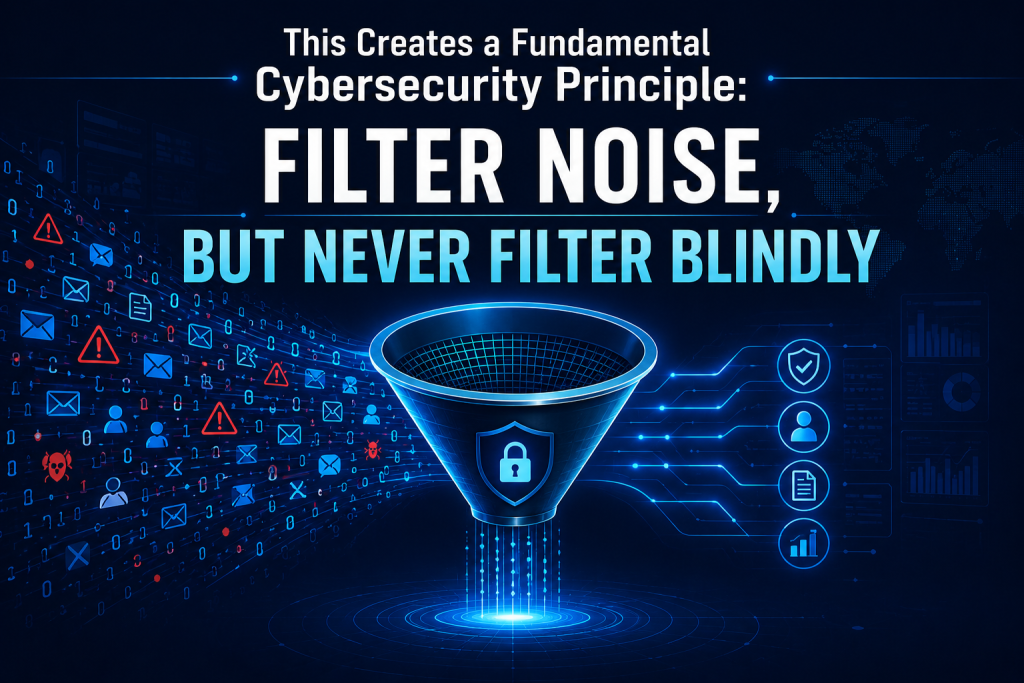
Cybersecurity teams should regularly review filtering rules, monitor false negatives and false positives, and adjust their detection logic as threats evolve. Filtering should also preserve sufficient information for digital forensic investigations and incident response.
Applications of Data Filtering in Modern Cyber Operations
Data filtering has applications across almost every major cybersecurity discipline:
- Network security: Filters suspicious traffic, protocols, destinations, and connection patterns.
- Email security: Identifies phishing scams, malicious attachments, suspicious links, and spoofing indicators.
- Endpoint security: Filters processes, files, scripts, and behavioral events for suspicious activity.
- Cloud security: Helps identify unusual access, configuration changes, exposed resources, and anomalous cloud activity.
- Identity security: Filters authentication and authorization events to identify suspicious account behavior.
- DLP: Detects when sensitive information leaves approved environments.
- Threat hunting: Allows analysts to search massive datasets for indicators and behavioral patterns.
- Incident response: Helps investigators isolate relevant events and reconstruct attack timelines.
Best Practices for Effective Cybersecurity Data Filtering
From a cybersecurity operations perspective, organizations should consider the following best practices for data filtering:
- Start with Security Objectives: Do not create filters only to reduce data volume. Define what the organization needs to detect, protect, and investigate.
- Establish Risk-Based Priorities: Give greater analytical weight to events involving critical systems, privileged accounts, sensitive information, and high-risk behaviors.
- Combine Multiple Signals: A single event may be benign. Multiple related events can reveal an attack.
- Regularly Tune Filtering Rules: Threats, applications, users, and infrastructure change. Filtering logic must change with them.
- Preserve Investigative Evidence: Filtering should not eliminate information that may later be required for forensic analysis or incident response.
- Use Automation Carefully: Automation can process enormous datasets quickly, but security professionals should retain appropriate oversight of high-impact decisions.
Learn How to Turn Big Data into Better Cybersecurity
Big data has transformed cybersecurity, giving organizations unprecedented visibility into users, systems, applications, networks, and threats. But visibility without effective analysis can quickly become overwhelming. Data filtering is the bridge between raw security data and actionable cybersecurity intelligence. When implemented correctly, it helps cybersecurity professionals detect threats faster, reduce alert fatigue, strengthen SIEM operations, protect sensitive information, improve threat hunting, and accelerate incident response. However, developing data filtering skills requires a combination of cybersecurity fundamentals, analytical thinking, technical proficiency, and hands-on experience with modern security technologies.
EC-Council University (ECCU) helps you build these skills through flexible, online cybersecurity education that emphasizes hands-on learning in virtual lab environments simulating real-life cybersecurity scenarios. You’ll have unfettered access to cutting-edge data filtration tools as you navigate through a maze of skill-building exercises. To know more about studying at ECCU:
Frequently Asked Questions About Data Filtering in Cybersecurity
Data filtering in cybersecurity is the process of examining and sorting large volumes of security data to identify relevant, suspicious, or potentially malicious information. It helps security teams prioritize important events while reducing irrelevant data and alert noise.
Data filtering is important because cybersecurity teams process enormous amounts of data from networks, endpoints, cloud systems, applications, and users. Effective filtering helps identify threats faster, reduce false positives, minimize alert fatigue, and focus security resources on the most critical events.
Big data gives cybersecurity teams greater visibility into systems, users, applications, and network activity. However, the sheer volume and complexity of this information can overwhelm analysts. Data filtering, correlation, automation, and analytics help transform large datasets into actionable cybersecurity intelligence.
Data filtering helps threat detection by identifying specific indicators, behaviors, and patterns associated with cyberattacks. Filtering can prioritize suspicious IP addresses, unusual login activity, malicious files, abnormal network traffic, and other indicators of a potential security incident.
Data filtering helps SIEM systems manage large quantities of security logs and events. By removing irrelevant information and prioritizing high-risk events, filtering allows security analysts to investigate meaningful alerts more efficiently and improve overall security monitoring.
Data filtering can help prevent breaches by identifying suspicious activity and restricting unauthorized data movement. In particular, Data Loss Prevention (DLP) technologies can use filtering rules to detect sensitive information and prevent its transmission to unauthorized users, applications, or destinations.
Yes. AI and machine learning can analyze large datasets and identify patterns, anomalies, and behavioral changes that traditional rule-based filtering may miss. AI can help security teams prioritize alerts and identify potentially malicious activity, although human oversight and well-designed filtering rules remain important.