The Vital Role of Ethics in Enterprise AI Usage
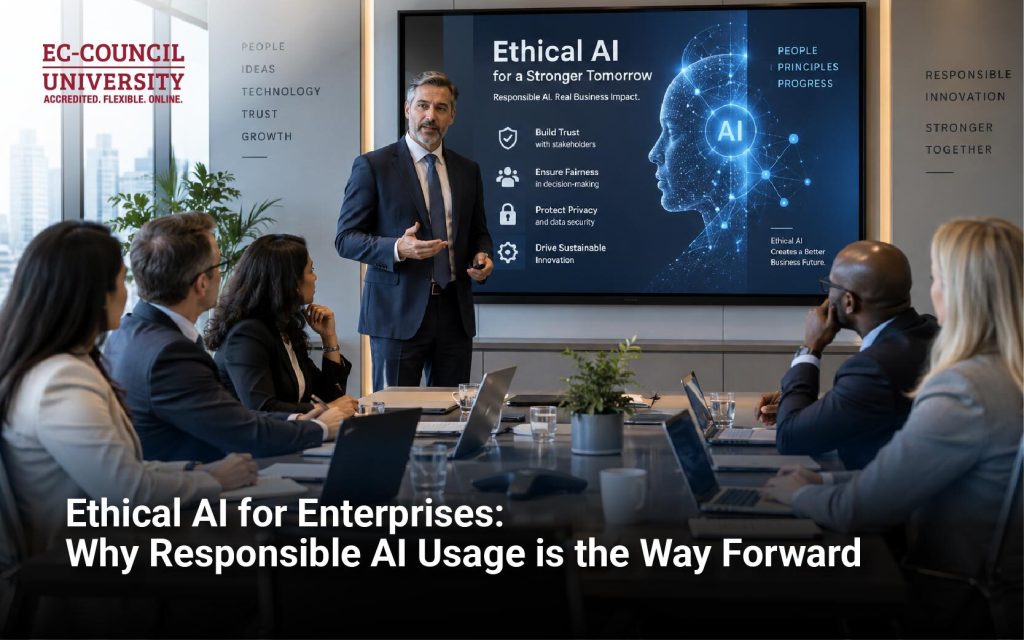
AI is a hotly debated topic in the boardrooms of most major organizations. Companies are using AI to automate workflows, analyze data, personalize customer experiences, support employees, detect threats, develop products, and make decisions faster. But there’s a critical question every organization needs to ask before scaling their AI usage: Just because we can use AI in any given scenario, does that mean we should?
The answer depends on how the technology is designed, deployed, governed, and monitored.
Ethical AI practices can keep your organization out of the news for controversial reasons and ensure that AI systems are trustworthy, secure, transparent, accountable, fair, and aligned with legal, regulatory, and organizational requirements. These considerations are becoming more pressing with each passing day, and companies know it.
EC-COUNCIL’S ADG FRAMEWORK FOR ENTERPRISE AI IMPLEMENTATION EMPHASIZES:
A – ADOPT (EXECUTE AND DELIVER)
D – DEFEND (SECURE AND VALIDATE)
G – GOVERN (OVERSEE, ASSURE, DECIDE)
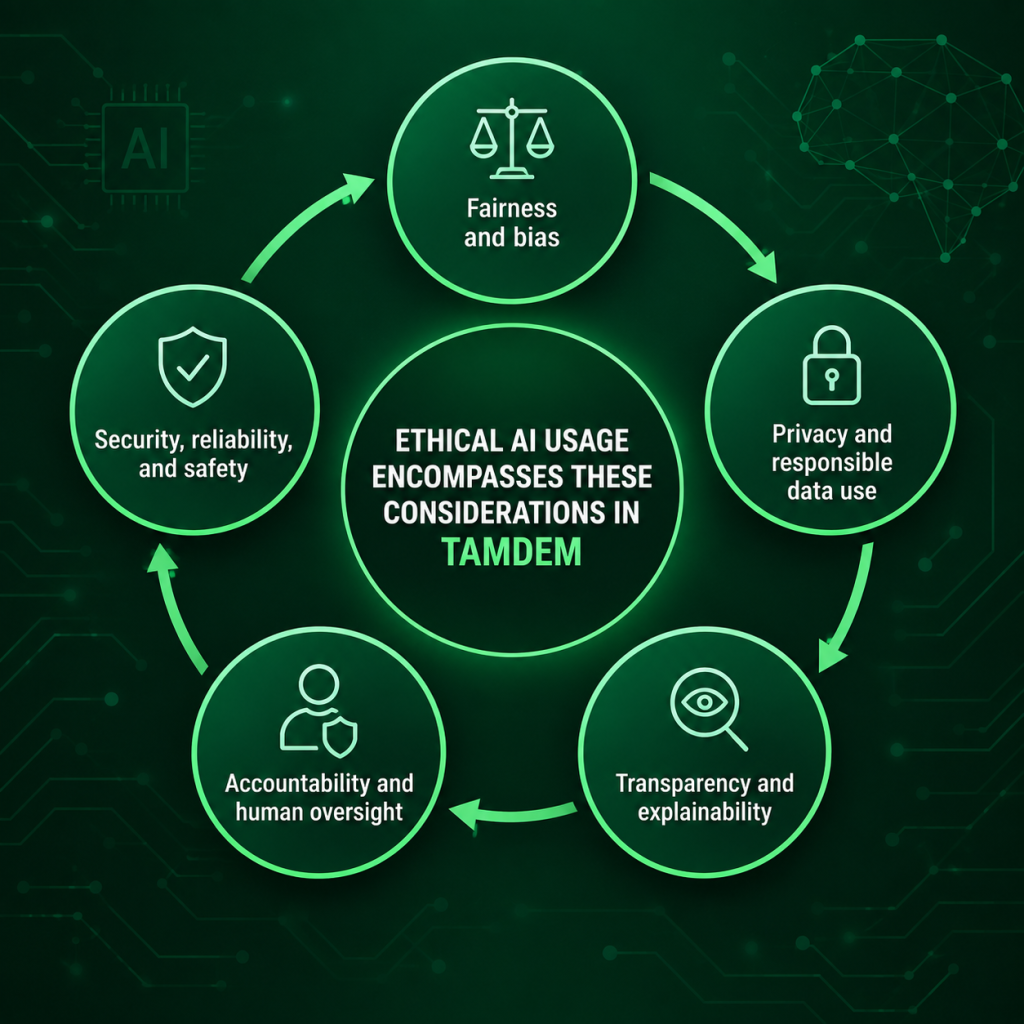
5 Main Considerations of Ethical AI Usage for Enterprises
1. Fairness and bias
2. Privacy and responsible data use
AI frequently depends on large quantities of data, including potentially sensitive or personal information. Businesses need to understand what data their AI systems collect, where that data comes from, why it is being used, where it is stored, who can access it, and how long it is retained.
Privacy should be considered throughout the AI lifecycle rather than addressed only after deployment.
3. Transparency and explainability
Employees, customers, regulators, and other stakeholders may need to understand when AI is being used and, depending on the application, how it influences an outcome. Transparency is becoming increasingly important from a regulatory perspective. Under Article 50 of the EU AI Act, certain transparency requirements took effect on August 2, 2026, including obligations regarding interactions with AI systems and certain AI-generated or manipulated content.
For businesses operating internationally, ethical AI practices strengthen both stakeholder trust and regulatory readiness.
4. Accountability and human oversight
AI should not be used as an excuse to ignore human responsibility. Organizations should clearly define who owns an AI system, who approves its use, who monitors its performance, and who is responsible when something goes wrong.
Human oversight is particularly important when AI is used for consequential decisions. Decision makers should have the authority, knowledge, and tools necessary to question, override, or stop an AI-supported process when appropriate.
5. Security, reliability, and safety
An ethical AI system also needs to be dependable and secure. Organizations should regularly test their AI systems for risks such as inaccurate outputs, data leakage, adversarial manipulation, model vulnerabilities, prompt injection attacks, unauthorized access, and misuse.
Unsecured or compromised AI can act unpredictably and freely, disregarding organizational policies and bypassing safety overrides, ultimately resulting in irreversible business damage. So regular AI security audits are on the to-do list for most large companies worldwide.
Best Practices to Instill Ethical AI Usage Across the Enterprise
Ethical AI cannot be the responsibility of the IT department alone. It must become an enterprise-wide discipline and philosophy. Businesses can establish this foundation by:
- Creating an enterprise AI governance framework that defines policies, responsibilities, approval processes, and risk tolerances.
- Maintaining an AI inventory so the organization knows which AI systems are being developed, purchased, or used.
- Conducting AI impact and risk assessments before high-impact systems are deployed.
- Establishing data governance controls covering privacy, quality, provenance, access, retention, and appropriate use.
- Testing AI systems continuously for accuracy, security risks, bias, reliability, and unexpected behavior.
- Documenting AI systems and decisions, including intended use, limitations, proprietary training data, testing results, and human oversight mechanisms.
- Training employees on responsible AI use, acceptable AI tools, data handling, verification of AI outputs, and escalation procedures.
- Including third-party AI providers in governance processes can help minimize organizational risk.
- Monitoring deployed systems, because an AI system that performs acceptably today may behave differently as data, models, users, or business conditions change.
How Employees Can Remain Mindful of AI Ethics
- “What data am I providing?”
Avoid feeding any confidential, proprietary, regulated, or sensitive information into AI systems without authorization. - “How reliable is the output?”
AI can generate inaccurate or fabricated information. Always treat important outputs as material that requires verification and not as automatically authoritative answers. - “Who could be affected?”
Consider colleagues, customers, applicants, business partners, and other stakeholders who may be affected by an AI-assisted decision. - “Can I explain or justify the decision?”
If you cannot explain how an AI-supported process works well enough to defend its use, it may require additional governance or human review. - “What happens if an AI agent gets it badly wrong?”
Consider the consequences of failure before deciding how much autonomy to grant an agentic AI system, especially when failure can lead to financial, legal, or reputational damage.
AI Governance, Ethics, and Risk Management Are New BAU Functions
Ethical AI adoption and usage have entered the realm of importance shared by enterprise governance, risk management, compliance, cybersecurity, legal, privacy, and executive decision-making. The reason is straightforward. Unsupervised AI can create devastating business risks that cross departmental boundaries.
Think of an AI system used for hiring. It may involve simultaneously accessing confidential data from HR, legal, compliance, IT, and executives. What happens if the AI releases some of this information publicly, without authorization or notification?
Likewise, an unchecked AI-powered customer service platform can raise questions surrounding privacy, transparency, data security, consumer protection, intellectual property, and reputational risk.
If recent events are anything to go by, regulators are also demonstrating that businesses cannot treat AI as a regulatory exception:
- In 2024, the U.S. Federal Trade Commission (FTC) announced enforcement actions against companies over allegedly deceptive AI-related claims, emphasizing that existing laws apply to AI-enabled conduct.
- More recently, the FTC finalized orders in August 2026 requiring Cox Media Group and two other firms to pay a combined $930,000 to settle allegations involving deceptive claims about an AI-powered advertising service.
The Business Consequences of Neglecting Ethical AI Usage
When organizations overlook AI ethics, the consequences can extend far beyond a flawed model:
- Regulatory and legal exposure from discriminatory, deceptive, privacy-invasive, or otherwise non-compliant AI practices.
- Financial losses resulting from erroneous decisions, remediation costs, penalties, litigation, or operational disruption.
- Reputational damage when customers or employees lose confidence in an organization’s AI practices.
- Security incidents caused by inadequate controls around AI models, agents, applications, data, or third-party systems.
- Poor business decisions resulting from inaccurate, biased, or poorly interpreted AI outputs.
- Loss of intellectual property or sensitive data through inappropriate use of public or third-party AI services.
- Customer dissatisfaction when people are subjected to opaque or unfair automated decisions.
The C|RAGE Certification: Ensure AI Governance and Ethics at Every Level of the Enterprise
For those who want to move beyond general AI awareness and develop specialized expertise in responsible AI governance, AI-related regulatory and compliance mandates, and ethical AI usage on an enterprise scale, EC-Council University’s Certified Responsible AI Governance & Ethics (C|RAGE) certification course provides the ideal platform to achieve these learning objectives.
Designed for busy mid- to senior-level professionals, the course is delivered entirely online over 10 weeks and is based on the EC-Council ADG Framework. It covers AI foundations, ethical principles, responsible AI usage, AI strategy, governance frameworks, regulatory compliance, and AI risk management. The curriculum also addresses practical areas such as AI governance policies and controls, organizational readiness, AI regulatory requirements, accountability, liability, user rights, AI threats and vulnerabilities, and AI risk identification, assessment, and prioritization.
Learners earn the C|RAGE certification upon completion, validating their executive-level capabilities in ethical AI and governance.
To know more about the C|RAGE certification course: