
Application Security Cannot Be Ignored When Entire Businesses Run on Apps
Think about how much of your organization now runs through software. Employees access business systems through web applications. Customers use mobile apps to make purchases and manage accounts. Developers rely on cloud services and third-party vendor components. And AI is increasingly being embedded into app interfaces, APIs, creation platforms, and business workflows. These developments have made applications attractive targets for cyberattacks, as they provide direct access to sensitive data and critical business functions.
Organizations can’t afford to treat application security as a final check before software is launched. It must be a constant consideration throughout app design, development, testing, deployment, operation, and maintenance.
The 2026 Verizon Data Breach Investigations Report (DBIR) underscores the business need for application security:
What Is Application Security?
Application security (or AppSec) encompasses the processes, technologies, and practices used to identify, prevent, manage, and remediate security weaknesses throughout an application’s life cycle. A modern application security program can include:
- Secure requirements and security-focused architecture
- Threat modeling
- Secure software engineering
- Identity and access controls
- Authentication and authorization testing
- Static Application Security Testing (SAST)
- Dynamic Application Security Testing (DAST)
- Interactive Application Security Testing (IAST)
- Software Composition Analysis (SCA)
- API security
- Secrets management
- Dependency and software supply-chain security
- Container and cloud-native security
- Security testing in CI/CD pipelines
- Vulnerability remediation
- Security monitoring and logging
- Secure deployment and maintenance
Top 5 Application Security Trends of 2026
The application security landscape has evolved considerably in recent years. Traditional vulnerability scanning and penetration testing still matter, but modern AppSec requires a broader and more continuous approach.
These are the 5 most notable trends of application security in 2026:
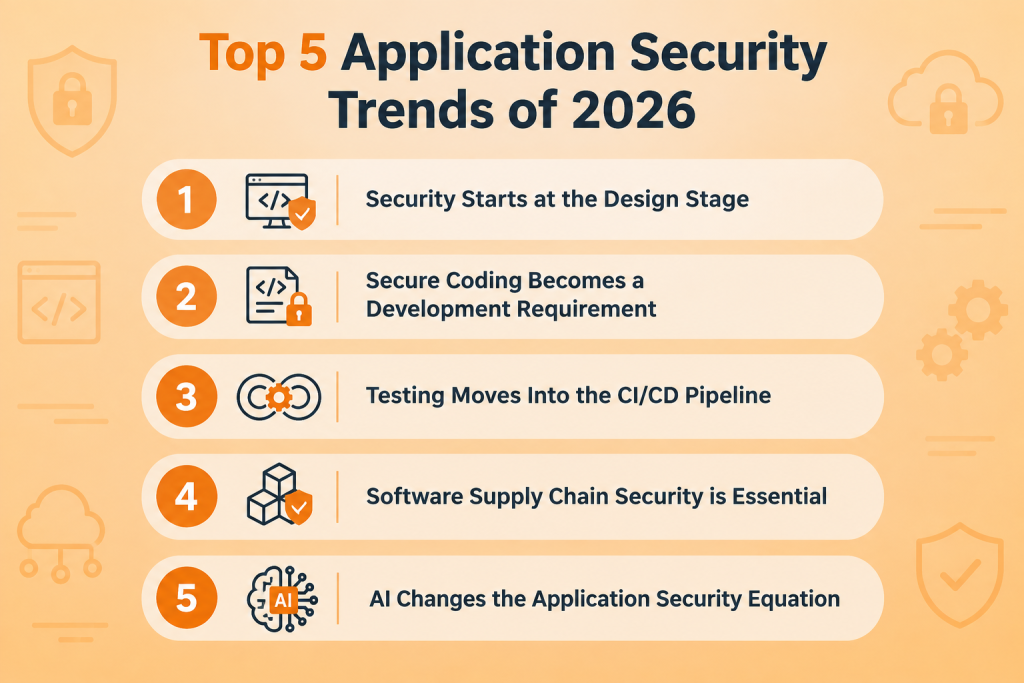
1. Security Starts at the Design Stage
One of the most important shifts is moving security upstream. Threat modeling allows security professionals and development teams to examine an application’s architecture from an adversary’s perspective, identify potential attack paths, and determine appropriate mitigations.
OWASP describes threat modeling as a structured, repeatable process and recommends performing it early in the SDLC, rather than waiting until an application has already been built. This matters because design flaws can be significantly harder to correct after deployment.
2. Secure Coding Becomes a Development Requirement
Application security engineers need to understand how vulnerabilities emerge in real code. This includes issues involving SQL injection attacks, improper authorization, authentication weaknesses, insecure cryptography, unsafe data handling, and other implementation flaws.
For an application security professional, knowing these categories is only the beginning. The real value comes from being able to recognize how weaknesses manifest in specific applications and help development teams remediate them.
3. Testing Moves Into the CI/CD Pipeline
Modern software gets created and released quickly. Security testing, therefore, has to keep pace. Rather than waiting for a security review immediately before production deployment, organizations are integrating automated security controls into development and DevSecOps pipelines.
However, automation does not eliminate the need for human expertise. It makes skilled professionals more important because someone still has to interpret findings, distinguish meaningful risks from false positives, investigate business-logic vulnerabilities, prioritize remediation, and make security decisions.
4. Software Supply Chain Security is Essential
Modern applications rarely consist entirely of code written by one development team. They may incorporate open-source packages, commercial libraries, APIs, containers, cloud services, development tools, and other third-party components. This creates software supply-chain challenges.
Tracking third-party dependencies and using software bills of materials (SBOMs) and related analysis capabilities helps improve visibility into application components.
5. AI Changes the Application Security Equation
AI introduces both opportunities and new security considerations. Developers can use AI coding assistants to generate code faster, while organizations can embed AI capabilities into applications. Simultaneously, cybercriminals can use AI to accelerate reconnaissance, vulnerability discovery, social engineering, and other stages of an attack.
Application security engineers, therefore, are rushing to understand AI-enabled applications, AI-generated code, model and API security, data exposure, authentication, authorization, prompt-related risks, and the security implications of integrating AI services into software architectures.
Core Job Responsibilities of an Application Security Engineer
Application Security Engineers connect software development with cybersecurity. They understand how applications are built, how attackers attempt to compromise them, and how organizations can reduce cyber risk without unnecessarily slowing development. Their primary responsibilities include:
- Reviewing application architectures
- Performing threat modeling
- Identifying and validating vulnerabilities
- Conducting application security testing
- Reviewing secure coding practices
- Assessing APIs and authentication mechanisms
- Evaluating third-party dependencies
- Integrating security into CI/CD pipelines
- Prioritizing vulnerabilities based on risk
- Working directly with developers on remediation
- Establishing secure development standards
- Supporting cyber incident response involving applications
- Continuously adapting security controls to emerging threats
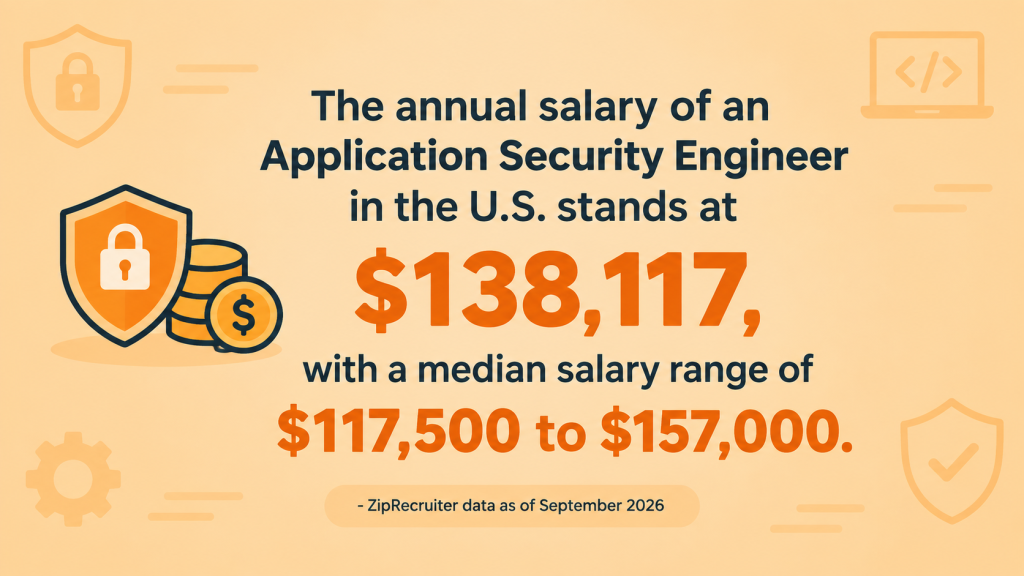
As applications are de facto engines of modern business operations, demand for recruitment and compensation for professionals who can secure applications will continue to rise.
Gain Advanced Application Security Qualifications at ECCU
For cybersecurity professionals seeking to develop specialized application security capabilities, EC-Council University offers a structured, practical way to validate their knowledge and demonstrate competence.
Our Certified Application Security Engineer (CASE) certification course focuses on application security throughout the software development life cycle. The curriculum explores the latest AI-powered application security practices and tools, and was developed with input from leading industry practitioners and EC-Council’s global advisory board. As an internationally recognized credential, CASE is ideal for helping aspiring application security experts achieve their career goals.
To know more about the CASE certification course:
Frequently Asked Questions About Application Security
What is application security?
Application security is the practice of protecting software from vulnerabilities and attacks throughout its life cycle. It includes secure design, coding, threat modeling, security testing, vulnerability management, secure deployment, and ongoing maintenance.
Why is application security important in 2026?
Applications are used across enterprises and have become a major component of organizational attack surfaces. Securing applications is key to ensuring smooth business operations, preventing data breaches, maintaining customer trust, and avoiding harmful business repercussions.
What does an application security engineer do?
An application security engineer helps organizations identify and reduce software security risks. Responsibilities can include threat modeling, secure architecture reviews, vulnerability assessment, application security testing, secure coding guidance, DevSecOps integration, and remediation support.
What is the difference between application security and cybersecurity?
Cybersecurity is the broader discipline covering the protection of systems, networks, applications, data, identities, devices, and other digital assets. Application security focuses specifically on protecting app software and its associated components throughout the development and operational life cycle.
What skills does an application security engineer need?
Important skills an application security engineer must possess include secure coding, application architecture, threat modeling, vulnerability assessment, security testing, authentication and authorization, API security, software supply-chain security, DevSecOps, and risk analysis. Professionals in 2026 also need to be familiar with AI-enabled application security.
Is application security part of DevSecOps?
Yes. DevSecOps integrates application security practices into software development and operations workflows. Practices such as SAST, DAST, IAST, dependency analysis, and supply-chain security are examples of application security activities that can be incorporated into DevSecOps.
What is the CASE certification from EC-Council University?
The Certified Application Security Engineer (CASE) is an application security certification focused on security across the software development life cycle. Its training encompasses planning, creating, testing, and deploying applications, as well as secure requirements, application design, secure coding, and post-development security activities.