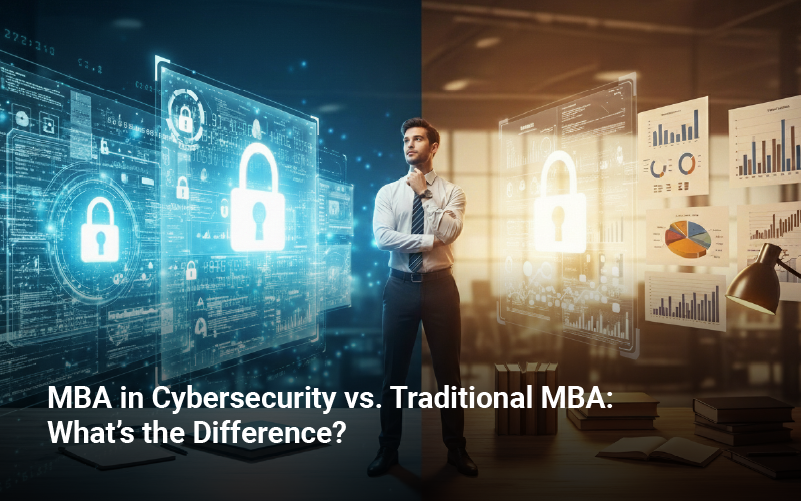
Cyberattacks now sit alongside financial risk and market risk as a standing item on the board agenda. That shift has created a specific kind of demand: leaders who can weigh a security investment the same way they’d weigh a capital expenditure, and who can translate a technical risk into a business decision. An MBA in Cybersecurity was built for that gap.
A traditional MBA remains the standard credential for general management, and it still opens doors across finance, marketing, operations, and consulting. But as digital infrastructure becomes the backbone of nearly every industry, a growing number of professionals are choosing a degree that pairs core business training with cyber risk, governance, and compliance expertise. Understanding what separates the two, and which one actually fits your career goals, is the first step in choosing the right path.
Key Takeaways
- An MBA in Cybersecurity blends business leadership training with cyber risk, governance, and compliance skills.
- Choose the MBA to lead teams and budgets; choose an MS in Cybersecurity to go deep technical.
- Salaries span roughly $130,000 for consulting and project roles to $385,000+ for CISOs with equity.
- The US BLS projects 29% growth in information security jobs through 2034, far above the national average.
- Judge a program on accreditation, certification mapping, and verified outcomes, not marketing claims.
Understanding MBA Specializations vs. Cybersecurity MBA: Exploring Your Options
What Does a Standard MBA Offer?
An MBA degree builds broad business fluency across finance, marketing, operations, and leadership. It trains decision-making, communication, and analytical skills that transfer across industries, including manufacturing, finance, healthcare, and marketing.
Graduates typically move into roles like management consultant, marketing director, financial analyst, or business development manager. The degree is built to produce versatile leaders who can drive growth and efficiency in nearly any business environment.
What Does an MBA in Cybersecurity Offer?
An MBA in Cybersecurity blends the same business core with technical grounding in cyber risk management, information systems security, data governance, regulatory compliance, and digital forensics. It prepares leaders who can manage information security risk while keeping the business running.
Graduates are trained to bridge the gap between IT teams and the executive suite, translating technical risk into strategy and aligning cybersecurity decisions with broader business objectives. As cyber threats grow more sophisticated and more expensive, that combination of business acumen and cyber fluency is becoming one of the more futureproof profiles in business education.
Key Differences Between an MBA in Cybersecurity and a Traditional MBA
| Aspect | Traditional MBA | MBA in Cybersecurity |
|---|---|---|
| Curriculum Focus | Business strategy: marketing, operations, finance, HR | Business strategy plus cybersecurity management: risk analysis, data protection, compliance, and governance |
| Skills Developed | Leadership, project management, communication, analytics | The same core skills, plus cyber risk management, IT governance, compliance, and digital resilience |
| Career Opportunities | Business management, consulting, marketing, operations, general management | Business management, IT operations, cyber risk management, IT project management, security consulting |
| Industry Demand | Broad, across all sectors | Especially strong in IT, finance, healthcare, defense, manufacturing, and government |
| Salary Range | Competitive, varies by industry | Frequently higher, driven by cybersecurity talent scarcity (see the salary guide below) |
| Program Mode | On-campus and online options | Increasingly offered online for working professionals |
Both paths build strong leadership and management skills. The MBA in Cybersecurity stands out because it sits at the intersection of two priorities boards now treat as inseparable: profitability and resilience.
MBA in Cybersecurity vs. MS in Cybersecurity
This is one of the most common points of confusion for prospective students, and it comes down to a simple question: do you want to lead the business, or lead the technical function?
An MS in Cybersecurity is a technical, specialist degree. Coursework goes deep into areas like penetration testing, digital forensics, network defense, and security architecture. It’s the stronger choice if your goal is a hands-on or highly technical role, such as security engineer, security architect, or digital forensics analyst, or if you’re aiming to move deeper into the technical track rather than into people or budget management.
An MBA in Cybersecurity is a leadership degree with technical fluency. Coursework covers financial management, marketing, organizational leadership, and strategy, layered with cybersecurity risk, governance, and compliance. It’s the better fit if your goal is to manage teams, own a budget, sit on cross-functional leadership, or eventually report to (or become) a CISO, CTO, or COO.
A useful way to think about it: an MS in Cybersecurity deepens your technical ceiling. An MBA in Cybersecurity raises your leadership ceiling while keeping you technically credible. Some professionals pursue both over the course of a career, often starting technical and moving into an MBA once they’re ready to lead.
Online MBA in Cybersecurity: What to Look For
Online MBA in Cybersecurity programs vary widely in structure and quality, and those differences matter more than most marketing copy suggests. Before enrolling, check a program against this list of criteria:
- Accreditation. Confirm the university holds recognized institutional accreditation(in the US, look for accreditors like DEAC, and recognition from bodies such as ACE or CHEA). This affects whether credits transfer, whether employers and other institutions recognize the degree, and in some cases whether federal aid applies.
- Curriculum-to-certification mapping. Strong programs map coursework directly to industry certifications (CEH, CND, CCISO, and similar), so you graduate with credentials that are independently recognized by employers, not just a transcript.
- Faculty and industry ties. Look for faculty with active industry experience, not purely academic backgrounds, and for programs with documented employer partnerships or alumni placement at recognizable companies.
- Format built for working professionals. Asynchronous or hybrid delivery, flexible start dates, and manageable weekly time commitments matter if you’re studying while employed full-time.
- Transfer credit and certification-to-credit policies. If you already hold certifications like CEH or CND, check whether the program lets you convert that expertise into academic credit and shorten time to graduation.
- Career outcomes data. Ask for actual employment rate, average salary progression, and placement data from recent graduates, not just illustrative role lists.
Career Paths After a Traditional MBA or a Cybersecurity MBA
Top Careers You Can Pursue With a Traditional MBA
- Management Consultant: advises organizations on strategy, growth, and performance
- Financial Analyst: guides investment, budgeting, and business decisions through financial data
- Marketing Manager: builds brand presence and drives sales through strategy execution
- Business Development Executive: identifies market opportunities and builds partnerships
- Operations Director: oversees daily operations and optimizes organizational effectiveness
These roles center on strategic decision-making, profitability, and growth within established business frameworks.
High-Demand Careers After a Cybersecurity MBA
- Chief Information Security Officer (CISO): leads enterprise-wide cybersecurity strategy
- Cyber Risk Manager: assesses and mitigates cybersecurity risk across business and IT operations
- IT Project Manager: plans and manages technology projects with security built into the design
- Security Consultant: advises organizations on compliance and security architecture
- Compliance Officer: ensures the organization meets data protection laws and standards
As regulatory scrutiny and cyber threats both climb, professionals with this combination of business and cybersecurity expertise are becoming essential across public and private sectors. For the full list of roles ECCU’s MBA in Cybersecurity prepares graduates for, see the program page.
MBA in Cybersecurity Salary Guide by Role
| Role | Typical Salary Range (US) | Source |
|---|---|---|
| Compliance Officer (general, not cyberspecific) | $90,000–$132,000 | Robert Half 2026 Salary Guide |
| IT Project Manager (general, not cyberspecific) | $103,500–$147,000 | Robert Half 2026 Salary Guide |
| Security Consultant | Around $130,000 average | Glassdoor |
| Cybersecurity Consultant | Around $150,000–$160,000 average | Glassdoor |
| Cyber Risk Manager | Around $146,000 average | Glassdoor (small sample, ~51 reports) |
| Security / IT Compliance Manager (cyberfocused) | Roughly $135,000–$175,000 average | Glassdoor |
| Information Security Manager | Around $191,000 average | Glassdoor |
| Director of Cybersecurity | Roughly $220,000–$285,000 average across related director titles | Glassdoor |
| Chief Information Security Officer (CISO) | Widely reported between roughly $150,000 and $385,000+ base, higher still with equity at large or public companies | Glassdoor, Salary.com |
Is an MBA in Cybersecurity Worth It?
“Worth it” depends less on the degree and more on where you’re starting from and where you want to end up. Consider these questions before deciding:
Are you already technical and looking to move into leadership? If you’re a security analyst, engineer, or IT manager who wants to eventually run a team, own a budget, or report into the C-suite, the business training is usually the missing piece, and the MBA closes that gap directly.
Are you in general business and want to specialize? If you’re already in a business role and want to move into a high-demand, better-compensated specialization, the cybersecurity layer differentiates you from a general MBA pool, particularly in regulated industries like finance, healthcare, and government.
Can you weigh the cost against realistic outcomes? Return on investment depends on your starting salary, the role you’re targeting, and how quickly you can apply the credential. Rather than relying on marketing claims, ask any program for actual data: graduate employment rate, typical salary progression, and time to promotion. For ECCU’s current tuition, program length, and reported outcomes, see the MBA in Cybersecurity program page, which lists current pricing and admissions details directly.
Is the market moving in the right direction? Regulatory requirements around data protection are expanding globally, and boards increasingly expect cyber risk to be reported in business terms, not just technical ones. That trend favors leaders who can do both.
If your answer to the first two questions is yes, the ROI case is usually strong. If you’re undecided on direction, it’s worth talking to a program advisor about outcomes data before committing.
The Future of Business Leadership in the Digital Era
Business success and cybersecurity resilience are no longer separate conversations. Future executives need both market instincts and the ability to anticipate and mitigate cyber risks that could damage revenue or reputation.
An MBA in Cybersecurity is built for that dual competency. It prepares leaders to design strategies that are profitable and resilient at the same time, a combination that will only become more central as technology continues to reshape how industries operate.
Choosing Between a Traditional MBA and a Cybersecurity MBA
The right choice comes down to your goals. A traditional MBA remains a strong, versatile credential for professionals aiming at general management, entrepreneurship, or a broad range of business functions. An MBA in Cybersecurity is the stronger fit for professionals who want to lead at the intersection of business strategy and digital defense.
Whichever path fits, choose a program from an accredited, recognized institution with transparent outcomes data. In a business environment where data is a core asset, the leaders who can protect it while growing the business will shape what comes next.
Frequently Asked Questions
It’s a graduate business degree that combines core MBA training (finance, marketing, leadership, operations) with cybersecurity-specific coursework in risk management, governance, compliance, and information security, preparing graduates to lead at the intersection of business strategy and digital defense.
It depends on your starting point and goals. For technical professionals moving into leadership, or business professionals looking to specialize in a high-demand area, the ROI case is generally strong. Review a program’s actual graduate outcomes data (employment rate, salary progression) rather than relying on general claims.
Each fits a different goal. An MS in Cybersecurity is the stronger choice for a deep technical or engineering track. An MBA in Cybersecurity is the stronger choice for a leadership or management track that still requires cyber fluency.
It varies widely by role. Reported US averages range from roughly $130,000 for consulting and project management roles up to $190,000+ for senior management and director roles, with CISO compensation reported anywhere from around $150,000 to $385,000 or more depending on company size and equity. See the salary guide above for role-by-role figures.
Program length varies by institution, generally between 18 and 24 months for a working professional studying part-time online. Check the specific program page for exact duration.
Common roles include Chief Information Security Officer, Cyber Risk Manager, IT Project Manager, Security Consultant, Compliance Officer, and Director of Cybersecurity, among others. See the full list on the program page.
Yes, in most programs. Many MBA in Cybersecurity programs are designed for both technical and non-technical professionals; prior IT or cybersecurity experience is often preferred but not required for admission.
Demand is expected to keep growing as cyber risk becomes a standing board-level concern and regulatory requirements around data protection expand globally. The US Bureau of Labor Statistics projects information security-related employment to grow much faster than average through 2034, and business leaders who can bridge strategy and cyber risk are increasingly viewed as essential rather than optional.