SQL Injection Attacks Are More Prevalent Than Ever
For more than two decades, SQL injection (SQLi) has ranked among the world’s most dangerous web application vulnerabilities. Despite significant advances in secure software engineering, cloud-native architectures, AI, and DevSecOps, SQL injection continues to expose organizations to costly data breaches, ransomware attacks, and regulatory penalties. The reason for this is simple: databases remain one of an organization’s most valuable assets. Whenever an application fails to properly validate user input before interacting with a database, cybercriminals may seize the opportunity to manipulate database queries and gain unauthorized access.
Today’s threat landscape makes SQL injection more relevant than ever. Modern applications rely heavily on APIs, microservices, third-party software, and AI-assisted development. While these technologies accelerate innovation, they also introduce new attack surfaces where insecure coding practices can unintentionally create SQL injection vulnerabilities.
With that in mind, let’s take a close look at SQL injection attacks and understand the nature of these threats in 2026.
What is an SQL Injection Attack?
SQL injection is a code injection attack that exploits vulnerabilities in applications communicating with relational databases such as MySQL, Microsoft SQL Server, PostgreSQL, Oracle Database, or SQLite.
Applications frequently use Structured Query Language (SQL) to retrieve, update, insert, or delete information from databases. When user input is incorporated into SQL queries without proper validation or parameterization, attackers can inject malicious SQL statements that alter the intended behavior of those queries. Depending on the vulnerability, attackers may be able to:
- Bypass authentication systems
- Read confidential information
- Modify database records
- Delete critical business data
- Escalate user privileges
- Execute administrative database commands
- In some environments, compromise the underlying operating system
These harmful consequences underscore why SQL injection remains one of the highest-impact vulnerabilities in web application security.
Why SQL Injection Still Matters in 2026
Cybersecurity researchers continue to uncover SQL injection vulnerabilities in both legacy systems and newly developed applications. Several factors contribute to its persistence:
- Legacy Applications: Many enterprise systems were developed years ago, before modern secure coding standards became commonplace. These applications often continue running critical business operations without comprehensive security updates or patches.
- Rapid Software Development: Organizations tend to prioritize faster software releases. Without adequate security testing, developers may inadvertently introduce vulnerable database queries into production environments.
- AI-Assisted Development: Generative AI coding assistants have transformed software development by helping developers write code more efficiently. However, AI-generated code is not inherently secure. If developers accept AI-generated database queries without security reviews, vulnerabilities such as SQL injection can enter production software. The OWASP Top 10 for Large Language Model Applications specifically highlights the importance of validating AI-generated code before deployment, reinforcing that human oversight remains essential throughout the software development lifecycle.
- Expanding Attack Surfaces: Today’s applications interact through REST APIs, GraphQL APIs, cloud databases, containerized microservices, mobile applications, and Internet of Things (IoT) platforms. Each database interaction presents another opportunity for attackers if secure coding practices are not consistently applied.
The Anatomy of an SQL Injection Attack
Most web applications retrieve information by sending SQL queries to a database. Here’s an illustration of how attackers can manipulate this functionality through SQL injection:
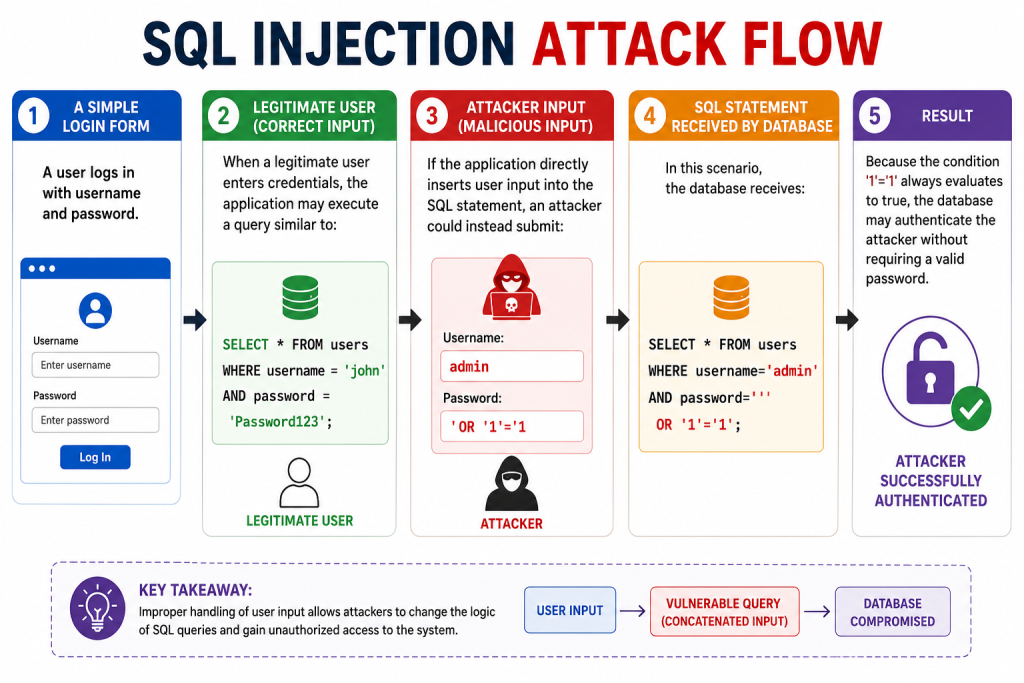
Although modern authentication systems typically include additional safeguards, this example illustrates how improperly validated input can fundamentally alter a database query.
Common Types of SQL Injection Attacks
Cybercriminals employ the following forms of SQL injection attacks depending on how the target application responds:
1. In-Band SQL Injection
This is the most common type of SQL injection because attackers use the same communication channel to both send malicious queries and receive results. In-band SQL injection usually comes in 2 varieties:
- Error-Based SQL Injection: Attackers intentionally trigger database errors that reveal valuable information about database structure, table names, software versions, or query syntax.
- UNION-Based SQL Injection: Attackers use the SQL UNION operator to combine legitimate query results with unauthorized data retrieved from other database tables.
2. Blind SQL Injection
Some applications suppress database error messages, making direct exploitation more difficult. Instead, attackers infer database behavior by observing subtle differences in application responses. Blind SQL injection generally falls into two categories:
- Boolean-Based Blind SQL Injection: The attacker sends queries that evaluate as either true or false. Changes in page content, HTTP responses, or application behavior reveal whether the injected condition succeeded.
- Time-Based Blind SQL Injection: Rather than displaying information directly, the database intentionally delays its response when a specified condition evaluates as true. Attackers measure response times to gradually reconstruct sensitive information one character at a time. Although slower than other SQL injection methods, time-based attacks remain highly effective against poorly secured applications.
3. Out-of-Band SQL Injection
Out-of-band SQL injection occurs when attackers receive information through an entirely different communication channel. For example, compromised database servers may initiate DNS requests, HTTP callbacks, or external network communications. Although relatively uncommon, out-of-band attacks are particularly dangerous because they can bypass traditional monitoring mechanisms.
The Growing Concern of Second-Order SQL Injection Attacks
Modern attackers increasingly exploit second-order SQL injection, a more sophisticated variation that may evade conventional security testing. Instead of immediately executing malicious SQL commands, attackers store carefully crafted input inside the application’s database. The payload appears harmless during initial validation. However, when the application later retrieves and incorporates that stored data into another SQL query without proper sanitization, the malicious code executes.
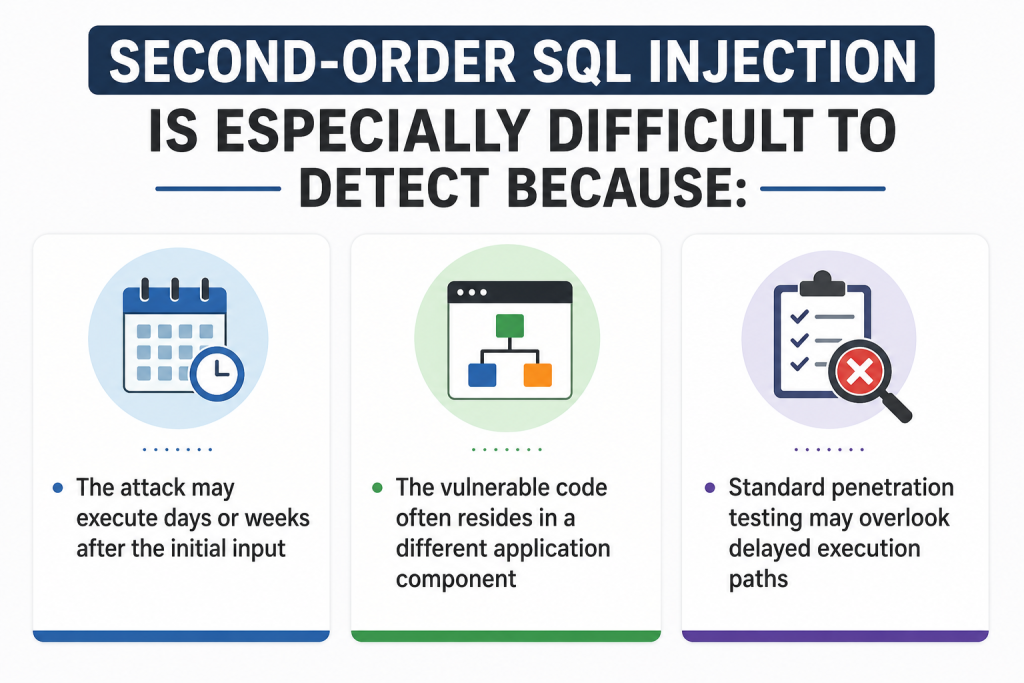
With microservice architectures getting more complex by the day, identifying these vulnerabilities requires comprehensive secure code reviews and continuous application security testing.
SQL Injection in Modern Cloud and API Environments
While SQL injection has traditionally been associated with web applications, today’s attacks also target cloud-native applications, APIs, and distributed software architectures. Modern organizations rely on REST APIs, GraphQL APIs, serverless functions, Kubernetes workloads, and microservices that constantly exchange data with backend databases. Every API endpoint that accepts user input presents a potential entry point if developers fail to implement secure database queries.
Cloud platforms themselves do not eliminate SQL injection risks. Instead, responsibility shifts to application developers under the shared responsibility model. Whether an organization hosts its database on-premises or in the cloud, insecure application code remains vulnerable.
Attackers automate the discovery of SQL injection flaws using vulnerability scanners and reconnaissance tools that probe thousands of web applications for weaknesses. Once a vulnerable endpoint is identified, exploitation can occur within minutes. Organizations adopting DevSecOps practices therefore integrate security testing throughout the software development lifecycle (SDLC), allowing vulnerabilities to be identified long before applications reach production.
Warning Signs of a SQL Injection Attack
SQL injection attacks often leave subtle indicators that security teams should investigate immediately. Common warning signs include:
- Unexpected database error messages
- Unusually high volumes of failed login attempts
- SQL syntax appearing in application logs
- Sudden spikes in database queries
- Unauthorized changes to records
- Missing or altered data
- Unexpected administrator account creation
- Significant database performance degradation
- Outbound connections originating from database servers
Continuous monitoring through Security Information and Event Management (SIEM), Endpoint Detection and Response (EDR), and Database Activity Monitoring (DAM) solutions can help organizations detect suspicious database activity before attackers achieve their objectives.
How Organizations Can Prevent SQL Injection Attacks
Preventing SQL injection requires a combination of secure coding practices, application security testing, and continuous monitoring. Fortunately, many of the most effective defenses are well established and relatively straightforward to implement.
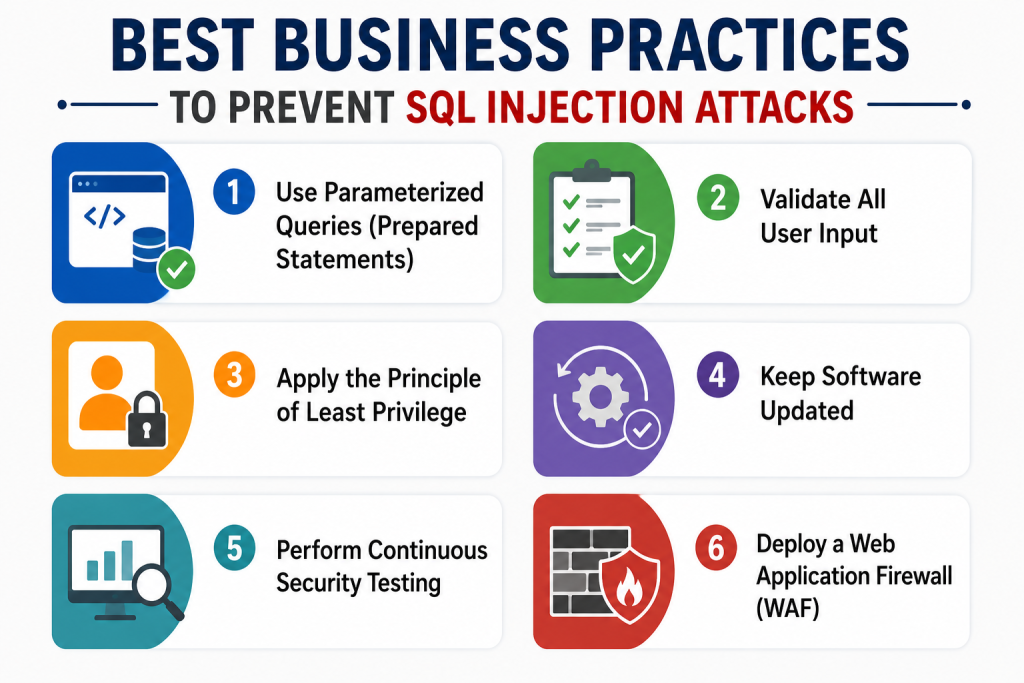
1. Use Parameterized Queries (Prepared Statements)
Parameterized queries, also known as prepared statements, are widely regarded as the most effective defense against SQL injection. Rather than concatenating user input directly into SQL statements, parameterized queries separate executable SQL code from user-supplied data.
This ensures the database interprets user input only as data, even if it contains SQL keywords or special characters. Most modern programming frameworks provide built-in support for parameterized queries and prepared statements.
2. Validate All User Input
Every piece of user input should be treated as untrusted. Organizations should:
- Validate data type
- Enforce length restrictions
- Use allowlists whenever possible
- Reject unexpected characters
- Normalize encoded input before processing
Input validation should complement, not replace, parameterized queries.
3. Apply the Principle of Least Privilege
Database accounts should possess only the permissions required to perform their intended functions.
For example:
- Read-only applications should not have DELETE privileges.
- Customer-facing portals should never use administrator database accounts.
- Separate database accounts should be used for different application services.
Limiting privileges significantly reduces the potential impact of successful exploitation.
4. Keep Software Updated
Organizations should routinely update and review:
- Database management systems
- Application frameworks
- Programming libraries
- Database drivers
- Third-party vendor software dependencies
Although software updates cannot eliminate insecure coding practices, they often address vulnerabilities that attackers actively exploit.
5. Perform Continuous Security Testing
Modern application security extends far beyond annual penetration tests. Organizations increasingly combine multiple testing approaches, including:
- Secure code reviews
- Static Application Security Testing (SAST)
- Dynamic Application Security Testing (DAST)
- Interactive Application Security Testing (IAST)
- Software Composition Analysis (SCA)
- Penetration testing
- Red team exercises
Continuous testing enables organizations to identify vulnerabilities early, reducing remediation costs and minimizing business risk.
6. Deploy a Web Application Firewall (WAF)
A Web Application Firewall (WAF) helps detect and block common SQL injection attempts before they reach backend applications.
Although WAFs should never replace secure coding practices, they provide an important additional layer of defense by filtering malicious requests, enforcing security policies, and identifying suspicious traffic patterns.
How AI Is Changing SQL Injection Defense
AI-powered tools now assist developers by generating code, identifying software defects, and recommending security improvements. Modern Application Security Posture Management (ASPM) platforms also use AI to prioritize vulnerabilities based on exploitability and business impact, helping security teams focus on the most critical risks.
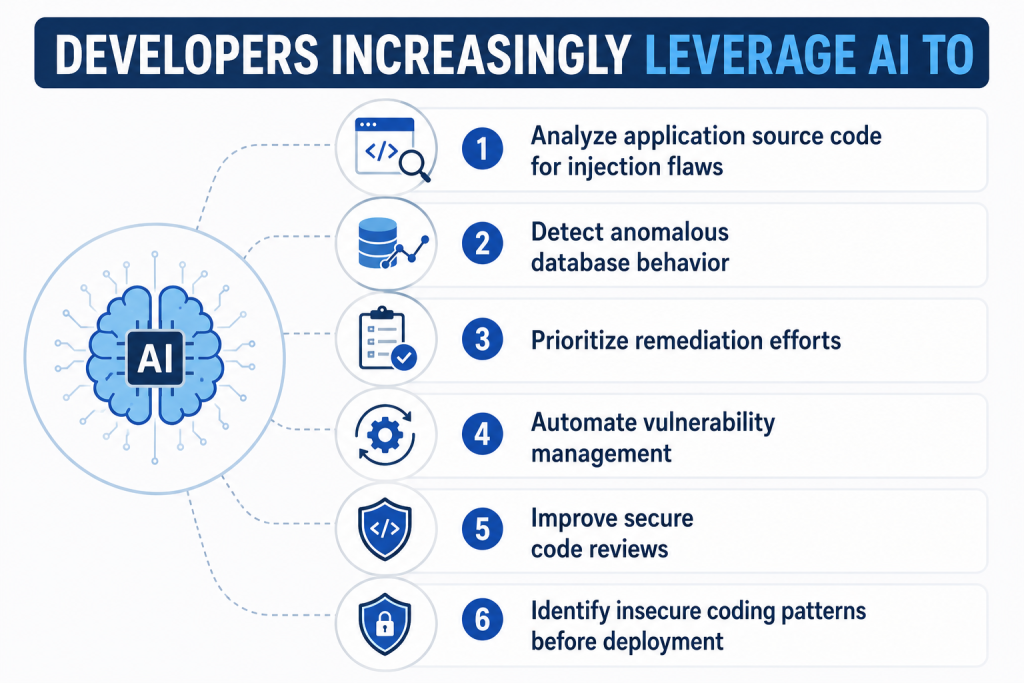
However, AI is not a substitute for secure software engineering. Generative AI models can occasionally produce insecure database queries or overlook subtle vulnerabilities if prompts lack sufficient security context.
Organizations should therefore treat AI as a productivity enhancer rather than an autonomous security expert. Every AI-generated code snippet should undergo human review, secure coding validation, and automated security testing before deployment.
Gain the Professional Skills and Credentials to Combat SQL Injection Attacks
As organizations place greater emphasis on Secure by Design and resilient software development, professionals who can build security directly into applications are becoming increasingly valuable. The Certified Application Security Engineer (C|ASE) certification from EC-Council University (ECCU) equips developers, software engineers, cybersecurity professionals, and application security specialists with the practical skills needed to identify vulnerabilities, implement secure coding practices, and defend applications against threats such as SQL injection.
By validating expertise in secure software development and application security engineering, C|ASE demonstrates a professional’s ability to build resilient applications in line with current and emerging security demands.
For more information:
Frequently Asked Questions About SQL Injection Attacks in 2026
SQL injection is a cyberattack in which an attacker inserts malicious SQL commands into an application’s input fields to manipulate its database. If successful, attackers can access, modify, or delete sensitive information without authorization.
Yes. Despite advances in secure software development, SQL injection remains a common vulnerability in legacy applications, custom-built software, and improperly secured APIs. It continues to be identified during penetration tests and vulnerability assessments worldwide.
SQL injection occurs when applications fail to properly validate user input or use parameterized queries before sending data to a database. This allows user input to be interpreted as executable SQL commands.
Any relational database can be vulnerable if applications are poorly coded, including MySQL, Microsoft SQL Server, PostgreSQL, Oracle Database, MariaDB, and SQLite. The vulnerability lies in the application’s code rather than the database itself.
Developers should use parameterized queries, validate all user input, implement least-privilege database access, avoid dynamic SQL whenever possible, and perform regular application security testing.
SQL injection targets relational databases that use Structured Query Language (SQL). In contrast, NoSQL injection targets non-relational databases such as MongoDB or CouchDB by manipulating database queries specific to those platforms.
AI can assist by identifying insecure coding patterns, detecting anomalous database behavior, and prioritizing vulnerabilities. However, AI cannot replace secure software development practices, human code reviews, or comprehensive security testing.