Why Does Modern Cybersecurity Need a Full-Stack Approach?
Today’s organizations depend on interconnected technology environments comprising cloud platforms, enterprise applications, databases, networks, endpoints, APIs, and distributed infrastructure. While these technologies improve operational efficiency, they also create multiple potential entry points for cybercriminals.
Consider a scenario in which an attacker steals an employee’s login credentials through a phishing email. Weak identity controls might allow the attacker to access a cloud application, exploit an application vulnerability, move laterally across the corporate network, and eventually steal sensitive organizational data. Such an example illustrates an important cybersecurity reality: a vulnerability in one technology layer can compromise an organization’s entire digital environment. This is where full-stack security becomes essential.
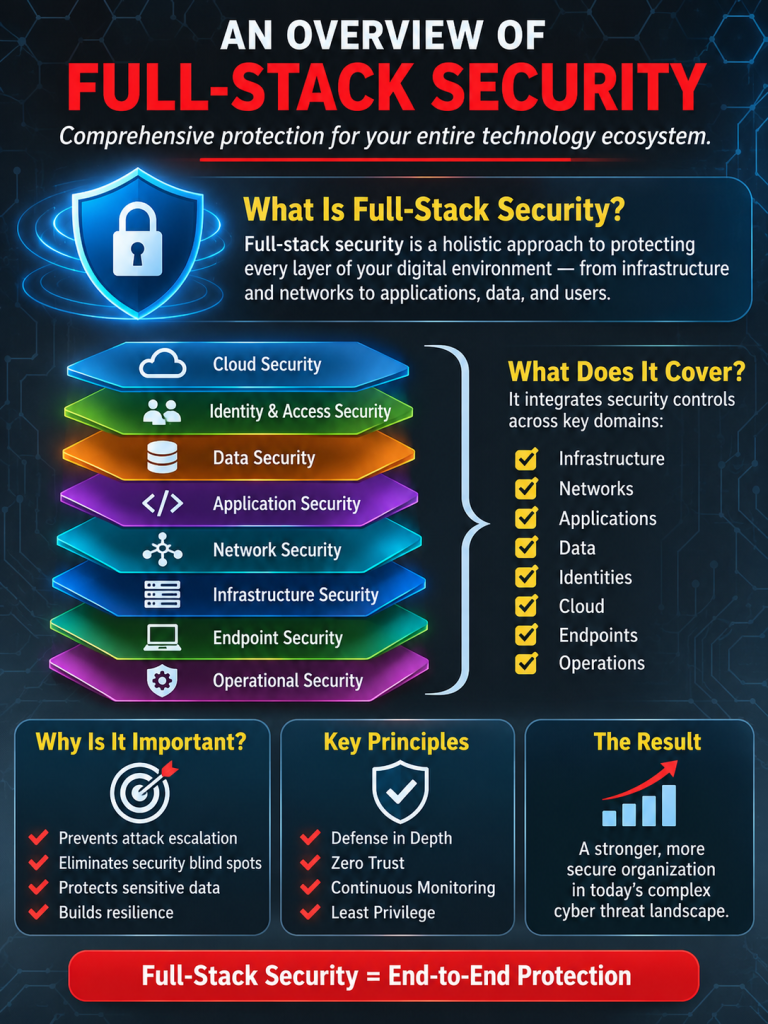
Full-stack security is a holistic approach to protecting every layer of an organization’s technology ecosystem. It integrates security measures across infrastructure, networks, applications, identities, endpoints, cloud environments, and data to establish comprehensive, end-to-end protection. Instead of treating cybersecurity as a collection of isolated activities, full-stack security brings these disciplines together to help organizations prevent attacks, identify vulnerabilities, minimize security gaps, and strengthen cyber resilience. Let’s examine full-stack security in greater detail.
What Are the Key Components of Full-Stack Security?
| Security component | What it protects |
|---|---|
| Infrastructure Security | Servers, operating systems, virtual machines, hardware, and data center environments. |
| Network Security | Routers, switches, firewalls, wireless networks, network traffic, and communication channels. |
| Application Security | Web applications, APIs, software code, application logic, and development environments. |
| Data Security | Sensitive information through encryption, access controls, data classification, and data loss prevention. |
| Identity and Access Security | User identities, authentication mechanisms, access privileges, and authorization policies. |
| Cloud Security | Cloud infrastructure, workloads, containers, storage, and cloud configurations. |
| Endpoint Security | Laptops, desktops, mobile devices, servers, and other connected endpoints. |
| Operational Security | Security monitoring, vulnerability management, threat detection, incident response, and recovery. |
Full-Stack Security vs. Traditional Cybersecurity: What's the Difference?
Traditional cybersecurity implementations may focus on individual security domains, with separate teams and tools managing networks, applications, endpoints, and cloud environments. Full-stack security emphasizes integrating these domains into a coordinated security architecture.
The distinction is not that traditional cybersecurity lacks comprehensive protection. Rather, full-stack security refers to the broader technical perspective needed to understand and protect the relationships among different technology layers.
| Traditional, siloed security approach | Full-stack security approach |
|---|---|
| Focuses on individual systems or security domains | Protects the interconnected technology ecosystem |
| May use disconnected security tools | Integrates security controls across multiple layers |
| Often emphasizes individual security boundaries | Emphasizes defense in depth and interconnected protection |
| Can create visibility gaps between teams | Promotes end-to-end security visibility |
| Addresses threats within specific domains | Coordinates threat detection and response across domains |
The objective is to eliminate security blind spots and ensure that weaknesses in one component do not create opportunities for attackers to compromise the entire environment.
Full-Stack Security vs. Full-Stack Development
The terms full-stack security and full-stack development sound similar, but they represent different professional disciplines. Full-stack development focuses on building and maintaining applications across frontend and backend technologies. On the other hand, full-stack security focuses on protecting the technology ecosystem, including applications and the infrastructure supporting them. Here’s a closer comparison:
| Full-stack development | Full-stack security |
|---|---|
| Builds and maintains applications. | Protects applications and technology environments. |
| Covers frontend, backend, databases, and application infrastructure. | Covers infrastructure, networks, applications, identities, data, cloud, and operations. |
| Prioritizes functionality, performance, and usability. | Prioritizes confidentiality, integrity, availability, and resilience. |
| Uses programming languages, frameworks, and development tools. | Uses security technologies, testing tools, monitoring platforms, and security frameworks. |
| Roles include full-stack developer and software engineer. | Roles include cybersecurity engineer, security architect, and security specialist. |
There is some overlap between these disciplines. For example, developers who understand secure software programming can help prevent vulnerabilities before applications reach production. However, full-stack security extends beyond application development to the protection of an organization’s entire technology environment.
Why Is Full-Stack Security Important for Organizations?
- Reduces security blind spots: Integrated monitoring helps security teams identify suspicious activity across applications, networks, endpoints, and cloud environments.
- Prevents attack escalation: Multiple security controls can prevent attackers from moving between systems after gaining initial access.
- Strengthens data protection: Encryption, access management, and data loss prevention help protect sensitive business and customer information.
- Improves incident response: Coordinated security visibility enables teams to investigate threats, understand their impact, and respond more effectively.
- Supports regulatory and compliance requirements: A comprehensive security strategy helps organizations manage risks involving sensitive information, access controls, and system integrity.
- Improves organizational resilience: Integrating prevention, detection, response, and recovery capabilities helps organizations maintain essential operations during and after cyber incidents.
How Can Organizations Implement Full-Stack Security?
- Map the technology environment: Identify applications, networks, endpoints, databases, cloud workloads, third-party software solutions, and sensitive data repositories.
- Conduct risk and vulnerability assessments: Evaluate weaknesses across the technology stack and prioritize remediation according to business risk.
- Adopt Zero Trust principles: Continuously verify users, devices, and access requests instead of relying on implicit trust.
- Integrate security into development: Implement secure coding, code reviews, application testing, and DevSecOps practices throughout the software development lifecycle.
- Strengthen identity and access management: Enforce MFA, least-privilege access, privileged access management, and appropriate authorization controls.
- Implement continuous monitoring: Integrate security information and event management (SIEM), endpoint detection and response (EDR), and other threat detection capabilities.
- Establish incident response and recovery plans: Prepare teams to investigate, contain, eradicate, and recover from security incidents.
What Skills Do You Need to Become a Full-Stack Security Expert?
- Networking and infrastructure security: Understand TCP/IP, DNS, firewalls, network segmentation, operating systems, and infrastructure hardening.
- Programming and secure coding: Develop familiarity with Python, Java, JavaScript, SQL, application architecture, APIs, and common software vulnerabilities.
- Application security testing: Learn vulnerability assessment, penetration testing, code analysis, and security testing methodologies.
- Cloud and container security: Understand AWS, Microsoft Azure, Google Cloud, virtualization, containers, Kubernetes, and cloud security configurations.
- Identity and access management: Develop expertise in authentication, authorization, MFA, IAM, and privileged access management.
- Threat detection and incident response: Learn SIEM, EDR, log analysis, threat intelligence, digital forensics, and incident handling.
- Security architecture and risk management: Understand defense in depth, Zero Trust, security frameworks, governance, risk assessment, and compliance.
What Career Opportunities Does Full-Stack Security Expertise Bring?
| Potential career paths include | |
|---|---|
| Cybersecurity Engineer | Network Security Engineer |
| Security Architect | Infrastructure Security Engineer |
| Cloud Security Engineer | Security Operations Center (SOC) Analyst |
| Application Security Engineer | Security Consultant |
| DevSecOps Engineer | Penetration Tester |
Learn How to Secure the Full Technology Stack with ECCU
Full-stack security requires the ability to understand, assess, and protect the complete technology ecosystem. From securing networks and applications to protecting cloud workloads, identities, and sensitive data, professionals must develop a broad technical foundation alongside practical cybersecurity expertise.
EC-Council University (ECCU) provides an opportunity to develop the advanced cybersecurity knowledge and practical skills needed to navigate this evolving landscape. Through specialized cybersecurity education, industry-relevant learning, and an emphasis on practical competencies, ECCU helps aspiring and experienced professionals strengthen their understanding of modern security challenges. Whether you aspire to become a cybersecurity engineer, security architect, cloud security specialist, or C-level cybersecurity leader, ECCU can equip you with the applicable knowledge and capabilities to formulate and implement comprehensive enterprise cybersecurity strategies.
Explore ECCU’s cybersecurity programs and take the next step toward becoming a cybersecurity professional capable of securing the entire technology stack. For more information:
Frequently Asked Questions About Full-Stack Security
What is full-stack security in cybersecurity?
Full-stack security is an integrated approach to protecting every layer of an organization’s technology environment, including infrastructure, networks, applications, databases, identities, endpoints, and cloud services.
What are the main components of full-stack security?
The main components include infrastructure security, network security, application security, data security, identity and access security, cloud security, endpoint security, and operational security.
Is full-stack security the same as full-stack development?
No. Full-stack development involves building and maintaining frontend and backend applications. Full-stack security focuses on protecting applications and the broader technology infrastructure against cyber threats.
Why is full-stack security important?
It helps organizations eliminate security blind spots, prevent unauthorized access, reduce attack surfaces, protect sensitive information, improve incident response, and strengthen overall cybersecurity resilience.
What is the role of Zero Trust in full-stack security?
Zero Trust strengthens full-stack security by requiring continuous verification of users, devices, and access requests. It helps prevent unauthorized access and limits attackers’ ability to move laterally across enterprise environments.
What technical skills are required for full-stack security?
Important skills include networking, infrastructure security, secure coding, application security testing, cloud security, IAM, vulnerability assessment, penetration testing, threat detection, incident response, and security architecture.
What career opportunities are available in full-stack security?
Relevant career paths include cybersecurity engineer, security architect, cloud security engineer, application security engineer, DevSecOps engineer, network security engineer, penetration tester, and security consultant.
How can I develop expertise in full-stack security?
You can develop full-stack security expertise by pursuing advanced cybersecurity education, gaining hands-on experience across different security domains, learning industry-recognized security frameworks, practicing vulnerability assessments and penetration testing, and developing expertise in cloud, application, network, and infrastructure security. A comprehensive cybersecurity degree and practical technical training can provide a strong foundation.
References & Sources:
1 – https://www.cisa.gov/zero-trust-maturity-model