Why Cybersecurity and Data Center Expansion Go Hand-in-Hand
Thanks to artificial intelligence (AI), cloud computing, IoT, remote work, streaming services, and digital transformation initiatives, organizations are building more data centers than ever before. From hyperscale cloud campuses in the United States to regional facilities across Asia-Pacific, Europe, and the Middle East, data centers are now integral to the global digital economy. Every online transaction, AI model, healthcare record, and software application relies on secure and resilient data center infrastructure.
But as the global data center footprint grows exponentially, so do cybersecurity risks. Modern data centers are no longer isolated server rooms. They are interconnected ecosystems spanning cloud environments, edge infrastructure, third-party vendors, software-defined networks, and hybrid architectures. This complexity creates an enormous attack surface for cybercriminals, nation-state actors, ransomware groups, and insider threats.
Cybersecurity and data center expansion are now inseparable.
Organizations cannot scale digital infrastructure without simultaneously strengthening cyber resilience, security governance, compliance strategies, and workforce capabilities.
The Key Trends Behind Global Data Center Expansion
These powerful trends are accelerating worldwide investment in data centers:
- The Artificial Intelligence (AI) Boom: AI requires massive computational power, GPU clusters, and low-latency infrastructure, with applications such as generative AI and autonomous systems dramatically increasing the demand for hyperscale data centers. Major technology companies are actively investing hundreds of billions of dollars into AI infrastructure and data center expansion.
- Cloud Computing Adoption: Organizations continue migrating workloads to public, private, and hybrid cloud environments. As a result, providers such as Amazon Web Services (AWS), Microsoft Azure, and Google Cloud continue to expand their global data center presence to support enterprise demand.
- Edge Computing Expansion: Edge data centers bring processing closer to users and devices, reducing latency for autonomous vehicles, smart cities, industrial IoT, and 5G networks.
- Unrelenting Data Generation: The world generates staggering volumes of data daily from mobile devices, connected sensors, enterprise applications, and digital services. This data must be stored, processed, analyzed, and secured.
- Digital Transformation Initiatives: Governments, healthcare providers, financial institutions, manufacturers, and retailers increasingly depend on digital infrastructure to remain competitive and operational. This has a domino effect, requiring more data centers to accommodate digital transformation.
The Industries and Regions Driving Data Center Expansion
| INDUSTRIES / SECTORS | COUNTRIES / REGIONS |
|---|---|
| Cloud Service Providers: Hyperscale cloud companies operate some of the world’s largest data center networks. | United States: The U.S. remains the global leader in hyperscale infrastructure, especially in Northern Virginia, Texas, Arizona, and California. |
| Financial Services: Banks, payment processors, and fintech companies require secure, high-availability infrastructure for sensitive financial operations. | China: The number of data centers operating in China has significantly increased over the past 10 years, and this trend will continue for the foreseeable future. |
| Healthcare: Healthcare providers depend on data centers to manage electronic health records, medical imaging, telemedicine systems, and patient analytics. | Europe: Major data center hubs include Germany, Ireland, the Netherlands, the United Kingdom, and France. |
| Government and Defense: Government agencies require highly secure data environments for intelligence, national security, and citizen services. | Asia-Pacific: Rapid data center growth continues across India, Singapore, Japan, South Korea, and Australia. |
| Telecommunications: Telecom companies rely on data centers to support 5G infrastructure, network management, and communications platforms. | Middle East: Countries such as the UAE and Saudi Arabia are heavily investing in digital infrastructure and smart city initiatives. |
| E-Commerce and Retail: Retailers process enormous volumes of digital transactions, customer data, and inventory systems through data center environments. | Latin America and Africa: These emerging markets are building regional facilities to improve digital sovereignty and connectivity. |
What Data Center Expansion Means for Cybersecurity
Rapid data center expansion creates new cybersecurity challenges in several ways:
- Larger attack surfaces
- More interconnected systems
- Greater third-party risk exposure
- Increased cloud complexity
- Higher reliance on automation and APIs
- Expanded remote access requirements
- Greater geopolitical and supply-chain risks
Every new data center, cloud environment, edge node, and connected device introduces additional vulnerabilities that attackers can exploit. At the same time, cyberattacks are becoming more sophisticated and automated. Cybersecurity must therefore evolve from a supporting IT function into a strategic operational requirement embedded into every stage of data center design, deployment, and management.
The Top 10 Cybersecurity Challenges Associated with Data Center Expansion
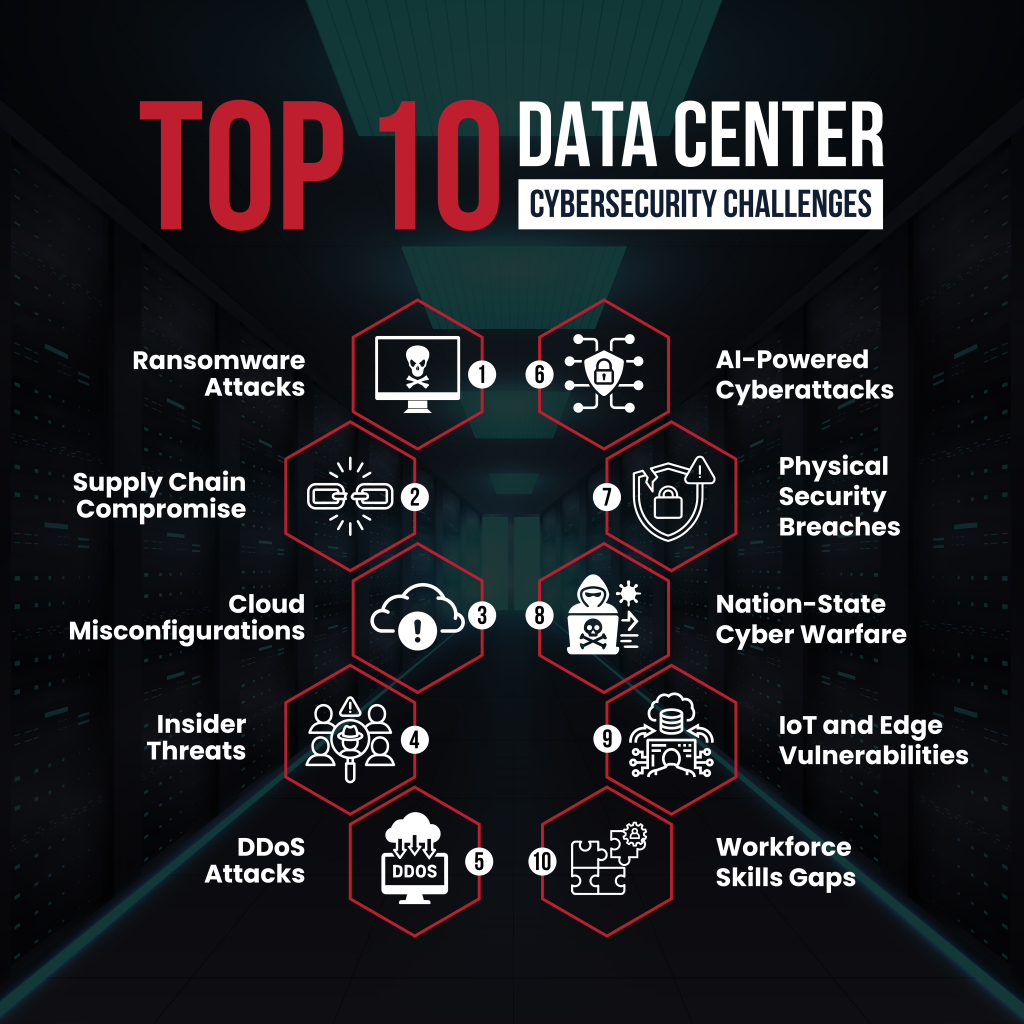
1. Ransomware Attacks
- The Threat: Ransomware groups are increasingly targeting data centers because they host massive amounts of sensitive data.
- Potential Consequences: Operational shutdowns, financial losses, data theft, regulatory penalties, and reputational damage.
- Prevention Methods: Zero Trust architecture, immutable backups, network segmentation, endpoint detection and response (EDR), and continuous threat monitoring.
2. Supply Chain Compromise
- The Threat: Data centers depend on complex hardware, software, and firmware, as well as third-party vendors. Attackers can compromise suppliers to infiltrate data center infrastructure.
- Potential Consequences: Embedded malware, persistent backdoors, and widespread harm to multiple client organizations.
- Prevention Methods: Vendor risk assessments, hardware integrity validation, software bill of materials (SBOM), and third-party security audits.
3. Cloud Misconfigurations
- The Threat: Misconfigured cloud storage, IAM permissions, or APIs can expose sensitive data.
- Potential Consequences: Massive data breaches, unauthorized access, and compliance violations.
- Prevention Methods: Automated configuration monitoring, least privilege access, cloud security posture management (CSPM), and continuous auditing.
4. Insider Threats
- The Threat: Insider threats are employees, contractors, or privileged users who may intentionally or accidentally compromise data center systems.
- Potential Consequences: Data theft, corporate sabotage, and credential misuse.
- Prevention Methods: User behavior analytics, role-based access control, privileged access management, and security awareness training.
5. DDoS Attacks
- The Threat: Distributed denial-of-service (DDoS) attacks overwhelm data center infrastructure with traffic.
- Potential Consequences: Operational downtime, service disruptions, and revenue loss.
- Prevention Methods: Traffic filtering, load balancing, DDoS mitigation services, redundant infrastructure.
6. AI-Powered Cyberattacks
- The Threat: Malicious actors are using AI to automate phishing campaigns and malware development.
- Potential Consequences: Faster attack execution, sophisticated social engineering, and wider scopes of attack.
- Prevention Methods: AI-driven threat detection, behavioral analytics, advanced email security, and security automations.
7. Physical Security Breaches
- The Threat: Cybersecurity is not purely digital. Unauthorized physical access can pose a threat to data center infrastructure.
- Potential Consequences: Hardware tampering and device theft.
- Prevention Methods: Biometric access controls, CCTV monitoring, multi-layer physical security, and constant surveillance.
8. Nation-State Cyber Warfare
- The Threat: Nation-state actors target critical infrastructure such as data centers for espionage, disruption, or to gain geopolitical advantage.
- Potential Consequences: Intellectual property theft and national security risks.
- Prevention Methods: Threat intelligence integration, advanced detection systems, government collaboration, and continuous monitoring.
9. IoT and Edge Vulnerabilities
- The Threat: Edge environments and IoT devices often lack strong cybersecurity controls and mechanisms.
- Potential Consequences: Expanded attack surfaces, lateral movement opportunities, and data interception.
- Prevention Methods: Device authentication, secure firmware updates, network segmentation, and edge security monitoring.
10. Workforce Skills Gaps
- The Threat: Organizations struggle to find professionals with expertise in cloud computing, AI, IT infrastructure, and cybersecurity.
- Potential Consequences: Misconfigurations, slower incident response, and increased breach risk.
- Prevention Methods: Continuous upskilling, professional certifications, cybersecurity-focused degrees, and workforce development initiatives.
Global Data Center Expansion Increases Demand for Cybersecurity Professionals
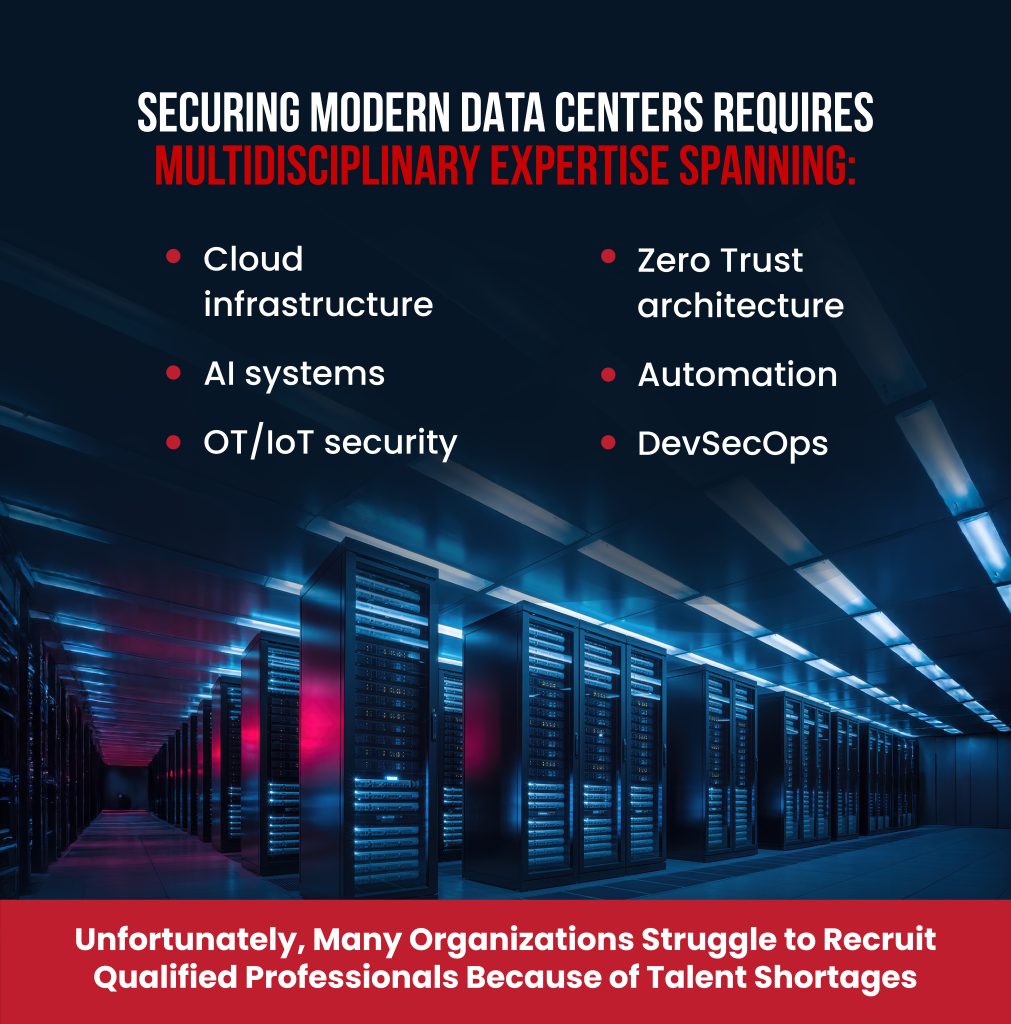
The unprecedented rate of data center expansion is fueling one of the largest talent demands in cybersecurity history. Organizations need professionals who understand:
- Cloud security
- Network defense
- Incident response
- Digital forensics
- AI security
- Threat intelligence
- Security architecture
- Compliance and governance
Protecting Data Centers: The Most In-Demand Cybersecurity Job Roles in 2026
Because of prevailing data center growth trends, cybersecurity professionals can command very competitive salaries. Roles associated with protecting data center infrastructure include:
- Cloud Security Architect
- Security Operations Center (SOC) Analyst
- Digital Forensics Investigator
- Threat Intelligence Analyst
- Penetration Tester
- Incident Response Manager
- AI Security Engineer
- Chief Information Security Officer (CISO)
Senior cybersecurity positions in the United States come with six-figure annual salaries.
Cybersecurity Education is Essential in the Age of Data Center Expansion
Technology alone cannot solve the cybersecurity challenges that come with data center expansion. Organizations need forward-thinking professionals who can identify vulnerabilities, design secure data center architectures, respond to threats, ensure compliance, and develop cyber resilience strategies. This is where advanced cybersecurity education plays a crucial role.
As a global leader in cybersecurity education, EC-Council University (ECCU) equips learners with practical, real-world cybersecurity expertise aligned with modern data center requirements. Our online cybersecurity degrees and courses provide in-depth knowledge, skills, and qualifications in:
- Cloud security
- Digital forensics
- Threat intelligence
- Risk management
- Security operations
- Ethical hacking and penetration testing
- AI security
- Incident response
- Cybersecurity governance and leadership
Students can also earn multiple industry-recognized cybersecurity certifications alongside their degrees, thereby strengthening their job-readiness and career prospects. To know more about studying at ECCU:
Frequently Asked Questions
As organizations build more interconnected digital infrastructure, attackers gain more opportunities to exploit vulnerabilities, misconfigurations, and third-party dependencies.
Ransomware remains one of the most dangerous threats because it can disrupt operations, encrypt critical systems, and cause massive financial losses.
AI improves threat detection and automation, but attackers also use AI to create more sophisticated phishing campaigns, malware, and reconnaissance techniques.
Misconfigured cloud environments can expose sensitive data, create unauthorized access points, and lead to large-scale breaches.
Critical skills include cloud security, incident response, threat intelligence, network security, ethical hacking, and risk management.
Advanced cybersecurity education prepares professionals with the technical expertise, leadership skills, and practical knowledge required to secure modern digital infrastructure and respond to evolving cyber threats.