
Cybersecurity education has a problem. The threats changed. For years, security programs have trained professionals to recognize known attack patterns, patch known vulnerabilities, and respond to known threat actors. That model worked when attackers were humans working at human speed. Today, attackers have AI working for them around the clock. The tools are faster. The campaigns are more convincing. The barrier to entry has collapsed completely. EC-Council University saw this shift coming. This blog covers how ECCU is restructuring cybersecurity education to align with the current threat landscape in 2026, and why the gap between traditional programs and modern threats has never been wider.
The Threat Landscape Has Already Changed
The best evidence of how much has changed is a 2025 incident. Three teenagers with no coding background used ChatGPT to hit a telecom company’s systems 220,000 times. That is not a story about nation-state actors. That is a story about how low the barrier to attack has fallen. Here is what the data shows about where things stand today:
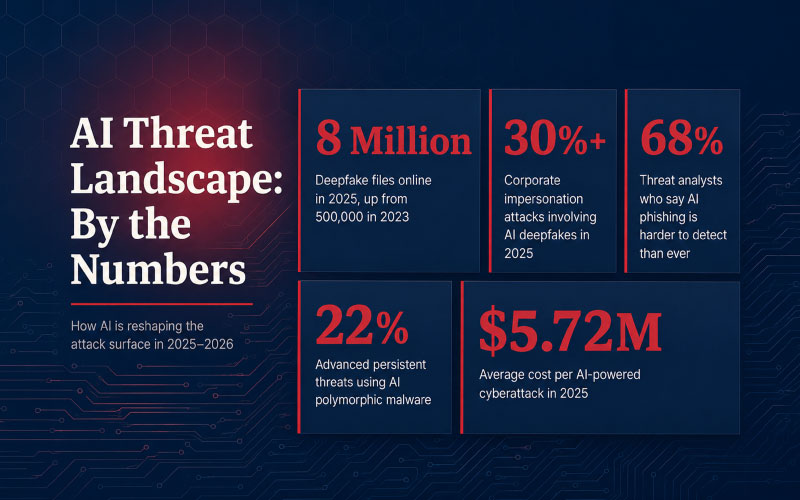
- The total number of deepfake files online jumped from 500,000 in 2023 to 8 million in 2025, a growth rate of over 1,500%.
- AI-powered deepfakes were involved in over 30% of high-impact corporate impersonation attacks in 2025.
- 68% of cyber threat analysts say AI-generated phishing is harder to detect than any prior year.
- Polymorphic malware using AI evasion tactics now accounts for 22% of advanced persistent threats.
- AI-powered cyberattacks cost businesses an average of $5.72 million per incident in 2025.
Attackers are not just using AI as a shortcut. They are using it to stay ahead of detection systems built on older assumptions.
What Defenders Now Need to Know
AI has changed what security teams can do and raised the bar for what security professionals need to understand. The tools are more powerful. But they require a different kind of operator. Here is what the modern defender’s toolkit looks like:
- SIEM platforms now use machine learning to triage alerts automatically, cutting analyst fatigue significantly.
- Behavioral analytics can detect anomalous user activity at machine speed. No human analyst catches it that fast.
- Generative AI tools now draft security policies, incident reports, and threat intelligence summaries in minutes.
- Cloud environments introduce new AI-specific attack surfaces: exposed API keys, vulnerable model endpoints, and bypassable LLM guardrails.
- 88% of security teams now report significant time savings through AI.
Deploying these tools is not the hard part. Knowing how to configure, evaluate, govern, and defend them is where the real skill gap sits.
The Curriculum Gap Is Real
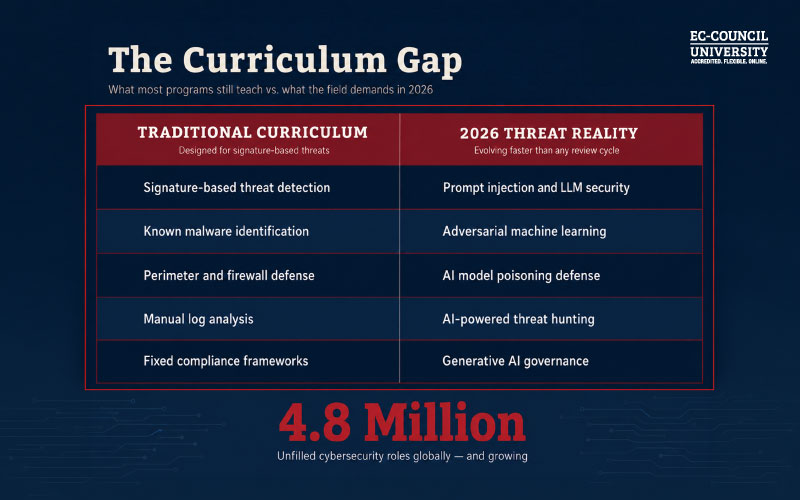
Most cybersecurity programs were designed for a world of signature-based threats. Detect the known bad. Block the known bad. Move on. That model has not kept pace.
Prompt injection, model poisoning, and adversarial machine learning are now active attack vectors with no standardized curriculum in most university programs. OWASP’s 2025 Top 10 for LLM Security lists prompt injection as the number one risk. Yet the majority of graduate cybersecurity programs have not formally incorporated these disciplines.
The skills gap reflects this. AI is cited as a critical skill needed by 41% of cybersecurity professionals in 2025, the top skill for the second consecutive year. The global cybersecurity workforce gap has hit a record 4.8 million unfilled roles. Traditional programs operating on three- to five-year review cycles cannot close that gap. By the time a curriculum refresh is approved, the threat landscape has moved again.
How ECCU Is Responding
EC–Council University’s approach is built around one core principle. Curriculum should reflect the threat environment as it exists today, not as it existed when the syllabus was last reviewed. Here is how that plays out across the MSCS program:
- AI is integrated directly into coursework through dedicated courses, industry certifications, and hands-on application. Not bolted on as an elective.
- Students work through AI-assisted attack simulations in virtual labs, not hypothetical scenarios.
- Incident management modules use AI-generated threat scenarios to reflect real attack conditions.
- Cloud security coursework covers AI service security, including model endpoints and LLM guardrails.
- Faculty are drawn from active practitioners working with AI security tools in the field today.
ECCU was ranked among Fortune’s Top 10 Online Master’s in Cybersecurity, and its programs are accredited by the Distance Education Accrediting Commission.
Ready to future-proof your cybersecurity career? Explore ECCU’s continuously evolving online cybersecurity programs.
What This Means If You Are Working in Security Right Now
The half-life of cybersecurity skills has compressed sharply. For technical skills like AI, cybersecurity, and software engineering, the skill half-life is now as short as 2.5 years. That is not a career planning concern. That is an operational one.
If your current skill set was built around signature detection and manual threat hunting, parts of it are already becoming less relevant. The professionals who will lead security teams in the next five years are those learning to evaluate AI tools critically, govern them responsibly, and defend against attacks that weaponize them.
87% of cybersecurity professionals believe AI will enhance their roles, not replace them. That confidence is well-founded, but only for professionals who stay current. Continuous education is not optional anymore. The threat environment updates faster than any static credential can capture.
The Bigger Shift: From Techniques to Reasoning
Something deeper is changing in how cybersecurity work needs to be understood. The old model asked professionals to know the attack. The new model asks them to understand the attacker’s reasoning, including when that reasoning is being generated by a machine.
An AI crafting a phishing email does not need to understand SMTP. But the defender needs to understand why that email got past the filter, what the model was optimizing for, and how to retrain the detection system to account for it. That is adversarial reasoning. It is not a tool skill. It is a thinking skill.
ECCU’s position reflects this shift. Technology will keep changing. The discipline of structured, evidence-based security thinking is what endures. Professionals who develop that discipline, not just technical fluency, are the ones who will still be effective when today’s tools are obsolete.
The cybersecurity professional of 2030 will not be defined by the tools they know. They will be defined by their ability to adapt when those tools change overnight.
Explore ECCU’s online cybersecurity programs and find the one built for where the field is going.
Frequently Asked Questions
AI is automating routine tasks like alert triage and log analysis. That shifts analysts toward higher-judgment work: threat hunting, AI tool governance, and detection engineering. New roles are emerging faster than traditional programs can track them. The job market is not shrinking. It is moving upward in complexity and specialization.
No. AI can triage and flag, but it cannot investigate, judge, or adapt to threats that are themselves AI-generated. Professionals who build evaluation and governance skills become more valuable as AI scales, not less. The security work that matters most still requires human reasoning.
The priority skills are understanding how AI security tools actually work, recognizing adversarial ML attacks like prompt injection and model poisoning, securing cloud AI services, including model endpoints and LLM guardrails, and governing AI systems for compliance and failure risk. The underlying requirement across all of these is judgment. AI produces confident outputs. Knowing when to trust them is still a human skill.
ECCU integrates AI throughout the MSCS program rather than treating it as a standalone elective. Students work through AI-assisted attack simulations in virtual labs, and incident management modules use AI-generated threat scenarios. Cloud security coursework covers AI service security, including model endpoints and LLM guardrails. Faculty are drawn from active practitioners working with these tools in the field today, so the curriculum reflects the current threat environment, not a syllabus written three years ago.