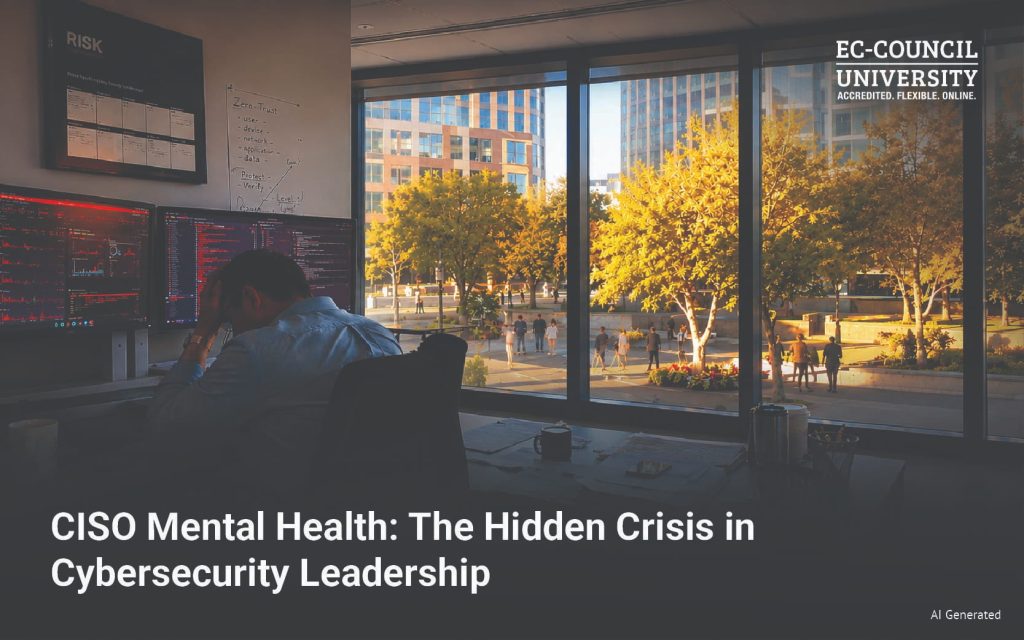
The CISO title sounds powerful. It suggests influence, access, and authority. But for the people who hold it, the day-to-day reality is something else entirely. They carry responsibility for outcomes they cannot fully control, defend against threats that never stop, and answer for failures that often happen above their pay grade. The mental health toll of this role is real, well-documented, and quietly getting worse. This piece looks at why the CISO role breaks people down, what organizations and individuals can do about it, and why the conversation has to start now.
Key Takeaways
- CISO burnout is not a personal failing. It is the predictable result of a structurally broken role.
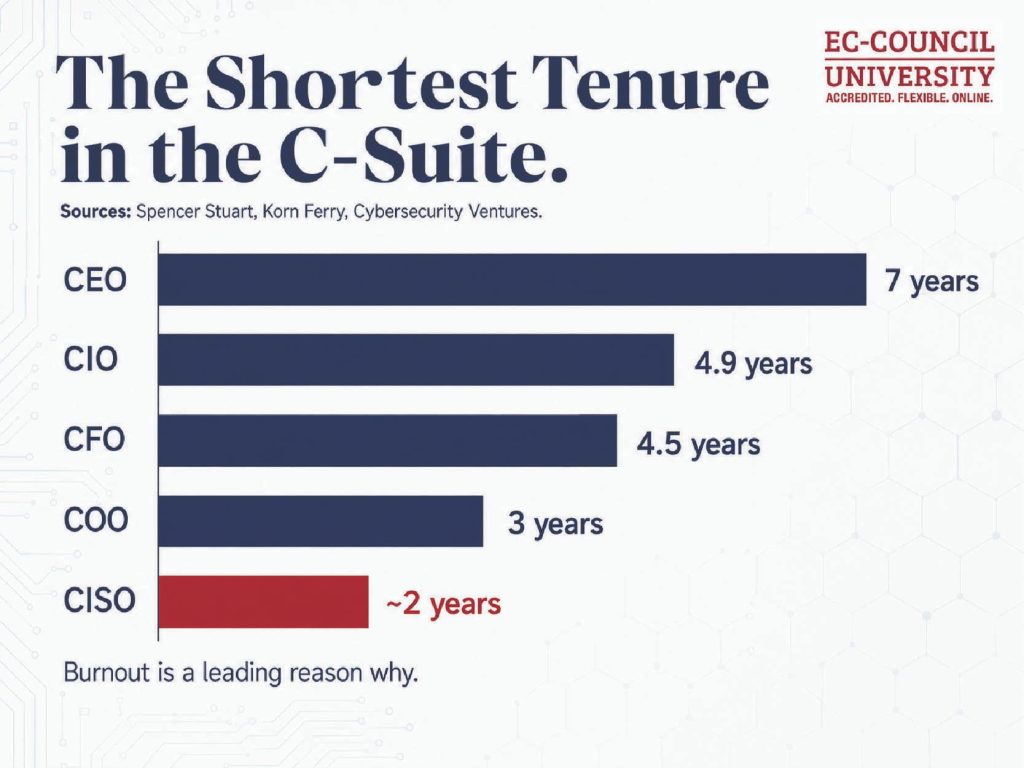
- Most CISOs last under two years. Burnout is a leading reason why.
- CISOs can now face personal legal liability after a breach, not just organizational fallout.
- Accountability without authority is the defining pressure of the role.
- Organizations that ignore CISO well-being pay for it in turnover, security gaps, and lost institutional knowledge.
- Graduate education builds the strategic vocabulary that makes leadership sustainable.
The Numbers the Industry Avoids
Burnout in cybersecurity is not a rounding error. It is structural.
According to Proofpoint’s 2025 Voice of the CISO report, 63% of security leaders either experienced or witnessed burnout in the past year. Sophos put that number even higher, at 76%. A 2024 Hack the Box study found that mental health struggles among cybersecurity teams cost medium- to large-sized enterprises an estimated $626 million in lost productivity annually. These are not edge cases. They are the baseline.
Tenure data makes the picture worse. The average CISO stays in the role for just 18 to 26 months, compared to a C-suite average of 4.9 years. The gap is not explained by ambition or career mobility. Burnout is a leading reason people leave. And when a CISO walks away, continuity suffers; institutional security knowledge walks with them, and the next person inherits the same broken conditions.
Compare this to almost any other leadership role, and the contrast is stark. CFOs manage crises. COOs absorb operational failure. But no other C-suite role combines the same level of personal liability, around-the-clock threat exposure, and chronic under-resourcing that comes standard in cybersecurity leadership.
A Role Built to Break People
The CISO role is structurally different from every other seat at the leadership table. Understanding why matters more than counting the casualties.
- Accountability without authority: CISOs are responsible when a breach occurs. But the decisions that create risk, skipping security training, delaying patches, cutting security budgets, often happen above them or outside their reach. 86% of organizations blame the CIO, CISO, or equivalent after a breach, regardless of where the failure actually started.
- The threat landscape has no off switch: Human cognitive capacity does. A CISO cannot stop thinking about threats at 6 pm. The work follows them. Most CISOs work at least 50 hours a week, and sustained hypervigilance at that pace degrades decision-making over time.
- The “fall guy” problem is now legally enforceable: The convictions of former Uber CSO Joe Sullivan and the SEC action against SolarWinds CISO Timothy Brown permanently raised the stakes. Personal liability for CISOs is no longer theoretical. As one industry analyst put it, CISOs are now accountable for how they represent security before a breach and how they respond during one. Many leave before they find out which version of events regulators will believe.
Root Causes: More Than Just Long Hours
- Regulatory and legal exposure: New SEC disclosure rules require public companies to report material breaches within four business days. GDPR, NIS2, and DORA add overlapping compliance demands. Each new regulation adds a layer of personal risk for the person whose name is on the security program.
- Resource and talent scarcity: The reported global cybersecurity workforce shortfall is 4.8 million professionals. CISOs lead teams that are perpetually understaffed, then get judged by standards that assume full coverage. 60% of organizations report difficulty retaining skilled cybersecurity staff, with stress cited as a primary cause.
- The isolation of the role: 66% of CISOs say senior leadership does not fully understand what they do. That makes it nearly impossible to explain why a request is risky, why a budget line matters, or why last quarter’s near-miss was actually a serious incident. The CISO often manages this alone, presenting a confident face to the board while privately bearing the weight of what the board did not fund.
The Psychological Toll: What to Watch For

Burnout does not arrive all at once. It compounds quietly until something gives.
Decision fatigue sets in when a person makes high-stakes calls across too many domains for too long. A CISO who evaluates generative AI risk in the morning, sits in a compliance review at noon, and fields an incident alert at 9 pm is not switching between tasks. They are repeatedly depleting the same cognitive resource.
Hypervigilance is the occupational hazard of defending against attacks that could come from anywhere, at any time. It is adaptive in the short term. Over months and years, it rewires how a person relates to rest, relationships, and normal uncertainty.
Imposter syndrome runs deep in a field that constantly reinvents itself. Even experienced CISOs can feel permanently behind. The technology shifts, the regulations shift, the threat actors adapt. There is no finish line to cross and feel competent.
The line between manageable stress and stress that requires professional support is worth naming plainly. Persistent sleep disruption, emotional withdrawal from colleagues and family, difficulty finding satisfaction in work, and a growing sense of dread before the week starts are signs worth taking seriously. Seeking therapy or counseling is not a sign of weakness in this role. It is what a rational person does when the job demands exceed normal coping capacity.
What Organizations Must Do
The burden of fixing this cannot rest solely on the individual CISO. Much of the cause is systemic, so much of the solution has to be too.
- Clarify the mandate in writing: A CISO cannot be held accountable for decisions that were never theirs to make. Organizations need to document what the role owns, what it influences, and what sits above it.
- Give security a real seat at the table: At smaller organizations, 42% of CISOs meet with their boards only on an ad hoc basis or not at all. That is not a partnership. It is exposure without support.
- Build mental health support into the structure: Forward-thinking organizations are embedding on-demand therapy, coaching, and mindfulness resources into their support for senior leaders. This should not be an afterthought or an EAP link in an HR handbook.
- Explicitly protect D&O coverage: As personal liability expands, CISOs need to know their organization has their back legally. Organizations that provide Directors and Officers insurance for their security leadership signal an important view of the role.
- Treat scope creep as a risk: More than half of CISOs say their scope is no longer fully manageable. Boards that keep adding responsibilities without adding resources are not growing their security program. They are accelerating turnover.
What CISOs and Future Leaders Can Do for Themselves
Waiting for the organization to change is not a strategy. There are things a security leader can do right now.
Peer communities matter more than most CISOs admit. Forums like H-ISAC and ISACA chapters, and informal peer groups of fellow CISOs, offer something a coach or therapist cannot: the specific understanding of someone who has sat in the same seat. The sense of isolation drops significantly when someone can say, “Here is what I did in that exact situation” rather than offering generic leadership advice.
Mentorship works in both directions. A CISO who mentors a rising security professional benefits from perspective, from articulating lessons they had buried, and from the clear evidence that their experience has transferable value.
Graduate education plays an underestimated role here. The CISO who can speak fluently about risk in financial terms, translate threat intelligence into board language, and build a defensible compliance posture is harder to scapegoat and harder to burn out. Not because knowledge insulates against stress, but because strategic vocabulary gives a leader the tools to advocate for themselves and their program with clarity.
ECCU’s Master of Science in Cybersecurity with an Executive Leadership in Information Assurance specialization is built for exactly this transition. It gives security professionals the frameworks to lead with confidence, align security strategy with business outcomes, and make a case for their program that non-technical executives can actually act on.
Build the Leadership Foundation That Lasts
The CISO role is not going to get easier. Threats are accelerating. Regulations are expanding. The personal stakes are higher than ever. But the professionals who lead with strategic clarity, rather than just technical depth, carry the weight differently.
ECCU’s Master of Science in Cybersecurity, with its Executive Leadership in Information Assurance specialization, is designed for security professionals who are ready to lead at that level. It is built for people who want to protect not just their organization, but their own ability to sustain a long career.
Frequently Asked Questions
Is burnout really more common in cybersecurity than in other industries?
Yes, and the data is consistent across multiple independent studies. Cybersecurity professionals face a combination of factors that is genuinely unusual: the work never stops, failure is highly visible, success is often invisible, and the workforce is chronically understaffed. A 2024 Hack the Box study found that 84% of cybersecurity workers report some level of mental fatigue or burnout, which places the field well above most professional categories.
Can a CISO be personally liable after a data breach?
Yes, in certain circumstances. The prosecutions of Joe Sullivan at Uber and the SEC enforcement action against SolarWinds CISO Timothy Brown established that CISOs can face personal civil and criminal consequences for how they handle and disclose breaches. The risk is highest when there is evidence of deliberate concealment, misleading disclosures, or failure to follow established governance processes. Organizations operating in regulated industries should ensure their security leadership has explicit legal protection built into their role.
How can someone transition from a technical security role to a resilient leadership role?
The gap between technical competence and leadership effectiveness is largely a language and framework problem. Technical professionals who move into leadership need to learn how to frame risk in business terms, manage boards and executive stakeholders, and build security programs that can survive budget cycles and leadership changes. Structured graduate education, peer mentorship, and formal exposure to GRC and strategic planning all accelerate this transition. For a deeper look at the CISO career path, this guide on how to become a CISO in 2026 covers the practical steps in detail.
What resources exist for cybersecurity professionals struggling with mental health?
Cybermindz is a non-profit focused specifically on mental health in the cybersecurity sector and offers structured support programs. ISACA publishes resources on burnout and professional well-being for its membership. Many large organizations now offer employee assistance programs with on-demand therapy. Beyond formal channels, peer communities and CISO-specific forums are increasingly recognized as a meaningful source of support, particularly for the isolation that comes with senior roles.
Does graduate education help CISOs manage leadership pressure more effectively?
It does, though not because degrees eliminate stress. The benefit is structural confidence. A CISO who understands governance frameworks, can communicate in the language of risk management, and knows how to build a defensible security posture is better positioned to navigate the pressures of the role. They can advocate more effectively upward, set clearer expectations, and avoid the “accountability without authority” trap that burns out so many people. ECCU’s Executive Leadership in Information Assurance specialization is one pathway built specifically for this outcome.