The Debate Between Outsourced and In-House Cybersecurity Operations
Businesses have viewed outsourcing their cybersecurity operations as a cost-saving measure for several years. Today, however, it’s not a decision they make lightly. Given the growing scale and complexity of cyber threats, they’re being compelled to rethink how to manage these operations. The debate centers on one critical question:
“Is it better to maintain cybersecurity capabilities in-house or to leverage external experts who specialize in protecting businesses around the clock?”
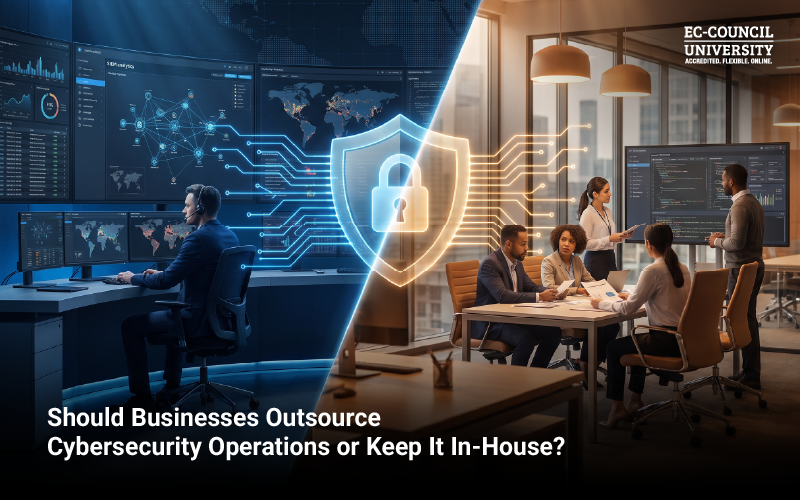
The answer is rarely straightforward. While outsourcing offers access to specialized expertise and 24/7 monitoring, an internal cybersecurity team provides deeper organizational knowledge and greater operational control. For many businesses, the most effective approach lies somewhere in between.
The Short Answer: It Depends on Your Organization
There is no universal solution, and the decision to outsource cyber operations or keep them in-house usually comes down to business size.
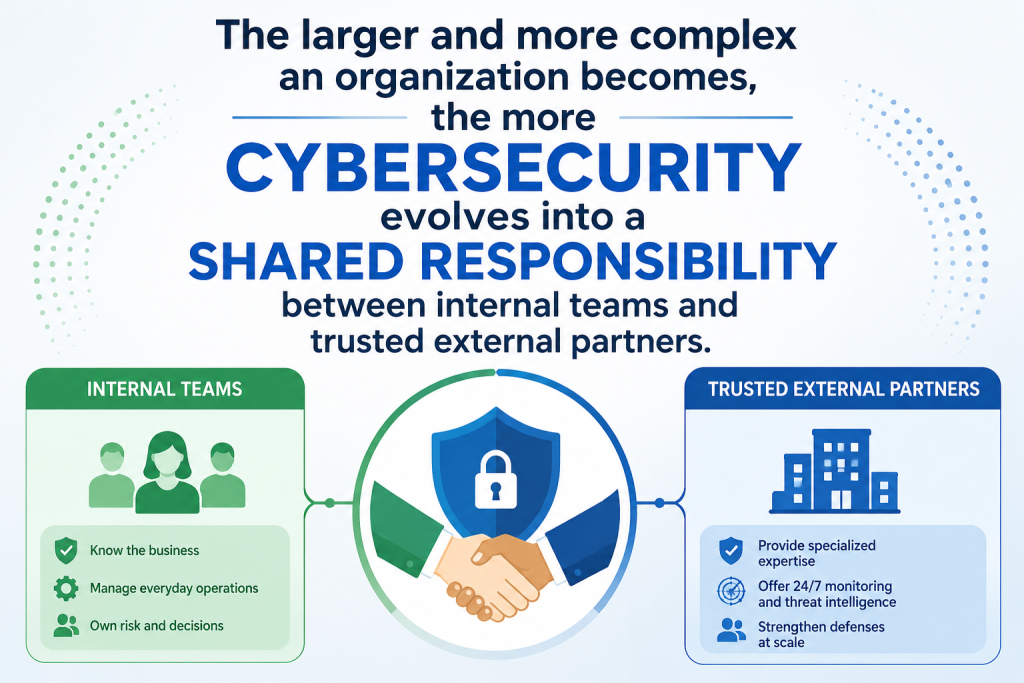
- Small and Medium-Sized Businesses (SMBs) often benefit from outsourcing security operations because maintaining a 24/7 Security Operations Center (SOC) is rarely practical or affordable. Managed Detection and Response (MDR) providers can deliver enterprise-grade monitoring and incident response at a predictable monthly cost.
- Large organizations typically adopt a hybrid approach. They retain governance, risk management, and compliance (GRC) and strategic decision-making internally while outsourcing continuous monitoring, threat intelligence, or specialized incident response services.
- Multinational corporations generally maintain mature internal cybersecurity teams but still partner with external providers for global SOC coverage, red team exercises, advanced threat intelligence, and surge support during major cyber incidents.
What It Entails: Outsourcing Vs. In-House Cybersecurity
Rather than viewing these models as competitors, organizations should consider which cybersecurity requirements are best performed internally and which can be enhanced through external expertise. Here’s a common bifurcation:
| Outsourced Cybersecurity Operations | In-House Cybersecurity Operations |
|---|---|
| 24/7 SOC monitoring | Internal SOC and security analysts |
| Managed Detection & Response (MDR) | Security engineering and architecture |
| Threat hunting | Vulnerability management |
| Incident response support | Identity and access management |
| Endpoint monitoring | Governance, risk, and compliance |
| Cloud security monitoring | Executive reporting and security strategy |
| Security tool management | Security awareness and organizational policies |
The Advantages and Challenges of Outsourcing Cybersecurity
The Pros:
Outsourcing provides immediate access to experienced cybersecurity professionals, specialized technologies, and mature security processes. Organizations gain continuous monitoring without the significant investment required to recruit, train, and retain an internal SOC team.
Another major advantage is scalability. As organizations expand into cloud environments, remote work, or international markets, managed security providers can often scale services more quickly than internal teams.
The Cons:
However, outsourcing also introduces trade-offs. External analysts may lack a detailed understanding of business priorities, critical applications, or organizational culture. Businesses also become partially dependent on third-party vendor service levels, communication processes, and contractual obligations. While providers strengthen operational capabilities, accountability for cybersecurity risks always remains with organizational leadership.
The Advantages and Challenges of Keeping Cybersecurity In-House
The Pros:
An internal cybersecurity team possesses institutional knowledge that no external provider can fully replicate. They understand business processes, operational priorities, technology environments, and organizational risk tolerance. This familiarity often leads to faster decision-making during security incidents and closer collaboration with executive leadership, IT, legal, and business units.
Internal teams are also better positioned to integrate cybersecurity into software engineering, cloud architecture, and digital transformation initiatives.
The Cons:
The primary challenge, however, is cost. Building a mature internal cybersecurity program requires significant investment in skilled personnel, security technologies, continuous training, and continuous operations. Recruiting experienced cybersecurity professionals remains difficult in today’s competitive labor market, and providing true 24/7 monitoring often requires multiple shifts of trained analysts. For many organizations, maintaining this level of capability internally is not financially sustainable.
Understanding the Financial Considerations for Both Options
Cost is often one of the most important factors when deciding whether to outsource cybersecurity operations or build an internal security team. Consider the financial implications of each approach:
Outsourced Cybersecurity
- Typically involves a predictable monthly or annual subscription/contract fee.
- Eliminates many hidden operational costs, including:
- Recruiting and hiring cybersecurity professionals
- Employee salaries and benefits
- Ongoing training and professional certifications
- Security software licensing and maintenance
- Security infrastructure and technology investments
- Staffing and operating a 24/7 Security Operations Center (SOC)
In-House Cybersecurity
- Requires a significantly higher upfront investment.
- Provides long-term strategic value for organizations with:
- Complex IT environments
- Strict regulatory or compliance requirements
- Highly sensitive data or mission-critical systems
- Gives businesses dedicated security professionals who understand:
- Internal systems and technology
- Business operations and organizational culture
- Security priorities and risk tolerance
- For large enterprises with mature cybersecurity programs, these benefits may justify the higher investment.
Decision Matrix: Which Model Fits Your Business?
As organizations mature, cybersecurity responsibilities typically become more distributed rather than completely internalized.
| Organization Type | Recommended Approach |
|---|---|
| Small business (under 100 employees) | Primarily outsourced cybersecurity operations |
| Growing mid-sized business | Hybrid model with outsourced monitoring |
| Healthcare, financial services, government | Hybrid model with strong internal governance |
| Technology or SaaS company | Hybrid model emphasizing internal security engineering |
| Large multinational enterprise | Mature internal team with specialized outsourced services |
The Recommended Model: Strategic Hybrid Security
For most organizations, a hybrid cybersecurity operating model delivers the strongest balance between expertise, cost efficiency, and operational control.
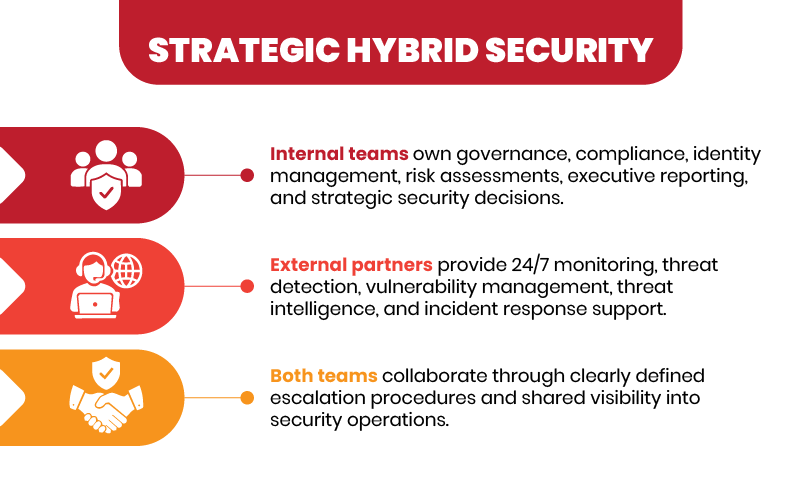
This model solidifies business ownership of cybersecurity strategy while leveraging specialized expertise that would otherwise be difficult and expensive to build internally.
Questions Every Business Should Ask Before Deciding
Before selecting an operating model, decision makers should ponder the following questions:
- Can our organization realistically provide 24/7 security monitoring?
- Do we have experienced cybersecurity professionals capable of investigating sophisticated attacks?
- Which regulatory frameworks apply to our business?
- How much revenue, productivity, or customer trust would be lost during a major cyber incident?
- Do we possess the internal expertise necessary to manage increasingly complex cloud, AI, and hybrid environments?
- Which cybersecurity functions provide strategic value if retained internally?
Answering these questions thoughtfully and honestly brings a lot of clarity to the decision-making process.
Building the Cybersecurity Leadership Skills to Make the Right Decision
Choosing between outsourced and in-house cybersecurity operations is not a simple business decision. Cybersecurity leaders must understand how to balance risk, cost, compliance, business continuity, and organizational objectives while adapting to an ever-changing threat landscape. As AI-powered cyberattacks, cloud-native environments, and global regulatory requirements continue to reshape the threat landscape, organizations need professionals who can evaluate security strategies from both technical and business perspectives.
Developing these capabilities requires a strong foundation in cybersecurity governance, secure architecture, incident response, cloud security, risk management, and executive decision-making. Through world-class online cybersecurity programs, EC-Council University (ECCU) prepares current and aspiring cybersecurity professionals to lead these critical conversations. By combining academic rigor with industry-relevant curricula and practical cybersecurity concepts, ECCU equips graduates with the knowledge and skills to assess modern operating models and make informed decisions that strengthen organizational resilience.
To know more about how our online programs empower cybersecurity leaders:
Frequently Asked Questions
In most cases, yes. Outsourcing provides access to specialized expertise and 24/7 monitoring without the significant costs associated with hiring, training, and retaining a full internal cybersecurity team.
Organizations should typically retain governance, risk management, compliance, identity and access management, executive reporting, and strategic security planning internally.
A hybrid model combines an internal cybersecurity team with external providers such as Managed Detection and Response (MDR) or Managed Security Service Providers (MSSPs), allowing organizations to balance operational efficiency with strategic oversight.
Yes. Most SMBs benefit from outsourcing cybersecurity operations because it provides enterprise-level protection at a predictable cost while reducing staffing challenges.
While large organizations often outsource specialized services, they typically maintain internal security leadership, governance, and engineering teams. A hybrid operating model is generally considered the most effective approach for enterprise-scale cybersecurity.