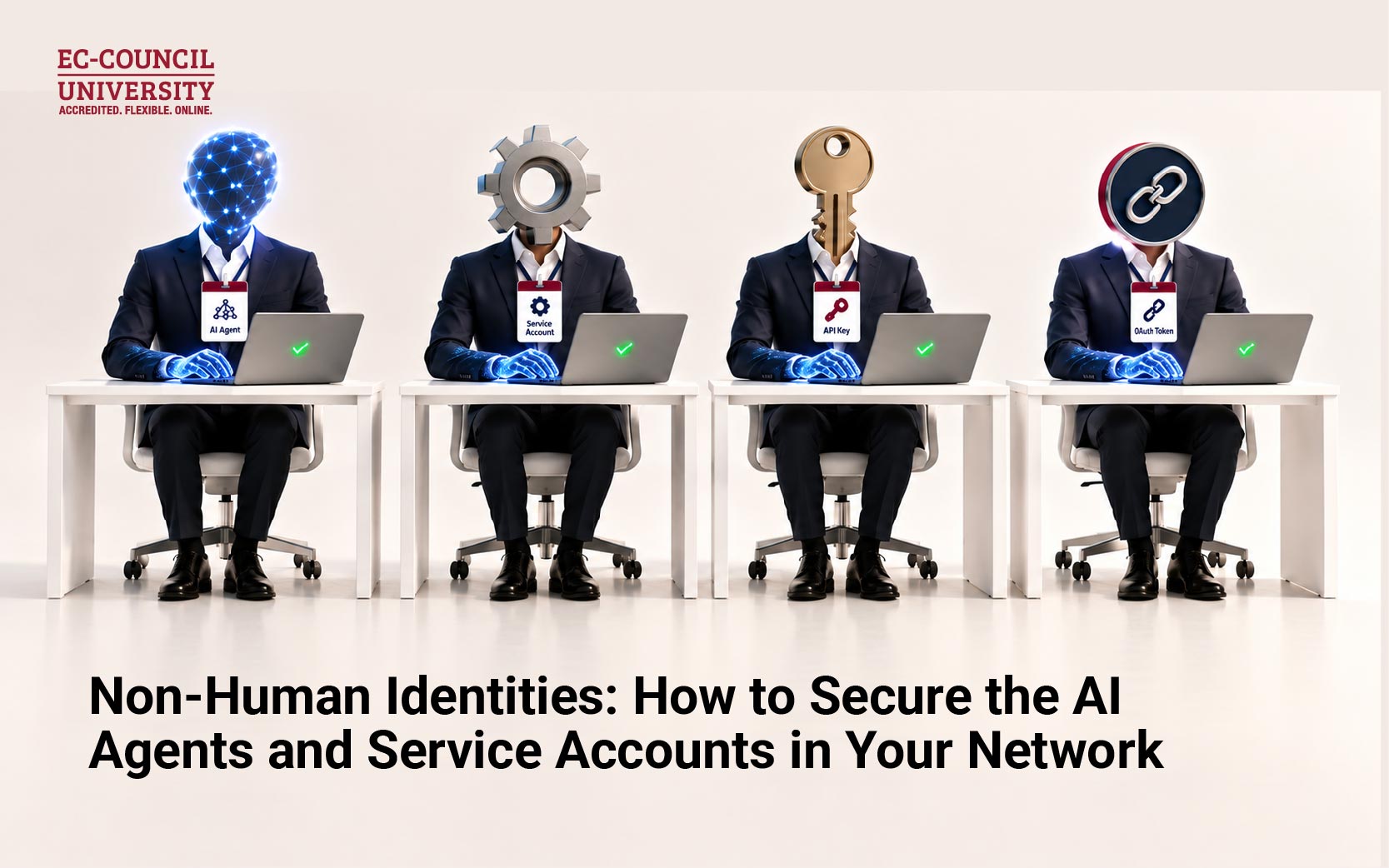
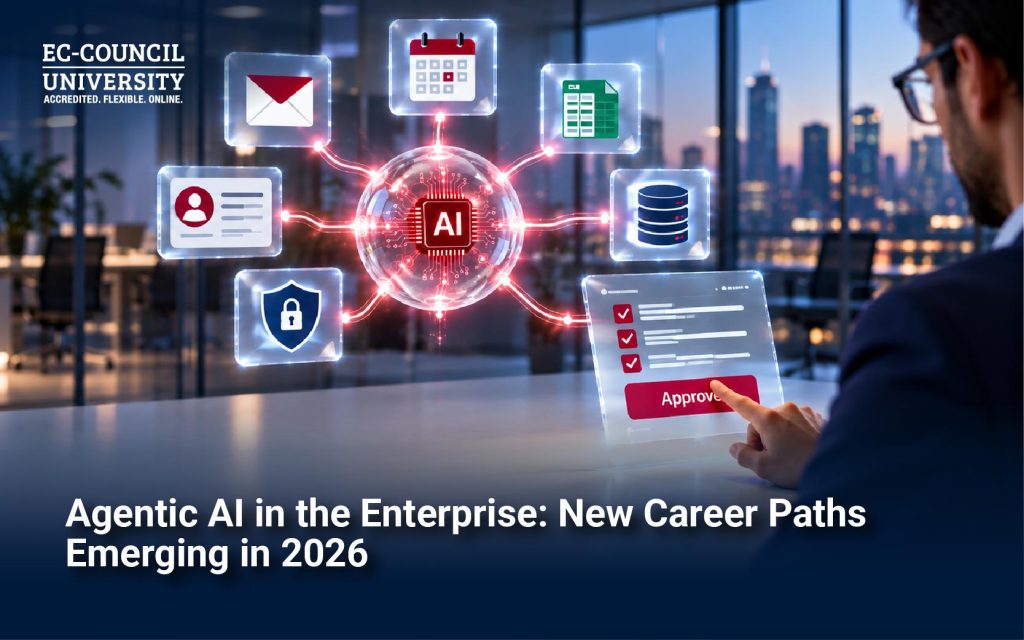
AI agents have left the lab. They now work inside real enterprise workflows. They file tickets, reconcile invoices, and route customer requests.
How is an agent different from a chatbot? Generative AI creates content when you ask. Agentic AI plans steps, picks tools, and acts across systems. A generative tool drafts the email. An agent sends it, logs it, and books the follow-up.
That autonomy creates brand-new work and brand-new careers. This guide maps the technical, business, and hybrid roles now forming. AI governance and policy leadership is becoming a specialized track too. Finally, you’ll see which skills employers want and how to prepare.
Key Takeaways
- Generative AI creates content, while agentic AI plans and acts.
- Most companies still struggle to move agents beyond pilots.
- The gap between pilot and production is where new jobs appear.
- Agent security is fast becoming its own career track.
- Employers reward shipped agent projects backed by structured learning.
Why Agentic AI Adoption Is Creating a New Job Layer, Not Just Automating Old Ones
Traditional automation follows a script. An agent doesn’t. It reads a goal, breaks it into steps, and calls tools. Each action needs clear limits, testing, and human review.
McKinsey’s latest survey found 40% of large firms scaling agents. That’s up from 27% a year earlier. Smaller companies stayed flat at 22%.
Many agentic projects won’t make it, though. Gartner predicts over 40% will be canceled by the end of 2027. It blames rising costs, unclear value, and weak risk controls. Each reason points to a skills gap, not a model problem.
The path looks familiar. A small team pilots an agent on a low-risk task. If it works, the agent goes live in one workflow. Next, several agents start handing work to each other. Then the company hires people to own the whole system. That last stage turns agentic AI jobs into permanent budget lines. This is the future of work with AI agents in practice.
New Technical Roles Emerging Inside the Enterprise
Engineering teams feel this shift first.
Agentic AI Engineer (Agent Developer)
AI Agent Orchestration Architect
Agent Security Engineer
Agents carry credentials, call APIs, and read untrusted content all day. A poisoned email can quietly hijack an agent’s goal. Agent security engineers give each agent its own identity and scoped permissions. They also decide which actions need human sign-off. OWASP now publishes a risk list built just for agentic applications. It covers goal hijacking, tool misuse, and identity abuse. Our guide to agentic AI in cybersecurity goes deeper.
AgentOps and Agent QA Engineer
Agents often fail quietly. A tool returns bad data, and the agent just keeps going. AgentOps engineers track cost, speed, accuracy, and drift in production. Agent QA engineers build evaluation suites that catch failures before customers do.
These roles reward deep computer science, not framework tutorials alone. ECCU’s Master of Science in Computer Science builds that depth. Coursework spans artificial intelligence, data science, algorithm design, and secure programming. Read about why an MCS still matters in the AI era.
New Cross-Functional and Business Roles Emerging Inside the Enterprise
Agentic AI Product Manager
AI Agent Operations Lead
Someone on the business side has to own the agent fleet. The operations lead tracks outcomes, budgets, and service levels for each agent. Engineers keep agents running. This person makes sure they’re worth running.
AI trust, safety, and governance leadership is also becoming its own track.
Business roles like these need leaders fluent in strategy and risk. ECCU’s MBA builds that mix through AI-integrated coursework. Its governance specialization adds AI program management and governance electives. Those courses align with the C|AIPM and C|RAGE certifications.
Hybrid, Domain-Specific Roles Popping Up Across Business Functions
Many AI agent jobs won’t carry an AI title at all. Existing jobs are absorbing agent oversight as a core duty.
- HR: Workforce transformation leads plan teams that mix people and agents.
- Finance: Automation analysts check agent-run reconciliations and approve exceptions.
- Sales and customer ops: Agent supervisors tune AI service agents and handle escalations.
- Legal and compliance: AI compliance specialists map agent actions to rules and liability.
Domain knowledge is your edge here. You know the work, so you spot bad agent decisions fast.
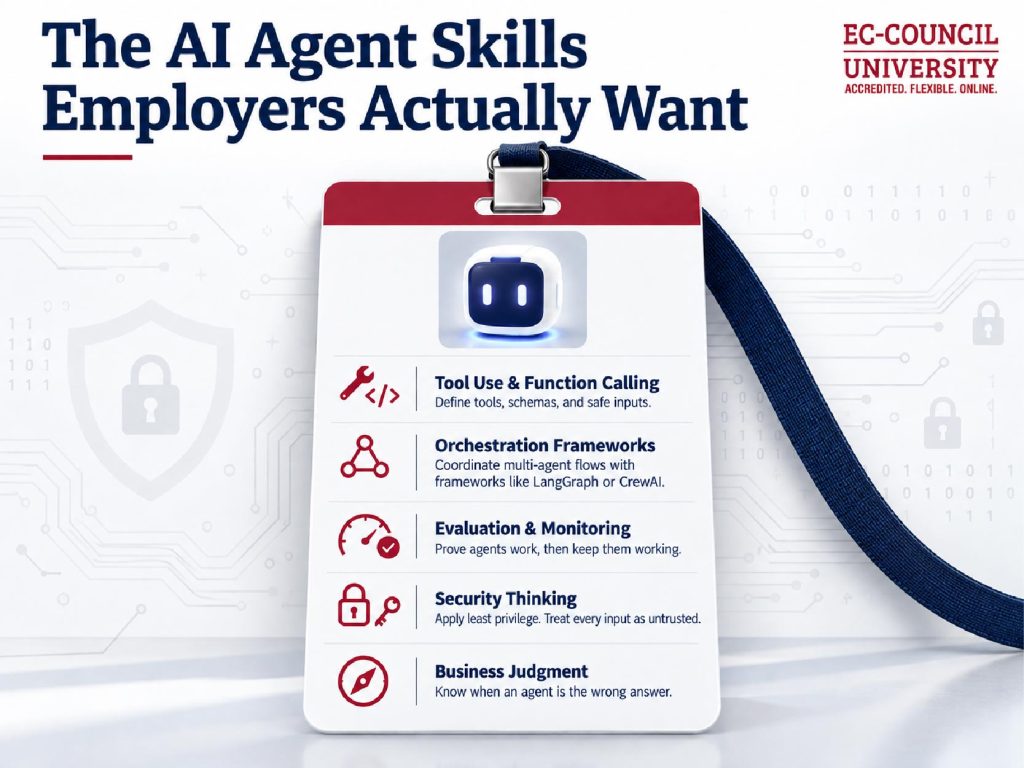
The AI Agent Skills Employers Actually Want
- Tool use and function calling: You can define tools, schemas, and safe inputs for agents.
- Orchestration frameworks: You’ve handled AI agent orchestration with LangGraph, CrewAI, or similar tools.
- Evaluation and monitoring: You can prove an agent works, then keep it working.
- Security thinking: You apply least privilege and treat every input as untrusted.
- Business judgment: You know when an agent is the wrong answer.
These build on the most in-demand AI skills employers already value.
You’ll often hear that agent work needs no degree. That’s true for some entry roles. Architect, security, and leadership roles carry real business risk, though. Employers want proof you can ship agents and reason about systems. A portfolio shows the first. Structured graduate study often shows the second.
An MSCS sharpens the defensive skills agent security roles demand. Depending on your track, it can include AI security certifications like C|OASP. An MBA prepares leaders to own agent programs, budgets, and accountability.
How to Position Yourself for These Roles
Start with proof. Build a small agent that solves a real problem. Document the design, the tests, and every failure you hit. Then pair that portfolio with accredited graduate coursework.
Builders and architects should look at the MCS. Aspiring agent security engineers fit the MSCS in Cyber Security. Product, operations, and governance leaders will get more from the MBA. Compare the MS in Cybersecurity and MBA paths side by side. New to the field? Our guide to starting a career in AI and machine learning helps.
Enterprise AI agents will keep spreading. The people who build, secure, and steer them will set the pace. Explore ECCU’s graduate programs and pick the track that fits.