Every few months, a headline predicts the end of computer science. AI writes code now. So why spend two more years studying it? That question feels urgent if you already juggle a full workload. But the question misses something important. Writing code was never the hardest part of computer science. Design, security, and sound judgment always mattered more. This blog looks at what AI really changes in CS careers. It also looks at where deep technical skills matter most. And it shows how ECCU’s MCS helps you lead this shift. You lead AI. It does not lead you.
Key Takeaways
- AI replaces shallow coding, not computer science itself.
- System design and security judgment matter more now.
- Entry level hiring cooled, but senior technical roles keep growing.
- Security is now a core CS skill, not an extra.
- ECCU’s MCS blends AI, blockchain, robotics, and security together.
- Your career goal should decide between an MCS and MSCS.
The Misconception: "AI Makes CS Obsolete"
The fear is not baseless. Junior hiring in tech has cooled. Many companies now expect AI to handle basic coding. But coding was always the entry point into computer science. It was never the ceiling. Writing a function differs from designing a hundred services. Those services still need to talk to each other. AI can generate code fast. It cannot judge if that code is secure or worth building. That judgment comes from understanding algorithms, architecture, and tradeoffs. Those fundamentals do not expire just because a tool types faster.
What AI Actually Changes About CS Careers
AI has reshaped daily work for many developers. Fewer hours go into boilerplate code. More hours go into specifying what a system should do. Engineers now review AI generated code instead of writing every line. They test it, secure it, and decide where it belongs. This shift created new roles across CS, AI, and security. Titles like AI security engineer barely existed five years ago. They exist now because someone must catch what AI tools miss.
Where Deep CS Skills Become More Valuable
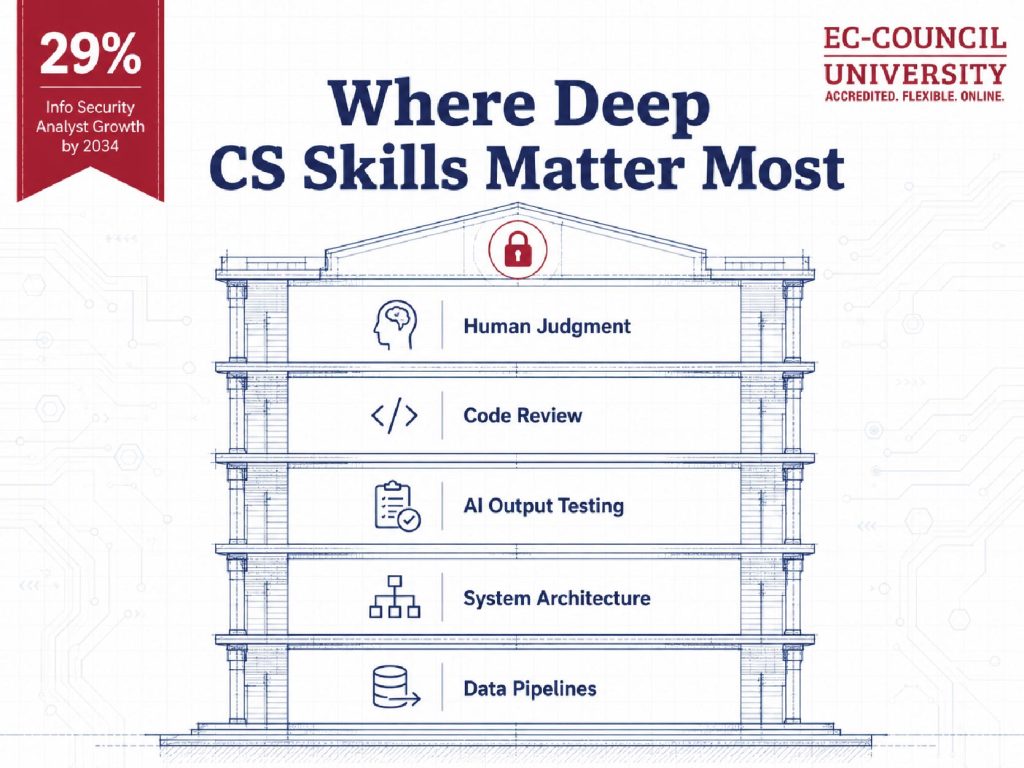
Designing a trustworthy AI system takes more than a working model. It takes people who understand performance, scale, and reliability under real conditions. This is where deep computer science training earns its keep. Demand backs this up. Information security analyst roles are projected to grow 29% through 2034. That figure comes from the U.S. Bureau of Labor Statistics.
Inside a typical AI project, a strong MCS graduate does the following:
- Designs system architecture that holds up under real load
- Tests AI outputs for bias, drift, and reliability gaps
- Builds data pipelines that survive production pressure
- Reviews AI generated code for logic errors and security holes
- Decides which parts of a system AI should never touch
Security as a First-Class Concern
Security used to sit at the edge of CS coursework. Not anymore. Every AI system runs on a pipeline. Every pipeline can be attacked. Data can be poisoned before a model ever sees it. Prompts can be manipulated to leak information. They can also dodge safety controls. Trained models can be stolen through repeated queries. CS graduates who understand these risks hold a real edge. They connect classic security thinking to new problems. That combination is hard to find. It is even harder to hire for.
What ECCU's MCS Builds
ECCU’s MCS was built for exactly this shift. It blends core theory with AI, blockchain, robotics, and data science. Ethical hacking, secure programming, and network security run through it too. None of this is an afterthought. Graduates earn up to three certifications alongside their degree. These include CEH, CND, and CASE. The program runs fully online across 12 courses. It takes roughly 18 to 24 months to finish. That pace suits working professionals balancing a job and a degree.
Want a closer look at where this training leads? ECCU has already mapped out the career opportunities for MCS graduates.
Career Outcomes for MCS Graduates
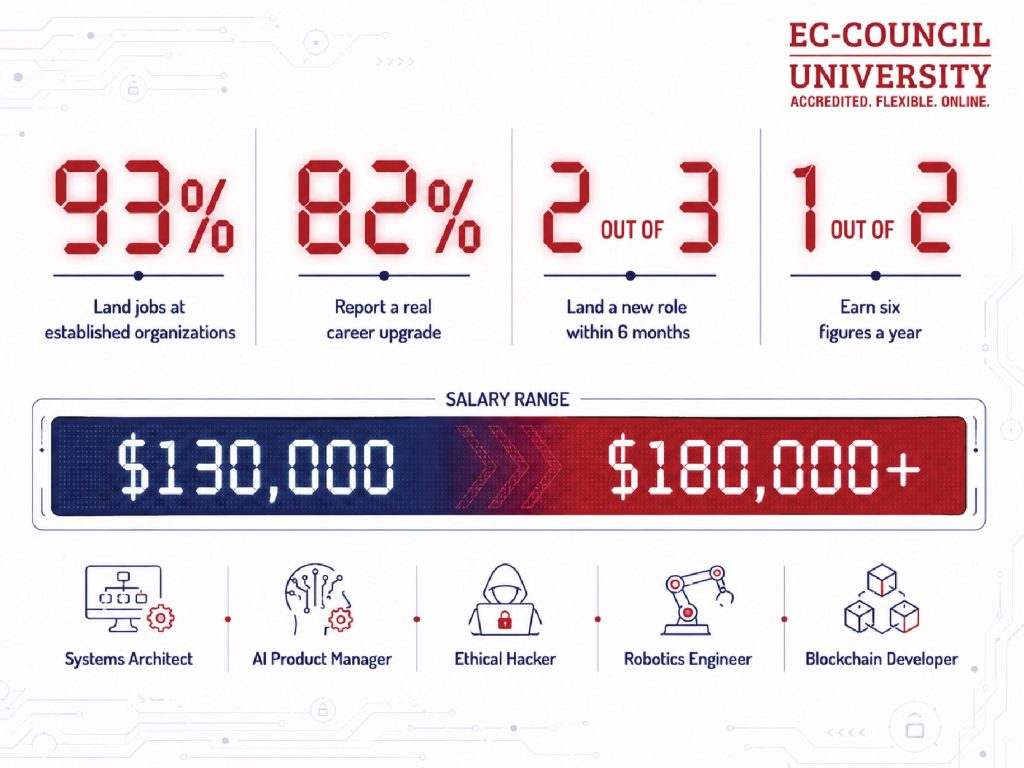
The outcomes back this up. 93% of ECCU MCS graduates land jobs at established organizations. 82% report a real career upgrade after graduating. 2 out of 3 graduates land a new role within six months. Roughly 1 out of 2 earn six figures a year. Experienced CS professionals with a master’s degree often earn more. Some reach $130,000 to $180,000 annually.
Common outcomes include systems architect, AI product manager, and ethical hacker. Others include robotics engineer and blockchain developer. Some graduates move toward IT leadership. Others go deeper into technical specialization. The degree keeps both doors open.
Choosing Between an MCS and a Cyber Security Master's
Not everyone needs the same degree. Want to build systems? An MCS fits better. Want to defend them full time? A cybersecurity master’s may suit you more. Computer science teaches you to build the digital world. Cybersecurity teaches you to protect it. If AI, blockchain, or robotics interests you, an MCS fits. Want to specialize in defense or governance instead? Cybersecurity is the faster route. ECCU covers the computer science vs cybersecurity master’s decision in detail.
Conclusion
AI changed what a computer science career looks like. It did not remove the need for one. The professionals who lead the next decade will understand systems deeply. They will guide AI, not just prompt it. A master’s degree builds that depth. Short courses and tutorials cannot.
Ready to build that foundation? Explore ECCU’s Master of Science in Computer Science program. Request the brochure to see the full curriculum.
Frequently Asked Questions
Yes. AI automates routine coding, not system design or judgment. A master’s degree builds skills AI cannot replace. That keeps computer science professionals valuable as the field changes.
AI is reshaping computer science jobs more than replacing them. Entry level coding roles have tightened. Demand keeps rising for engineers who secure AI-driven systems.
ECCU’s MCS covers AI, blockchain, robotics, and cybersecurity too. Students also earn up to three certifications, including CEH, CND, and CASE.
Choose an MCS to build and lead across emerging tech. Choose a cybersecurity master’s for full time defense or security work.
Yes. ECCU’s MCS runs fully online across 12 courses. It takes about 18 to 24 months.
The flexible, asynchronous format suits working professionals.