
Cybersecurity for Microchips: A Top Priority in Chip Design
Microchips are the tiny engines powering modern life. Smartphones, laptops, autonomous vehicles, medical devices, military technology, cloud servers, AI systems, and every other digital invention depend on semiconductor technology, which makes protecting the chips at their core a matter of utmost importance. Beyond software-level threats, sophisticated cyberattackers are now targeting hardware itself, seeking to compromise semiconductor designs, insert malicious circuitry, steal intellectual property, or exploit weaknesses that cannot easily be patched after deployment. A single vulnerability embedded within a processor can affect millions of devices worldwide.
Today, semiconductor manufacturers are embracing a Secure-by-Design philosophy, integrating cybersecurity protections throughout the entire chip lifecycle, from architecture and design to fabrication, deployment, and ongoing operation. Rather than treating cybersecurity as an afterthought, modern microchip development embeds it directly into the hardware.
This article explores the cybersecurity mechanisms that help safeguard today’s microchips and explains why hardware security has become one of the industry’s most critical priorities.
Why Hardware Security is Vital
Cyberattacks have evolved to the point where nation-state actors, cybercrime groups, and advanced persistent threats recognize that compromising hardware provides an opportunity to undermine entire technology ecosystems. Unlike software vulnerabilities, hardware flaws often cannot be fixed with a simple update. In many cases, vulnerable chips must be physically replaced, making prevention significantly more important than remediation.
The growing complexity of semiconductor manufacturing compounds this challenge. A single advanced processor may contain tens of billions of transistors and involve contributions from dozens of organizations spanning multiple countries. Every stage, from electronic design automation (EDA) tools and third-party intellectual property (IP) blocks to fabrication, packaging, testing, and distribution, introduces potential cybersecurity risks. Protecting these highly complex supply chains requires multiple layers of security working in tandem.
Building Cybersecurity Into Every Stage of Microchip Design
Modern semiconductor manufacturers incorporate the following cybersecurity mechanisms throughout microchip development lifecycles:
1. Secure-by-Design Architecture
Security begins long before silicon reaches the fabrication facility. During architectural planning, engineers perform extensive threat modeling to identify potential attack vectors before development begins. Security requirements are incorporated alongside performance, power consumption, and manufacturing objectives.
Chip design teams commonly implement:
- Least-privilege hardware access
- Secure memory isolation
- Protected communication pathways
- Security-focused architecture reviews
- Hardware attack surface analysis

2. Hardware Root of Trust (HRoT)
Every secure system requires an immutable foundation of trust. This foundation is known as the Hardware Root of Trust (HRoT), a collection of hardware-based security functions embedded directly within the processor. The HRoT enables:
- Secure boot
- Device authentication
- Secure firmware verification
- Cryptographic key protection
- Trusted software measurement
Because these functions are implemented in hardware, attackers cannot easily modify or bypass them using software exploits. Many enterprise processors, smartphones, and cloud platforms rely on HRoT to verify that systems boot into trusted states.
3. Secure Boot Prevents Unauthorized Firmware
One of the first cybersecurity mechanisms activated when a device powers on is Secure Boot. Secure Boot validates digital signatures before firmware executes, ensuring that only trusted software loads during startup. If authentication fails, the device halts booting, preventing malware from executing before operating system defenses become active. This verification chain protects against firmware implants, rootkits, bootkits, and unauthorized operating system modifications.

4. Cryptographic Protection Inside the Chip
The latest microchips contain dedicated cryptographic engines that accelerate security operations and improve performance. Chip designers are also preparing for the quantum computing era by evaluating Post-Quantum Cryptography (PQC) implementations. These hardware accelerators support algorithms such as AES, RSA, Elliptic Curve Cryptography (ECC), SHA-2, and SHA-3.
Hardware-based cryptography enables data encryption, digital signatures, authentication, secure communications, and confidential computing. Implementing these capabilities directly within silicon reduces latency while improving resistance against software attacks.
5. Physical Unclonable Functions (PUFs)
No two microchips are perfectly identical. Tiny manufacturing variations create unique electrical characteristics that can serve as a hardware fingerprint known as a Physical Unclonable Function (PUF). Instead of storing cryptographic keys directly within memory, chips can generate secure identities from these naturally occurring physical properties.
PUFs support:
- Device authentication
- Anti-counterfeiting
- Secure key generation
- Supply chain verification

6. Protecting Cryptographic Keys
Modern chips store sensitive credentials inside highly protected hardware components, such as secure key vaults, One-Time Programmable (OTP) memory, eFuses, and secure enclaves. Many processors automatically erase sensitive information if tampering attempts are detected, significantly reducing the risk of key extraction.
7. Defending Against Physical Attacks
Not every cyberattack occurs over the internet. Attackers may attempt to physically manipulate chips through voltage glitches, laser fault injection, electromagnetic analysis, or microprobing. To defend against these attacks, semiconductor manufacturers use:
- Active shield meshes
- Tamper detection sensors
- Voltage monitoring
- Clock anomaly detection
- Temperature sensors
- Automatic memory zeroization
These protections help ensure that sensitive information remains secure even when attackers gain physical access to hardware.
8. Preventing Side-Channel Attacks
Even properly encrypted systems can unintentionally leak information. Side-channel attacks analyze indirect signals such as timing, power consumption, electromagnetic emissions, or cache behavior to infer secret cryptographic keys. Engineers mitigate these risks through:
- Constant-time cryptographic operations
- Randomized execution
- Power balancing
- Electromagnetic shielding
- Differential Power Analysis (DPA)-resistant circuit design
These defenses significantly reduce information leakage without affecting normal device functionality.
9. Detecting Hardware Trojans
One of the microchip industry’s most concerning threats involves hardware Trojans, which are malicious circuitry inserted during design or manufacturing. Unlike malware, hardware Trojans exist inside the physical chip itself. Manufacturers employ numerous techniques to identify these threats beforehand, including:
- Formal verification
- Functional testing
- Side-channel analysis
- Machine learning anomaly detection
- Logic equivalence checking
- Runtime monitoring

10. Securing the Semiconductor Supply Chain
Modern semiconductor manufacturing spans an intricate global ecosystem involving design firms, IP vendors, fabrication facilities, packaging providers, testing laboratories, logistics partners, and original equipment manufacturers. Each stage introduces potential cybersecurity risks. To strengthen supply chain resilience, organizations increasingly implement:
- Component traceability
- Vendor risk assessments
- Cryptographic device authentication
- Digital certificates
- Secure manufacturing processes
- Anti-counterfeiting verification
- Chain-of-custody documentation
These measures help ensure chips remain authentic and untampered throughout their lifecycle.
AI’s Impact on Cybersecurity in Microchip Design
AI is becoming an essential tool in microchip cybersecurity. Machine Learning (ML) algorithms can rapidly analyze enormous design datasets, identify anomalous behavior, detect counterfeit components, and monitor manufacturing systems for unusual activity.
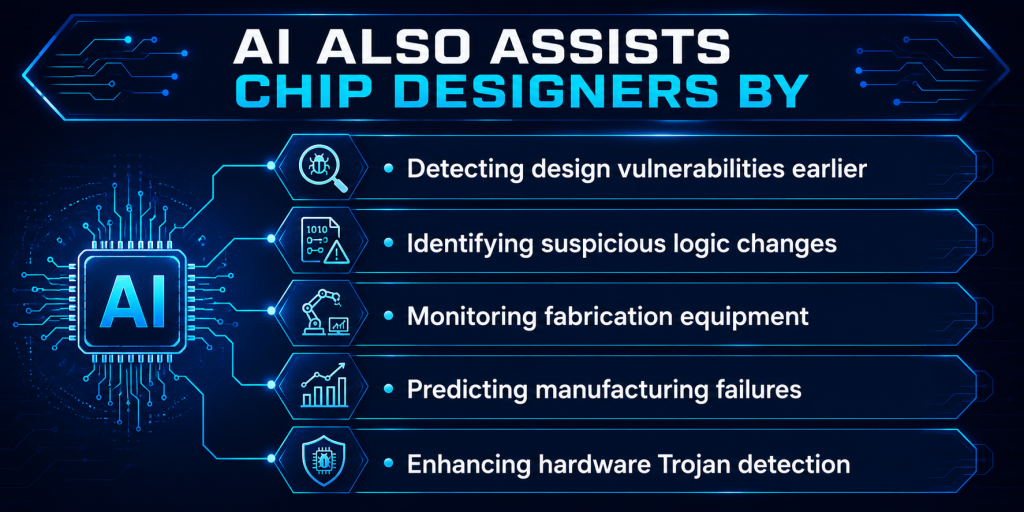
As semiconductors continue to grow in complexity, AI-driven security analysis is expected to become a standard component of future chip development.
The Cybersecurity Standards Driving Modern Chip Design
Leading microchip manufacturers are aligning their cybersecurity programs with internationally recognized cybersecurity frameworks, such as:
- NIST Cybersecurity Framework (CSF) 2.0
- NIST Secure Software Development Framework (SSDF)
- NIST SP 800-193 Platform Firmware Resiliency Guidelines
- FIPS 140-3 for cryptographic module validation
- Common Criteria (ISO/IEC 15408)
- ISO/SAE 21434 for automotive cybersecurity
- IEC 62443 for industrial control systems
These frameworks provide structured guidance for designing secure products, validating security controls, and improving organizational cyber resilience.
The Future of Cybersecurity in Microchip Design
Emerging technologies like quantum computing, edge AI, autonomous transportation, and critical infrastructure modernization are reshaping microchip cybersecurity requirements. Future microchips will incorporate Post-Quantum Cryptography, confidential computing, secure chiplet architectures, AI-assisted hardware verification, silicon lifecycle management, hardware-backed digital identities, and Zero Trust architectures at the hardware level.
As cyber threats evolve, securing the hardware foundation of computing becomes just as important as protecting software and networks.
Interested in gaining the cybersecurity knowledge and skill sets required in microchip design? EC-Council University (ECCU) has just the programs for you! Speak to our advisors for more information:
Frequently Asked Questions About Microchip Cybersecurity
Hardware security refers to the technologies and engineering practices used to protect semiconductor devices from cyberattacks, tampering, intellectual property theft, and unauthorized modifications throughout their lifecycle.
A Hardware Root of Trust is a built-in security foundation that securely verifies firmware, stores cryptographic keys, authenticates devices, and establishes trusted execution before software loads.
Secure Boot prevents unauthorized firmware and malicious code from executing at startup by verifying digital signatures before software can run.
PUFs use naturally occurring manufacturing variations within semiconductor devices to create unique hardware identities for authentication, secure key generation, and anti-counterfeiting.
A hardware Trojan is a malicious modification inserted into a semiconductor design or manufacturing process that can alter chip functionality, leak sensitive information, or create hidden vulnerabilities.
Hardware-based cryptography enables secure encryption, authentication, digital signatures, and confidential communications while providing stronger protection than software-only implementations.
AI helps detect hardware Trojans, identify counterfeit components, analyze complex chip designs, monitor fabrication systems, predict anomalies, and automate security validation throughout the semiconductor lifecycle.
Organizations commonly align semiconductor security with frameworks such as NIST Cybersecurity Framework (CSF) 2.0, NIST SP 800-193, NIST SSDF, FIPS 140-3, Common Criteria (ISO/IEC 15408), ISO/SAE 21434, and IEC 62443.