
Cybersecurity used to reward generalists. One analyst could touch firewalls, forensics, and compliance in a single week. That era is fading fast. Organizations now build dedicated teams around narrow, defined skill sets. This shift reflects real changes in tools, threats, and team structures. This blog breaks down why specialization is replacing the generalist model. It maps the major career tracks shaping the field today. It also shows how professionals can prepare without committing too soon.
Key Takeaways
- Cybersecurity is shifting from generalist roles to defined specialist tracks.
- NICE and DoD frameworks now formalize distinct cybersecurity work roles.
- Five major tracks dominate: analysis, architecture, forensics, operations, and leadership.
- Specialization pays well but narrows options if chosen too early.
- A broad foundation still matters before committing to one track.
- AI is creating new hybrid roles across every specialization.
- ECCU’s MSCS lets you explore tracks through embedded certifications.
From Generalist to Specialist: What Changed
The old model assumed one person could cover everything. That assumption has broken down under real pressure. Attack surfaces have multiplied across cloud, mobile, and connected devices. A single analyst struggles to master every layer now. Organizations have also matured their security operations significantly. Mature teams build dedicated roles instead of one catch-all position. A SOC analyst now differs sharply from a forensic investigator. Each role demands its own tools, mindset, and depth. Regulatory pressure has added another layer of specificity. Sector-specific rules now shape how teams get structured. Healthcare, finance, and defense each carry distinct compliance demands. Generalist knowledge cannot satisfy all of them at once.
The Frameworks Formalizing Specialization
Two frameworks have formalized this shift on paper. NIST’s NICE Framework defines cybersecurity work in granular detail. It currently maps 41 Work Roles across five categories. Employers use it to write job descriptions and hire precisely. Educators use it to design curriculum around real roles.
The Department of Defense has gone further still. DoDM 8140.03 replaced a decades old certification checklist. It now requires proof against specific work-role qualifications.
The deadline for most remaining DCWF elements passed on February 15, 2026. Federal hiring managers now look for named work roles. A generic security clearance no longer covers that gap.
The Major Career Tracks
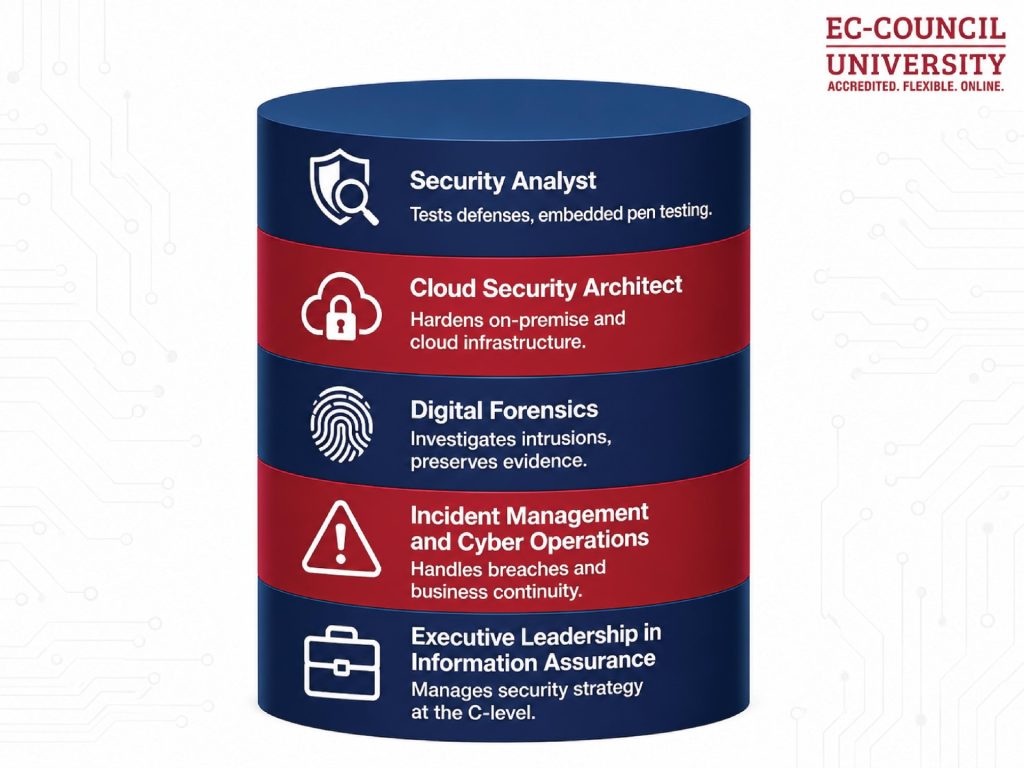
Five tracks dominate cybersecurity hiring right now.
- Security Analyst: monitors threats and tests defenses, including embedded penetration testing.
- Cloud Security Architect: designs and hardens on-premise and cloud infrastructure.
- Digital Forensics: investigates intrusions and preserves evidence for cyber law.
- Incident Management and Cyber Operations: handles breaches and business continuity.
- Executive Leadership in Information Assurance: manages security strategy at the C-level.
These five map closely to how EC-Council University structures its master’s program. Each of these cybersecurity specialization path pairs technical depth with embedded, industry-recognized certifications. Choosing between them depends on temperament as much as skill. Some professionals want to break things and find flaws. Others want to build systems that never break at all.
The Upside and Risk of Specializing
Specialization now comes with a real pay premium. Median pay for information security analysts reached $124,910. Demand keeps climbing too, with roles growing 29 percent through 2034.
The picture carries real tradeoffs too. Budget has overtaken talent as the top hiring barrier. Employers want specialists, yet many cannot fund new headcount. Eighty–eight percent of organizations reported an incident tied to skill gaps. AI now sits atop the list of urgent skill needs. Forty–one percent of security teams call it their top need.
Narrowing too early carries its own risk too. A professional locked into one track loses flexibility fast. That is why a strong shared core still matters. It lets specialists pivot as the field keeps shifting. Think of specialization as depth built on a wide base. The base keeps you employable if one track cools off.
How to Choose and Prepare for a Track

Start by testing your instincts, not just your resume. Ask whether you enjoy breaking things or building them instead. Ask whether you prefer solo deep work or team leadership. Formal education helps translate that instinct into direction.
EC–Council University’s MSCS covers all five specializations across twelve courses. Each specialization embeds three to five certifications directly:
- Security Analyst: CEH, CND, CPENT, COASP
- Cloud Security Architect: CEH, CND, CASE, CCSE
- Digital Forensics: CEH, CND, CHFI
- Incident Management and Cyber Operations: CEH, CND, EDRP, ECIH
- Executive Leadership in Information Assurance: CEH, CND, CCISO, CAIPM, CRAGE
Professionals aiming for the C-suite often start there directly. If you are looking for something more specific to leadership roles then a MBA in Cybersecurity could be a great option. Non-degree courses and graduate certificates offer a lighter entry point. They let you test a track before committing two years.
The Future of Cyber Careers
AI is reshaping every track at once. NIST proposed adding an AI Security competency area in 2025. ECCU already offers non-degree courses in offensive and defensive AI security. Hybrid roles are emerging between traditional tracks and AI oversight. A cloud architect now needs some AI governance literacy too. A forensics investigator increasingly handles AI-generated evidence. Staying adaptable matters more than picking the perfect track. The frameworks themselves keep evolving alongside the threats they define. Quantum-resistant cryptography is already drawing early specialist attention. Supply chain security is becoming its own dedicated track too. The list of named specializations will likely keep growing.
Conclusion
Specialization is now central to how cybersecurity operates. Pick a track that matches your strengths and curiosity. Build a broad base first, then go deep with intent.
Explore ECCU’s MSCS specializations today. Talk to an advisor about the right starting point for you.
Frequently Asked Questions
Threats and tools have grown too complex for one generalist. Organizations now build dedicated teams instead of single catch-all roles.
Build broad foundational skills first, then specialize with intent. A shared core keeps your options open as the field shifts.
The main tracks include security analysis and cloud architecture. Others cover digital forensics, incident management, and executive leadership.
Specialize once you understand your strengths and the field’s basics. Most professionals specialize within their first two to three years.
ECCU’s MSCS offers five specializations, each embedding industry certifications directly. Non-degree courses and graduate certificates let you explore tracks first.