
Most companies now use AI somewhere in their daily work. Far fewer can say who owns the rules for it. A model screens job applicants. A chatbot answers customers. Each one carries legal and security risk. Someone has to decide what is allowed and then prove it. That person is the AI Policy Lead.
Titles vary by company. You may also see AI Governance Lead, Manager, or Officer. The job underneath stays the same. It turns laws and risk appetite into rules people follow.
This guide explains why every organization now needs this role. It covers the daily work, the laws behind it, and pay. It also maps a realistic AI governance career path.
Key Takeaways
- An AI Policy Lead owns the rules for company AI use.
- The role turns regulations into controls that auditors can check.
- The EU AI Act delay gave companies time, not an exemption.
- U.S. state AI laws keep shifting, so someone must track them.
- Most people enter from compliance roles or from technical AI work.
- Certifications prove knowledge, while degrees build judgment and leadership depth.
- Pay climbs when you combine privacy, AI, and governance skills.
What Does an AI Policy Lead Actually Do?
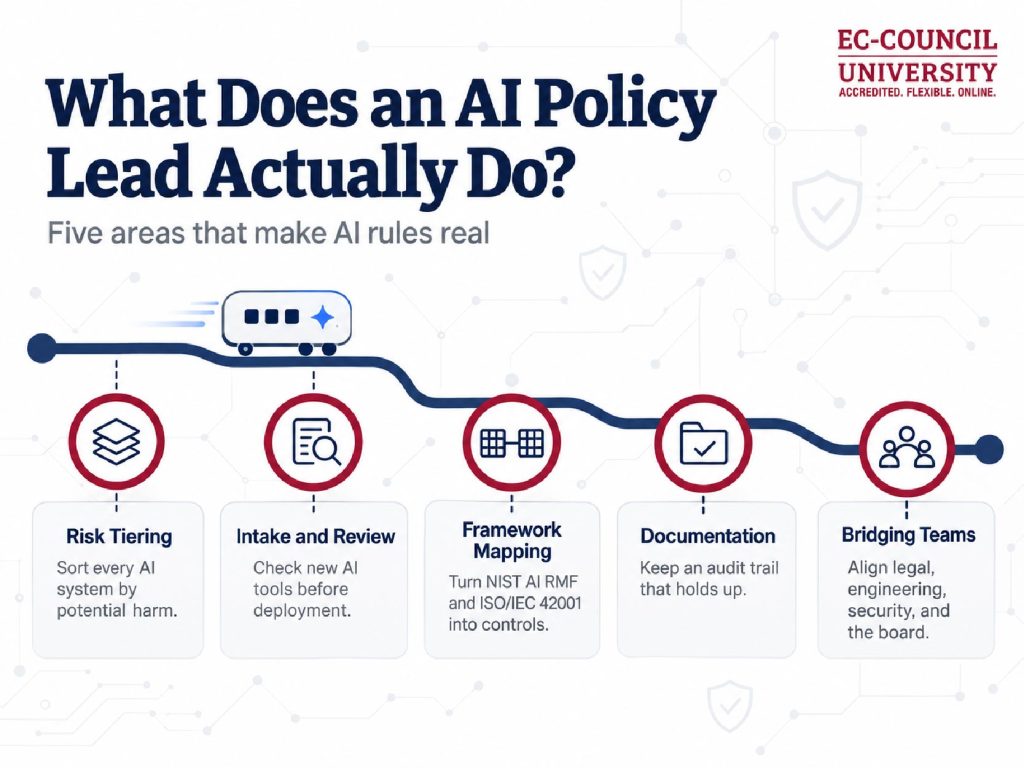
An AI Policy Lead makes AI rules enforceable and auditable. Writing a values statement is easy. Getting engineers and buyers to follow it is harder. The work spans five areas:
- Risk tiering. Sort every AI system by the harm it could cause. A resume screener deserves more scrutiny than a meeting summarizer.
- Intake and review. Check new AI tools before anyone deploys them. This step also catches shadow AI that teams adopt without approval.
- Framework mapping. Turn the NIST AI RMF and ISO/IEC 42001 into internal controls.
- Documentation. Keep an audit trail that survives outside scrutiny.
- Bridging teams. Speak the language of legal, engineering, security, and the board.
The role overlaps with GRC but goes deeper on AI. It governs systems that learn and change. Earlier in your career? Read our GRC cybersecurity career guide first.
Responsible AI governance also has an ethical side. Our piece on cybersecurity ethics explores that ground.
Why This Role Is Becoming Mandatory, Not Optional
Grant Thornton surveyed senior U.S. leaders early this year. 78% lacked full confidence in passing an AI governance audit. CIO.com’s State of the CIO survey shows murky ownership too. There, 24% of CIOs were unsure who owns AI goals. Three pressures now make that gap costly.
The EU AI Act reaches far beyond Europe. It sorts AI systems into risk tiers. It also covers U.S. firms whose AI affects EU residents. Fines for banned practices reach €35 million or 7% of global turnover. The new Digital Omnibus amendment pushed high-risk deadlines back. Stand-alone high-risk systems now face rules from December 2, 2027. AI built into regulated products follows on August 2, 2028. Standards were not ready, but the obligations did not soften.
Prepared companies are building programs now.
U.S. state laws keep piling up. AI laws in Texas, Illinois, and California started on January 1, 2026. Colorado repealed its broad AI Act before it ever took effect. A narrower replacement starts on January 1, 2027. A federal executive order now challenges state AI laws in court. It does not cancel them. Someone must track every shift.
Agentic AI raises the stakes. AI agents now act on their own. They file tickets and approve refunds. Governance must define their limits. Our look at agentic AI career paths covers the operational side.
The AI Governance Career Path: How People Actually Get In
Most people come through one of two doors.
From GRC, compliance, privacy, or risk: You already write policy and run audits. Your gap is AI literacy. Learn how models train, drift, and fail.
From AI, machine learning, or cybersecurity: You already understand how systems break. Your gap is policy and influence. Learn to read regulation and persuade people you do not manage.
Some leads rise through AI program roles instead. Our AI program manager career guide shows how.
AI Governance Certifications Worth Your Time
The right AI governance certification signals focus. These four stand out:
- AIGP (IAPP). A widely recognized credential, strongest for privacy and legal backgrounds.
- ISO/IEC 42001 Lead Implementer. Shows you can build a formal AI management system.
- CRISC plus AAIR (ISACA). CRISC covers IT risk broadly. AAIR, launched in April 2026, layers AI risk on top.
- CRAGE (EC-Council). Covers responsible AI, regulatory compliance, and audit readiness.
What AI Governance Jobs Pay and Where the Demand Is
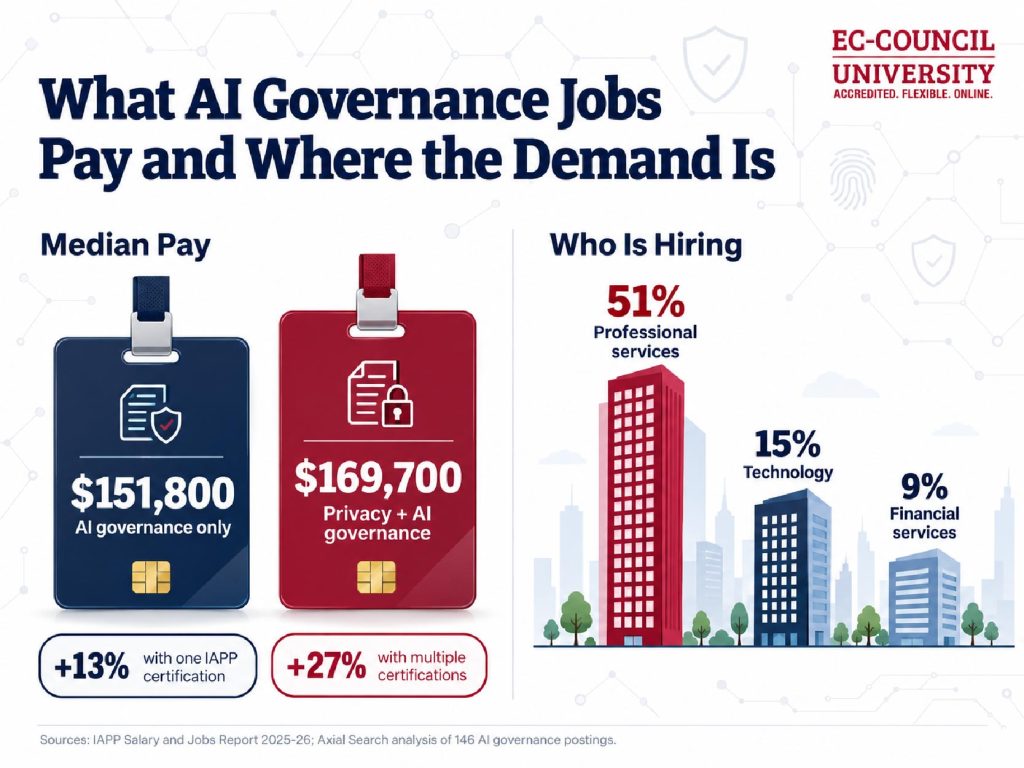
- Professional services firms posted 51% of roles.
- Technology companies followed at 15%.
- Financial services came next at 9%.
Building Your Own Path Into AI Governance Leadership
Start with an honest self-check. Your starting door decides which gap comes first.
- Coming from compliance or privacy? Build technical depth first.
- Coming from AI or security? Build policy and leadership skills first.
Plan a steady build, not a sprint. Here is where an accredited ECCU degree fits.
Master of Science in Computer Science (MCS): This suits compliance professionals who need technical fluency. Core courses include artificial intelligence and data science.
MSCS, Executive Leadership in Information Assurance: This suits technical professionals moving into governance. It now offers AI program management and AI governance courses. They prepare you for the CAIPM and CRAGE exams.
MBA, Cybersecurity Executive Leadership and Governance: This suits anyone aiming for budget authority and board access. Read why in our MBA in cybersecurity for security leaders guide.
Then add one credential, such as AIGP or ISO/IEC 42001. The degree builds depth. The certification signals focus. Together, they prove you can lead AI governance.
Every company using AI will soon need someone accountable for it. With the right preparation, that person can be you.