Ethical Dilemmas Are Unavoidable in Cybersecurity
When most people think about cybersecurity, they picture firewalls, malware, ransomware, and highly skilled professionals defending networks from relentless attacks. What often goes unnoticed is that cybersecurity professionals face another challenge every day, one that no technology can solve for them: ethical dilemmas.
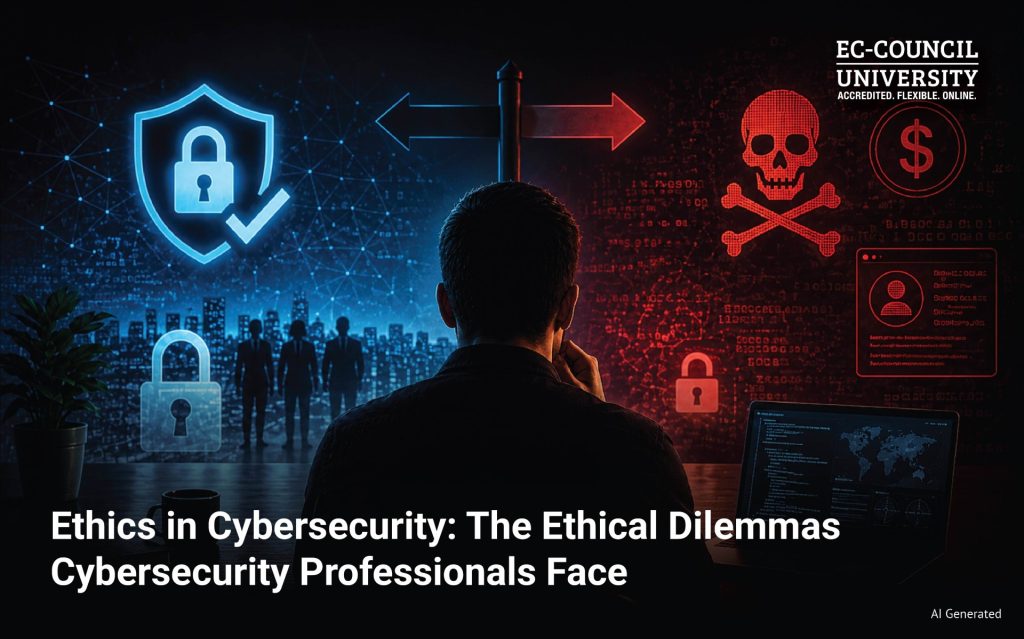
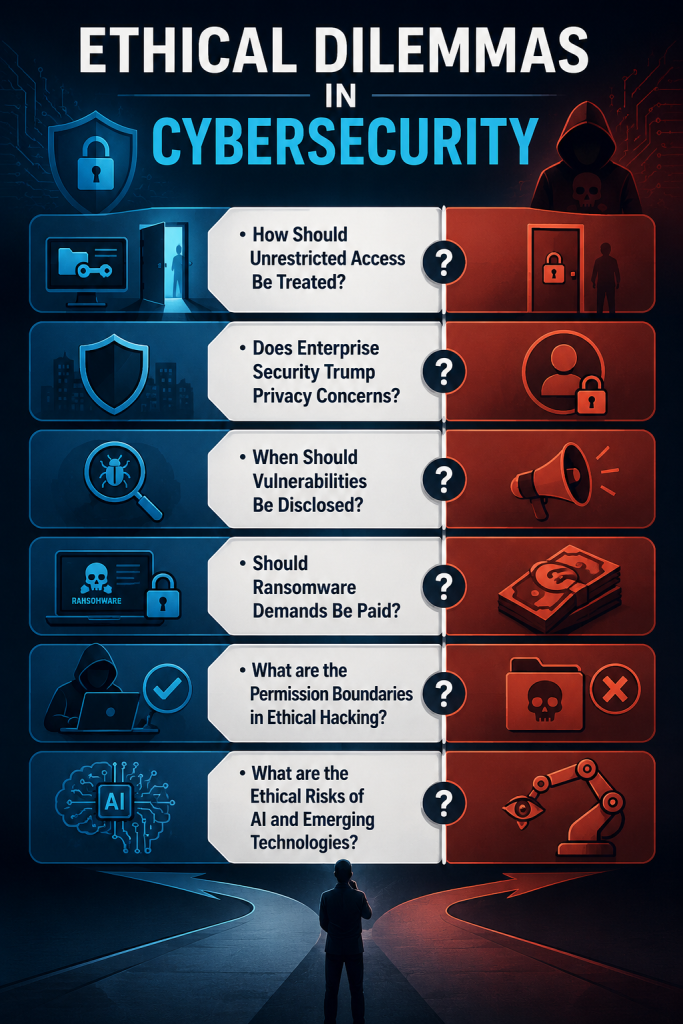
In a profession built on trust, access, and responsibility, cybersecurity practitioners routinely encounter situations where there is no perfect answer. They must balance security with privacy, business continuity with moral responsibility, transparency with operational necessity, and organizational interests with individuals’ rights.
As AI is making cyber threats more sophisticated and organizations become increasingly dependent on sprawling digital ecosystems, ethical decision-making is emerging as one of the most important competencies in cybersecurity. The question cybersecurity professionals must grapple with is how prepared they are to navigate ethical dilemmas.
The Power (and Responsibility) of Access
Cybersecurity professionals often possess extraordinary levels of access. They may have visibility into employee communications, customer data, intellectual property, financial records, and critical infrastructure systems. In many organizations, security teams can see more than almost anyone else.
This access is necessary to protect systems and identify threats. Yet it also creates an inherent ethical tension. Just because a security professional can access certain information does not always mean they should.
Consider a routine insider threat investigation. A security analyst may discover evidence suggesting an employee is exfiltrating sensitive company data. Investigating the incident could require reviewing emails, monitoring activity logs, and analyzing communications. The organization has a legitimate interest in protecting its assets. At the same time, employees reasonably expect a degree of privacy and dignity in the workplace.
The ethical challenge lies in determining where security oversight ends and unnecessary intrusion begins. In many cases, cybersecurity professionals must operate within legal frameworks and corporate policies while also applying personal judgment. The law may define what is permissible, but ethics often determine what is appropriate.
The Privacy Versus Security Debate
Few cybersecurity dilemmas are more persistent than the tension between privacy and security. Organizations increasingly rely on monitoring tools to detect malicious activity, prevent data loss, and identify insider threats. At the same time, employees, customers, and citizens are becoming more concerned about how their personal information is collected and used. The dilemma is straightforward but difficult: how much surveillance is justified in the name of security?
Supporters of extensive monitoring argue that organizations cannot defend against modern threats without visibility into user activity. Critics contend that excessive monitoring can erode trust, create a culture of suspicion, and infringe upon individual rights. Neither side is entirely wrong.
Effective cybersecurity requires visibility. Effective organizations require trust. The challenge lies in balancing both requirements.
As AI expands organizations’ ability to analyze behavior and identify anomalies, this dilemma is becoming even more complex. According to IBM’s 2025 Cost of a Data Breach Report, 63% of organizations lacked AI governance policies, highlighting how rapidly technology adoption is outpacing oversight and accountability.
The ethical fine line threads how organizations should monitor users while maintaining responsibility, transparency, and proportionality.
Vulnerability Disclosure: When Timing Matters
Cybersecurity professionals frequently discover vulnerabilities that could expose systems, organizations, or even entire populations to harm. What happens next is rarely straightforward.
Suppose a researcher identifies a critical vulnerability in widely used software. Public disclosure could pressure the vendor to act quickly and alert users to potential risks. However, immediate disclosure could also provide threat actors with a roadmap for exploitation before a patch becomes available.
Responsible disclosure has become the preferred approach across much of the cybersecurity community, but disagreements remain regarding timing, transparency, and accountability.
How much time should a vendor be given to address a vulnerability before it becomes public knowledge?
What happens if the vendor fails to respond?
Who bears responsibility if attackers exploit the vulnerability during the remediation period?
These questions illustrate the broader reality that cybersecurity ethics often involves weighing competing harms rather than choosing between right and wrong.
The Ransomware Dilemma
Few ethical questions generate more debate than whether organizations should pay ransomware demands.
Imagine a hospital facing a devastating ransomware attack. Critical systems are unavailable. Patient care is disrupted. Lives could be at risk. Paying the ransom may restore operations more quickly, but refusing to pay may uphold broader ethical principles by denying criminals financial rewards. Both options carry consequences.
Organizations that pay may encourage future attacks and help finance criminal enterprises. Those who refuse may face prolonged disruptions that harm employees, customers, patients, or citizens.
This is not simply a technical or financial decision. It is an ethical one.
Cybersecurity leaders are often asked to provide recommendations under extreme pressure, vague information, and significant uncertainty. Their decisions can affect thousands, or even millions, of people.
Ethical Hacking and the Boundaries of Permission
The domain of ethical hacking introduces another layer of ethical complexity.
Penetration testers and ethical hackers are authorized to think and act like adversaries to identify vulnerabilities before actual criminals can exploit them. Their work is invaluable, but it demands clear ethical boundaries.
What should a penetration tester do after gaining access to highly sensitive information that falls outside the agreed scope of engagement?
Should they continue exploring to understand the full extent of exposure?
Or should they stop immediately to avoid violating trust?
The best professional ethical hacking courses emphasize authorization, transparency, and responsible conduct precisely because these situations occur in real-world environments. Ethical hacking is not simply about technical capability. It is about exercising restraint and judgment when capability exceeds authorization.
AI and Other Emerging Ethical Risks in Cybersecurity
Artificial intelligence is creating entirely new ethical challenges for cybersecurity professionals. AI can improve threat detection, accelerate incident response, and reduce the time required to identify breaches. Organizations that extensively leverage AI-powered security capabilities have reported significant operational and financial benefits.
Yet AI also introduces difficult questions.
How should organizations balance automated decision-making with human oversight?
What happens when AI systems generate false positives that affect employees or customers?
Who is accountable when an AI-driven security decision causes unintended harm?
Researchers have increasingly highlighted the need for stronger ethical frameworks in cybersecurity, noting that practitioners must frequently balance technical, organizational, and human considerations when making security decisions.
As AI capabilities continue to advance, cybersecurity professionals will likely spend less time making purely technical decisions and more time making ethical ones.
Watch This Compelling Deep-Dive Examination of Ethics in Cybersecurity
Why Ethics Is Becoming a Core Cybersecurity Skill
Historically, cybersecurity education focused heavily on technical proficiency. Technical skills remain essential, but today’s environment demands something more. Cybersecurity professionals must now understand ethics, law, governance, privacy, risk management, organizational behavior, and AI-related policies.
The most effective security leaders recognize that cybersecurity is ultimately about protecting people, not merely systems. Every security decision affects stakeholders, whether employees, customers, patients, investors, or citizens. The ability to evaluate competing interests, anticipate unintended consequences, and make principled decisions under pressure is becoming just as important as identifying vulnerabilities or configuring security controls.
In many ways, cybersecurity has evolved from a technical discipline into a human one.
How ECCU Weaves Ethics Into Cybersecurity Education
As organizations confront increasingly complex digital risks, they need professionals who can do more than secure networks. They require cybersecurity leaders capable of making sound ethical judgments when the stakes are highest. This is why cybersecurity education must extend beyond technology and certifications. Students need opportunities to explore real-world dilemmas, evaluate competing perspectives, and understand the societal implications of cybersecurity decisions.
At EC-Council University (ECCU), ethical responsibility is recognized as an essential component of cybersecurity leadership. Our online degrees and certification courses integrate legal, governance, risk, and ethical considerations alongside technical cybersecurity education, ensuring students understand not only how to solve security problems, but also how to evaluate the consequences of their decisions. Our curricula include coursework that addresses legal issues in information security and professional ethics, while emphasizing practical, real-world applications.
In today’s cybersecurity landscape, technical expertise may help professionals identify threats. Ethical judgment determines how they respond to them.
To know more about ethical cybersecurity education at ECCU:
Frequently Asked Questions About Ethics in Cybersecurity
Ethics is important in cybersecurity because professionals often have access to sensitive systems, personal data, and confidential information. Ethical decision-making helps ensure that security measures protect individuals and organizations while respecting privacy, trust, legal requirements, and professional responsibilities.
Some of the most common ethical dilemmas include balancing privacy and security, deciding how and when to disclose vulnerabilities, handling insider threat investigations, determining whether to pay ransomware demands, and managing the ethical implications of AI-powered security technologies.
Cybersecurity professionals balance privacy and security by implementing monitoring and security controls that are necessary, proportionate, and transparent. The goal is to protect systems and data while minimizing unnecessary surveillance and respecting individual rights.
Responsible vulnerability disclosure is the practice of privately reporting a security flaw to the affected vendor or organization and allowing time for remediation before publicly revealing details. This approach seeks to protect users while encouraging vendors to address security weaknesses promptly.
There is no universally accepted answer. Paying a ransom may help restore operations quickly and reduce immediate harm, particularly in critical sectors such as healthcare. However, it can also fund cybercriminal activity and incentivize future attacks. Organizations must carefully weigh the risks, consequences, and ethical implications of either decision.
AI can improve threat detection, automate incident response, and strengthen security operations. However, it also raises ethical concerns related to privacy, bias, transparency, accountability, and the potential misuse of automated decision-making systems.
Ethical hackers must operate within authorized boundaries, follow agreed-upon rules of engagement, protect sensitive information they encounter, and report vulnerabilities responsibly. Their role requires both technical expertise and a strong commitment to professional integrity.
Cybersecurity professionals can strengthen their ethical decision-making skills through formal education, professional training, industry certifications, mentorship, and real-world scenario analysis. Studying cybersecurity law, governance, risk management, and professional ethics helps practitioners make sound judgments in complex situations where there may be no clear right answer.