Employee Cybersecurity Training is a Business Priority
Cybersecurity is everyone’s responsibility. Even though organizations are investing huge sums into securing digital assets, human error presents one of the biggest risks to their mission. A single employee clicking a malicious link, reusing a weak password, or sharing sensitive information with the wrong person can lead to catastrophic data breaches and business disruption.
The good news is that effective cybersecurity awareness and hygiene can be taught. With the right training strategy, businesses can significantly reduce cyber risk while fostering an environment in which employees embrace a security-first work culture.
And so, here are 10 advisable practices for meaningful employee cybersecurity training:
1. Make Employee Cybersecurity Training an Ongoing Process
One of the biggest mistakes organizations make is treating cybersecurity awareness as a once-a-year compliance requirement. Employees often forget what they learned long before the next annual training session.
Instead, businesses should provide short, engaging learning opportunities throughout the year. Monthly microlearning sessions, quarterly workshops, and weekly security reminders help reinforce good habits without overwhelming employees. Cybersecurity is constantly evolving, so employee training should keep pace.
2. Customize Training for Different Job Roles
Every employee faces different cybersecurity risks. For example:
- Finance teams frequently encounter invoice fraud and business email compromise attacks.
- Human Resources professionals handle sensitive employee information.
- Software developers need to know secure coding practices.
- Business leaders are often targeted through spear phishing and executive impersonation attacks.
- General employees should understand password security, phishing, and safe internet browsing.
Role-specific training makes security education more relevant and increases employee engagement.
3. Teach Employees Using Real-World Simulations
People learn best through experience. Rather than simply explaining AI-based phishing attacks, organizations should conduct simulated phishing campaigns that safely test employee responses. Other practical exercises may include:
- Social engineering simulations
- Ransomware response exercises
- Incident response tabletop scenarios
- Secure remote work drills
These exercises allow employees to recognize attacks in a controlled environment before encountering them in real life.
4. Focus on Everyday Cybersecurity Habits
Cybersecurity hygiene is built on small, consistent actions. Training should encourage employees to:
- Create strong, unique passwords.
- Use password managers whenever possible.
- Enable multi-factor authentication (MFA).
- Lock devices when away from their desks.
- Verify unexpected requests before responding.
- Report suspicious emails immediately.
- Ensure secure usage of public Wi-Fi networks when working remotely.
Simple daily habits often prevent the most common cyber incidents.
5. Help Employees Understand How Cybercriminals Think
Employees are more likely to identify attacks when they understand how cybercriminals operate. Training should explain common cyber threats, including:
- Phishing emails
- Spear phishing
- Business Email Compromise (BEC)
- Smishing (SMS phishing)
- Vishing (voice phishing)
- QR code phishing (quishing)
- Credential theft
- Social engineering tactics
Understanding attacker psychology helps employees consider, think critically, and verify suspicious requests before taking action.
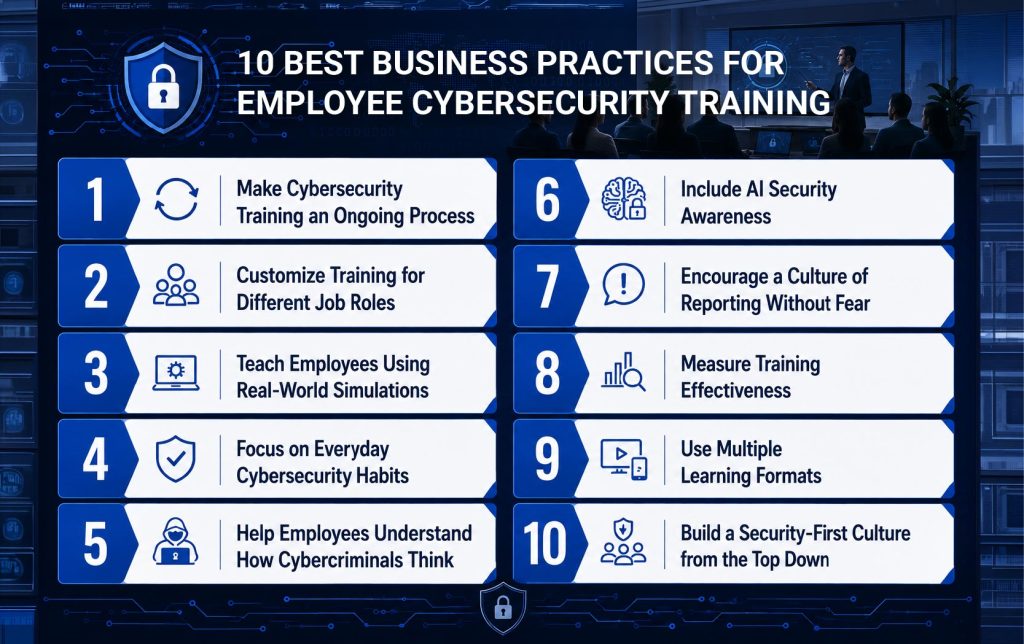
6. Include AI Security Awareness
AI has transformed both cybersecurity and cybercrime. Today’s employees need guidance on how to use AI tools safely and responsibly. Training should cover topics such as:
- Avoiding the upload of confidential company information into public AI platforms
- Recognizing AI-generated phishing emails
- Identifying deepfake voice and video scams
- Understanding prompt injection risks
- Following organizational AI governance policies
As AI adoption continues to grow, AI security awareness is becoming an essential part of cybersecurity hygiene.
7. Encourage a Culture of Reporting Without Fear
Employees should never hesitate to report a mistake. If someone accidentally clicks a suspicious link or opens a malicious attachment, early reporting gives security teams a better chance of containing the threat before significant damage occurs.
Organizations should encourage employees to report incidents immediately without fear of punishment. A supportive reporting culture helps identify threats faster and strengthens the organization’s overall security posture.
8. Measure Training Effectiveness
Successful cybersecurity training goes beyond tracking course completion. Businesses should measure whether employee behavior is actually improving. Useful metrics include:
- Phishing simulation click rates
- Credential submission rates
- Number of suspicious emails reported
- Training completion rates
- Assessment scores
- Incident reporting times
- Reduction in successful phishing attacks
Monitoring these indicators enables organizations to regularly improve their employee cybersecurity training.
9. Use Multiple Learning Formats
Employees absorb information in different ways. Instead of relying on lengthy presentations, organizations should combine different learning methods, including:
- Short videos
- Interactive quizzes
- Gamified learning
- Live webinars
- Cybersecurity newsletters
- Internal podcasts
- Digital posters
- Team discussions
Using a variety of formats keeps employees engaged while reinforcing important cybersecurity concepts throughout their training.
10. Build a Security-First Culture from the Top Down
Cybersecurity awareness is most effective when business leaders actively support it. Executives should participate in training, communicate the importance of cybersecurity, and demonstrate secure behaviors themselves.
When employees see leadership treating cybersecurity as a business priority, they are more likely to adopt secure habits in their own daily work.
ECCU: Helping Businesses Conduct Impactful Employee Cybersecurity Training
Maintaining a cyber-aware workforce demands practical, engaging education that empowers employees to recognize threats and make informed cybersecurity decisions every day. If your organization is looking to strengthen its security culture, improve regulatory compliance, or reduce the risk of human error, investing in employee cybersecurity training is the obvious course of action.
EC-Council University (ECCU) partners with organizations worldwide to deliver engaging, instructor-led cybersecurity awareness workshops and customized workforce training programs for employees across all departments and experience levels. From executives and managers to frontline staff and technical teams, ECCU helps businesses build stronger security cultures through practical, real-world training designed to address modern-day cyber threats. With deep expertise in cybersecurity education and workforce development, ECCU is a trusted enterprise partner for organizations committed to making cybersecurity awareness a lasting competitive advantage.
Frequently Asked Questions About Employee Cybersecurity Training
Employees are often the first target of phishing, social engineering, and credential theft attacks. Regular cybersecurity training helps employees recognize threats, reduce human error, and strengthen an organization’s overall security posture.
Most cybersecurity experts recommend continuous training throughout the year. Monthly microlearning sessions, quarterly workshops, and regular phishing simulations are generally more effective than a single annual training session.
Training should cover phishing, password security, multi-factor authentication, ransomware, social engineering, secure remote work, data protection, AI security awareness, and incident reporting procedures.
Role-based training provides employees with cybersecurity education tailored to their specific job responsibilities. For example, finance teams learn about payment fraud, while software developers receive secure coding training.
Organizations commonly track phishing simulation results, employee assessment scores, incident reporting rates, training completion rates, and reductions in cyber incidents to evaluate training effectiveness.
Phishing remains one of the most common and effective attack methods because it exploits human trust rather than technical vulnerabilities. AI-generated phishing campaigns and social engineering attacks are making these threats even more convincing.
AI introduces new risks, including deepfake scams, AI-generated phishing emails, and the accidental exposure of sensitive information via public AI tools. Modern cybersecurity training should show employees how to use AI responsibly while recognizing AI-enabled threats.