A cybersecurity master’s degree only holds value under one condition. The knowledge and skills must still work beyond the graduation day. That fear drives every serious application to a program like this one. Spend two years studying, and the threat landscape can shift entirely. This piece looks at how EC-Council University builds its MSCS to avoid that trap. We explain why static curricula fail security professionals fast. Then we cover three things. First, how ECCU keeps the curriculum current. Second, the threats now built into coursework. Third, how embedded certifications keep the degree market-relevant.
Key takeaways:
- Cybersecurity threats evolve faster than most academic calendars.
- ECCU updates MSCS content through an active Industry Advisory Board.
- Virtual labs mirror current attack tools, not outdated ones.
- AI security, cloud, and zero trust now sit inside core coursework.
- Every specialization embeds three to five EC-Council certifications.
- The curriculum maps to the NICE Framework and DoD 8140.
- Currency alone will not carry a career. Fundamentals still matter.
Why a Static Curriculum Is a Liability in Cyber
Most university programs review curricula every few years. Attackers do not wait that long. New CVEs appear daily. Attack techniques shift within months, not years. The CVE database now holds over 305,000 recorded vulnerabilities. Tens of thousands more are expected in 2026 alone. That gap between classroom content and live threats costs graduates. Those trained on outdated tools struggle in technical interviews. Hiring managers now test for current threat knowledge, not textbook theory from three years back. A curriculum stuck in 2022 leaves 2026 graduates a step behind.
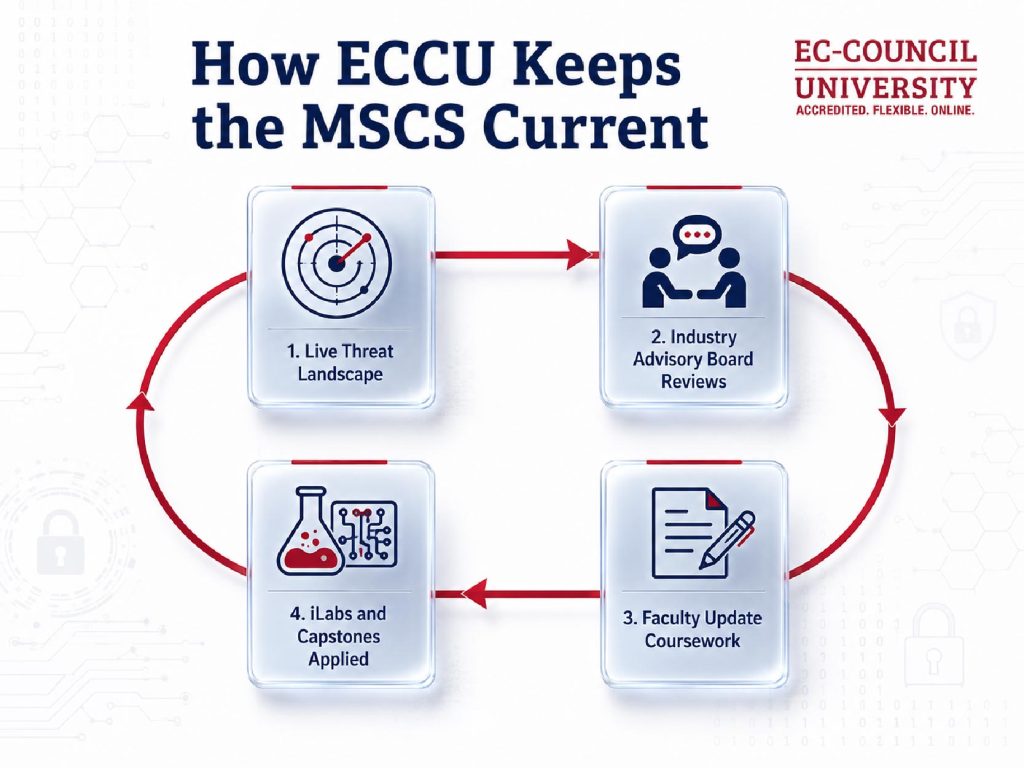
How ECCU Keeps the MSCS Current
Industry Advisory Input and Practitioner Faculty
ECCU built its Industry Advisory Board for exactly this reason. Board members are recognized cybersecurity leaders from across the globe. They review coursework and flag what practitioners face on the job. Faculty bring direct industry experience into every course they teach. That mix keeps lectures grounded in current attacks, not old case studies. Course content shifts as threats shift, not on a fixed academic cycle.
Hands-On Virtual Labs and Capstones
ECCU runs 24×7 virtual labs, called iLabs, for hands-on practice. Labs get updated as new tools and attack methods emerge. Students work through the same techniques attackers use today. That beats reading about an attack in an old textbook. Capstone projects apply these skills to realistic security scenarios. Students build defenses instead of just writing about them.
Emerging Threats the Curriculum Now Addresses
AI, Cloud, and Zero Trust
AI is reshaping both attacks and defenses at once. ECCU now teaches AI security across three dedicated MSCS courses. That includes offensive AI red-teaming and AI governance work. Over 64% of cybersecurity job listings in 2026 ask for AI skills. Professionals with that fluency earn a 56% wage premium over peers. Cloud security runs through the Cloud Security Architect specialization. Students learn to defend both on-premise and cloud infrastructure. Zero trust architecture appears across multiple tracks, not just one. It assumes compromise from the start, rather than reacting after a breach.
Threat Intelligence, SOC, and Incident Response
The Incident Management and Cyber Operations specialization builds SOC-ready skills. Students train in incident handling, disaster recovery, and business continuity. Identitybased attacks now drive a majority of intrusions. 75% of intrusions involve compromised credentials, not malware alone. Coursework covers continuous authentication and identity governance directly. None of this floats free of outside standards, either. The curriculum maps to the NICE Cybersecurity Workforce Framework. It also aligns with DoD 8140, a federal benchmark. That alignment matters to hiring managers in government and defense.
Embedded Certifications Keep Skills Market-Aligned
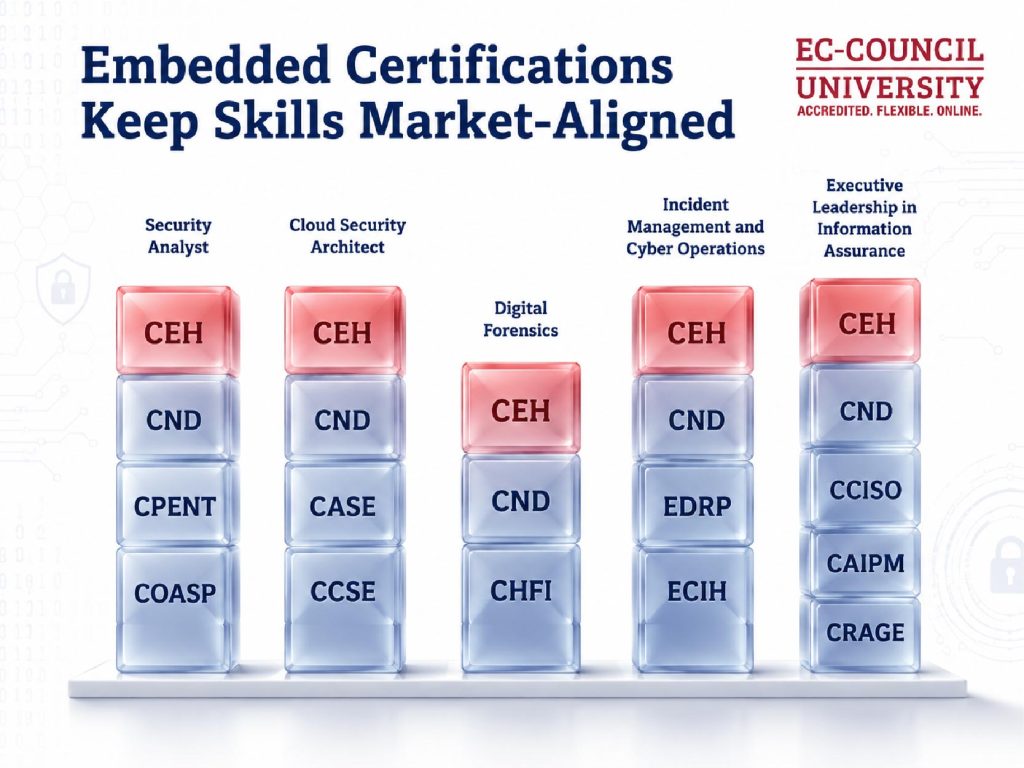
Every MSCS specialization embeds three to five EC-Council certifications directly. Students test for these exams as part of coursework, not as a separate track. Here is how the mapping breaks down:
- Security Analyst: CEH, CND, CPENT, COASP
- Cloud Security Architect: CEH, CND, CASE, CCSE
- Digital Forensics: CEH, CND, CHFI
- Incident Management and Cyber Operations: CEH, CND, EDRP, ECIH
- Executive Leadership in Information Assurance: CEH, CND, CCISO, CAIPM, CRAGE
CEH and CND anchor every track, regardless of specialization chosen. Each certification maps to specific NICE Framework work roles. That mapping tells employers exactly what a graduate can do.
What This Means for Your Career
A currency-focused curriculum solves one problem, not every problem. Employers still want the fundamentals: networking, cryptography, risk analysis. ECCU teaches both together, rather than choosing one over the other. The average U.S. cybersecurity salary sits at $153,295 as of March 2026. About 1 in 2 ECCU graduates report salaries above $100,000. Graduates walk out ready for today’s SOC and cloud roles. They also carry the judgment to adapt when threats shift again. That combination, current skills plus durable fundamentals, is what holds up.
Conclusion
Cybersecurity moves fast, and curricula that stand still fall behind quickly. ECCU avoids that trap in three ways. Advisory input, updated labs, and embedded certifications keep pace with threats. The result is a degree that matches today’s threat landscape, not yesterday’s. That is what makes the investment worth making.
Frequently Asked Questions
ECCU reviews MSCS content on an ongoing basis rather than a fixed multi-year cycle. The Industry Advisory Board and practitioner faculty flag changes as threats shift, and course material updates follow.
Yes. AI security runs across three dedicated MSCS courses, covering both offensive and defensive applications, while cloud security anchors the Cloud Security Architect specialization.
Faculty with direct industry experience teach MSCS courses, guided by input from ECCU’s Industry Advisory Board of global cybersecurity practitioners.
The curriculum pairs current threat coverage with durable fundamentals like cryptography and risk analysis, so skills hold up as the landscape shifts. No single degree guarantees relevance forever, so continued learning after graduation still matters.
Security Analyst and Cloud Security Architect track closest to today’s AI, cloud, and zerotrust threats, though all five specializations now include AI-related coursework.