Employers hire for skills. Every new hire brings habits too. Those habits touch company data from day one. A single rushed click can cost a business dearly. That is why employers care about cyber readiness.
This post explains what cyber readiness means for new hires. You will see why employers care about it. You will also see what it looks like in daily work. We cover how AI changes the picture too. Finally, you will learn how to show and grow your skills.
Fresh graduate or career changer, you can start building today.
Key Takeaways
- Employers want new hires who handle everyday cyber threats with confidence.
- Cyber readiness matters in every role, from marketing to finance.
- New hires face higher phishing risk in their first weeks.
- AI makes scams more convincing, so sharper habits matter more.
- Safe use of AI tools is now a core workplace skill.
- Proof of your skills helps you stand out to employers.
- A short assessment shows where you stand and what to build next.
Why Employers Care About Cyber Readiness in New Hires
People sit at the center of most security incidents. Attackers know this and aim at people first.
Verizon’s latest breach report shows the scale. It found the human element in 62% of breaches. That covers phishing, stolen logins and honest mistakes.
New hires carry extra risk. A 2026 study tested this with phishing simulations across 237 organizations. Recent hires showed 71% phishing susceptibility. Tenured staff showed 49%. The riskiest lures posed as the CEO or an HR portal.
There is good news here. Role-aware onboarding training cut susceptibility by about 30%. The study is observational. Treat the numbers as a signal, not a guarantee.
One click can expose client files, payroll or customer data. Cleanup costs time and trust. Employers value hires who arrive knowing the basics. They spend less time on training. They also face fewer early risks.
Demand for security skills keeps climbing too. The World Economic Forum tracks the fastest-growing skills through 2030. Networks and cybersecurity rank in the top three.
Cyber readiness gives you a quiet edge. You show up ready to protect the team from day one.
What Cyber Readiness Looks Like in Any Role
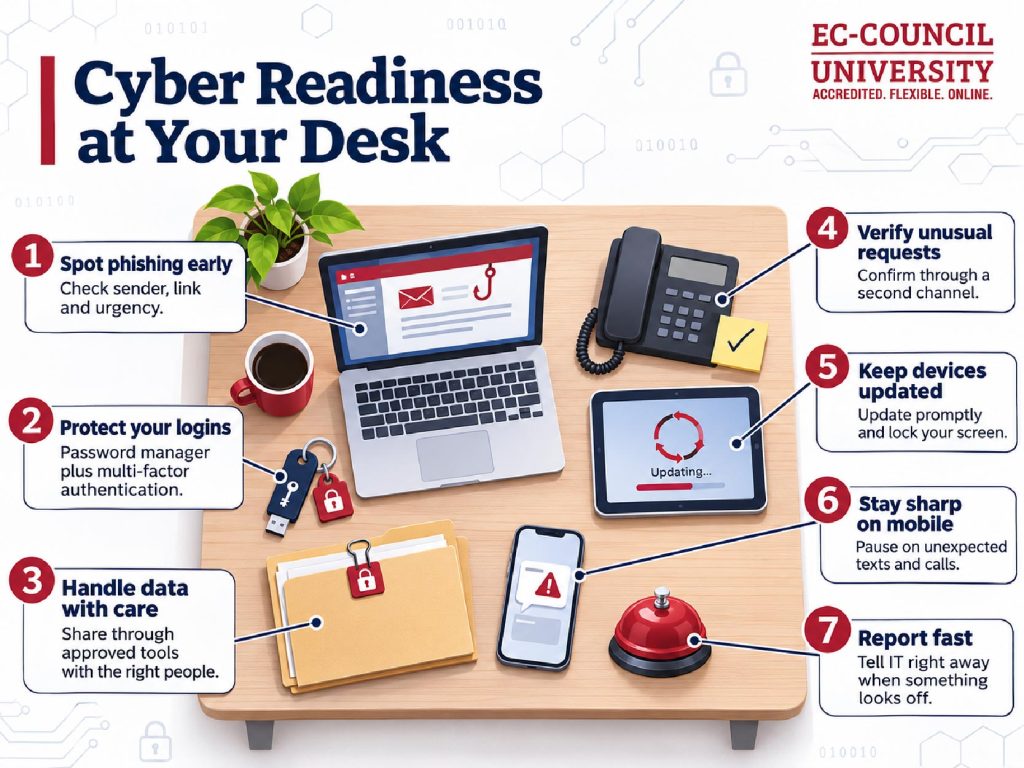
- Spot phishing early. Check the sender, the link and the urgency before you act.
- Protect your logins. Use a password manager and turn on multi-factor authentication.
- Handle data with care. Share files through approved tools with the right people.
- Verify unusual requests. Confirm payment or access requests through a second channel.
- Keep devices updated. Install updates promptly and lock your screen when you step away.
- Stay sharp on mobile. Verizon shows scam texts and calls win 40% more clicks than email.
- Report fast. Tell IT right away when something looks off. Early reports limit damage.
How AI Raises the Stakes for New Hires
AI has changed what a scam looks like. Attackers now write polished messages in seconds. Spelling mistakes no longer give them away. Cloned voices and fake videos can mimic a manager. New hires are still learning who is who. That makes them easy targets. Our guide to AI-powered phishing shows what to look for. See social engineering in the age of generative AI for more examples.
AI also creates risk from the inside. Staff paste company data into tools nobody approved. Verizon found unapproved AI use among employees tripled to 45%. One careless prompt can leak client details.
Safe AI use is a skill you can learn. Start with these habits:
- Use only the AI tools your employer approves.
- Keep client data, passwords and internal files out of prompts.
- Check AI answers before you share or act on them.
- Pause on urgent requests, even when the voice sounds familiar.
Want a structured start? ECCU’s Applied AI Foundations course covers prompt skills and responsible AI use.
How to Show Cyber Readiness to Employers
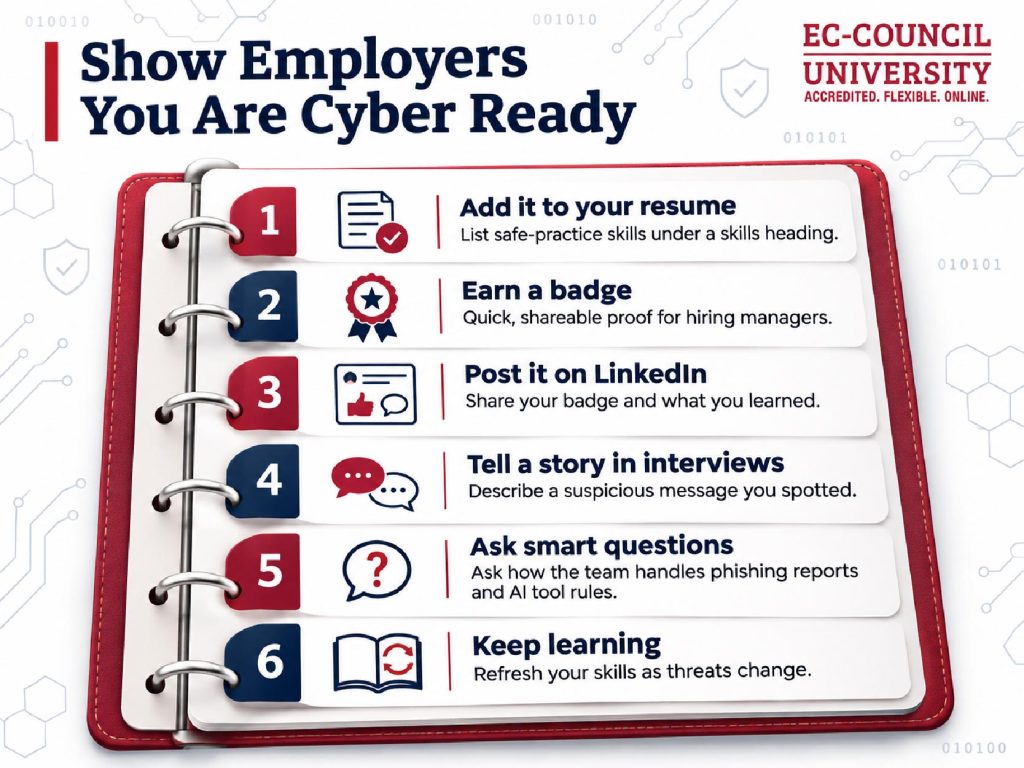
- Add it to your resume. List safe-practice skills under a skills or training heading.
- Earn a badge. A cyber readiness badge gives hiring managers quick, shareable proof.
- Post it on LinkedIn. Share your badge and say what you learned.
- Tell a story in interviews. Describe a time you spotted a suspicious message and acted.
- Ask smart questions. Ask how the team handles phishing reports and AI tool rules.
- Keep learning. Threats change, so refresh your skills often.
Check Where You Stand
Guessing your readiness leaves gaps. A quick check shows your strengths and your weak spots.
ECCU’s cyber readiness assessment gives you that clear starting point. It uses practical, workplace-style questions. You finish with a level that reflects your skills. You also learn where to focus next.
Each level comes with a badge you can share with employers:
- Level 1: Cyber Aware
- Level 2: Cyber Ready
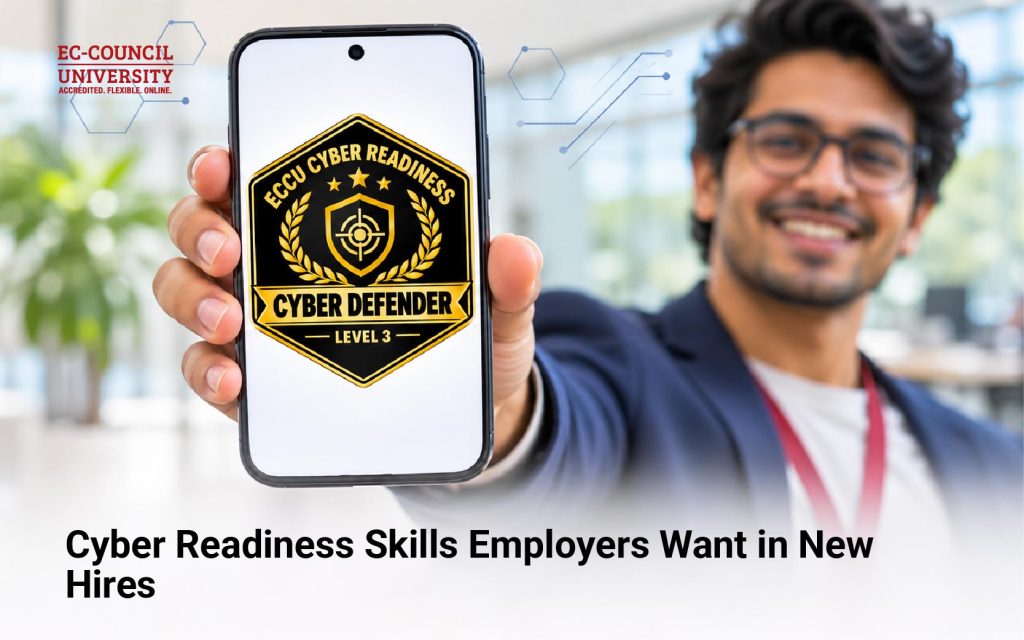
- Level 3: Cyber Defender
A badge turns private knowledge into public proof. Post it on LinkedIn. Add it to your resume. Mention it in interviews.
Take the cyber readiness assessment and see which level you earn.
Keep Building Your Cyber Skills
Readiness grows with practice. Threats change fast, so your habits should keep pace.
Set a monthly reminder to update devices and review passwords. Follow a trusted security news source. Practice spotting phishing at work, even when nobody is testing you. Share what you learn with teammates.
To go deeper, explore ECCU’s guide to high-demand cybersecurity courses. It includes options for beginners. Strong basics can also lead to security roles later.
Frequently Asked Questions
What is cyber readiness?
Cyber readiness is your ability to spot and handle everyday cyber threats. It covers habits like safe logins, careful clicking and responsible AI use.
Why do employers care about cyber readiness in new hires?
New hires touch company data from day one. Early mistakes can open the door to attackers. Hires who know the basics lower that risk.
Do I need a technical background to be cyber ready?
Cyber readiness builds on daily habits. Any role can learn them, with no coding needed.
How can I show employers that I am cyber ready?
Earn a badge and list it on your resume. Share it on LinkedIn. Back it up with a short story in interviews.
How does AI change cyber readiness?
AI makes scams more polished and harder to spot. It also adds risk when staff use unapproved tools. Readiness now includes safe AI habits.
What is ECCU's cyber readiness assessment?
ECCU’s cyber readiness assessment shows how well you handle cyber threats. It uses practical, workplace-style questions. You finish with a level and a badge to share with employers. Levels run from Cyber Aware to Cyber Defender.
How do I find out my cyber readiness level?
Take ECCU’s cyber readiness assessment. You receive a level and a badge you can share with employers.